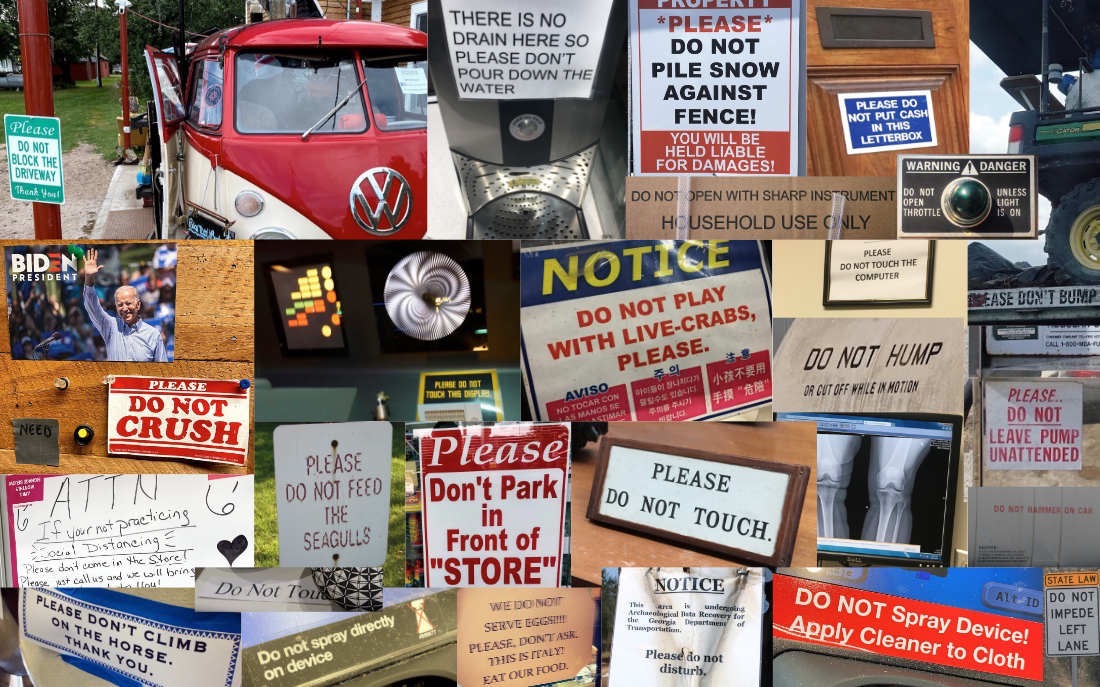
Pictures from (my) exhibition.

In late November, I got an email from Flickr saying “hey, you know your lapsed Pro subscription? We’re giving you a free Pro account again through late March.” A $29.95 value!

And so they did. And to honor their marketing strategy, I made the most of the past few weeks, uploading and tagging and exploring and doing all that stuff that you’re supposed to do with a social photo-sharing service.


I felt a loyalty of some sort to the once cutting edge service. I joined up in, I dunno, 2004 sometime, posting pictures of then cutting-edge technology, or of our travels on back roads.

And then the other day it reverted to the free mode, where I only see the last 200 pics and the interface becomes decorated gaily around the edges with ads. “Come back!” says Flickr. Give us your $29.95! Ah, well, I would, but there’s Instagram and there’s 500px and there’s Google Plus and really there are way too many places for me to share pictures for my own good.

I’d been using Instagram now and again in kind of a low-energy experimental way and I had a general sense that no one was looking at the pictures I uploaded and no one certainly was clicking on the heart-shaped button that indicated they liked what I put out there. Okay, fine. I didn’t have a lot mentally invested in what I was uploading—I used it more as a vehicle to play with square-format imagery (like I did with SX-70 pictures in the old days.) And the filters—yeah, it was fun to mess my pictures up in various creative ways.

I tried (purely as a science experiment) tweeting links to Flickr and Instagram pics and sure enough, that seemed to generate some…viewership? Linkership? But still, I felt as if I was dropping pictures into some Instagram vortex, never to be seen nor admired again.


That’s because, of course, I was missing one important part of the game (hey, I never read the instructions.) Unlike on Twitter, where, if you search for any word in the text that accompanies an image you’ll get a hit, on Instagram, it’s all about the hashtags. Yeah, those things beginning with that octothorpe (#) that are quite popular with the kids these days are the ONLY thing that Instagram searches and indexes. So a photo with a clever caption (hey, I went to school to learn how to write a clever caption) was pretty much invisible in the Instagramvese. Fill that space with a cascade of #hashtags and apparently the bored people who explore page after page of images will seek and find your Apple 2-ish screenshots or your fine train pictures or your attempts to bring Sohio back from the dead or your pictures of your brother’s family cat.

Suddenly, it appeared that people worldwide were liking my work! Ah, how reassuring. Or at least it would be if I didn’t inspect more carefully and discover another, nastier part of the Instragram ecosystem: a lot of those likes were coming from bots, fictional people, or semi-fictional people who would like you to buy what they’re selling, even if it’s only advice on how to get more likes.

Eugh. Started to feel a bit like the whole somewhat greasy, somewhat distasteful Facebook ecosystem, which I’ve stayed away from like the plague it is. And I guess that’s not surprising, considering who bought those fine entrepreneurial Instagrammers and their technology.

But I’ll probably toss a few more things up onto Instagram, if only to play with their filters. (And I keep a backup of all these images so, hey, they’re just pixels tossed out there in one sense.)

Truckstop redux.


Did I mention that on our recent trip to the northeast we spent the night in Breezewood, the fabled town of one thousand motels? The midnight home of truckers aplenty? The western end of an abandoned chunk of the Pennsylvania Turnpike? And once the stopping place for transcontinental buses bound for New York that might have picked up a passenger or two in Columbus, Ohio? Yeah, that one.

Is this the new one…?

20120325-110948.jpgSpending a little of my time away from the hospital wandering around, and on Sunday morning I decided to wander over to one of the Best Buys—Lansing is Apple Store free. Sure enough, there was a lineup of maybe 20 folks at the door, and although that translated to a line of maybe a dozen in front of the iPad sales table, they were willing go get what they could, pretty much sight unseen…all the demo units were iPad 2s.

I guess I can see why Apple made a marketing deal with Best Buy a few years back…if this scene is being repeated in the Fort Waynes and the Springfield Ohios of the world….well, that’s a way to move quite a few of the magical tablets.

Apple pro ‘trucks’: workflow-tough?

There’s a fair amount of consensus among the online sources I read that Apple is at least neglecting, if not outright abandoning the pro marketplace, and more specifically the world of television professionals. Today brought an Ars article entitled Why the video pros are moving away from Apple. I read reports of large production houses that used dozens of Apple’s Final Cut edit systems who are reluctantly switching to Avid—the only other viable option, they say.

I also detect a fairly healthy backbeat—voices saying that programs like Final Cut Pro X are the future, tape is the past, and that the universe of people who need truly pro-level tools to create graphics, animation, and to edit, finish, and deliver broadcast and film content is, really, get over yourselves, a niche market.

I’m not so sure. If you define “niche” in terms of raw sales numbers, you may be missing the outsized influence that edit and graphics rooms filled with Macs around the world have on the creative community.

Because those workplaces exist, there are students in schools everywhere learning Final Cut, Motion (and 3d software like Maya and Cinema 4D, and 2d essentials like Adobe’s After Effects, Photoshop, and Illustrator). They work (for the most part) on Macs. They come through a training regimen ready to walk into edit suites and design houses and create material that actually works on “real” projects.

Video pros like to use the word “workflow” a lot, and the reason for that is simple. The stuff they make is part of a whole—the opens and graphics of a larger program, or a package that shows up within that program, or a program that fits within a stream of programming throughout a day, or a commercial or interstitial that has to bridge the gaps between programs. When you’re part of a team, you’re handed material, you work with that material, and you hand it on in a way that meets certain standards and fits in the puzzle in a predictable way.

That’s being a pro. That’s being part of a team. In television-land, you may be part of a closely-knit unit of a dozen or fewer. On a film, you may be one of hundreds. The amount of raw material you work with and have to sort through is staggering. Metadata is your friend. Doing it right—frame rates, codecs, interlace, gamma—is part of the job.

Workflow is part of the job. It’s not just a “nice to have” option.

Starting a few years back, Apple was able to deliver hardware and software that made it easier to not just create content, but to do it in a way that fit into professional workflows in such a way that it made creative professionals’ lives easier.

It wasn’t just that you could make movies or television bits. You could, with these tools, make “real” stuff. Stuff that met standards. Stuff that could air without jittering or blowing out the color on your TV.

It was interesting to me that in a world increasingly filled with iDevices, Steve Jobs spun out the now well-known analogy that iPads would be more like cars with automatic transmissions, but, he said, we’ll always need trucks for the heavy lifting of content creation.

With the release of Final Cut Pro X, some in the creative community saw a slick sports car that Apple designed that, sadly, was not street-legal. Very cool, very shiny, but pros often found no way to use it to do the heavy lifting of their modern workflows.

We still need fresh new trucks, with tricked-out power and industry-leading features. At CES this month, manufacturers showed off 4K camcorders…a higher-than-high definition that makes my hard drives wobble at the knees just to contemplate.

We’ll all be editing on iPads someday? Well, if the largest iPad would only hold, say, 10 seconds of 4K video, that might be a challenge.

To do a professional job of content creation, those fresh new trucks, the 2012 models, will need:

  • The fastest processors and maximum RAM, of course.
  • Increasingly, the GPUs—graphics processing subsystems—need to be hugely powerful, upgradable, combinable—they’re the core of the powerplant of future content creation, if I haven’t bent a metaphor too much there. New software, from Apple and elsewhere, will rely on them more and more with each rev. You may need not one but several, working cooperatively, in one box.
  • Huge flexibility in i/o options. This includes bringing things in and getting them out in almost every conceivable way, including to videotape when appropriate. Sure, Thunderbolt is a good start in that direction.
  • And software, including operating system software, that works hard to keep all the bits circulating at max speed with minimum complications.

Now the nice thing, the win-win, about Apple putting energy into creating systems like these, and the key to why this is not just a niche market question, is that development success here leads to staggering improvements in all the behind the scenes slickness that makes iOS so powerful in devices. There’s no doubt that all the work spent in making type, animation, transitions, and movement work on professional content, software, and systems paid off in huge benefits when Apple wanted to bring modern design slickness, speed, and elegance to things you hold in your hand.

They have to keep that innovation in every part of the pipeline. Mac OS X has to remain, at its core, a pro-level, configurable operating system. It’s gotta run on high end boxes. And those boxes have to run a complete suite of pro-level creative software that not only serves those who must work within very particular and demanding workflows, but establishes a great test bed for the next innovations for iOS and our increasingly device-filled world.

Seems to me Apple abandons this workflow at their peril.

Michigan light.

I’m sitting on the futon couch in Sammy’s dad’s living room, and her dad is paging through this morning’s NY Times, which shows up at 4 am in the mailbox across the road, along with the Wall Street Journal, which Sammy’s brother Gordy is reading. Their postures are remarkably similar in the way that direct relatives are. They’re both sitting to get as much daylight from outside as possible. Although it’s cold, it’s sunny and bright, and we’re grateful for that. It just as easily could have been the dark grey cloud helmet of winter that seems to settle in here and make people’s lives, well, dim in addition to cold.

We’re here to help with the pile of mundane tasks that accompany the passing of a loved one. Sammy’s mother—Nick’s seven-decades-long wife—left the stage just as 2011 turned into 2012. The basic chores—moving, disconnecting, finding places for things— have gone well, and we’re hoping to leave things in a good place for her dad to make his personal adjustments to life more alone.

Somehow being up here in winter always puts me in the mind of beginnings and transitions. Cold, darkness, and vast, flat stretches of midwestern dormant agriculture will do that to you.

Hope your year is starting with enough light to burn off the winter doldrums.

A feeling for timelines.

Ten years ago today the original iPod was introduced. (Ours is on a shelf next to a Brownie camera in our dining room.) Sixty years ago last Thursday the CBS ‘eyemark’ logo created by William Golden and taken and ran with by legendary CBS design guy Lou Dorfsman was introduced. (Dorfsman’s book about his CBS design career is in our downstairs bathroom.) Nine days ago the newest iPhone, the 4S, became available for sale in the US (and a handful of other countries…we watched the rain-soaked first adopters outside the Apple Store in downtown Montréal.) Four years ago last Wednesday Sammy and I were in “our” Apple Store picking out her desktop machine, which in some ways still looks and “feels” new. In 1999 on October 23rd we were in CompUSA (where? wha?) picking out her blue-and-white G3 desktop, which is…well, I have no idea what happened to it. That day “feels” as if it’s long, long ago. But our data stream reports we had sushi with Bill, Morgan, and Miranda after picking up the machine.

I can string all this data out on a timeline and it still doesn’t “feel” like a linear progression that makes any kind of sense. It’s more like a half-hearted attempt to line up Billy Pilgrim’s unstuck jumbled bullet points of an existence. Our modern digital devices say we were here, or there, at discrete moments. On this day in 1992, we were in Little Rock Arkansas, and while archaeologists met, Bill Clinton’s war room moved him closer to the White House in rented space just down the street from our hotel. We saw Jim Carville in the bar. The next day, we’ll eat at a Hunan restaurant in Benton, Arkansas. Last year on October 23rd we went to Trader Joe’s and spent $39.27. Some of that on chocolate-covered almonds, I don’t know.

And a year or two from now, I can pull out my phone and ask “Siri, where was I on this day in 1977?”

And it’ll still feel completely abstract.

Squint.

I’m not sure whether I’m squinting because it’s late, or whether my allergies are kicking up or because I’m squinting with skepticism at the idea of writing in this dusty old journal. Probably it’s all of the above.

My sister visited over the weekend, and it was great to see her. When last we saw her, she had graduated law school and had the sword of passing the bar over her head. Well, she has earned that ‘Mission accomplished’ banner, and now, as she visits, I’m aware that she’s simply a lawyer, without disclaimers or asterisks. She’s for real. We celebrate that.

And somewhere in there America commemorated a holiday that is easily the most…well, maybe this is what it felt like to commemorate Pearl Harbor just a handful of years after the event. We did a lot of our commemorating by averting our eyes from the pre-edited pre-digested media presentation of the anniversary. It happened. It’s a while ago now. We go on.

And now, the day after my sister’s visit, I got up early with Sammy and dove deeply into work, crafting layers of (as it turns out) rendered PNGs and animate sequences and making type sizes hit nice even round numbers and, well, it’s the work of a designer. And it felt good to get a lot done.

But now, I’m pretty sure that it’s just late. So I think I’ll go rest my eyes.

Dear nice Swiss tourists…

Sammy and I enjoyed talking to you at Segesta the other day. Remarkable that you remembered having seen us before at Selinunte, specifically, you remembered Sammy from her somewhat distinctive hat.

We were once again struck by the language skills of so many we encounter in Europe. We have trouble crafting a sentence in English sometimes and you’re able to communicate in our language and apparently several others. And we were delighted to hear that you had visited the United States in the past and had wandered from Niagara Falls out to Arizona. I had to tell you that I had only briefly visited one tiny part of Switzerland. The places you mentioned sounded quite beautiful and I hope we get there sometime.

And when you told us that it would be much harder to choose to visit the US nowadays because our government treats people entering our country like criminals, well, I realized immediately what you were saying and, out of embarrassment for the choices our leaders have made and out of embarrassment for the choices the American people have made in choosing leaders, I apologized profusely.

No amount of terrorist threat, real or imagined, justifies a government that treats its visitors—and its citizens—as suspects first and human beings second. I kept wanting to somehow explain that once you get past the Orwellian paranoia of government, the American people are a fairly decent lot, but of course if you can’t get into the country without being searched, scanned, queried, and probed it’s hard to experience that hospitality.

So, again, sorry. And maybe we’ll be able to dig ourselves out from the pile of scanners and security cameras and secret laws and offer a warm welcome to the rest of the world that matches our beliefs and best traditions.

Traveling colors.

Sammy tells me that we are looking out from this lovely balcony at the Tyrrhenian Sea. I can tell you it is a calm vastness of water, a blue that would be at home painted on the walls of our Virginia Highland home, and it extends to a soft, defocused horizon.

Our home here for two days, perched on a steep hillside, is a collection of terra-cotta tile colors, stonework old and new, and soft canvas awnings that, taken together says style and comfort and hey, sip some coffee and be contemplative.

So, OK, sure.

Unlike the busy seaways over by the Amalfi coast and between the Punto de Campanella and the island of Capri, these waters seem to be punctuated by just a tiny white fishing boat or two, maybe that’s a sailboat with masts down off in the distance. Still, somehow, you get the sense that the sea is a workplace, a superhighway, a playground.

If I mention that three italian donkeys—Asini in Italian—(Equus asinus domesticus)—are watching me type this, do their shades of cocoa brown and hay-brown add color to the scene, or muddy the picture?

The problem with writing about any of this is as soon as you drop in place names like those, you end up with what sounds like Mythical Typical Travel Writing, an attempt to string phrases as lyrical as the placenames they connect. And if you find yourself hearing your words in your head narrated by Robin Leach, stop, you’ve definitely done something horribly wrong.

So maybe I should practice a bit.

Echoes of protest and repression.

I’m going to sleep after watching dawn rise over Cairo through live internet feeds from Al-Jazeera, MSNBC, and CNN. (As it turns midnight on the U.S. east coast.) Tanks. Tear gas. Molotov cocktails. Protest. Fear. Rumor. Machinations behind the scenes. Incredulity.

Very nervous about what today will bring to the good people of Egypt. Kinda fearful that if we won’t—or can’t—watch, very bad things will happen.

I look at this faraway square in Cairo.

I think back to another distant square, 22 years ago.

And I think back much further to an Ohio campus square, 41 years ago.

We can look on, listen in, and twitter amongst ourselves and the world community about this pivotal event in the history of a country and its people better than at any time in history. Does it make a difference to their fate, in the face of a gun barrel?

Scanned past.

At my sister’s behest, I’ve been scanning a large collection of old images from our family. And at this rate, I should have them done sometime in 2017, so, hey, that’s progress. Came across a badly crinkled old black and white contact sheet from my stay in the fall of 1974 in New York’s East Village (I returned some filmmaking equipment for some friends—on the Greyhound—and spent a while living by myself at their Crosby Street loft, which was then a new term to me.)

At any rate, here’s one of the images:

And it didn’t take more than 20 seconds of messing with Google Maps and Google Street View to line it up with the near-present:

This is (and I didn’t know this back in 1974, because my online search capabilities were a bit more limited then) a view toward the The Puck Building, which Wiki-p tells me is “an example of Romanesque Revival architecture”, and during the 1980s was the home of Spy magazine, which I faithfully read, even though their use of tiny type surely led me to my squinty early adoption of reading glasses.

Back in 74, this rust-colored historic place housed a printing ink manufacturer, and in fact I remember the rich smells of toxic ink formulations that wafted down Houston from that fine Romanesque whatever-you-said-it-was architecture. And the smells mixed with the Gulf (hm, now BP) gas station to provide a wonderful urban bouquet in Abe Beame’s New York City.

I’m hoping I can find the negatives from these long-ago pix in all of this mess, but these crinkly scans might have to do.

Target audience.

Yeah, I thought this was a great example of using design as a political statement:

As reported in Salon, this cover, designed apparently by Dan Savage and Aaron Huffman, reminds us of the power of symbols and the impact of the gun on politics—and personal freedom—on American history.

I’m aghast at the machinations of the Palin/Beck block to try and spin this into something of an attack on right-wing political speech; they attempt to conjure a world where people on the left use the same violent, final terminology as they do. Doesn’t happen. When the very malevolent Roger Ailes has to say “tone it down, guys,” and “make your arguments intellectually,” something has really gone off the rails. They may be so far down the track from the intellectual components of their political arguments that they’ve forgotten how to do that, Roger.

Symbolic.

This, I think, means ‘go ahead and read your iPhone in the shower.’ (From The Noun Project.)

Hello there from our frozen city, which is suffering through what in most places would count as a minor snow event, but here, we’re attempting to attach apocalyptic terms, but for some reason, they’re just not uh…sticking. I might post a few pictures later, but for now, enjoy this one from last night, as we returned from Buckhead and the snow was really coming down at an impressive rate, for a while.

Backing it up at the beginning.

A quiet saturday afternoon in the new year, and I’m sitting here savoring the back-room sunlight watching the winds pick up as we contemplate the threat of another city-paralyzing snow + freezing rain + ice event here in a part of the country that seems highly unprepared for even the mildest of winter weather calamities.

Our plans are to travel the very few miles up to my dad’s house tomorrow evening with a carefully-crafted portable Sammy dinner, but I guess we’ll have to see if that will involve firing up the four-wheel-drive vehicle and creeping back here as the aforementioned storm gets underway (it’s supposed to get bad after dark Sunday night.) Ah, adventures of the winter kind.

Otherwise, it’s been a mercifully quiet week or so after the start of 2011, and we’ve been fairly diligent about taking care of loose ends, small chores, financial recordkeeping, and so on, mixed in with the usual array of tech support questions I find myself fielding from family and friends.

I’m conscious during these arbitrary calendar boundary crossings that it’s a good time to make sure that our various digital assets are being backed up, preserved somehow the way one might expect.

So earlier this week I went out for a run to the twin mega tech merchants of Gwinnett County—MicroCenter and Fry’s—with my brother, mostly to offer moral support for his purchases, but damned if I didn’t end up buying one more 2 TB drive to, well, pile stuff onto. I mean, what future visionary could have possibly imagined that a mere $89 would give me yet another another gigantic data landfill, a virtual blimp hanger of unused space to pile stuff into/onto?

Yeah, if I do have a weakness for impulse purchases, it tends to be in this category. It’s probably much worse that I’ve lived through the entire progression of computer storage from the early days where a megabyte or two cost more than a house—so just forget it—through the early 1980s where I was willing to pay thousands of dollars for a 20 megabyte hard drive (thousands. of. dollars.) to the present where bits live throughout our cluttered home in little silver boxes, just waiting to disappoint me with a random data failure in the future, when I call upon the device to work its archival magic.

It really doesn’t help that the size of my average television project—the raw materials used in making a station package, let alone all the bits and pieces needed for a 3D NFL football game, way, way exceed the capacity of a standard DVD-R (4.7 GB)….and really, they take up more room than a BluRay disk, which is a tech that, nah, I’m not going to invest in.

So it’s big hard drives, which are dirt cheap. That is, unless I am concerned about the drives moving parts over the long run, and instead want to pick up a bunch of flash memory (hey, no moving parts!), which at the moment is, at best, $25 for 16 GB of storage.

And of course, there’s always “the cloud,” which, in theory, is infinite, but in the real world has its own very real costs and risks as well as the costs in time it takes to push all this stuff to and from wherever “there” is.

Which brings me full circle to the mental exercise that really underlies all of this: how much of this exercise is just plain hoarding behavior in high tech clothing? Am I really going to need that background for that station in Birmingham from years ago that has probably moved on to some other perishable design?

Bit of a ponderable, if you’ll pardon the pun.

Autumnal recharge.

I’m sitting here watching sunlight drift into Sammy’s family’s Green Cottage in between moments of solar hide and seek in the abundant clouds over Big Manistique Lake. We’re listening to a scratchy FM radio signal and we have internet-via-iPhone, which means that the MacBook and iPad sit here sullenly with light grey wifi logos, craving packets, while the walled garden of the iPhone, as long as we hold it close to the south windows, serves as our tenuous gateway to the more connected world in a place where, most of the time, we’re comfortable not being all that connected.
I am happily recharging and resetting after my August of mostly nonstop work. On a tight deadline, I cranked out graphics in stereoscopic 3D for the first NFL football game to be broadcast in a way that, hey “the players come out right at you,” and, uh, you have to buy a really overpriced TV and still wear silly glasses.
As a design exercise it was a lot of fun and made me even more aware of the delicate dances of 3d coordinate systems as they contribute to what we call vision, seeing, and dimension.
But now, it’s nice to look at the world not through any kind of colored or polarized or shuttered glasses and just sorta enjoy the autumnal light, growing color (those maple trees are reddening nicely) and reset my visual context to something outside of safe title markers and render queues.

Current tools of my trade.

Current tools of my trade.
See that Lee Filter pack with the rubber band? Very important.

I’ll say.


Hi, just checking in from the other side of the screen. I keep composing well-thought-out essay-length things in my head, but then my day job (is that what it is?) distracts me from actually flowing them into this site.
As many of you know, I’ve been working pretty much nonstop on a complete graphics package for a preseason NFL game, which wouldn’t be such a big deal except that this one’s in 3D. As in, yeah, dimensional. Stereoscopic.
So please excuse me while I get back to massive piles of left eye, right eye graphics that have to be designed well enough so as not to give people headaches. Not since my 1981 Braves Baseball open (aka ‘Disco Baseball from Outer Space’) have I had the health concerns of my viewers be a factor in design.
Me, I pump the coffee and ibuprofen.

Pampas Cat.


Although I admire the developers who see algorithms painted, floating in mid-air everywhere they go, I am most certainly not one of those people. And yet I’m interested in the tech behind the apparent seamless experiences, and I have a sense of the powerful frameworks that spin together to create a user experience that is as visually smooth as it is powerful.

This is a (fragmentary) book review of a book I received on the doorstep (dead trees!) an hour ago. I’ve gone through maybe a dozen pages. I’m already in rapt admiration. This is a great approach for people like me. Apple developer/aesthete Scott Stevenson realizes (I’m paraphrasing from his introduction) that there are hard-core coders who bleed zeroes and ones, and then folks like me, designers who want to understand how to make the underpinnings serve their vision.

So he wrote Cocoa and Objective-C: Up and Running: Foundations of Mac, iPhone, and iPod touch programming, and so far, it’s filled so many of the gaps in for me in the mysteries of the C language, Objective-C, built on C, and Cocoa, the massive framework collection built on Objective-C. See? More clarity already.

April in a nutshell.

Things have been, well, pretty close to the ‘normal’ baseline here at casa positively atlanta georgia through the month of April. I looked up and noticed that I hadn’t added to this fine collection of journal entries since the getting an iPad and enjoying it in the backyard post. So what’s been happening? Okay, in 10 seconds: Convivial meals with family and friends. Birthday fun. Hike in the north Georgia mountains with neighbors. Wandering through the Atlanta Dogwood Festival. Opening up and adding new RAM and storage to a Mac Mini from Seattle. Lots of rendering animation at 1920×1080 (that’d be HD 1080i to you.) helping a friend get a new water pump so she could return safely to Lexington, KY. And…more settling in with that semi-magical iPad device.

Writing amidst birds on a glare-y morning.


I decided to start the morning out in the back yard with a cup of coffee and that device that I’ve been, well, anticipating seems like such an insufficiency…shall we say salivating over? Really, really wanting to get my hands on? That’s more in the ballpark.

As a specialized device, as opposed to a “replacement” for a laptop or netbook or phone, the iPad is wonderful and indeed gives me that same sense I had after I dragged the first Macintosh home. This is new, different, and it may not have all the answers now, but it certainly can serve as the container for those answers when placed out there in a healthy stream of developer creativity, a modern marketplace for digital ideas. And as you may have read, there’s some question as to whether the Apple-controlled system of app development and approval—give them $99 a year to be allowed to put stuff out there, and then only distribute your apps as approved chunks of binary through Apple’s own store, interface, and forbearance—is open enough, and for me, the jury is less out on that than it is on the question of being able to get your stuff in and out of the machine with (as the modern dev kids like to say) as little friction as possible. It took quite a while for my desktop machine to manipulate the thousand or so JPEGs i wanted in our photo library before it was willing to slide them over…and that felt like a lot of friction to me.

And then there’s the whole question of this fine, high-resolution led-backlit screen and whether this is indeed superior to, say, the Kindle’s approach that uses something fancily called ‘e-ink’ but basically is just a low power display that can be read out in glorious black and white in the bright glare of sunlight.

Which brings me back to this beautiful Atlanta spring morning, out in our back yard.

Serenaded by every bird sound effect on our yard’s library, invigorated by the smell of morning coffee mixed with flowers in bloom, I was able to read the morning’s news with the tablet perched in my lap, but when the time came to bat out these few paragraphs painlessly on this new device, well, the batting was painless (the onscreen keyboard supports my high speed hunting and pecking well), but the visual it presented was less than crystal clear. In order to type comfortably, I have to put the device down on our backyard table, and as the angle of pad surface to sky becomes more perpendicular, it becomes more problematic. As I type to you now, looking down at the table, I am also simultaneously looking up at the large budding tree that looms over me…because I can see its reflection quite clearly in the iPad’s very glossy screen. This certainly contributes to a feeling of being one with nature, but it does make it a tiny bit hard to read what I’m writing. Indoors, the screen is plenty bright to blot out that effect, but out here, Our Friend The Sun seems to have other ideas.

Don’t get me wrong, it’s not an impossible task. And it’s way readable enough for me to, say, walk around the yard and catalog our weeds into a comprehensive database, but when the primary concern becomes angle of typing vs angle of seeing, then you get this kinda superimposition effect that as I sit here, I’m bemused to say I’m getting used to, a bit. Boy, we humans can be adaptable when we have a new thing to mess with.

Hmm…what are these..hey, little dots of pollen are falling on the iPad! Ah, springtime in Atlanta, when nature conspires to cover up all of man’s technological folly in a fine coating of yellow.

I came back inside and Sammy, looking at this very page, said “you may want to proof that a bit,” and sure enough, when I looked at this post on my large desktop screen, I saw a few ‘deVices’ and ‘i’s and other corrections to be made—and I should point out that I had to come in here to add the photos—taken with our iPhone—to the post. Would have been great to be able to just poke the phone and send them to the pad and from there drop them in, but I guess that breakthrough is for another day.

Counting down.

On an evening where the embargo on talking about the iPad was lifted (and a great spewing sound was heard throughout the series of tubes), we have thus been inundated with reviews and screenshots and semi-childish squealing, I find myself waiting with quiet anticipation. They’re selling this thing on Saturday, perhaps you’ve heard?

Mortally-wounded tree edition.

To celebrate a Sunday that showed some signs of pulling out of the greyness that this winter has been, I went out early-ish and picked up a dozen bagels and, almost as an afterthought, a six dollar copy of The New York Times, which some of you may not know is an actual newspaper, published on big ol’ soy-ink chugging presses nightly from a couple of dozen offset printing plants around the country.

Yes, we bought the paper. Now, for someone who went to journalism school and contemplated life amidst the ink-stained before being seduced by the blue crackly glow of television, this may not seem that surprising. But truth is, as much as I love the idea and honor the history of newspapers, reading the news on newsprint is amazingly unsatisfying, as if I’m pawing through two-day-old printouts left in some newsroom’s recycled bin. It feels, old, stale, expired. Didn’t we see that Style section story on the web on thursday? Where are the Times blogs breathlessly updating the story of the Cablevision-Disney battle that threatened cable viewers’ view of the Oscarcast?

I’m not one who believes that when magazines and newspapers make the switch to iPad-like delivery, they should become some sort of multimedia animation-fest. in fact, I think they’ll do just fine if they avoid discarding a handful of things:

  • Layout matters. Columns, headlines, callouts, color, and big photos will look superb in a tablet. You really don’t need to go much beyond the classy approach you’d see in the print Sunday Times Magazine.
  • Ads in context. Part of the charm in paging through the NYT Arts and Leisure section on Sunday always was (and remains) seeing the huge ads for moveis and shows interspersed with the editorial content. Again, if they’re NOT flashfests or blink-monstrosities, they’ll get noticed and appreciated for what they are…advertising wrapped around some of the world’s most prestigious content.
  • We always will welcome and find ways to pay for well-edited, carefully sourced, copyedited, and corrected content. Shovel dross at us and we won’t care how much it animates…it’ll be dead to us.

The upcoming iPadThingie can be my BBC Newspad, perfect for reading whole eating mysterious earth-tgoned puddings in zero gravity, or accompanying fresh-made bagels on an Atlanta Sunday morning.

Magic: we’ll be the judge of that.

jcbpad.jpgThe Apple folks have announced the day-it-shall-be-buyable of the iPad, and, for the wi-fi only versions, it’s April 3rd, a mere 8 days before my birthday (in case you need any last minute gift ideas).

I continue to be intrigued by the paradigm-shifting possibilities of the device, especially for those out there who, truth be told, don’t really need a computer in their lives…they need a fancy doohickie that reads email and surfs the web and shows photos and plays games. For those people, if they never see a filesystem, they’re fine with that. If they never have to mess with another preference file or repair permissions, their lives will be that much better.

And I want to see as many of those folks as possible with these in their hands. But I also want this as a hackable, playable, messable-with device for folks like me, and it remains to be seen how completely this fits into that paradigm.

But there is one thing I’ve heard quite enough of. I’m looking at you, Apple marketing and PR weasels. You know that whole “magical and revolutionary product at an unbelievable price” thing you keep saying over and over and over again? The Steve Jobsian thing to do would be to put this device out there and let us be the judge of that. There’s gotta be a law somewhere where you can’t call your own innovation “magical”, and you’re violating it again and again.

Let us buy the thing and take it around the block and we’ll let you know. Even if the verdict is “yep, magical,” it’s for us to say, and you to smile and count our cash.

William Shatner stands on guard for thee.

Photo by Duncan Rawlinson, one of many cool ones at his ‘Last Minute Blog’.

After speeches, anthems aplenty, and flags raised, lowered, and passed along, Neil Young sang “Long May You Run”, the Olympic torch was extinguished, and with it, any air of sobriety left in Vancouver’s BC Centre.

What followed was folly: William Shatner, with a dramatic reading plus Keynote presentation on what it means to be Canadian (ien?). Catherine O’Hara, swept in by curling brooms, with comedic variations on that theme, and an apology for being apologetic. Michael J. Fox, yet another sometimes-expatriate, tugged on a heart or two.

And then came the the giant inflatable beavers, the floating mermaids with maple leaf wings, and a gigantic tabletop hockey game, batting about a small child dressed as a puck. And moose. And canoes. And, oh yeah, Michael Bublé singing some snippet of maple leaf doggerel over and over again accompanied by mountie babe backup singers…segueing into the famed Hockey Night in Canada theme.

And how did it all end?

Well, we don’t quite know, on this side of the border. At 10:30 eastern, NBC did their best attempt at self-parody: they cut away (abruptly!) from the ceremony, promising to pick up where they left off in a hour—on, yes, say it with me, tape delay. had to run that Seinfeld Marriage game show thingie, y’know.

After that odd acid trip of an experience, it’s hard to believe Seinfeld was ‘More colorful.’

Converged, 20 years on.

pshop.jpgFriday, February 19th is the 20th birthday of Photoshop. Yes, the software that liberated me from paint systems that cost six figures is two decades old, and in that staggeringly long time (when you measure in ones and zeroes) has grown from a simple way to make and alter bitmapped images to a complex, multilayered, largely 3d and multiframed behemoth that has all kinds of horsepower to handle massively megapixel-y frames of stuff in lots of different formats.

It also, increasingly, has the tools to help ordinary joes create retouched reality that is nearly undetectable except by those who examine their work on a fractal/pixel level.

I spoke at a SMPTE conference 20 years ago about how to use the tools of the time to work with multigenerational video to create layers of graphic design (back in a time where television’s on-air look was distinguished by a distinct lack of layering. The demo I showed used the state-of-the-then-art, a $160,000 Quantel Paintbox, to create text, color gradients, and the raw material that I would layer into multigenerational creations. And this was a device that could only work at the (amazingly low) resolution of standard definition (ah, we used to call it NTSC) television.

A month later—a month later—Photoshop was released. And yes, that changed everything.

So in 1993, I gave a talk to a bunch of NBC promo execs (back when they could have deluxe retreats and talks) about everything having been changed, and I, well, kinda geeked out about the possibilties of working with desktop systems and this cool program called Photoshop and vector files and a new compositing program called COSA After Effects. I went on at some length, and in a terrifying amount of detail, as I’ve been known to do, and, well, I suspect I baffled more than enlightened my audience, but now here we are.

Everyone knows the word Photoshop, and most use it as a generic to mean “mess with an image.” There are websites that celebrate and call out the overuse and misuse of the venerable application’s powers. There are songs—not very good ones, or I’d link to them—venerating and trashing the app.

So thanks, Knoll brothers and Adobe, for extending what was only the work of a few specialists now into the grasp of nearly anyone with a laptop in a coffeehouse. And as we sit here in the ‘now’ where fancy tablet computing thingies are about to ship that may well open up even newer digital highways for those who find computers way too computer-y and spell the sunset of some of the desktop machines we’ve delighted in for two decades, I’ll still, I suspect, be firing up the venerable program most mornings to design cool things. Or scribble, as I search for an idea.

Oh, and if you (uh, as I do) like to see computer guys who were young punks when they invented the thing get together decades later to reminisce, please enjoy John and Thomas Knoll, Russell Brown, and Steve Guttman sitting around talking.

Snow cliché 2010!

Run for your lives! Well, on second thought, don’t. We had four inches (expert meteorologists…top men, I tell you..told us) of frozen precipitation, which, I think in the greater country-wide scheme of things, means we got off very lucky indeed. We were able to get up to my dad’s 84th birthday yesterday through the snowy beauty with nary a skid, and when the sun rose today, it was a good time to get out and shoot a few pictures.

Sam snaps amidst snow.

Our street, melting already.

Frozen city services.

Shower of snowiness.
Neither rain, or sleet, or...

…and there are a few more here.

Sapelo weekend.

Back from a weekend hanging with archaeologists and looking at things archaeological down on the Georgia coast. On Sunday morning, we took a ferry over to Sapelo Island, one of Georgia’s barrier islands that has (they tell me), been intensely occupied over the centuries, from native peoples who built shell ring mounds (one 100 meters in diameter) way way back in BC sometime to the Spanish to the French to sugar cane growers who forged their operations on the backs of slave labor to the descendents of those slaves (and, along the way, a Detroit auto engineer who bought up a big chunk of the island, North Carolina tobacco emperor R.J. Reynolds who built a big old house there, and bunches of researchers, some who live on the island full-time.)

On the ferry over (a zippy modern catamaran named after Katie Underwood, the island’s last resident midwife), three kids from what seemed like widely variant socialeconomic backgrounds (that is, some seemed to be dirt-poor and some didn’t) nevertheless had iPhones or iPod Touches, and they and their friends exhibited the now-familiar behavior “look at this cool app! look at this picture I just took of you! listen to this song!” Modern mobile kids, doing the new social, poking, pinching, and sliding on tiny glass surfaces.

Once on the island, at least for us, it was a decidedly low-tech wander, packed into a beat-up minivan, bouncing along dirt roads with deep puddles from Friday’s rain. We did collect lots of GPS points and digital photos, and we learned about the island’s history the old-fashioned way, listening to the stories of those who had spent decades investigating the centuries of human occupation on the island.

Long may you run.


Hey, I’ve been around for a while. I’ve seen Johnny Carson’s last show. Heck, I’ve seen Dick Cavett’s last show. I saw one or two of Tom Snyder’s last shows. (And I’m talking when they aired, when they were broadcast to an still fairly monolithic american tv viewing public.)

Conan O’Brien’s last Tonight Show, last night was a classy
and entirely on-key farewell.

The guy is creative, talented, smart, works hard, and seems to inspire loyalty in his colleagues and guests. You can’t ask for much more than that.

It was, in some ways, all the more compelling coming on after the, uh, George Clooney show—a prime-time two hour fundraiser for the earthquake victims in Haiti, which, aside from the considerable good charitable work, was a modern masterpiece of live television. The music, interlaced with simple, straight-to-the-camera pleas for help (delivered by a-list movie talent), seemed to be exactly what tone you’d hope would be struck after a bad couple of weeks in the world. ‘Hope for Haiti Now’ reminded me how elegant well-produced LIVE musical numbers can be when done with restraint (hey, no audience!) and style, in glorious high definition.

Me, I hope television continues to function as a common electronic hearth, every once in a while, for us all to gather in realtime and, uh, tweet about it. Last night was a good night to do both. And hey, no Jay Leno show at ten…they ran Dateline!

One chunk of Conan’s closing comments is getting a lot of note in the hours after, and deservedly so. After the comedy stylings of Steve Carrell and Tom Hanks, and after the chords of Neil Young’s “Long May You Run” (I know, eh?) and before the comedy chord stylings of Will Farrell and company performing “Free Bird”, the Host Of The Tonight Show said this:

“All I ask of you, especially young people…is one thing. Please don’t be cynical, I hate cynicism — it’s my least favorite quality and it doesn’t lead anywhere. Nobody in life gets exactly what they thought they were going to get. But if you work really hard and you’re kind, amazing things will happen. I’m telling you, amazing things will happen.”

I can’t disagree.

Almost in frame.

Almost in frame.Pulled up steaks.Portrait w two cameras.Waxy brilliance.Detritus of the analog age.Piscine glow.I think one of the reasons I like Flickr, the photo sharing site put together by Stewart Butterfield and Caterina Fake way back in 2004 (and sold, ca-ching, to Yahoo about a year later) is that not only do I get to upload and share my photos with the greater, uh, planet, but I do so in a way that makes each picture a post of its own…each one has a headline…sometimes a caption…and tags.

And, if you so permit, folks from the greater, uh, planet can add comments and generate a bit of a dialog right there on the page about what the image holds, signifies, or conjures up in their own overactive imaginations. (The picture of J.C. Salyer at top right, where he’s almost in the frame, even netted a quick comment from cofounder Fake herself.) I’ve ‘met’ some interesting people from the comments…neighbors, and people, well, anywhere.

And as a guy who used to really enjoy writing headlines back in the days when they involved equal amounts of copyfitting and wit, I try to put the same kind of work in the photo titles (which are, after all, little headlines) as I did in taking the picture. So I cobble together odd phrases like Watch this tower grow. and Ohio occurs in various colors. and The long shutter, en fuego. and teton zombieland. and But how do they hold the pencils? and Better than ‘Sindiana’ or ‘Swest Virginia.’ and Food that pleases at 2 am.

And yes, just like here, for some reason, the periods at the end of the headlines are important to me, so don’t mess with them, OK?

Some folks who upload (sometimes hundreds of) images don’t even bother to change the title, and so have a bunch of headlines resembling “IMG2137.JPG”, and some others elect to write little haikus of poetry in the tags, like:

  • cold
  • frozen
  • I was so cold
  • brrr

…and I think all of these idiosyncracies make browsing through the 2 billion or so pictures all the more interesting.

And yes, there’s the actual photography too…the technical approaches and styles used to create Flickr images inspire imitators, trends, and way too much discussion. I don’t think it’s any coincidence that after a blizzard of uploaded tilt-shift fake photos —that’s a technique that takes the characteristic shallow depth of field you see in miniature photos…why the model railroad layout has sharp trains and fuzzy cars in the foreground—and applies that (often digitally) to real-world objects to make them look like tiny toys. Anyway, there’s an Allstate commercial out there now that uses the technique, and if it hadn’t become fashionable online, I doubt they would given it a go on Real Network Television.

So every few days I try to make sure I upload a few choice-ish pictures to le Flickr and I give my brain a little headline-writing practice and I get a small smile knowing that you there in Kuala Lampur can sit there and look at a picture of my old Apple //e or Bob Beasley operating a 1970s-era video switcher or ‘Bowling from the future!’—a bowling alley in Wapakoneta, Ohio.

13 years after hitting ‘save.’

Seems like it’s often in the cold of January when folks are busy resolutioning and starting with clean slates that I pull a couple of old CD backups off the shelf and ask myself “okay, how screwed am I now?”

Because things change. Operating systems change. Applications grow and evolve and the newest version of, say Adobe After Effects will not read files created by the oldest version. (This is even true of the 20 year old Adobe Photoshop, yet they’ve done a better job of most of perpetuating their file format. And some folks say that’s one of their biggest problems.)

I think this year it’s because I was reading a book I picked up on Borders’ discount table for $3.99 by computer journalist Steven Levy, called The Perfect Thing—about the development and launch—right after 9/11—of the iPod, a device that changed (say it with me): everything. (Later, I found Levy’s book for 50 cents at Amazon, but that’s neither here or there.)

So I went from iPod nostalgia—where I took out our old first-gen iPod and powered it up and verified that yep, it still plays songs and the screen still had Chicago type—to watching a couple of old Steve Jobs product introductions (“behold, the tangerine iBook!“) to looking pensively at an old After Effects 3.1 project file from 1997 (hey, not so long ago) and wondering if it would work in nice, shiny, After Effects CS4 on my nice shiny Intel iMac running Shiny..er, Snowy Leopard.

Click. Drag.

after_effects_cant.jpg

Um, no, it would not. However, the error dialog sensibly and helpfully suggested that maybe I could save it in a version of AE that was later than AE 3.1 and earlier than the current one.

Turns out, the ideal middleman for that is After Effects 6.5 and because, yeah, I have a drawer full of old Adobe disks, I could install it…except, hm, there’s no way it’ll run on Snow Leopard on an Intel machine. And certainly not one running full 64 bit. Well, okay, I need a PowerPC machine running Tiger (Mac OS 10.4). Fortunately, my sister-in-law’s Titanium laptop was recently retired and sits here awaiting a good retirement-home (one where it can be babied and always plugged in)…and sure enough, AE 6.5 installs and runs on that system like a champ, and I was able to open and save the project file and send it over to my modern iMac and ta-da! It opened in After Effects CS4.

Except most of the footage was missing (okay, I could find much of it on other CD backups) and some of that footage used an obsolete Quicktime codec that only runs on old PowerPC machines running 10.4 Tiger or so and…well…short story, the Titanium was able to transcode that video, one clip at a time, into the modern Apple ProRes codec that I would have killed to have worked with back in 1997.

And then there was a 3D move for which I had the Electric Image project file, and because the version of Electric Image (a 3d rendering program from the dawn of computer time) I have is indeed ancient and yet still runs (in Rosetta) even on Snow Leopard (!!) I was able to open up the project file and rerender the 3d move in what seems like a tiny fraction of the original time.

And so finally, there was my project, right exactly where I left it back in 1997, down to the last kerned character and reflected highlight, running on a modern 64 bit machine.

Moral: keep a PowerPC Mac alive—if on life support—running 10.4. Well, that’s not the only way to have done it, but it’s certainly one path to backward compatibility. And why is backward compatibility at all important? (I mean, it’s not like Time Warner’s gonna call me up now and say we need you to do that Bay News 9 project again. For one thing, they don’t even own Bay News 9 anymore.)

So why go to this Rube Goldbergian trouble? I guess I just think there’s something sacred about hitting ‘save’ on a project or on image and any sort of computer file and having the confidence that 15 or 20 years later, I can still read that file. Or I can go through some process to rehydrate it and breathe life into it. It seems important. And, it seems, it’s not a process that happens easily unless you stay on top of what is compatible with what—which certainly can be a full-time job.

Otherwise, what does ‘save’ mean, exactly?

Cable math.

While I was busy playing around making cool graphics for the nascent WTBS/WTCG, I often overheard the suits in the hallways on West Peachtree Street talking per-sub rates…the money cable companies were willing to pay per subscriber, per month, to cablecast the SuperStation (ask for it by name!) These were negotiated, of course, and back when there were hundreds (thousands?) of independent cable companies it was quite a process…and the deals seemed to rely on schmoozing and wheedling as much as on plain old marketing.

CNN’s price per sub, according to a 1984 New York magazine article, was, back in those olden times, between 15 and 22 cents per sub, although Ted Turner cut the subscription price (the article says) to as little as 3 cents per to get the cable operators to start carrying CNN.

Now, large mega cable companies like Time Warner, Comcast, Cox, and Charter negotiate (and wheedle) with large mega content providers like Fox, Scripps, Viacom, Disney, and, uh, Time Warner and Comcast/NBC/Universal, eventually. It’s fewer entities talking to fewer entities and therefore the negotiations take on a more apocalyptic tone—when millions of cable homes are at stake at once. Then, they sit down, add all these fees up, and pass a hefty cable increase on to you.

In this morning’s Times, Brian Stelter does the modern math and the range and imbalance of the numbers surprises me: Food Network averages 8 cents (Scripps, the network’s owner wants a raise up to closer to 25 cents per month) and ESPN gets $4.10!?

This is, of course, why many cable companies (and content providers) fear a no longer so hypothetical future world where people get their content a la carte. At our house, we’d probably pay more for the Food Network and none at all for ESPN.

Hand me a tablet to figure it out….actually, I mean hand me the mythical end-of-January Apple tablet and let’s see if that device coupled with an iTunes-like TV-type entertainment-like system behind it can create a world where we can easily duct tape together the entertainment we want and avoid paying for the stuff we, well, avoid.

It’s what’s causing of the content providers and resellers to do some new (year’s) new math of their own.

Hip to be (a) square (bar code.)


So you take your fancy iPhone app, like this one, and point it at the screen here, and darned if it doesn’t read this fancy QR Code (ah, so that’s what these square-ish barcodes are called) and ka-whamo, it reads the URL I’ve encoded into this collection of blotches, and darned if it doesn’t read…well, the site you’re already looking at now. Hey, impressive!
(By the way, these QR codes are way more readable when blurry, tilted, or seen in a dark place than, say, the UPC Codes—aka ‘bar codes’—we know and love. I just get my iPhone within the tristate area of the screen and WHAM!—it’s read.)
Apparently Google not only generates these codes from their Chart API (a fancy programming interface to create charts online) but they’ve distributed zillions of stickers for real-world locations (you know, bars, stores, coffee shops) that rumor has it can be used for anything from coupons to meetups to Orwellian scariness to…well, dunno.
None of that here. This is just barcode as decor. Enjoy! Buh…leep!

Gotham snaps.

I had a quick day-trip to New York last Friday for a business meeting and it was sunny (but jeez-o-petes cold by Southern standards). I bought a one-day unlimited-ride MetroCard at LaGuardia and let my trusty iPhone (with some judicious power management) lead me through buses and subways to some photographable sites. It was the kind of day where the city just looked nice…so I took advantage of that, grabbing pixels hither and yon…through two Apple stores, several seats of broadcasting, quite a few subway stations, the new-ish High Line park down by Chelsea Market, and finally, at Grand Central where I hopped a Metro-North train to get out of the city for an early, early flight home—just ahead of the snows that dumped on the east coast.

So I’ve uploaded a selection of the images to this Flickr photo set, and I’m sharing them with you.

Wifi onboard.LGA wingage.Jackson Heights underneath.The classic staircase shot.All red shirts?Not Black Rock.

Plaza horse.Such a deal I have for you.Not some set in Astoria...High def tree.RCA 'television' camera.Helvetica underground.

Sidewalk sausage.Spelling words with the letters 'A-C-E-L'.Not oceanic.Elaborate kids' sidewalk game?The park upstairs.Was rusty ex-railroad, now sunny park.

Not benched.East on 15th.Afternoon shadows, overhead.Marketplace sign.Back in the High Line again.One television booster, please.

Les affiches du Chelsea.A friendly place, sales-wise.Grabbing a recharge.View from Apple Store Chelsea.And the haircut lasted for...Tile signage below ground.

Grand, central timepiece.Lights! Flag! Wreath! Action!Deco dominance.Absolut-ly not.Not part of the SNL set.Metro-North blur.

Privet property.

Yesterday, Sammy and I drove through the mist and fog up Highland and Lenox Roads to the low area where Peachtree Creek and a rail line cross through the twisty residential stretch that is our common way to get to the splendors(?) of Buckhead. This time, though, we pulled into a driveway just this side of the railroad tracks and parked our Prius among several others just between a new Georgia Power substation, crossed by high tension lines, and a sign that said “Morningside Nature Preserve.”

This is all because of a tweet I picked up that simply said the park was being dedicated Monday at 11 am. It didn’t say that this was culmination of nearly a decade of struggles of a bunch of neighborhood organizers, the city parks and rec department, and enough cooperative people at Georgia Power. It didn’t say that the way these dedication things are apparently done is someone from the city brings out a small portable awning (it looked like the rain might hit full blast any moment) and a small portable podium with a microphone and then the folks who worked hard on it gather and tell themselves how much they appreciate each others’ efforts. A few pictures are taken. There is applause.

But that’s more or less what happened, and when they packed up the speakin’ gear and drove away wishing it was a warmer, drier day, Sammy and I strolled up the trail, through a small woods separating a condo complex and the power line cut, and then across, over through some trees, down a set of wood and steel stairs to the Peachtree Creek floodplain, and then up through a muddy stretch along the creek that probably was part of the storm runoff system Atlanta has been fighting to modernize. Then, we clambered back up the steps and we were back to the car after probably 20 minutes.

We took some pictures with the old camera and the new one, and Sammy wrote about this promptly yesterday in her blog, and I followed her links this morning and paged through some of the many documents involved in keeping some 30 acres of intown greenspace from becoming wasteland of the industrial, mcmansional, or kudzu-covered sort. I admire what these folks were able to do, although in the greater scheme of things most Atlantans will probably drive by, maybe a few wondering why a Georgia Power substation has a ‘nature preserve’ sign at its apparent entrance. Probably the more visible signs of the negotiations between city, neighborhood, and the power company is that Lenox is getting sidewalks that run all the way up to Cheshire Bridge, and the power company footed a chunk of that bill. Yay, sidewalks.

At any rate, I’m always amazed how much documentation and plain old investigation has to accompany some sort of public endeavor like this one…and I particularly got a chuckle out of the legend that ran down the side of one of the appended maps: “Map 11: Vegetation: Invasive Exotics.” It’s the series of boxes on the right running the length of this post.

I smile and shake my head because I had no clue that there could be such a thing as quantifiable (and precisely mappable) levels of invasive species, like kudzu and privet (which, as you might guess, to me are just “that fast-growing prickly stuff you get in the south you can’t walk through.”) And I really get a quiet hoot out of the idea that if you stack them as they did in this legend you get a kinder, more botanical homeland security threat scale for our times: “We’re at Privet Level 2!” “Careful, we may reach Kudzu Level 5!”

So I wanted to show you this scale (clicking on it leads to a PDF of the whole map), and get a chance to use my favorite lame line (Sammy is so patient when we hike) as the title of this post, and, in one last exhale of pun-osity, let me say that I (metaphorically) sign my name to this post because I don’t want it to be euonymous (level 3).

Twenty, and smiling.

Today was a special day for Sammy and me. And it was a special day back on December 9, 1989, when we gathered some people very important to our lives together here and made some promises to each other and then went off to lead a shared life, with the usual array of stumbles, surprises, savors, and, always, ultimately, smiles. After rain, wind, and storms overnight, the day shone bright (if breezy) and we celebrated by wandering the Atlanta Botanical Garden and the aisles of a camera shop and a fine grocery store. The result, a celebratory new camera (those are the first two images from it, above) and a homecooked meal that was oh man, so good. And, indeed, every day we get to do simple things like that together is a special one in my book, and I’m looking forward to more smiles, and miles, together, hand in hand.

Compelling-osity.

Okay, just a quick rant. I’ve been following, at a great distance, mostly via Twitter, this conference here that appears to follow on the heels of this conference here that seem to be part of an onrushing tide of conference-y efforts to “reinvent” public radio (among other media) so that, it’s…I dunno, the word “compelling” keeps coming up. As if the opposite of “compelling” is something to be avoided at all costs. Without sufficient compelling-osity, we are told, the audience—all of it, or at least all of it under 30—will simply abandon it, like totally, dude.

Well, let’s see, some quotes from this ‘The Future of News’ white paper [PDF link]:

Tom Rosenstiel and others pointed out [that] those journalists and news organizations that don’t drop the pose of lecturer and learn how to genuinely engage the audience will be lost.

The pose of lecturer!? Perhaps you’re confusing that with, uh, reporting the news. That is, reading it aloud, just the unvarnished, well-researched, fact-checked facts, the four or five Ws and maybe an H?

That’s really what we have a dearth of. That’s really what we need to re-sanctify in the canon of journalism.

“Draw me in. Engage me. Challenge me, make the radio (or whatever platform) experience as compelling as the journalism. If not, I’ll go somewhere else.”
- Online Attendee Israel Smith

Oh, okay, online attendee Smith. You want the “platform experience” to be as “compelling” as the “journalism.” I think my quote key is getting stuck, or maybe my spittle is getting on the keyboard.

Hey, look. If you’re being offered a diet of Pure Journalism, delivered as actual no kidding reporting, not prognostication or pontification, and you don’t find that compelling, then please oh please go the hell somewhere else.

Chris Worthington, Minnesota Public Radio’s managing director of news, is quoted as saying:

We need to “listen more to the audience” to understand what the gaps in journalism are we need to fill, and what sort of journalism they will value.

This is, of course, along the same vector that compels TV producers to put up real-time ticker crawls of viewer’s tweets. “Hey look, we’re listening to you!”

I’m kinda thinking maybe you’re listening a bit much, and losing the skills of going out and finding out in great and sophisticated detail exactly what is happening. Guess what—your listeners, readers or viewers may have no idea that they want this information until you present it to them. They’re simply not aware of many of the informational gaps in their nutritious daily news diet.

My hope and dream is that we will re-discover the crucial importance of facts, reported without varnish or abuse of the future tense. We will value them…literally. We will fund a vast army of people…let’s call them “reporters” …to go out and lasso those facts.

We will pay for actual humans to report…to go out and do original research and newsgathering, which means sit in chairs at countless boring meetings and don’t talk about your feelings even one little bit…just sum up exactly what happened.

And we will then deliver that information on new media and old. Into microphones and cameras, yes, and onto tweets and into whatever darn other social doohickies you want as well…but the point and the focus of our financial support will be on their gathering, and our presentation will be sober, simple, and unadorned.

Publishing is now even easier than ever. We don’t need to subsidize that.

But we need to pay for folks who will do the craft and hard work of gathering the news.

Okay, you can back to all that “engaging our readers in conversations” tripe now.

Unfriend-ly.

A bit of a twitter out there today and yesterday about ‘unfriend’ being cited as uh, wait, let me check: “The New Oxford American Dictionary 2009 Word of the Year.” Ah, the coveted OxWordie! Or, something like that (it may be connected with People’s 100 Most Beautiful Words of 2009, or I may be getting confused. So many awards, so little brain-cell-space to process them.)

What’s scarier is the list of words and, to be frank, psuedo-words that you’ll never get me (consarn it) to include in any real dictionary…words that were genuinely considered for this great lexicographical honor. Scroll down and be very afraid of the likes of “sexting” and “funemployed.”

But after a good chuckle over what are, after all, just words, what I really wanted to serve up for your remaining brain cells today is this pondering from Anil Dash, blog software pioneer and, it would seem, free thinker. Mr. Dash is concerned (and I quite agree) that in all this hoohah about the great global social and devices that do everything we wanted our Star Trek tricorders and communicators to do, we neglect or avert our eyes from the reality that we perform this wizardry at the whim and to the largely unregulated profit of those who control the giant tubes:

We cannot say we were not warned. We will not be able to say “nobody saw this coming”. It’s clear that, even those who are privileged by access and wealth and the ability to amplify their own voices have anticipated that we’ll all be disenfranchised by the private companies that own and control our networks of communication. And yet, most of our effort and ambition in the technology industry are not going towards building for the open web. Most communities that are disadvantaged are still trying to win on networks that they don’t own and will never control. Most of us are still cheering when the most powerful voices in culture and society embrace closed networks, instead of properly criticizing them for doing so.
[and he adds]
This, for me, is a social issue, a cultural issue, and a political issue, not just a technological issue. Perhaps we need to speak of it that way more often, to make the stakes clear.

Even more succinctly: we’re at the mercy of AT&T, Comcast, Verizon, and Time Warner, and really, we shouldn’t be. That’s not the way the internet was conceived, and that’s not what was supposed to happen as we spread broadband like creamy peanut butter across this great land of ours. They should profit, sprawl and survive with our permission, consensus and oversight, not the other way around.

Waiting for the light.

I was sitting across from Sammy just moments ago, and she lit up with a golden glow. No, this isn’t any mysterious superpower. It’s just the morning sun, finally cresting the ridge of the hill across from us. Well, I say ‘just’, but we’re in a place where the quality of light…how it casts a rich, angled gold at days beginning and day’s end…is why we travel to places like this.

Hello from New Mexico, a place quite unlike Michigan, Nebraska, Wyoming, Washington, Oregon, or any of the California Coast we’ve explored on this multi-thousand mile trip.

And yet the constant (for me at least) through these road days has been a solar (and lunar)-defined rhythm. The sun sinks below the horizon and we take a few minutes to savor the last rays cast on clouds.

Before we see the moon above a ridgetop at Organ Pipe Cactus National Monument, we watch western mountains bathed in blue, ghostly light, seemingly from nowhere, and then spin around, looking back east, as the tiniest sliver of full-on moonlight breaks above the rock cliffs by the edge of our campsite. Then, over just a minute or two, the moonlight bursts free, and plays, like a roving spotlight, across the desert floor, and its full intensity is enough for even my old eyes to read by.

Next morning, the sun follows a similar route, and provides a bolder range of visual effects. Add or subtract the ocean (and humidity)…take us down to sea level or up thousands of feet, and the visual display continues to delight. Always the same processes at work…always a spectacularly different experience.

Estimated progress.

Rain finally came to Atlanta mid-September, on a day when I focused on trying to make any visible progress I could in the big stack of Things Left Undone.

This included plowing through a bunch of bankers’ boxes to discover, with some delight, that I could throw away some 60% of what I found without even having even engaging more than one brain cell—I won’t need Grandview High School alumni newsletters from 1997, I guarantee you. And that tin of Altoids, circa 1999? Well, let me just try one…mmm…not bad, a decade later.

But the big progress was made by reconciling our various electronic banking and credit card accounts (yes, to the penny,) and sending off the estimated tax payments that the Internal Revenue Service really prefers you to shoot their way every quarter. And for all the computing power around me, I really can’t see into the future for the rest of the year’s income and expenses, so making tax estimate payments carries a level of fuzzy math along for me that kind of unwinds the self-satisfaction I was generating over reconciling and balancing. We’re straight with the Feds, but who knows how many people will call before the end of the year offering work? There’s the possibility of zero, and there’s the possibility of many multiples of what I’ve brought in so far.

Reply hazy, ask again later.

Must. Put. Thoughts. Out. There.

It’s late Sunday night and Mad Men is on (but we’re recording it,) and my adverbs aren’t doing as well as they should, but I’m bothered by the number of things I’ve seen, composed words to share with you in my head, and then never managed to get them committed to this fine, surely permanent form.

So, like so many others who do this kind of thing, I write a paragraph like this as much to me as to you: Must. Put. Words. Out. There. They don’t do me nearly as much good bottled inside. They’re happier, free on the internetwaves, banking, packet-colliding, being shunted from switch to router to hub.

So, so much. Local politics. The snowiest of leopards. The most oleophobic of phones. The plans for a journey of several thousand miles that will begin with a single tank in the prius. The art of putting old letterhead in an IBM typewriter, composing, and sending an actual written letter. All of that, bottled.

But, hey, it’s late Sunday night and Mad Men is on (but we’re recording it.)

Not quite over it.

Moooooon.

Frank Reynolds and Jules Bergman and Frank McGee and David Brinkley, and, oh yeah, Walter Cronkite were my guides and edge-of-seat companions 40 years ago as Wapakoneta Boy and Buzz Lightyear (on the backs of hundreds of NASA people) fulfilled Kennedy’s challenge. Even in the age before remote controls I punched (or dialed) around, grabbing coverage from all three networks.

Here’s a collection of things we may not have known then. Then as now, it’s a cool summer’s day.

I hoist my coffee in salute to the late Mr. Cronkite (all the other anchor guys I mentioned above have also passed away) and I sip in contemplation of what we humans are capable of when we hear the call.

The photo above, by the way, is of a theatre marquee in Yellow Springs, Ohio, roughly halfway between where I watched and Neil Armstrong’s tiny home town in Western Ohio.

Studies at Princeton.

Marquee at dusk.

We drove north just before the 4th via a route that would take us past an archaeological site on the Ohio River near where Indiana meets Illinois, and that would get us up directly through Chicago to suburban Milwaukee to celebrate the graduation of the older brother of the godson, who will go off to change the world via the University of Wisconsin in the fall.

Great visit, great sociality, but the day and evening before we got there was devoted to travel along US 41 through rural Kentucky and Indiana. We stopped and looked at mounds left for us to ponder by folks many hundreds of years ago, we drove around a large floodplain that forms a teardrop-shaped bend in the Ohio just west of Evansville, IN, we dined at an Amish buffet (how many kinds of egg noodles does one need?), and then we spent the night in a small town that seemed to be weathering the global economic whatever-the-heck-it-is better than most. We parked the Prius for the night in Princeton, Indiana.
Handmade act of patriotism.
It didn’t take long to figure out why—billboards deep in this heartland town kept referring to a Japanese car company: Toyota had come to town to build pickup trucks and SUVs. (That explains the Japanese magazines in the lobby and the rice and miso at the breakfast bar at the Hampton Inn.) We saw many examples of the kind of small businesses that spring up around big ones around Gibson County and when we took a walk through the Princeton town park at sunset, the town seemed, well, fairly alive with optimism and energy on a warm summer night. The residents swam, played baseball, and the teenagers (a bit more lower middle class than Atlanta’s constantly-texting youth) socialized IRL (in real life!) by getting together at the pool.

As I skim headlines concerning Toyota’s American operations, it sure sounds like they have a lot of the same challenges as the Big Three do in Michigan (oh, now they want fewer SUVs. Wait, maybe they want more. Maybe the Prius should be built in Missouri…no, make that Mississippi.) There’s talk of furloughs here, retooling there. It’s just plain hard to do manufacturing well in a fickle, changing economy…but the feeling in small towns where folks make things is way different than the vibe in the places where they make things no longer.

So we need to make things, somehow. And although I’m not particularly concerned that the impetus here is coming from a Japanese-owned company, I’m certainly hoping a broader swath of American business figures out how to make things here, in a lot more places like Princeton, Indiana, again.

Patterns in the heat.

Wow. It’s settled into the classic Atlanta summertime of yore, where we get serious heat and humidity by midday, and if you want to be productive out of doors, it’s best to get up early and get back inside before, oh, 8 or 9 am.

So that’s what we’ve been doing, mostly at Sammy’s wise instigation. Settling into patterns around the patterns.

The early morning walk around our neighborhood, or down and around Piedmont Park can take on a variety of textures, depending on whether you set out at 6:10 am or 8:00 am. The sound itself is different…whether you’re cruising by the soft hissing of southern summer lawns (earlier) or dodging the parade of commuting crossover vehicles (later). Earlier, and you’re more on your own, although there seems to be a distributed team of hardcore people Getting Their Exercise who certainly seem to be exerting themselves more than I am, although any uphill stretches turn me into a fine purveyor of beet-redness and sweat. Later, and you are more likely to run into the folks who who use Orme Park as their own personal dog free-run zone. I guess they think the “pets must be on leash” signs (all defaced) don’t apply to them or their critters, because, like, you know, they’re special. (We use it for our personal let’s-not-exclusively-walk-on-sidewalks-between-home-and-the-park zone.)

So we’ve bent to the pattern imposed by the weather and have had a series of really quite enjoyable morning walks, and, since our return from Michigan, a fairly quiet period work-wise that I’ve really enjoyed. Sammy, it sounds like, has hit upon a vision for her writing and research, and has been very nose-to-the-keyboard. Me, I’m cheering her on.

She’s come up with new and even healthier ways to combine beans and quinoa and tofu and..uh…ketchup and ultra-fresh herbage from the garden, and again, I cheer her on and try to do the dishes and keep the pantry stocked.

Actually this morning, just to break my patterns up a bit more, I’ve wandered down to the Starbucks about a mile from our house (next to the Trader Joes, indeed), and I’ve just been watching a succession of patrons order elaborate coffee drinks and climb back aboard (respectively) their black Prius, their red Prius, their silver Prius, and, uh, a pink bicycle that matches their bike-spandex. I’m sitting at the table where, last week, I saw a guy with a MacBook Pro and noise cancelling headphones editing high-def video, and over across the room from where Bill Ambrose and I sat discussing the modern technology options when you want to be able to edit and create in any of the modern high definition media. (Where once we “did television”, we now acquire. Push pixels. Slam them around. Stack them into beautifully synchronized sandwiches. Manage the huge files we’ve created. And some of us prefer to do it where people drink coffee. Hm, maybe not me, at this point.)

I’m sitting next to where I saw the guy who literally wrote the book on Cocoa programming was hanging out just before our Michigan trip.

Yes, it’s a coffee shop filled with creativity, or so it would seem on the surface. I came down here to bathe in that. It’s an essence that has a soundtrack fileld with Elvis Costello and Simon and Garfunkel, and when I fire up iTunes, it reports that it has no idea what the last song played at this Starbucks was. Hey, I didn’t ask. May I recommend some songs based on your metadata? Nah, no thank you, iTunes.

And then I go home and look at the stack of D1, D2, and Digital Betacam tapes I have in our upstairs closet. What the heck did I use these things for, again? I plan strategies to stack books around the house that add to the comfy feeling (as opposed to looking like we’re prepared for the next tree assault on our property.)

Meanwhile, my sister has upgraded her iPhone to the latest and greatest, my brother is hacking his birthday Kindle and the AppleTV (bought with birthday money), and I’ve upgraded our original-generation iPhone to the 3.0 software, and it feels like a whole new device. Okay, a little slower than the whizzy one we saw on demo at an AT&T store, but for the moment, I can deal.

I feel artificially insulated from the global economic meltdown, but the caffeine has kicked in, so I have other microeconomic patterns to shift, nudge, bump just a little.

Enjoy Monday in your neighborhood.

Keeping pixels present posted.

Multiplatform KOIN logoness.
A former Krystal in midtown.
Watch this tower grow.
Diner en rain.

I really like photography…I enjoy my own blurry efforts, I’m more delighted by Sammy’s visions of the natural and un-natural world, and sometimes, when I’m trying to get some creative traction, it’s easy to stumble near-mindlessly through endless seas of online JPEGs, most quite beautiful, some just tiny doorways into a life I’m not getting anywhere near.

I’ve been talking with Sam about a couple of new cameras that are just nearly almost on the verge of being released, and with luck and a clarity of consumer vision, I might be off on another binge of pixel-gathering in the coming months. I kinda keep telling myself, “self, your older, future incarnations are going to be very happy you’ve captured the soul-moments of these little chunks of your world when you’re sitting in your space future home five or ten years hence.”

No, I really don’t talk like that at all, not even to my future self. But I do like having these representations of what is…for real, for now.

Evidence that I mumble sometimes.

I guess Sammy’s right…

Adobe announces Creative Suite CSOLPC®

csolpc.jpgFOR IMMEDIATE RELEASE
Adobe Systems Incorporated (Nasdaq:ADBE) today announced the Adobe® Creative Suite® CSOLPC® product family, a breakthrough release of the industry-leading design and development software optimized for the One Laptop Per Child XO machine, running a version of the Linux-based operating system with the distinctive Sugar GUI. The release will, for the first time, enable entire villages of small children to use Adobe After Effects® and Adobe Photoshop® on a computer they understand and use everyday—the OLPC XO—to make a creative contribution to the world by taking on the ever-growing number of film and video industry projects that require rotoscoping, motion tracking, color retouching, and wire removal.

“In tough global economic times, film, video, and print production companies are looking for even newer ways to outsource labor, especially to countries where the technological infrastructure is in a nascent form”, said Shantanu Narayen, president and chief executive officer at Adobe. “We think this is a win-win for production houses and the growing surplus of small rural villages around the globe with bored, XO-trained children, waiting to join the digital production line creating sparkling, state-of-the-art entertainment for global audiences.”

The pricing for the CSOLPC® package is similarly innovative. Users at large, successful design firms in the western world who purchase a copy of Adobe Creative Suite 4 SuperPremium® (USD$ 2299) will be simultaneously purchasing a copy of CSOLPC® for a small child in Ulan Bator, Peru, Bangladesh, Vietnam, or any of 16 other countries which have signed up for the pilot program.

Once entire villages of children have activated the software over the convenient XO wireless mesh network, they will begin to receive 2K and 4K film frames to rotoscope and retouch using the Adobe After Effects® application, which will break the large frames up into dozens of small tiles optimized for the child’s XO and attention requirements. The finished frame will be then reassembled and sent back to a central server in San Jose, where it will be securely returned to the film or video studio who requested the job. The process is seamless and transparent on both ends.

Because of the tight memory and disk space requirements of the ultra-portable OLPC laptop, the standard Adobe Installer program will not run on a single XO; instead, establishing a mesh network of at least a dozen OLPC XO laptops is required. The process has all the speed and convenience that Adobe customers have come to expect.

Let every word tell.

I would have thought this was the two hundred and fiftieth anniversary edition—this timeless, tidy collection of rules of the writing road seem to have lived among us since the dawn of time.

But, no, it’s just about the same age as my brother (me, I’m the same age as Helvetica.) Yes, the seminal work by William Strunk came out in 1918 (a shade younger than my father-in-law) but the “and White” part of it, the contribution, revision, and expansion by long-time New Yorker contributor and “Charlotte’s Web” author E.B.White made the oh-so-concise rules of his old Cornell professor live again for several generations of succeeding writers.

Some of White’s (and Strunk’s) advice can be ingested and then gently set aside in our new world of marvels like the quickly-burped-out weblog and the vast twitterscape: “Prefer the standard to the offbeat.” “Do not affect a breezy manner.” Heck, what fun is that?

But we can all continue our searches for “one moment of felicity” (S&W quoting Robert Louis Stevenson there.) We can all “omit needless words.” We can all slam the keys with vigor and then hone the result until a bright sheen casts out from our 24″ LCD displays.

Playing vs. working vs…?

byte_issue1.jpgEven on weekends, I’m sorry to report that I spend a lot of time sitting in front of the computer, and generally what I’m doing could be classified as “work.”

But what is that exactly? Sure, the stuff I do for income is unmistakably work, but what about the time spent learning new, complex workflows in order to do the things I do? What about the time spent trying to bludgeon my machine into making a computer-generated light cast the sort of shadow that I’ve seen in the real world? What about the time I take looking “under the hood” to figure out how this particular web page does what it does, micro-googling snippets of javascript to try and parse what for me is the unparsable?

Of course, even from my earliest exposures to computers and their possibilities, the experience of learning by trying something and seeing if that works…and then trying something else and seeing if that works…the iterative process is one that can seem…depending on where you’re coming from…as falling into either the “work” or the “play” categories.

I’m not at all sure that it might not be something else entirely. Sometimes it has the unmistakable characteristics of non-productivity…as in, “I’m trying this, and trying, and…uh…trying…and I’m really just spinning my tires and making no progress at all.” Look up at the clock, another hour has passed. And sometimes (maybe the minority of times) it feels like that sort of ostensible wheel-spinning actually puts the rest of my brain in a good place to do the paying stuff. But it’s easy to tell yourself that’s what your doing and then look up to discover it’s 2 am and one really ought to call it a day.

There are definite tradeoffs into how you learn, how you work, how you play, and how you make the transition from one to the other throughout your waking hours, whenever those may be.

Can you tell where I stand amidst those transitions at this very moment?

Well, gotta get back to it. Or, maybe go to Trader Joe’s and pick up some milk. Or maybe…

Attention(s).

Sammy says it takes a week for her to get readjusted to Daylight Savings Time and it’s been about a week, and this morning, a cool, quiet one in Atlanta, feels about right. I feel adjusted…I hope you do too. Hi from here, where this weblog journal thingie of mine has been lying somewhat fallow in 2009, a clear sign that my attentions have been elsewhere.

It sure hasn’t been that I’ve been away from my computer—no, I’ve been working fairly steadily since Christmas, on projects as far-ranging as graphics for a Youngstown group of television stations to some last-minute hacking on a sales video for United Airlines to a bunch of web design, including helping Sammy establish a new and dynamic site for the Society for Georgia Archaeology that involved all kinds of delving into the arcana wrapped around javascript, CSS, PHP, and SQL. I can honestly say that it now comes more or less naturally for me to crank out inelegant code to bend a web page to my will, although sometimes I sure end up googling for snippets that I can slice and duct-tape together to get the job done.

But I get a real hit of satisfaction from cobbling and honing a small snippet of code that, for example, adds a just-the-right-size and just-the-right look map (using something called the Google Static Maps API) to articles on the SGA site that are ‘tagged’ with a latitude and longitude, automatically, no muss nor fuss.

Kinda like this, behold:

One of the places I lived in college:

…maps are just fun.

APIs to fancy web services willing to belch maps on command are just fun too. Although if I had any substantial concerns (and some folks most surely do) about the long-term wisdom of trusting Google and…well, mostly Google…with my data and my information, maybe I wouldn’t. I mean, wow—I read my RSS through them, I have spreadsheets and photos and maps and code and of course email and now even transcribed voicemail and telephony that passes through the GoogleOmniPlexOverLordEntity, and if they really are evil, I may be screwed, as may we all be. But I don’t think they are. Flawed and human, yes…evil, no.

But if you scale “flawed and human” up to Google-sized über-global proportions, does that equal evil? Does a global economic downturn subtly turn a huge corporation’s rudder just ever so slightly toward the dark side? Um, reply hazy, ask later.

Back to work: I’ve also had projects that require me to come up with elements that look good in one of the most resource-constrained, throwback, arenas out there—the cable set-top box. There are a bunch of people out there trying to do cutting edge interactive TV by pushing code out to ‘legacy boxes’ that are a decade and a half old. Yes, that cable box parked atop or under your TV (a little computer-like thing, of course) is a dinosaur from the nineties! Why can’t it do the honorable thing and catch fire and die? Otherwise, because it has about zero ram and a microprocessor that my phone can run rings around, and because there are about a zillion of them still out there functioning, I have to take really pretty graphics and use all my cleverness to dither and smush them down into color palettes reminiscent of the old Vidifont I labored over in…the eighties. No, not pinker and teal-er colors, way fewer colors than the 16.7 million available before your eyes now. It’s kind of like having to create web pages that would look good on a Mac 128k from 1984. It’s kinda like…well, you get the idea. But it does seem like this is one more area where having lived and worked struggling through those paleodigital days pays off—understanding constrained tech can be a marketable skill.

Elswehere, it seems like there have been a steady stream of computer crises that I’ve been able to help family and friends with, if sometimes just to reassure them (those hardy few friends we have who are not Mac owners) that no, their machine has probably not been infected and their identity stolen and their bank accounts drained. No matter what kind of computer you have, the feeling of being out of control can easily seem to eminate from the whirring box on your desktop that brings you the interwebs…if you let “what my computer is doing” become this thing of mystery.

What’s it doing? Sammy and I were watching TV and something in the cabinet underneath began a quiet low grunting. RRunnnt-runt. Nggg-nrunt. What’s that!? What’s it doing!? Relax, it’s just the hard drive attached to the Mac Mini which is recording The Daily Show for our later viewing pleasure…the drive is mostly full and besides, I have it sitting on that old ice cube tray so it’s well-ventilated, but that’s just enough to give it room to vibrate when it’s doing some heavy record-to-the-platter action…thus the grunting.

There’s always an explanation, usually one too mundane and too tiny to spend too much time on. I get a huge amount of satisfaction of seeing folks I care about set up their digital worlds on machines that are largely hassle-free…and I’m always happy to help in that process, if only to offer a few well-timed “what’s it doing?” explanations.

So that’s where my easily ping-ponged attentions have been through much of The Year Thus Far. There, and, of course, distracted by bright shiny objects like the Twitter and the iPhone and the..uh…Global Economic Crisis. One of those things is not like the other.

Enjoy your Friday…thanks for your attention(s.)

It’s just some snow.

Urbane renewal.

A year ago February I was getting over the silly-ass trauma of losing the Starbucks right down Highland Avenue from us.

I went out in the fog this morning to discover that the sign was going up on a shiny new one which has been built for our upscale caffeinated pleasure down in what we now call the Trader Joe’s shopping center. Ah, life no longer out of balance…de-koyaanisqatsi-ed.

The old one, I can tell you with some precision, was 0.334123 miles by air, or 0.5 mi by road away from here. The new one is 0.974822 miles by air, or 1.2 mi by road. It is in fact a tiny bit further away as the crow flies than the Little Five Points Starbucks (0.895309 miles by air, yet 1.3 mi by road)…but I can count the number of times I’ve zipped over there with my personal jetpack on the fingers of no hands whatsoever, so the stroll to the new one is quite easy and enjoyable…and you don’t have to cross Ponce.

As I think I said back at the start of 2008, I was really in no way deprived by the departure of the old one (nor would I feel much loss over the collapse of the entire chain) except that it was, as designed, an enjoyable place to stroll into amidst clothing shops and beauty parlors that, to be honest, don’t get much of my business.

I thought maybe the store closing was indicative of the times (and well, yeah, things got a lot rougher for SBUX and damn near every other corporation out there in 2008), and maybe the real tell of where we’re at is the sign that said a Krispy Kreme was going in there disappeared quickly and the exBucks property has been sitting unoccupied the whole year. It still looks exactly like the first photo…down to the signage residue.

And it’s not like we’re Krispy Kreme-deprived…an ancient and venerable one (it’s once semi-burned-out sign offered “erica’s Favorite Doughnuts”) is right down Ponce, next to the AIDS hospice.

So what does it tell us that the Starbucksians are confident enough to open another one round here in the current economic climate? Well, I can tell you that the Midtown Promenade shopping center, with the opening of Trader Joes and the subsequent arrival of Richard’s Variety Store has filled in the small shoporama (long ago the home of a sad Winn-Dixie) nicely and made it (certainly over the holidays) a mobbed-parking-lot kinda place brimming with urban disposable-income-disposing. All they really needed to complete the picture was…well, we’re good now, thanks.

Messages from the CPU.

Sometimes it’s nice to know when you’re done…

And…what you should do next. Okay, where’s that envelope?

And sometimes, when you think you’re doing just fine, it’s nice to know when a piece of software thinks you haven’t quite measured up…

Why would I want to discard change? Change is good. Change is what I’m counting on as I breathe the last of 2008.

Planet of the bad special effects.


Some Sunday mornings I’m a bit nostalgic. So I give you: the Millennium Falcon landing in WTBS’s West Peachtree studio, circa 1980. Careful study of this frame tells you: 1) I was allowed to play with expensive TV equipment in the middle of the night. 2) I had a large model of the Millennium Falcon…in fact, I was apparently willing to spend some of my meager disposable income on a model kit in my early twenties. 3) Our Grass Valley 1600 switcher really didn’t do that good a chromakey. Oh, and 4) we still had Norelco PC-72 cameras.

What this frame doesn’t show is the blast of “landing exhaust” that came from discharging a fire extinguisher right behind the model. Convincing!

Why, you ask? Bill Tush was interviewing Harrison Ford, and I wanted to do something special.

I do not believe that camera.


Hm. Okay. I’m thinking you shouldn’t be in the icon design business when your drawing of a video camera has to have the words “video camera” on the side in order to even remotely resemble what any human might call a video camera.

And I don’t even want to know what it’s plugged in to.

At any rate, rest assured, the Atlanta Botanical Garden’s (controversial) parking deck construction site is really, really, really well protected. Restricted! Monitored!

By what, you ask? Uh…

Always listening.

I’m going to have to figure out a way to pull back from politics and settle back into my usual vast panoply of micro-obsessions with geeky minutiae, and I will, soon, I promise, but for now consider this paragraph of wisdom:

Obama has continually been asked to defend something that ought to be at democracy’s heart: the importance of talking to as many people as possible in this complicated and wildly diverse society, of listening with the possibility of learning something new, and of speaking with the possibility of persuading or influencing others.

That’s unfortunately about twice the size of a 140-character tweet, but I send its common sense out to you nonetheless.

It’s by William Ayers. Bill Ayers. The real guy behind the caricature concocted by the Republicans in order to try and win the election. The so-called domestic terrorist.

And you know what? Even if you completely disagree with every thing he has done and stands for (and I urge you to at least read the short piece I’ve linked to above (right now their server is slogging a bit) before you jerk your knees in that direction) you have (I assert) to respect that he nailed a key difference between the President-elect and the current office-holder, and, at the least, McCain v.2008 (as opposed to the 2000 model, which seemed to have a better listening subsystem.)

Simple for me: we have to keep listening.

Here’s one more chunk:

The McCain-Palin attacks not only involved guilt by association, they also assumed that one must apply a political litmus test to begin a conversation.

On Oct. 4, Palin described her supporters as those who “see America as the greatest force for good in this world” and as a “beacon of light and hope for others who seek freedom and democracy.” But Obama, she said, “Is not a man who sees America as you see it and how I see America.” In other words, there are “real” Americans — and then there are the rest of us.

In a robust and sophisticated democracy, political leaders—and all of us—ought to seek ways to talk with many people who hold dissenting, or even radical, ideas. Lacking that simple and yet essential capacity to question authority, we might still be burning witches and enslaving our fellow human beings today.

and at the end:

In this time of new beginnings and rising expectations, it is even more urgent that we figure out how to become the people we have been waiting to be.

Something to work on while we’re waiting for January 20th.

A triumph of science over fear.


No, it’s not a real headline, but it cracks me up in a way that I really can’t explain.

There are more here. I think this gets close to the kind of fake headlines and odd stuff we’d stick to the walls of my college newspaper’s office and laugh at over the sound of Warren Zevon and Jackson Browne late into the night. Nice of them to share. Hee, hee.

And yes, we’ve been celebrating all week. I was out getting milk at the Kroger last night and a carful of kids headed up Ponce joyfully chanting “O-ba-ma! O-ba-ma!” This was Thursday night!

Sometimes a Great Notion.

And just like that, we’re past Halloween, through the tissue-paper barrier between October and November, and headed down the chute toward the first Tuesday in November…historically, Election Day.

But for maybe as many as 35% of eligible voters, they’ve been there, and, in many cases, stood in line quite a while before having done that…voted, that is.

That’s heartening, to be sure. But here in Georgia, the potential of early voting still collides with the realities of state law (flatly forbidding early voting on Saturday and on the Monday before the election) and our classic oh-we’re-a-sleepy-southern-state-isn’t-it-cute state government that is now forecasting that, aw, shucks, it might be several days until we get that darn avalanche of ballots counted.

Yeesh.

So Sammy, smart enough to see I could use a distraction along with some exercise, took me up to Northwest Georgia for a nice hike, and I brought my Obama-Biden button along to counteract some of the vibes cast by the dozens of McCain-Palin signs that dot the rural Georgia landscape. The leaves were beautiful, the air was clear, and I’ve returned in a good place to enter my final 40 hours or so of focused, intense concern and active internet monitoring of our Tuesday general election.

And yes, we will, as tradition holds, walk down to the library to cast our ballot…in the morning. If we’re still standing in line as the sun goes down…well, we’ll stand, feeling fortunate that we have the kind of schedule where that can happen. And I’ll make sure the iPhone is fully charged.

One linguistic tic that I’m noticing all over the darn place this campaign…but especially coming out at the beginning of Barack Obama’s carefully-crafted responses, is this notion of…this notion.

It’s this quasi-intellectual way of holding an idea up between two fingers, with apparent scientific detachment mixed with a dash of disdain, moments before you toss it aside as not quite what you want to sign your name to.

“we should overcome this notion of North-South…”
“this notion of the little person going up against the big and powerful…”
“this notion of self- constraint is one that is set out in terms of the ability of the self to be governed by pure practical reason…”
“This notion of punishing people by not talking to them has not worked…”
“But this notion of no coal, I think, is an illusion.”

After I started batting this notion around in my election-soaked brain, I came across this AJR piece that suggests that its use is on the rise precisely because Obama uses it as a rhetorical device: “it may mean that Barack Obama’s speech pattern has gotten into our brains…even those of conservative commentators and reporters – all unawares.”

So be prepared for a post-election boost in notional discourse. Or, perhaps, invest now in “items used in sewing, such as buttons, pins, and hooks”…definition three in my Mac’s New Oxford American Dictionary.

Hope to see you at the Starbucks with your “I voted” sticker on tomorrow.

Big type, big sky.

A couple of brief farewells to start this week before the election. Famed CBS Designer (his life forever intertwined with the Eye network) Lou Dorfsman died last week, the creator of, no, not the iconic CBS eye logo itself, but so much else that defined the once Columbia Broadcasting System as a serious force in American journalism and American culture.

His obsession with the details—as they fit into a very big picture—could be seen in his Gastrotypographicalassemblage, which was, to put it simply, a really, really big wall of 3d wood type in the CBS cafeteria. This was nothing a CBS viewer ever saw on the air—yet for Lou, it had to be crafted with meticulous care and style.

Big (BIG!) type, used boldly, distinctively, confidently—that was Dorfsman all over. I was, of course, inspired by him and his work.

And much further west, we say goodbye to Tony Hillerman, born in Oklahoma, moved to go to school in New Mexico, and there around the Four Corners is where he spent most of his life, amidst great visual beauty and immersed in the ancient culture of native Americans…and their very modern poverty and marginalization.

He was able to bring to life realistic stories of Navajo detectives on tribal land…and in some ways, he brought the sights and smells of the land itself to life in books like “Skinwalkers” and “The Blessing Way.” His attention to telling detail in the written word, and spare, yet evocative word-painting earned my respect from the first words of his I read.

One of my enduring memories is traveling New Mexico with Ms. Sam, heading up to Canyon de Chelly, surrounded by stunning vistas, while reading a Hillerman paperback and listening to the soft discordant melodies of Navajo speech come out of the radio. It almost seemed like random tonalities…until the announcer read the phone number and said the word “brake repair” in English.

Tweets of change.

From Twitter on this sunday fall afternoon, the sounds of change, 140 characters at a time:

Just got a call from my Mom in Denver. She is seeing Barack Obama speak today!

100,000 gather in Denver for Barack Obama rally. My sons called it “life-changing.”

Everything is bigger out west. Over 100,000 at obama’s rally in Denver today! 38 minutes ago

Reading that Obama spoke to a crowd of 100,000 today in Denver. McCain spoke to a crowd of less than 1,000.

Had a great time at the big Obama rally in Denver. No problem getting there – bus from boulder. Saw him from the steps of the capitol.

Over 100K at rally for Obama in Denver today. Seems like a lot of people are paying attention to this election and not just randomly voting.

fortunate enough to meet Barack Obama last night. What an inspiration.

Denver Post says there were 100k at the Obama rally. It was an impressive site and I’ll post the pictures when I get back to my mac.

100K at Denver Obama Rally. Denver, you rock. I’m feeling idealism coming back again.

Meanwhile, make no mistake, there are plenty of tweets out there that link the Democratic nominee to the holocaust, nazis, communists, Timothy McVeigh, Karl Marx, and anything else they can think of to generate fear.

Fear. Of a man running for president. That’s the sole tactic now.

It’s really amazing. And on such a beautiful fall day. Would have like to have seen that crowd in Denver in person (and in Indianapolis—Indy! last week)…but the 140-character-bursts-of-optimism will do.

One Colorado blogger reported “More than half of the crowd raised their hands in the affirmative to the question of whether they have voted yet. That’s inspiring, too! All in all, it was a somewhat effortless voyage into a considerably positive event. It was strong. It was intensely good. It was beautiful.”

Inspiration versus fear. There ya go.

Through Ohio, headed South.

Hey there, we made it home last week, and that feels good. The dumpster is out of our driveway. 99.5% of our house reconstruction is done, and we’ve returned from a journey north to see family and friends, to put The Green Cottage to sleep for the winter, to enjoy the leaves changes through bright shades of maple-red and sycamore-gold.

A meeting with a new client of mine gave us a chance to swing wide through Ohio and wander down through West Virginia on our way back south, and because this is the political season as much as it is autumn, it gave me a chance to—in a fairly non substantive way—get back in touch with my roots and get a sense of how the midwest is faring economically (mmm…not well) as well as get the faintest read on the political landscape—by watching the political signs as they literally dot the countryside.

In Michigan and Ohio, the yard signs were out in force, and I was heartened to see Obama signs in places that were traditionally considered Republican strongholds. Sammy, ever-attuned to the nuances of the landscape, pointed out the difference between yard signs…the ones that you put on your own property and the ones that appear on the edge of public right-of-ways that can be scattered by political operatives and volunteers. We saw both in the upper peninsula of Michigan and the farm country of northwest Ohio. South of Youngstown, down to the Ohio River, where my mom grew up (on the West Virginia side) we saw more democratic signs, and a lot of them tied into the unions—still a force after all the closings and all the layoffs and all the 1980s.

We got as far as just south of Parkersburg, West Virginia for the night, and I had a good chance to watch the political ads for three states there, and Obama dominated the airwaves, along with spots that used Joe Biden in a way to, frankly, say to folks in these parts “I know this Obama guy, and he’s not a scary guy.”

Biden has been doing some very heavy lifting for the campaign, including a series of satellite TV interviews with local anchors—one, for a TV station in Orlando was just beyond my belief. Longtime anchor Barbara West apparently wanted to pose nothing but questions crafted by those somewhere way, way to the right of Rush Limbaugh. “You may recognize this famous quote, ‘from each according to his abilities, to each according to his needs.’ That’s from Karl Marx. How is Sen. Obama not being a Marxist if he intends to spread the wealth around?” Biden: “Are you joking? Is this a joke? … Or is that a real question?” Was Obama trying to “turn America into a Socialist country like Sweden?” Biden said, “I don’t know anybody who thinks that except the far right-wing of the Republican Party.” I watched and shook my head…this is exactly why so much of local television news is ridiculed, ignored, increasingly irrelevant. Biden handled it with sophistication and intelligence. Any questions about jobs, the economy, our future? Social security? Um…no.

As we drove south of Charleston, West Virginia and down through Pikeville, Kentucky and hard-core coal country, the political signs seemed to disappear completely…and yet I’ve found no laws that prohibit them. Maybe folks are just feeling more disenfranchised there. We dropped down through western Virginia (yes, the real Virginia) and they picked back up again, and again I was heartened to see the Obama name scattered through the political sign-forest. That was less true back in our own red state, at least up in the mountains, but then we got back to our latte-sipping, Prius-loving neighborhood, and we were awash in Obama-hope. And, home.

My summer ‘vacation.’

Rebuild the house? Check. Do a new logo, animation, and station design for some nice people in Portland?


Check.

By the way, the KOIN Local 6 package was delivered completely online…no tape whatsoever…and was the first that I could watch premiere live from across the country, streaming from their website. Nice.

Oh, and I put a few more images up here.

Back to you.

A fellow Postie—that is, of course, someone who worked at the Ohio University Post in Athens in the olden days—made a cogent observation about the Republican ticket:

“Think of all the newscasts that feature the avuncular old pro who’s been at the station for years, teamed with the youthful, attractive female anchor,” said P.J. Bednarski. executive editor of Broadcasting & Cable, as brought to my attention by Chicago Sun-Times media columnist Robert Feder.

“He’s the cranky, old salt who tells it like it is and jokes he can’t figure out that ‘My Friendbook,’ let alone work that damn newfangled fax machine. She’s the breath of fresh air who humors the old coot and draws in the women and younger demos.

“My intention, of course, is not to demean female anchors or older male anchors; the May-December anchor formula is well known. He teaches; she learns.”

Well, exactly, Peej. And that adds a new level of understanding about what’s inspired the McCain TV spots post-convention. Think “news promos.” Maverickwitness news. A lack of substance and veracity…you can count on.

By the way, the photo above is of the troubled Philadelphia May-December (former) anchor team of Larry Mendte and Alycia Lane…you may remember her altercation with the city of New York and his criminal actions that started with reading her email and went further into bizarroland. Not implying that the Republican ticket will have problems like that…they’ll probably have other equally bizarre and entertaining problems.

Doing battle with language.

I’m all for the power of metaphor, but it seems like the folks who write plain old everyday news copy have learned somewhere to “enhance” their work by casting every news event in the terms of a battle, a struggle, a clash, a fight.

Barack Obama “takes it to” John McCain, “pummeling” him in his acceptance speech. Really? I heard a speech full of optimism, idealism, and hope. Democrats “ripped into” John McCain. I hope they didn’t spill anything vital…his VP pick scares me enough as it is. McCain’s been busy “ripping” Putin, Bush, Romney, Clinton, Obama…jeez, the guy must be stopped!

The Clintons “threw a one-two punch” against McCain. Biden, it’s said, gives McCain, a “blue collar punch in the mouth.” The taste of denim? And Biden’s been bashed, and he bashes right back, and I don’t mean a fancy-dress cocktail-party bash, either.

Throughout the debates, the candidates were said to “batter” each other, to “strike first,” to “take shots at,” to “blast”…what’s all this damn blasting? There are “sucker punches.” Someone is hitting someone else “below the belt.” Everyone apparently sanctions “attack ads.” One site asks breathlessly: will Hillary attack Sarah Palin? I think the Alaska governor is now getting Secret Service protection, so that would probably be thwarted. A disgruntled caribou might make some headway, though.

How can anyone from any party have a substantive political discussion amist all this language distortion?

But it’s not just politics. Hurricanes are personified as malevolent, sentient forces, “taking aim” at this coast or that, swerving, feinting, and again with the pummeling and battering. Tropical storm Ike “lurks” just behind Hanna.

It makes me think that the policy of naming tropical storms and hurricanes is a bad idea. Let’s call Hanna “Storm B329X5,” and see how scary it sounds.

Would news writers’ lives become that much more boring if they, uh, merely used words like “said,” “claimed,” “announced,” “charged,” and maybe even “challenged”? Those are words that could bring what’s really going on into sharper focus. It might not make for as compelling a banner at the bottom of the screen, but it might make for a less bruised body politic.

The new Segrettis.

Someone I know who listens to way too much Rush Limbaugh forwarded me a collection of jokes the other day that was topped with some sort of godawful cartoon that tried yet again to play on the Obama/bin Laden muslim crap thing that I would have thought anyone with half a brain would have tossed aside back in, oh, February.

So I wrote him and said “Please do NOT send me any more of this crap.”

So he sends me this today:

Subject: Fwd: Fw: THIS ONE WILL REALLY SHOCK YOU!!!!!!!

John;

An old friend of mine who is a VERY GOOD news guy (and LIKES OBAMA) sent this to me. Please take a look in your spare time and tell me why BLACK people are after him now? This is not an argument on my side, just strangeness to me.

It had been forwarded about 6 times previous to my getting it.

So here’s what I wrote back:

I read Barack Obama’s book “The Audacity of Hope” cover to cover. He’s a smart guy. That’s pretty much case closed for me…he’s the smartest guy in the room, and Biden’s right up there. I vote for guys (or women) who can outthink me without breaking a sweat. McCain doesn’t pass that test.

I really don’t think it’s fair to say “BLACK people are after him now.” he’s just a person. [someone we both know] is NOT after him–a black guy! [another guy we both know] is not after him–a white guy! You can be damn sure that the Karl Rove associates McCain has hired to smear Obama are paying for as much of this crap as they can (hey, way cheaper than TV spots), and they count on well-meaning folks like you to forward it. Don’t play their game.

You’re just doing the McCain campaign’s dirty work by forwarding crap like this…they LITERALLY want exactly what you did to happen over and over again. Their cost? Free. They’re chuckling at how easy it is to put stuff out in a world pre-jaded by the likes of Limbaugh and O’Reilly.

We’re all just “guys”…Barack’s race (which is what, exactly?) is meaningless to me, mostly because we’re all just DNA mixed cocktails anyway. His upbringing is certainly something I identify with more than McCain’s.

Youall have to take a deep breath and realize we need a leader to get us 1) out of our current mess and 2) make our country again worthy of respect around the world. (No, we’re not respected now. Feared maybe. I don’t want to be feared.)

I’m going with Obama.

–jcb

Folks are seemingly oblivious to what extent this machine of destruction has been embedded into American culture, and the internet is just the perfect—almost infinitely cheap—medium for this kind of stuff to propogate. Back in 1972, Donald Segretti and the rest of Nixon’s dirty tricks squad had to work a lot harder to get a meme of evil to extend its tendrils through society. These days, a click or two, and you’re done.

And you know why it works…in some ways, it’s the classic social thing: “I really didn’t want to receive that kind of junk, but I didn’t want to offend him by telling him I was upset.”

Don’t break the chain, in other words. We’re all so polite. It’s time to, instead of simply hitting the delete button or tuning out in a cocktail party conversation, to speak up for what you (and I) believe at your core.

This verminous smear campaign only stays alive if we keep quiet. Are you voting for Obama? Glad to hear it.

Tell your friends why, and what you believe in. And stand by your words.

Unevolved.

I’ve gotta stop reading the newspaper..er..the web as a way to spin down after working late into the night. I look up and it’s 2:30. I think about blogging about what I’ve read, and it’s 3. Now, it’s 4.

I had another one of those moments, here, in mid-night, where I had to shake my head not in a casual “tsk, tsk” kind of way but in a bigger, more brain-throbbing, “nooo….this simply can’t still be like this in 2008″ kind of way. But in my frustration, there are growing rays of hope, worth writing about.

Read (and read all of) A Teacher on the Front Line as Faith and Science Clash by Amy Harmon in the New York Times…about today’s challenges of teaching evolution in the Bible belt. That phrase, by the way, appears nowhere in the article, but I’ve lived down here long enough to feel its presence, tightly squeezing the minds of now several generations of youngsters into a contrived vision of the Earth as a giant playset, arranged just so by…well, by God over the last 10,000 years, tops.

The piece hangs its hook on the positive news that there is a fading resistance to teaching evolution as, well, the proven science that it is. Florida, Harmon reports, is just one of the states which has drafted new standards for the teaching of and testing on the scientific (theory of) evolution. (That parenthetical, inserted in the state’s language, to appease the folks who are still back there in 1925.) They’re drafting standards I think as much from fear of litigation as much as fear of humiliation in the greater community of humankind.

So read about a Florida teacher, David Campbell, representative of those who try to reach the unreachable, who gently offer science straight-up, not with contempt but with a compassion that matches the words (if not deeds) of their Christian charges. They are (and I don’t use this term casually) modern heroes to me…I can’t imagine anything much more challenging in the arena of modern education. They have to deliver information with an coaxing approach that allays unreasonable fear and makes it all right to begin to see a broader, more logical, more scientific world view, outside the doctrinaire confines of the family Bible.

These educators have to face almost incomprehensible ignorance, day after day. And contempt and tuning-out too, of course.

How did we get to this point? We’re decades after I was taught evolution as “no big deal”—as established science…decades after we looked at the Scopes trial as a sepia-toned snapshot of how far we’ve come…and chuckled at the backward attitudes that (I was sure, back in grade school) would be as extinct as the mammoth in a very short time.

It’s as if we’ve generationally backslid, and we’re only now slowly getting back to the quality of understanding that was prevalent in the early 1960s. We’ll be able to figure out how to put a man on the moon (again), soon.

Take a close, close look at the photo at the top of the article, which somehow manages to encapsulate the fear, skepticism, and just plain ignorance that these caring teachers face. The boy in the center is quoted in the article as saying “there’s no way I came from an ape,” as if that’s the big takeaway from an understanding of vast but minute biological changes over almost immeasurable time.

Yet the photo somehow conveys the magic of education at work. There’s the surface skepticism—the bred-in contempt the students have for the scientific method is on the tips of their tongues…but they are listening. They are engaged. They’re just the tiniest bit open to the possibility of learning, growth, change.

And I was delighted to discover one hopeful footnote in the comments attached to the article. One of David Campbell’s former students seems to have emerged into a more examinable, thoughtful world:

Bless Mr. Campbell. He was my high school biology teacher, and this article only begins to illustrate all the ways in which he is an amazing teacher. He constantly challenges his students to think for themselves, to analyze, and to test hypotheses rather than simply accept things at face value. He was the first teacher who ever taught me how, not what, to think, and Mr. Campbell is the reason I am now a biologist, studying evolutionary biology. Thank you, Mr. Campbell, and all biology teachers like you, who, in teaching evolution well, nurture the natural curiosity in young minds.

Thanks to the hard work of (at least) one diligent, engaging teacher, 21st century American public school biological education is…an evolving situation.

Whose headlines these are…

Sometimes, latenight when I should be actually working, I divert myself with one of the web’s oldest aggregation sites. Slashdot is a festival of “news for nerds, stuff that matters,” and at least some of it emerges from a small town near Ann Arbor Michigan, so Sammy would tell you it can’t be all bad.

So tonight, the headlines are pouring into my sleep-deprived eyeballs, and they read like so much bad tech poetry:

Japan Demands Probe of iPod Nano Flameouts

Flash Ads Launching Clipboard Hijack Attacks

Judge Rules Man Cannot Be Forced To Decrypt HD

MIT Students’ Gag Order Lifted

Teens Arrested For Motorized Office Chair

Leaping the Uncanny Valley

…I took the road less traveled by flaming Nanos and Motorized Office Chairs, and that has made all the difference.

Smoothing out Apple’s cloud.

Well, I’m glad that I didn’t drink the particular flavor of Kool-Aid that is the online cloud of services that used to be overpriced when they were called ‘.mac’, and seem still overpriced (and we have serverspace already, thanks) as MobileMe.

I’e consumed vast uncounted gallons of the many other brands of Apple Kool-Aid, anyway.

I applaud what Apple was trying to do…and there’s certainly a market out there for people who need what MobileMe was supposed to do.

But as you may have heard or read in various distorted ways in the mass media, MobileMe has had its problems…and maybe the best thing Steve Jobs could do is admit those problems, and maybe shuffle some folks around and hope for the best.

Well, ArsTechnica’s Jacqui Cheng is reporting that he has done just that:

“It was a mistake to launch MobileMe at the same time as iPhone 3G, iPhone 2.0 software and the App Store,” [Jobs] says. “We all had more than enough to do, and MobileMe could have been delayed without consequence.” [...] “The MobileMe launch clearly demonstrates that we have more to learn about Internet services,” Jobs says. “And learn we will. The vision of MobileMe is both exciting and ambitious, and we will press on to make it a service we are all proud of by the end of this year.”

Well. Yep. Indeed.

And I’m rooting for you, Steve…good luck with the pressing on.

Oh, and by the way…if you’re running Leopard and have a Google account, take a look at Google Calendar‘s free offering which now features complete CalDAV support…which means that you can edit your calendar on a web page, your phone, your iCal app…every darn where. If I had actual places to be and real things to do, this would be hugely useful.

And also in the meantime, I’m admiring our fine first-generation iPhone with the latest 2.01 software (just out today), and this fine phone has been all we wanted it to be and more. It’s just an amazing device, and Apple should be as proud of it (and its 2.0x software) as they are ashamed of MobileMe 1.0.

And in one more parenthetical, I have one word for a fine non-game (yet game-ish) app to load for free on your iPhone or iPod Touch: Bubbles. I can now be distracted like a toddler by bright shiny objects…on my phone!

Unkept incidences.

Jane Espenson is a writer and producer on some of my favorite television work of the recent years. She’s done her Fireflys and her Battlestar Galacticas and even her Buffys. And she blogged a bit yesterday about something that, as a caring consumer (and sometimes producer) of the English language, absolutely annoys the heck out of me:

Sir, you mean “unkempt,” not “unkept”. “Whirlwind,” not “worldwind.” You might mean “incidents,” or you might mean “instances,” but you certainly do not mean “incidences.” And, Miss, you must mean “hot on the heels of,” not “hot OFF the heels of.”

And just as I was reading and nodding and feeling all superior over folks who write “for all intensive purposes” and suchlike, she wisely adds:

The only thing wrong with feeling superior about knowing how to use these words is that each of us has a matching supply of words we’re using wrong without even knowing it.

I’ll take her at her word, although I’m not sure where I’ve misplaced my matching supply. I think these kinds of usage errors are a fine indicator of a culture brought up kinda sorta listening to television and hearing-but-not-quite-hearing phrases tossed out…and not bothering to figure out just what was said.

When you pick this stuff up for the first time in, say, a book, the phrase is right there in black and white. But then you may not know how it’s pronounced…until you hear a character in a movie or on TV show say it out loud. (And even then, you may not be getting it just right.)

Her blog, by the way, is a regular in my big ol RSS feed, a consistently entertaining window into the modern world of toiling in television writing.

This is Don Lennox, with the…

Sometimes, I just look at an ancient piece of TV I did with 25-year-old technology, and I say to myself, wow, if I could redo all of that in crisp, clean high-res vectors now…

twominutenewscast_sm.jpg

Brap-brap-brap! Kiribati! Islamabad! Nashville! Decatur! The earth! The universe! The news channel. Oh by the way, the original kinda survives on this fine YouTube video.

Rooting for cane sugar.

Growing up in a sixties Ohio white bread environment doesn’t do a lot to provide you with an understanding of what food is good for you (after all, they test-marketed Pringles where I lived) and, well, besides, good information on nutrition seems to have evolved at about the same rate as the commercial food industry has taken mass-market food down a path toward high-fructose artificiality.

But after reading Michael Pollan’s The Omnivore’s Dilemma a couple of years ago, my growing concerns about the evils of high fructose corn syrup—in terms of what it does nutritionally, what it does ecologically, and well, it just doesn’t taste that good—reached enough of a threat level that I steer clear of it as much as possible…in everything.

So even my longtime favorites like Heinz Ketchup (for example) have given way to Trader Joe’s Organic Ketchup—not for any huge desire for organicness as much as to get back to a better-tasting cane sugar flavored product.

And the last time a huge tree hit the house, I was regularly buying IBC Root Beer—but I now try and make sure any rooty goodness is sweetened the old fashioned way. Yeah, internally, I know it is better for me…but I think I’m really doing it for the taste. Last summer, I enjoyed an old central Ohio favorite, Frostop Root Beer, while in upper Michigan…but it has that HFCS stuff, but I’m not so much of an absolutist that I didn’t give it a try—and I enjoyed it. So I drink it up there, but I deduct points.

You know, those mythical “points.”

So I was delighted today to see a six-pack of Abita Root Beer at a grocery store down off of Caroline Street, and I’m here to tell you, it is darned tasty on a summer’s morning. In a recent New York Times piece rating root beers, it came in third…right behind my old favorite IBC and its HFCS sweetening. Would IBC and Frostop taste better if they switched (or switched back to) to cane sugar? I sure think so. Will they do it just because I ask politely? Mmm, probably not.

We shall simply explain.

From time to time I get asked to beta-test new versions of software, and of course there’s just the common experience of taking a new online service out for a spin. That’s when I’ll discover something, not necessarily something you’d label a “bug,” not really a “feature,” but a way the thing works that just doesn’t work for me, the real-world user.

I figure if I mention it to the developer, and explain what I was trying to do and why this is frustrating to me, I not only help myself to get an application or web service that works better down the road, but I’m making the lives of everyone else who uses the software easier as well. This might not always be the case—I’m not always Joe Everyman when it comes to how I use my computer—but I try to raise my hand and point out what I see as a problem, as opposed to grumbling to myself or to folks who have no influence on how the product actually works.

It’s amazing how many times in the Mac community this really works well…they appreciate the observation, they’re motivated to make stuff that sets new standards in user interface, they get it.

But lately, I’ve come up a bit against an attitude from software developers that calls to mind an experience when I was doing graphic design for a new twenty-four hour news channel in Austin…which was using some custom software for newsroom automation that was so unfinished at the point of purchase that it required a large team of developers from Germany to come out and live onsite for what seemed like weeks, months.

And at one point as we were trying to make this software work, we came up against a huge slowdown at the very start of the process…when a user dashing to a workstation in a newsroom, under deadline pressure, would log in and enter his or her password, the system would seemingly stop and wait upwards of 30 seconds until the login was accepted.

30 seconds is an eternity in newsroom terms. When this fact was presented to the developers (“hey, this might be a concern”), the unconcerned development lead said officiously—a quote I will always remember—”well, we shall simply explain [to everyone] why it must be this way.”

Um, yeah, that will help.

After the head of the local news group simply explained how quickly they could be sent packing, the software guys tackled the bug with extreme priority, and darned if they didn’t get the login time down to one second.

But that “we shall simply explain” attitude, well, I’m butting up against it in a couple of places lately. (And there’s its governmental cousin, popular in the Bush administration: “People just have to understand that…” —but that’s another story, another annoyance.)

There’s an otherwise great FTP/SFTP client—Cyberduck—which came out with a major revision that took away a key piece of functionality—having all the sites available in a drawer off to the side of the window, always there with one click. When I (and a handful of others) pointed out that this effectively hobbled our workflow, requiring multiple clicks to get where we used to take one. The change also eliminated the ability to just glance off to the side—no clicks, just eye movement—and get valuable information.

Well, the developer wanted to simply explain why it must be that way. Since the initial posting on the forum that tracks bugs and development changes, dozens of people have chimed in to say “we like the old version better.”

This is also the case in the latest release of the otherwise amazing and wonderful Google Earth. They’ve changed the way the navigation works “for the better,” according to all their PR online. According to post after post in the Google support groups, it’s not better, it’s more cumbersome for most users. And the Google Earth support folk “simply explained” that much of the old functionality is there if you hold down the shift key when you click. OK, fine, but that means you can’t just fly it with the mouse..you have to grab the keyboard (if, like me, you’re leaning back in your chair) for one keystroke in a sea of mouse-manipulation. Why!? Why??? Well, they simply explained it was “better” this way.

There’s an even more egregious example—actually several of them—on a product I am under an NDA not to discuss, so I won’t, except to say that like the first example, users who upgrade will find fundamental components of their workflow hobbled in the name of progress. And this app has a LOT of users, cross-platform. It’s big. Huge. Uh-oh.

I think there’s one basic precept all developers should hold dear. If they make a change “for the better,” and they immediately get even a dozen complaints saying “the old way was better,” they are obligated to step out of their own reality distortion field (because, of course, if you’re a developer, you can’t help but be excited by the new features you’ve labored to produce) and see what all the grumbling is about. And then, if there’s a glimmer that they might have broken more than they may have “fixed,” have the courage to roll the behavior back, or provide (at the very least) an option for longtime users to customize back to the old behavior.

Hey, I’m simply explaining.

Carefully framed optimism.

Okay, so, yeah, we’ve been busy, what with dealing with insurance people and contractors and so on, but on a muggy Atlanta July Sunday morning, I find myself tilting toward optimism.

We have a roofline again. We have a ceiling (well, we have a subfloor) over our dining room again. We have had entertaining framers come early to work (to beat the midafternoon heat) and we (and our house) are standing up to a line of Georgia thunderstorms whipping through town with something just slightly more substantial than tarps propped up on scrap lumber.

We’ve made yet another trip north (in our tree-damage-repaired car). For this up-and-back, we had certain large-ish items on our to-do list mixed in with sociality and conviviality and we managed to check all those to-dos off with a smile…and with new knowledge! Sammy and I now know that if the guy at the hardware store didn’t cut the replacement window glass exactly square, you can sand it down enough to make it fit. It’s easier to buy new toggle bolts than to go up into the attic and try to fish out the old toggles.

These insights don’t have a widespread practical utility, but they do give us a sense that we can push ahead and accomplish a, followed by b, followed by c. Well, sometimes we skip b and go back to it, but it gets done.

It all gets done.

So disturbing.

So I went to high school in Ohio with this nice Polish-Italian gal, Michele, who married this guy Dave Daubenmire, who has, in the name of radically fundamental “christian family values”, dragged his family through one embarrassing abomination after another.

There was Coach Dave’s (he was once allowed to coach football at a small Ohio high school) forced, mandatory prayer in the locker room. There was the campaign for bringing churchiness forcefully back into, on top of, and generally obliterating the state. There were his rabid radio shows, and the preaching/protesting at gay pride marchers, and being “in overdrive for the lord”, well, since he lost his last teaching job. There’s his website (nah, no link), filled with connections to groups who want nothing less than a new holy war, a new crusade, a revolution that will replace government with their version of christianity.

He sells coaches’ caps with a cross on them. He is so anti-abortion he says it’s “hedonistic, pagan, and demonic”—and then he really gets started. A woman’s right to choose is incomprehensible to him, and his other written attitudes about women fall into line with the precept that he is the king of his marriage and his family. Terrorism in the womb leads to terrorism in the world. The Constitution never mentions the separation of church and state, he thinks. Income taxes are illegal. Gays make him sick. Judge Roy Moore of Alabama is one of his heroes. The ACLU is…well, you get the idea.

And finally, last year, there was their son, a teacher like his parents, caught with child pornography on his computer. And so I’ve seen Michele’s name, and that of the rest of their family, dragged down through the arrogance of this guy who is just the latest to have the direct line to the Lord’s plan for America.

And just when I thought maybe they would stay out of the headlines, an apparent buddy of his in Mount Vernon, Ohio is now all over the news for, well, teaching Christianity in science class, teaching creationism, and offering extra credit if students went to see the anti-evolution film “Expelled.”

Here’s the Columbus Dispatch article, and an AP report adds:

Freshwater’s friend Dave Daubenmire defended him.

“With the exception of the cross-burning episode. … I believe John Freshwater is teaching the values of the parents in the Mount Vernon school district,” he told The Columbus Dispatch for a story published Friday.

Freshwater used a science tool known as a high-frequency generator to burn images of a cross on students’ arms in December, the report said. Freshwater told investigators he simply was trying to demonstrate the device on several students and described the images as an “X,” not a cross. But pictures show a cross, the report said.

Other findings show that Freshwater taught that carbon dating was unreliable to argue against evolution.

Daubenmire is going to make the rounds of Fox News (his web site says) and defend his friend and talk about the values of his corner of small-town Ohio, which he claims to be uniquely in touch with. Well, sure. Gotta sell those ballcaps with crosses.

His wife and I went to school together, were co-editors of the school paper. We could not now be further politically and philosophically apart, it seems.

How does that happen, exactly?

A much nicer whisper campaign.

Oh, please, read the truth about Barack Obama and pass it on to everyone you know. I especially like that it’s in Courier, the typeface of psuedo-truth.

Departures.

Just seems like they come in waves sometimes. Since June, the obituaries have been piling up:

  • Tim Russert, age 58, political insider turned journalist. Prototypical blue-collar Irish Catholic boy made good.
  • Stan Winston, age 62, four-time Academy Award winning master of real-world (as opposed to CGI) visual effects and creatures.
  • Alton Kelley, age 67, graphic artist and illustrator, known for his psychedelic art, and 1960s rock concert posters.
  • Yves Saint Laurent, age 71, fashion designer, businessman.
  • Algis Budrys, age 77, Hugo-winning science fiction writer.
  • Bo Diddley, age 79, a man with a rhythm all his own.
  • Tony Schwartz, age 84, the “media consultant,” ad guy, and jazz preservationist who came up with the LBJ “Daisy” political ad in 1964.
  • Jim McKay, age 86, sportscaster, television pioneer.

Meanwhile, we and our loved ones get our tests and try to eat right and stretch and walk and do, you know, all the right things to avoid showing up on the departure board anytime soon.

(Update: Cyd Charisse, the very next day.)

Life uprooted, again.


When a big old oak tree hits your house, it gets your attention. It also focuses your attention on a completely different set of aspects of your life.

As you may have heard, we have been thus refocused. The towering oak between our western neighbors and our driveway fell Sunday night in our direction, and now, at the end of the week, we are, amazingly, back into what’s left of our house, living amidst tarped roofs and zipwalled-off sections inside what is usually a comfortable, familiar home base.

There’s a photo album here with captions that walk you through the process from tree to tarp…we didn’t have much in the way of internet, digital cameras, or iphones back the last time an oak tree felled our home, but boy, we have captured the pixels this week.

So I’m contemplating the mental and physical remnants of the last treefall…as shattered drywall and splintered lumber were carefully extracted from the northwest corner of our house, one of the large 2-by-sixes was clearly labeled “to Sawhorse, Atlanta GA”—the contractors who rebuilt this place in 1991, and who may well reconstruct it for its next seventeen years or so of turbulent existence here in this century. As I box up dining room objets-d’almost-art and drag clothes I will never wear again from our amazingly-intact upstairs closet, I take a census of stuff—how did we come to have this much of it? What do we keep? What do we toss? How stuff-filled a life do we choose in our next chapter?

In many ways, we are so fortunate…much more so than our fellow metro residents (down in Clayton County) who were sent a fresh tornado the same weekend. Much more so than the blue-tarped denizens of Cabbagetown and East Atlanta who are still dealing with the mid-March tornado that wreaked havoc on a line east out of downtown (and they were forced to deal with Sunday’s winds and Thursday’s rain with their houses already crushed and tarped). And so, so much more fortunate we are than the victims of natural disasters in Myanmar and China which struck around the time of our little crisis. Their losses, made much worse by governments who pretend (even more than ours does) that they’re doing a heck of a job even as the side effects of the storms and quakes reverberate and revisit. It’s hard for us to even focus on external events this week, but when we do, and when we see pictures from the other side of the planet, we shudder and are thankful just as you are when you look at our pictures and count your blessings.

So in that fine American middle class milieu we seem to have ended up in, we are indeed fine. And will be fine. And eventually, so will our home.

I’m sure we’ll be the beneficiaries of improvements in construction materials and techniques, and I know we’ll have a better-insulated, healthier, more energy-efficient house when we’re done. It’s gonna take most of the summer.

This is my brain on fonts.

helvetica, everywhere

It was particularly wonderful for James, Rebecca, and Brigid to get me the DVD of Helvetica for my birthday. It sat here unwatched, however, “awaiting just the right moment,” until last night, when Sammy and I had a razor-sharp viewing on our fine HDTV screen…even the standard-def DVD looked outstanding.

It was so worth the wait.

There it was, the story of a font as old as I am, the font that seemed so stunningly new and clean to me on the side of NYC garbage trucks and along the multicolored routes angling through Massimo Vignelli’s NYC subway map. The font that probably was my first Letraset purchase, and therefore used in my painstakingly (and crushingly) kerned logo for my high school newspaper-turned-magazine. The font that became the ubiquitous signature of 1970s corporate America. The font that brightened up the sooty Greyhound buses that took me across the Pennsylvania Turnpike from Ohio to New York. The font I brought excitedly to the corporate identity of SuperStationWTBS. And now, the font that greets me in bright Target red when I drive down to Caroline Street to buy toilet paper.

And here were the international masters of modern design and typography discussing their own particular loves and hates of the font that somehow changed everything…and nothing. Kelley’s type teacher Matthew Carter. Gotham god Tobias Frere-Jones. Spiekermann. Scher. Hoefler. Brody. Carson, so many more.

In their self-proclaimed type nerdiness I recognized the pulls I’ve felt since I was first aware there were things called typefaces. I could relate to all their persnicketiness and flashes of ego, their romance with the magic of type on the page and their contempt for all things mediocre (Erik Spiekermann‘s evisceration of Microsoft on the DVD extras is so damn entertaining)…and I especially connected with the moments where they paused, looked aside, and seemed to grasp for greater meaning in something that is ultimately an alphanumeric collection of light and dark shapes…and failed, one after the other, quite to put it into words.

Well, exactly.

Coffee, tea, or soup.

world_news_now.jpgUp there on my bookshelf, along with my pointlessly-displayed local television awards, collections of caps, and mardi gras beads (a gift from a news director in New Orleans) is something I really treasure…my ABC World News Now coffee, tea, or soup mug, which, I should explain, was not so much earned from the program (they gave them out as prizes) as cajoled from a buddy who was a powerhouse at Good Morning America back at the turn of the nineties when WNN was given license to take over the overnight airwaves at ABC.

Quirky, offbeat, irreverent, the show was certainly a tonic for me—back when I had to do design in the overnight hours in order to make the financial and technological equation work, I usually had the program on in the control room, and the voices of anchors Aaron Brown and Lisa McRee brought welcome sanity to some quiet early morning hours.

The show was largely crafted (cobbled?) together by Brown and then-executive-producer David Bohrman, and featured witty writing, cardboard cutouts of absent anchors, a review of how morning newspapers worldwide would be covering stories, super-sarcastic sports, a cryptic World News Now ‘National Temperature Index’, and, on Fridays, long credits accompanied by a guy on accordian doing the World News Polka.

Really, that’s just about all you need to get you through the night.

And because they celebrated their 16th anniversary earlier this year, I’ve been able to find a couple of YouTube videos which feature Brown and Bohrman talking about what they wrought and where the parade of distinguished anchors are now (Anderson Cooper, Thalia Assuras, Alison Stewart, and a raft of literate Canadians have populated the WNN anchor chairs over the years.)

World News Now owes some large debt to Lloyd Dobbins and Linda Ellerbee’s as-quirky-but-shorter (and shorter-lived) NBC News Overnight, which premiered on the night of a lunar eclipse on July 6, 1982. It might even be said that they both owe a tip of the hat to WTCG/WTBS’s Bill Tush and Tina Seldin, and their beyond-quirky 17 Update Early in The Morning on the nascent SuperStation.

I bring all this up mostly to say: I think that there remains a market for quirk…especially literate quirk, at all hours of the day or night. Bohrman recalls “There were a million people watching this show every night…that’s where Larry King peaks out, at a million people.” There’s a lot of television and internet programmers who would be very satisfied with that much viewership.

Bohrman, by the way, went on to create the short-ish-lived NewsNight with Aaron Brown at CNN and then apparently had some sort of nightmare that involved being trapped with Wolf Blitzer inside a Best Buy, that led to The Situation Room on CNN.

Quirk and wit works—if you can create a hip club that welcomes people in, doesn’t insult their intelligence, and offers a relaxed smile with their buffet of information.

In some ways the best internet commentary sites (oh, okay, blogs) are traceable descendants of programs like this. If cable networks would hand over the keys to the control room to upholders of this tradition of wry information, presented with a chuckle (as opposed to, say, streaming nonstop informercials) my mug of happiness would run over.

The looming squirrel threat.

We started (well, for me, started) the day yesterday with a 20 minute or so power failure, which appeared to affect at least our whole block. Gee, I guess so:

Squirrel Knocks Out Power in Midtown

ATLANTA — About 7,000 residents were left without power in Midtown Atlanta Thursday morning due to the workings of a tiny critter.

Georgia Power officials said a squirrel somehow got into a substation and knocked out the power in the area, including Colony Square. The power was restored after 20 minutes.

The squirrel was killed during his explorations, officials said.

By electricity, I’d assume…not by the ever-vigilant forces we’ve been told are protecting our valiant homeland’s infrastructure.

News overhead (Fox.)

Somehow satisfying to be able to figure out—or in some cases, actually watch—“what happened” online, even when the what happened is, as often the case in the big city, violent and unnerving.

I came out one morning to find two news helicopters hovering directly overhead our house…a few days later, some modest Googling brought up this police action (video with siren sounds, btw) around the corner at the same time and date, caught, as they like to say these days, on tape, and then pushed out to the world on YouTube. As far as I could tell from the Atlanta police reports, there was no one actually shot—just the aftermath of a police chase, despite how the video’s labeled.

Case(s) closed?

Quality views, on fine linen (pixels.)


The Boston Public Library is putting scanned images from several of their collections up on Flickr (as did the Library of Congress before them), and the first few I happen across bring back fond memories of my Vermont past. And, apropos of the Barre High School there, did I mention that my father’s name is Robert Burns? Mhm.

Most of the ones I’ve paged through so far are the work of the Tichnor Brothers, whom I first heard of years ago, from my Goddard buddy and postcard afficianado Alice J.

Oh, please, just read the sign.


…but what if the question goes on and on and on? Hm. It’s the same caution icon as is on my shoes.

Mooving along.

Just finished reading a borrowed copy of Barbara Ehrenreich’s nearly decade-old book Nickel and Dimed, about the realities of the American working poor, including a section where she worked as a $7 an hour Walmart employee in Minneapolis…and was hard-pressed to find affordable rental housing that microscopic a wage could support.

So it was in that context (and when I think of Walmart, most of my thoughts are along the lines of: Walmart = evil) that I came across this surprising report that would earn a ‘breaking news’ from me, were I in charge of CNN’s Situation Room:

Giant food retailer Wal-Mart Stores Inc. announced that its store brand milk in the United States will now come exclusively from cows not treated with artificial growth hormones.

Wow. And then I read further on down the page:

Grocery chain Kroger Co., with 2,500 stores in the U.S., began last month selling only milk produced without the use of hormones like recombinant bovine somatotropin (rBST). Safeway Inc., with more than 1,700 stores, has switched its in-store brands to non-rBST milk, though it also sells other brands produced from cows given the hormone. And starting in January, Starbucks Corp. has only used non-rBST milk in its stores.

This was one of the main reasons we had walked away from Kroger as any regular supplier of staples like milk and eggs…milk’s not a bargain if you don’t want what’s in it…and folks for whom milk of any kind is a big-dollar purchase are certainly not in a position to choose stuff that may be better for them.

And, as a bit of a rebuke to big corporate PR firms out there, I hadn’t heard Kroger had made any kind of switch…I guess I’ll have to go down to the Wino Kroger (in Atlanta, we’ve given our Krogers various neighborhood-appropriate names, starting with the immortal Disco Kroger in Buckhead) and see for myself this is the case. After all, I don’t want Kroger visits just to be about buying Tab three times a year.

It sounds like they simply heard the drumbeat of a zillion consumers’ demands, or talied the votes-with-their-pocketbooks numbers, or something. At any rate, it’s hard not to cheer on the end result.

By the way, Ehrenreich’s blog has a bunch of thought-provoking fomentations, including her discussion of a Kathryn Joyce and Jeff Sharlet piece in the September 2007 Mother Jones where she wonders whether Hillary’s pastor problem might be worse than Barack’s. The Joyce/Harlet piece says:

Through all of her years in Washington, Clinton has been an active participant in conservative Bible study and prayer circles that are part of a secretive Capitol Hill group known as the Fellowship.

Gulp.

And one final Ehrenreich writing: Welcome to Cancerland is her examination of the “marketplace” that has sprung up around breast cancer “awareness,” and it’s written in the context of her own breast cancer diagnosis and treatment.

Pass-FAIL.

Back home in Positively Atlanta, having missed by mere hours a downtown tornado that not only caused all kinds of urban mess at the city’s core, but messed up some in-recent-years-reborn neighborhoods just south of here. I’m sad for the folks with trees on their houses, in part because it seems like just the other day (but no, 1991) that a tree split this very house in half and landed us on the front page of the AJC (in color! Above the fold!)

So we’re catching up and adjusting schedules for the next sixty days or so. I can tell I’m in catchup mode because I have about a zillion browser windows open and I’m reticent to close any of them, because in the mixmaster that is my brain on limited attention spans, I keep thinking about this or that for just a few seconds.

nuance.jpgTake ‘fail,’ for example. Or perhaps FAIL, as it’s usually in all caps in the indigenous language of the Lolcats. Huh? Wha? I’m as almost as lost as you are. Start with what this guy says:

In the modern age, we’ve found a much more efficient way to express disdain, distilled into only four letters: FAIL. This usage as a standalone interjection has been around for years, since at least 2003, but its recent explosion in popularity comes from 4chan and the Lolcats memes.

Now, I know about the Lolcats thingie, but apparently 4chan is just some damn site where people post images and then blow them off in vast clouds of succinct jargon. Okay, fine. We’ve reached the point where the quality of interaction online has, in many nooks and crannies, devolved to “here, look at this” followed by “LOL” or “FAIL”. Meme or site X is new, it’s promising, but hey, it has a flaw, so it gets the big ‘FAIL’ rubberstamp and it’s off the desktop, never to be parsed again.

Wow. I’m not criticizing a critical eye (hey, had one myself for years,) but the sensitivity on that way-too-binary rubber stamp has been set way too high in most corners, and it’s kinda sad to see so many promising ideas being strangled in their respective cribs. I can only hope that a bit of greyscaled nuance makes it back into the land of “DO NOT WANT”.

So, I mentioned browser windows. Probably most of these are of interest only to me, but I’ll list a few here, to give you a sense of what I’m distracted with:

  • Use Mac APIs to suck things out of the vast Google brain.
  • Parse how signed certificates will allow cool new programs to be installed on iPhones starting June-ish.
  • Len Lye, an early animator “convinced that motion could be part of the language of art.”
  • A new Panasonic camera with a very wide lens.
  • One of the guys who worked on the original OS X interface.
  • A book of vintage 1970s print logos painstakingly scanned, preserved, shared.
  • Which DTV stations appear over the air and on Clear QAM cable in our neighborhood (you can search your own.)
  • A blogger for The Atlantic says that the Barack Obama ‘race speech’ was written by Obama alone. Dozens of commenters immediately pour skepticism onto the page. Me, I believe it.

And those are just the browser tabs I’m not too embarrassed by. Have a güd Friday.

Mmmm….new data.

Lee Gomes in today’s Wall Street Journal has a plausible explanation for why I can be so happy for so long wading through the endless streams of new information that the internet provides.

What is it about a Web site that might make it literally irresistible? Clues are offered by research conducted by Irving Biederman, a neuroscientist at the University of Southern California, who is interested in the evolutionary and biological basis of the human need for information… Coming across what Dr. Biederman calls new and richly interpretable information triggers a chemical reaction that makes us feel good, which in turn causes us to seek out even more of it. The reverse is true as well: We want to avoid not getting those hits because, for one, we are so averse to boredom.
It is something we seem hard-wired to do, says Dr. Biederman. When you find new information, you get an opioid hit, and we are junkies for those. You might call us ‘infovores.’

I remember having a similar feeling one of the first times I was in a no-kidding newsroom with a no-kidding clattering wire machine. It’s why I enjoy a classroom lecture where a new world is being opened up to me (that really didn’t happen that often in my so-called academic life.) It’s why in the early days of CNN, I’d go downstairs to the main newsroom and just feel comfortably at home amidst the buzz of new stories, satellite feeds, raw news on those ancient computer screens, pouring in.

Now, of course, I have an additional tap for that opiate source in my pocket.

Even this new self-awareness carries the warm buzz of a new-info hit. Mmmm.

Failed to open page.

sdk.jpgThis afternoon, Steve Jobs and his very best friends Phil Schiller and Scott Forstall announced an SDK (a Software Development Kit) for the iPhone.

Come and get the beta, they said, at developer.apple.com/iphone. (Click on that link if it’s still Thursday and you want to see “Failed to open page…because the server unexpectedly dropped the connection, which sometimes occurs when the server is busy. You might be able to open the page later.”)

I have never seen a site (the entire developer site, which, by the way, is way more than iPhone stuff) go down so fast and stay down so long.

I mean, “boom,” indeed. As I explained to Sammy, they either way underestimated the demand or failed to plan for it. Apple seldom fails to plan for it these days.

So, “boom.”

To say that software developers are interested in developing applications for the iPhone is..well, they are, and they will, and this growing new platform, powered by what appears to be called the “Cocoa Touch” API, is going to (continue to) change the mobile computing and online experience.

Another ballot-y Tuesday.

The weather is miserable enough in Ohio that the CNN reporter is holed up inside (C’mon! We want to see skylines behind you! That’s the function of reporters on the scene!) and in Texas, the Democrats have apparently grafted the head of a caucus on the body of a primary, and that just scares me.

Regardless, happy primary day to my former states of residence (Ohio and Vermont) and, yeah, those other two. Get out there and do voting-type products.

Meanwhile, two bloggers way more famous than I have some smart things to say about Barack Obama, and I thus commend you their way. Start with the guy who wrote Mosaic and move on to the guy who plays a PC on Apple commercials.

And for the technology-impaired: Mosaic.

Oh, and a propos of Tools You Can Use, the Google Maps Election Team (didn’t know there was one. uniforms?) has brought election returns together in one place that lets you see data from the state down to the precinct level…or so they say. I gan get it to show me counties (thanks) but not finer-grained than that. Ah, I’ll mess with it later, when I can watch Ohio’s 88 counties (I memorized them in 8th grade) light up.

We’re between weather systems here, so Sammy and I are gonna see if we can get to the library and back before we get Bonus Supplementary Rain. Also, just a note: it smells like Spring outside. Ahhh.

Goeglein, post-Google.

Whoa, I can feel the server churning, rumbling the floorboards, serving up pages at a frenetic page under my feet. Well, wait, it’s actually in California somewhere, not here, and it’s not an old-fashioned newspaper printing press belching soy-based ink, but the effects are much the same when people read, react, and change happens. Quickly.

This leap day is one where my college friend Nancy has, after a moment of curiosity and a few minutes of constructive Googling, turned up a big story that could (we’ll see) cost someone at the White House his job. Nancy’s online home is just one of our little ragtag family of sites, so I’ve been keeping an eye out to make sure the server can keep up with the heightened interest.

‘Copycat’ is a simple story of plagiarism, well told, well documented. Nancy published it on nancynall.com at breakfast-time, and before long, the comments on her weblog post began to fill, with the vast majority expressing outrage at White House staffer and Fort Wayne op-ed contributor Tim Goeglein and congratulating Nance on her efforts. There were a handful (one, really) contrary opinions posted…basically taking the position that Nancy should be as offended by Barack Obama’s ‘plagiarism’ of his campaign co-chair, but that comment itself was quickly (and intelligently) debunked by subsequent comments.

At 10:34, one on Nancy’s commentators posted the results of his googling another Goeglein column, and found yet another case of pilferage, this time (amazingly) from a Washington Post reporter.

It’s no small irony (as the “another cases” start to pile up) that one of Nancy’s favorite shows has a serial plagiarist as one of the recurring plagues cast upon Baltimore.

Although she has never had any admiration lost on Goeglein, I know Nancy does have friends remaining at the paper and worries about the painful steps they’ll have to go through to make it right.

Those steps began at 11:10 am eastern, when the news-sentinel.com site posted:

Tim Goeglein, former Fort Wayne resident and now a special assistant to President George Bush, has been accused of plagiarism over a guest column about education that we carried on our editorial page on Thursday. While we look into the matter, we have taken the column down from our Web site. We are also checking out previous guest columns of Mr. Goeglien’s that we published. We will promptly report what we find.

At 11:34 am, The Fort Wayne Journal-Gazette reported:

A Fort Wayne native and White House official acknowledged Friday he copied large portions of an essay that appeared in a Dartmouth College publication and presented them as his own in a News-Sentinel column.

“It is true,” Tim Goeglein wrote to The Journal Gazette in an e-mail. “I am entirely at fault. It was wrong of me. There are no excuses.”

Just before noon, another nancynall.com commenter has posted more similarities in another Tim column, and minutes later, a guy who knows his way around programming languages produced a ‘diff file‘—the Goeglein text computationally overlaid on that of his plagiarism victim…a great way to use visualization to communicate a point.

At 12:21 pm, the News-Sentinel published a short piece by editor Kerry Hubartt saying in part:

He [Goeglein] has apologized to the editors of The News-Sentinel and also said there may be other previous columns he has written for The News-Sentinel that also may contain plagiarized material. We have found material in at least two other previous guest columns lifted from other sources without attribution and are continuing to check other previous submissions.[...] We will not publish writings by Goeglein in the future.

And with a whiff of arrogance that bespeaks old media, there’s NO mention of the key fact that their former columnist was the one who made this morning’s discovery. I hope Hubartt at least writes Nancy a nice thank-you note.

(Update) At 2:08 pm, Washington Post reporter Dan Froomkin tells the tale…and does mention Nance. At 2:45, word spreads. Drudge. Breitbart. Wonkette, who, tongue in cheek, calls her a “lady blogger” with a “lady blog.” A reader on the News-Sentinel site says Goeglein was caught in the Nall of America…heh. Nance’s post now has more than 150 comments. At 2:57, Terence Hunt of the AP files a story that quotes White House spokesperson Emily Lawrimore: “His behavior is not acceptable and we are disappointed in Tim’s actions…He is offering no excuses and he agrees it was wrong.” The piece mentions Nancy by name, and thus, when it appears on the News-Sentinel site, is the first acknowledgement “in the paper” of the source of this revelation. At about the same moment, Editor and Publisher pushes out a piece headlined “Scandal Involving White House Plagiarist Spreads.

Wow, internet speeds, indeed.

I rock back in my chair and look at my scatter of browser windows from this morning and I marvel at how this story has moved…with more substance than radio or television and with way way way more immediacy than newspapers or magazines can muster. This is a modern process, and it’s playing out with journalistic quality and the multiplier effects of 1) immediate transmission and 2) many eyes and hands on the job willing to take a little of their own time to push the story a little further down the pike.

Part of this process is the active commenting, and a bigger part is the ecosystem of larger-readership bloggers picking up the story, linking to it, advancing it. I suspected premier journalism blogger Romanesko would pick up the story and run with it…and its not surprising that high-visibility blogs like Atrios and Talking Points Memo would get on the story. These “liberal” blogs of course don’t think much of anyone at the White House (nor do I), but they perform a valuable distribution function, getting the story out there in front of eyes of people who would be outraged by the conduct. The question is, if you only read “conservative” blogs, will you be getting this story? Will you care?

After my last weekend at the Computation & Journalism conference a week ago, where I developed concern that the modern online equivalent of journalism—let’s just say ‘blogging’— doesn’t necessarily have the hard work, precision, and impact of its ancient-age predecessors…well, if we had a world of people doing good work like this from their kitchens and home offices, I wouldn’t miss any of the old media, not one bit. Now, we just have to figure out a model to pay them for their efforts, or economically grant them the independence so they have the luxury of being able to do this kind of work and keep the kids in nice clothes.

(End-of-the-day-update:) Just like the finale of All The President’s Men (the movie, not the book)…except accelerate it to 21st century speeds. The dominoes continue to fall, until a press release at dinnertime brings the inevitable end to the story. 250+ comments from Nancy Nall’s readers—an essential part of the equation, but probably a footnote in the mainstream media coverage. The server didn’t go down. One more of the president’s men did.

Sensemaking and nonsensibility.

[Previously! On Positively Atlanta Georgia! Part one of my visit to the C&J conference is right here.]

Saturday dawned cold and overcast in Atlanta, and I decided to bring our OLPC XO to the second day of the Computation & Journalism conference, just to test out the wifi reception and to see how annoyed I’d get typing on the tinyish keyboard. Short answer: not that annoyed, and the “ooh, aah” reception the machine got was an education in itself. It’s amazing how many people evaluate the XO for themselves—would this machine work as a high-powered yet portable laptop for me (answer to you, probably not, but if you are 10 years old and living in Somalia, this is a really good tool for your world.) It was clear that folks had not had a chance to physically get their hands on one…which made me wish that the Apple Stores all had a little OLPC exhibit off in a corner, just to let people get a sense of it.

Panel: Advances in News Gathering

Bagel digested and mediocre coffee downed, I went into the first panel, chaired by Medill School of Journalism—that’s Northwestern—professor Rich Gordon, who had that “pleased to have a substantial budget for scholarships” smile on his face as he briefly talked about his part of his school’s graduate program, which takes computationally-minded folks and teaches them the craft, ethics, and smarts of journalism. My take-away (augmented by chatting with some of the academics at this conference) is that a lot of them youngsters are willing to take on the mantle of responsibility that comes with being a no-kidding journalist for one of the same reasons my post-Watergate cohort did: they see problems in society and see the potential for societal good that journalism offers.

And some of them see the powerful computational tools unimagined in the days of manual typewriters and wire tickers and really want to take hold and use them for something more significant than aggregated tweets, pings, diggs, or shared spreadsheets of stultifying somnambulism.

But, back to Gordon, who says his work “playing around in this intersection of journalism and technology” gives him some sociological insights about those two very different constituencies that ring very true to me:

“We don’t understand each other terribly well…many of us in the journalism field don’t appreciate computer science is a creative discipline, and think that computer scientists—programmers—are people who should do our bidding…to build things we want…and I think maybe on the computer science side there is not quite enough respect for the intellectual rigor that a good journalist goes through…or an appreciation of the intellectual and creative challenges of doing that job well.”

Indeed. And I’ll extend that mutual disregard to graphic designers, who at journalistic organizations must have technical and j-school chops: “Crank out my graphic, font boy.” Some of the news execs ordering up tools in yesterday’s session seemed to have that attitude, and I can only hope that Medill and Georgia Tech (and my own almae mater) create a new generation of hybrid newsfolk who will get past that old myopia.

I was sorry to see that the New York Times’ Michael Rogers was unable to make this panel—I think the Times and Times Digital are doing a lot of innovative work and have created an online product with enough depth, vitality, and innovation that it would certainly be my “desert-island choice” if my iPhone could only pick up one broadband feed in the middle of the Pacific.

But speaking of picking up feeds from remote places, CNN’s Paul Ferguson, next up, brought along a compelling promotional video (hey, I used to make those for CNN back when cameras weighed three thousand pounds) that showed just how liberating a smartly-assembled kit of any DV-ish camera, Powerbook, and satellite modem can be to a team of television news reporters trying to get important stories out of war zones, drought zones, and other places hostile to human life in general and journalists in particular. One of the liberations beyond reduced weight and greater portability: the relatively much cheaper cost of broadband/satellite time versus satellite video time (I’d love to know exactly how much that amounts to) makes the decision to cover much less financially-dictated.

I found it telling that his video, loaded with substantial, important reports, was almost all coverage from CNN International—the domestic feed (this is becoming a consistent rant for me) carries far, far, far less world news…in fact their story count in general is an embarrassment and I think if you could choose between the CNN Celebrity-Studded Domestic feed and the much more BBC-esque International feed on your local cable system, you’d pick the world over the hype in a second.

Reuters Media’s Nic Fulton followed Ferguson, and seemed to have one of those fun jobs in Big Corporate where you get to back up your “what-if”s with a halfway decent budget, and right now his what-ifs say “why don’t we just shoot short ad hoc interviews off of cell phones and point-and-shoot cameras,” and my answer would be “because then people would have to try and watch crappy video of self-conscious people shot on cell phones and try to hear what the heck the interviewee is saying and not be distracted by noise and passing busses and so on.” (He has several on his site, go on, watch, try.) I have no doubt that one day we’ll be able to hold up an iPhone-like device and end up with stunning, stabilized, beautifully compressed high-def video online…but we’ll still need something substantial to shoot.

The panel closed with Andrew Haeg, who is Michael Skoler’s associate at American Public Media, and he provided a useful behind-the-scenes look at the Public Insight Journalism project. I was again impressed by the use of social-y technology in service of newsgathering professionals. They seem to have a clear separation there where these tools gather the raw stuff, then real pros with brains sit down and figure out what it all means.

The potential downside of course, is that this reinforces the old-fashioned role of the reporter as gatekeeper that I learned in school (oh, maybe gatekeeping 2.0). What does it all mean? We’ll be the judge of that. The younger social-computing folks kept asking the Minnesotans “is there any way to get all of your source people into a conversation amongst themselves?” —and that doesn’t seem to be the Public Insight they’re going for here. Also, to recap from yesterday: privacy concerns, and how good are your passwords?

Panel: Sensemaking & Information Visualization

Let me quote conference organizer Brad Stenger here: “Computer science researchers talk about sensemaking when they’re exploring the role computation plays in helping people to organize information and find meaning in data. A related subject, information visualization, deals with the interactive, graphical presentation of information.” This panel provided some high-protein tastes of the work being done in taking vast seas of data, and probably their offerings were tempting to journalists faced with parsing meaning out of endless rows of columns of..uh..rows and columns. That sensemakes, I guess.

Let me veer off one moment and link you to my favorite site for a beautiful (literally!) ongoing overview of what’s being done in visualizing information. I go here sometimes just to be able to say “oooh, pretty data.”

Georgia Tech’s John Stasko showed off some data-connection-node-y goodness that had me grumbling about the Windows OS primitive, edgy, annoying user interface that gets wrapped around data when you work on that platform. I’d like to introduce his team to the silken wonders of Mac OS’s CoreAnimation, CoreVideo, and CoreImage, but…oh, wait, he’s on leave at Microsoft. Uh-oh.

Berkeley’s Jeffrey Heer has worked hard in the land of Java and Flash to provide much more aesthetic and interactive work. His sense.us “site” (what the heck? it redirects to a page about the project…so we can’t actually work with the site and the data itself) takes decades of census (get it? heh.) data and does a remarkable collaborative interactive visualization thing that allows comments and random exploration. Or it would, I guess, if it were an actual site. Darn those academics.

Jeff and John went before Newsweek.com’s Xaquin Veira González, who had another Powerpoint/Keynote/laptop-not-working-with-the-projector meltdown. Veira’s work (here’s a fine example) earns my respect as he and his colleagues go in every day to news meetings and try to find ways to tell stories that burst out of mere words, pictures, and paragraphs. Me, I’m waiting for the day that HTML5 and Web Standards make more proprietary stuff like Flash fade away (with a lovely transition effect).

Panel: News X Roadmaps

After some recaffeination, I was ready for ‘News X Roadmaps.’ Normally, I’d avoid a session that has ‘X’ in the title, but I saw Jacob Kaplan-Moss‘s name and said, hey, I’m there.

Neil Budde has a long resumé that includes WSJ.com and Yahoo News, both in the past tense (and some lovely photos here.) His prime thesis could have been the topic of an entire conference: “It needs to be a focus of the news industry—how are we going to produce enough money from the viewing habits of people today online to cover the cost of people to go out and gather news.” Well, exactly, ca-ching. Sure, the cost of “the printing press” has plummeted…but the economic model, where someone thinks they’ll get enough money from somewhere to pay reporters actual non-second-life dollars or euro remains elusive. Budde asked the question. I’m not sure there were a lot of answers presented, although Google News would like you to look at their AdWords and AdSense and Yahoo…well, let’s see how that shakes out, shall we?

Fortunately for my waning optimism, Wally Dean was next…a legendary TV news director from an age before graphics made loud swooping sounds as they arrive and depart. Dean now works for the Committee of Concerned Journalists…they’re concerned that their craft is going into the dumper in the face of new economics and a national attention deficit disorder.

The night before the conference, I reread my Christmas present—Bill Kovach and Tom Rosensteil’s The Elements of Journalism, aptly subtitled “What Newspeople Should Know and the Public Should Expect”—Kovach always did love upstyle capitalization. Dean gave the conference a solid grounding in the idea of the discipline of verification (never add anything; never deceive; be transparent, be original; and exercise humility)—and reminded us that it’s not naive to expect objectivity in journalists’ methods—not in the people, but in the tools they use.

My scribbled notes as Dean talked could be printed in bold type on post-its and stuck on the screen-edges of journos’ laptops everywhere: “Do not confuse communication with news…do not confuse news and information with journalism…fact is not wisdom…do people need more information…or more knowledge? How can we move from giving them more stuff to giving them more knowledge?”

This is the kind of central idea that points to the value of trained, ethical professionals in the pipeline…even in a world where a lot of the pipeline contains algorithmically-aggregated stuff. I want some knowledge with my stuff too, please.

Django co-creator Jacob Kaplan-Moss’s roadmap was entertainingly-crafted in Keynote, cleanly-designed, and told a compelling story even if a lot of the journalists in the audience had no idea what a web framework really is, what the heck an API is (oh, please, Wikipedia that one yourself) or who Linus (who he quoted first-name-only, as if he were Plato or something) is…wow, sure enough, the first result to a Google search on that single name. Jacob was lucky and talented enough to get into the right place at the right time to create a tool for web developers to get structured data out there in a fast, modern, python-y way.

And to his credit, he didn’t talk much about that. He instead tackled considering what happens as a newsroom evolves into producing content in new ways, and he cleverly punctured a prominent evil in newspaper and television newsrooms in the process: vendors of proprietary software. The bane of my existence for many years. Vendors and the Microsoft or Oracle-encrusted, over-licensed, high-priced, locked-down, resource-hungry stuff they perpetuate just makes my life harder. So…he introduced and elegantly defined the term Open Source…and then, for good measure, rammed it into the heads of the attendees about 17 to 20 times. Big logo on the screen. Here’s why it’s good. Here’s why it’s vital. Ask for it by name.

Then Ramesh Jain from UC-Irvine talked, and I found the breakroom calling.

Panel: Information Mashups: Aggregation, Syndication, and Web Services

This panel, again missing one speaker, seemed to divide neatly between one thoughtful mashup and one tech-minded academic’s vision of what television is.

First, the sunshine. Or the Sunlight. CTO John Brothers explained that the organization was focused on using publically-available data (again “available” does not mean “easy to use”) to correlate Congresspeople’s contributions, spending, earmarks, and hanging-out with lobbyists. This kind of journalism-via-data-analysis is exemplary, and unfortunately but understandably, it sounds like they’ve decided to focus on doing that one thing well—looking at the US Congress—where conferencegoers suggested that this could and should scale down to the state, and local levels…you might say, down to EveryBlock.

Next, “isn’t it about time your nightly news was delivered by an avatar?” Truth be told, Nate Nichols, recently minted from Northwestern University’s InfoLab, probably just enjoys exploring the worlds of text to speech and developing one of the most elaborate webs of scraping, parsing, and scriptaculously mashing up something into what just oh so vaguely resembles a television newscast. Hey, research is fine, but I’d like him to stop, take a long drink of his favorite beverage, and think intelligently about presentation of information and break out of what seems like a shockingly limited mindset: “we want to have news on something like TV, so we need something like a talking head there on something like a camera doing something like reading.” No, you don’t. No, you shouldn’t. No, that’s not what people want.

Avatar-y online synthnews IS NOT television IS NOT radio IS NOT newspapers and attempts at mimicry DO NOT breed familiarity but instead, creep people out. You’ll figure that out eventually..it might take two or three long drinks, but you’ll get it…and turn this powerful tech into a compelling news presentation.

Panel: Improving Journalism Workflow: Automation & Productivity

At this point, I began to think that I was getting to listen to a variety of really interesting speakers mixed somewhat less than logically into more-or-less interchangable panels. Here, at midafternoon, we were presented with:

Alexander Hauptmann from Carnegie Mellon, who presented their News on Demand project, a very sophisticated system that absorbs vast amounts of traditional television news, text-to-speeches it, indexes it, translates it if necessary, does really smart stuff with image recognition—are we looking at an anchor or at B-roll?—and then shoves it into a fairly-easy-to-use yet kinda Microsofty UI.

Then, from high-tech to high-human-factors: Solana Larsen of Global Voices, basically a really big, multilingual WordPress blog that “aggregates, curates, and amplifies the global conversation online”…ooh, great modern online jargon there. Basically, she has developed an amazing network of bloggers who know bloggers who know bloggers worldwide, and her site is kind of an ongoing review of what’s being said in the blogosphere where the sphere part in this case is in fact the whole damn world. Absent from her talk: any concerns that her people might not write about other totally legitimate bloggers who they might not be friends or fans of…that’s the problem with socialness, it’s so selective or exclusionary sometimes.

The afternoon stretched on, getting…sleepy…wha?

“I used to be a yoga teacher, so, okay, everyone on their feet, it’s time to stretch.” Well, okay, good idea, Carol Minton Morris of the The National Science Digital Library. The attendees were grateful for the 15 second break, and listened to how a targeted blog could help elementary teachers teach kids about the polar regions of our planet—beyond the clichés.

And then, well, remember what I said about Open Source vs. the evils of vendors? Well apparently they brought on Rob Lamb of Clickability to reinforce that point. Actually, his company may be worse—they appear to be leveraging Open Source software for their own profit—and giving, uh, well, nothing back to the Open Source community. Arrrgh.

Panel: Participant Journalism & Journalism Participation: Interacting & Authoring in New Media

Okay, last panel, long day, big finish, right? Well, sorta.

We started with the bombast, snark, and sheer entertainment value you’d want from a videogame designer. Ian Bogost, Ph.D., game designer, critic, proud father, fellow Atlantan, and apparently mediocre speller (he was concerned that his presentation slides would be correct…better check your Persuasive Games bio, Ian.) I think he communicated successfully to me, a complete non-gamer, that a) games are fun, useful, and can carry the opinionated subtext of an editorial cartoon and b) The New York Times liked his company’s games…but only up to a point. Probably a point well taken.

Then Ezra Cooperstein from current.tv had the kind of complete MacBook cursor-freeze meltdown/presentation failure you just hate to see if you’re a Mac fanboy like me. He gave us a lesson on how to be a cool San Francisco kinda management guy by handing it off to a Georgia Tech volunteer and saying “Dude, here, you fix it,” while explaining that Current gets an enormous amount of user-created content..er..video that they don’t have to pay for.

And so does fellow big media person Lila King of CNN, who is a key manager behind iReport and CNN’s new completely unfiltered and uncensored beta.iReport.com site that is a treasure-trove of usefulness to CNN, and hey, they pass the savings on to…their shareholders? Ms. King, who is, I’m sure well-intentioned, gave us some insights as to her under-30 definition of “news” (clue: more diversity in Barbie princesses) that made me want to mandate some lengthy remedial classes with Wally Dean, with the Kovach/Rosensteil book as required bedtime reading. There will be a quiz later, for all of our sakes, lest that Lila’s Sense of News creeps any further into the CNN ethos (it may be too late.)

It’s unfortunate then that one of my top three favorite graphic designers in any medium, Wilson Miner, was next to talk about EveryBlock. Project: fascinating. Approach: compelling. Graphics: impeccable. My annoyance with Lila King: residual. Concentration ability: on the wane. I stayed for most, but then staggered out and summoned my patient chofera in her fine Prius to take me away from Journalism’s future for a while.

Ultimate conclusions? Well, not yet. Gotta get the guest room cleaned up for my sister’s visit. Good thing this is just a weblog, right?

Making journalism compute.

I hold a real fascination with what’s happening to the craft/profession of journalism because, well, I come from a time when journalism functioned, and I appear to be living in a time where the first rough draft of its epitaph is being crafted online.

Premature? Most probably. Persistent, those rumors of its demise? You bet.

I have an odd and diverse set of interests in newswriting, media, television, graphic design, journalism, computers, databases, and open source software…and I was thus surprised to see a conference organized that seemed to dump all of those interests into one big ol’room for a day and a half…barely two miles from my house.

Georgia Tech, seldom regarded as an incubator for journalists, sponsored the mashup, the mixup, the remix, the…oh, all right, A Symposium on Computation and Journalism. Ask for it by name.

It’s an ambitious attempt by Tech’s School of Interactive Computing professor Irfan Essa, Wired’s Brad Stenger, and Essa’s grad student colleagues to swirl together the hard-to-emulsify bastions of journalists and computer scientists in order to…to…save journalism as we know it via the responsible application of global raw computing power?

Well, no. Of course it was couched in terms like “start a conversation,” and “begin a dialogue.” The computer scientists by en large made nice with the unsettled lot of journalists, disclaiming loudly and often that they were not journalists, that many of their projects were in no way journalism. But in some ways the organizers of this confabulation did their jobs too well, and attracted a large audience and participants that ran the spectrum from old to new journalism, with lots and lots of looks at online entities that are if not journalism, than a batch of fluffy, frothy, quickly-consumed substitutes for the real thing.

And depending on where you’re coming from (and by that I mean whether you remember Watergate or not…okay, whether you’re geezery like me or not), you can find these new concepts engaging or deeply threatening. I saw the spectrum of emotions on the faces peering above the sea of laptops at the conference, which, as many modern meetings do, featured the soft, near-constant clattering of keyboards and the embarrassingly clumsy setup and interchange of Powerpoint and Keynote presentation images between speakers. Often, the reactions to the Brave New World were amazingly predictable by age.

Let me take you though some of my notes from the gathering, hastily scribbled on MacBook, iPhone, and oh yeah, our OLPC XO, which got some attention for being, well, the greenest laptop in the room.

Keynote(s)

They started strong, with Georgia Tech alum Krishna Bharat, who was instrumental in bringing Google News to life. He explained its computationally complex workflow in a way that seemed calculated to reassure journalists that its function really is to accumulate—like a lens—interest in a certain story and focus and transfer that concentrated attention directly to the linked site. No evil issues, here, old school journalists! To paraphrase MST3K, repeat to yourself “it’s just an algorithm; I should really just relax.”

Fellow keynoter Michael Skoler from American Public Media (aka Minnesota Public Radio) described a fascinating and clever way to aggregate public opinion to form the grist for APM/MPR’s day-to-day mill of stories. By creating a database of lots of people from diverse backgrounds and experiences, and asking them open-ended questions instead of inane online surveys, and making smart, targeted inquiries of these people at the right time, they’ve created a cool multiplier effect on the conventional reporter rolodex, and their reporting breaks way, way out of the mold of the classic “soundbites from the handful of the same experts” mold we’re fast becoming sick of on cable television news and other mainstream media. In some ways, they’re only starting to plumb the depths of the information they’ve harnessed…and it seems almost sad that the output of this prodigious new engine for storytelling is in some ways the most traditional of media: plain ol’ terrestrial radio programs.

I also hope Skoler and company, as their Public Insight Network grows, manage to “have meaningful conversations” amongst themselves and experts on the security and privacy concerns that any large geolocated, demographic-rich database of people can engender.

Panel: Ubiquitous Journalism

Sanjay Sood’s allvoices.com site is one of those aggregation sites that make journalists nervous, yet he too tried to reassure scribes that their approach just broadens the canvas and provides a place for rumors, blogged ideas, and traditional news reporting to all, ahem, get on the same page.

Leah Culver, one of those young developers well-known in certain circles outside the journalistic mainstream, talked about her development of Pownce, a service for sharing messages, files, images, and random thoughts around and among your social network. Yeah, there’s another service similar to that out there. And the old-line journalists (including the panel’s moderator) seemed to use her as an interchangable placeholder for a whole raft of “social conversation” services—his questions seemed to stroll right on by Pownce and saunter on to other hip young sites he’d heard of. That’d annoy me if I spent months of my life slaving over a big ol’pile of Django code.

Finally, Mark Hansen is one of those people you could spend hours to just listening to as ideas spin out and layers of possibilities emerge. The UCLA-based creator of sensorbase.org seems endlessly fascinated with the questions that can be raised and answered by ubiquitous inputs—cell phones, traffic-sensors, webcams, networked thermometers—scrape in vast quantities of raw data, massage, visualize, and pluck insights out of the results. Nice work if you can get it…and I mean ‘get it’ in the comprehension sense…not sure how many folk there did. Hansen is also part of the duo that created Moveable Type, the art piece that provides a “A world of news? You’re soaking in it!” experience in the NYT’s fancy new lobby. Very cool to meet him.

Tidbit from Hansen: the name of the original ‘zipper’ ticker-like news light-brite thingie around the base of the old Times tower? The Motograph News Bulletin, of course.

Panel: Social Computing and Journalism

The next panel probably had some members that could have been swapped out with those of the previous one. Michigan State’s Cliff Lampe is a pure-academic researcher well-prepared to dive deep into the underlying (and unruly) behavior of the social networks created by sites that allow commenting, rating, and ranking stories, posts, and ideas. He pries up the lid of Slashdot or Facebook and tries to figure out what the scurrying white mice are doing with each other in there. It’s part online economics, part human factors psychology, all duct-taped together with sloppy Perl scripts. Great presentation, despite a complete Powerpoint meltdown.

Like Culver, but with a degree in Physics and a fascination with the power of social dynamics that would blend right in at Google, Digg‘s Lead Scientist Anton Kast took attendees behind the scenes of the news(ish) aggregation site that does magic with the power of vast numbers of upraised or downturned thumbs. Kast (he too, loudly not a journalist) made the telling point that Digg’s credibility pretty much lives and dies on the trust that its users have that 1) it’s an egalitarian, if not a democratic system, and 2) they’re getting unfiltered, unmoderated raw content to process. This is a point that a lot of traditional outlets miss.

Finally, David Cohn has to work on his resumé. Not that it’s insubstantial, it’s just all over the new media map. During his brief, entertaining talk about being a j-school grad who moved through citizen-journalism into the world of, uh, paid content providing, he mentioned about 329 affiliations, all of which sounded like “dubya dubya new blogger assignment zero dot beat net com” to me, but it was getting late in the afternoon and I am, like, totally about 50 years older than he is.

Panel: 21st Century Editor in Chief

In contrast, this panel served to remind us that a lot of the money to pay journalists involved in creating the raw material that, through whatever modern or ancient alchemy gets turned into content..uh..stories still comes from big ol’ corporate America, and a lot of the thinking in their newsrooms is maybe even beyond old school.

Christopher Barr of Yahoo (and before that, Cnet/ZD Networks) came at The New Journalism from a management-y perspective, ordering up a laundry list (are you taking notes, youngsters?) of technology that would facilitate his work. I kinda wanted to sit him down in front of a text editor and see how his raw HTML skills were.

Mitch Gelman of CNN.com saw the world with familiar (to me) Time Warner-colored glasses, and seemed unaware of the disconnect between the relatively sober content of CNN online and the vapid, increasingly substance-free CNN and Headline News mix of on-air wolf-crying.

And Shawn MacIntosh of the AJC, our hometown paper, seemed to miss the subtext in one of the questions from the audience: Why the heck is your website so poorly designed, so user-unfriendly, so content-free? I hesitate to link to the Cox-owned paper, because non-Atlantans might conclude that in a time of drought and dead-serious concerns about overdevelopment and sprawl, we Atlantans want to read about lottery winners, American Idol contestants, NASCAR, Wal-Mart, and Florida gator-promoting license plates. Uh-oh. (Looks around nervously.)

* * * * *

And all that was just Friday afternoon. Let me down a tasty beverage or two and then come read part two about the Saturday session. Satellite modems! A wise dose of newsroom perspective and common sense! A Django wake-up call! And some guy trying to leverage open source software for some very one-sided profit!

Gothamed City.

Sometimes, a movement can be defined by a typeface. But sometimes, good typography just allows the truth to speak in a clear, unflavored voice. I know the first time I saw a ‘Change we can believe in’ banner behind Barack Obama, I was pleased and inspired by his team’s smart choice of Gotham, a typeface I’ve been (over?)using a lot lately, and one that, for some reason, gives me a centered, unsubtle sense of well-being every time I gaze upon its sans-serifed geometries. Ahhh.

Even though, as the font’s designers explain here to ‘Helvetica’ filmmaker Gary Hustwit, the font’s origins (and those of its creators) are firmly of the windy streets of New York City, I think the face transcends the Grande Pomme and in fact speaks to me as confidently from snow-filled Iowa and sun-drenched California as it would from the deep shadows around the Port Authority Bus Terminal or the glassy trendiness of, well, what I imagine the headquarters of GQ magazine to be.

It’s just a darned pretty sans-serif. It stands up to abuse. It’s modern indeed. And thanks to the 2008 campaign, it’s everywhere you look.

Worst. Prop. Ever.

So, we (and by we I mean Sammy) were punching around trying to find actual content on the television last night, after perhaps having had our fill of Anthony Bourdain and before Wolf Blitzer’s magic Wall of Counting Down (not to be confused with Keith Olbermann’s Countdown) was willing to call Wisconsin for Obama, and, okay, I’ll admit it, we watched thirty seconds of Hawaii Five-O on WSB’s second digital channel, a seemingly random collection of ancient reruns, from Perry Mason to Knight Rider apparently provided as a trickle of revenue stream to broadcast channels.

At any rate…we saw Steve McGarrett questioning a Hawaiian security guard in the lobby: “Are you sure you saw him come in at 9:41?” The guard said: “Positive. All three of us saw him.” “Three of you?” “Yeah, me, my partner”—indicating another guy at the table—“and the computer.”

The role of the computer is being played by—I’m not kidding—a consumer-grade Akai reel-to-reel tape deck with a small silver box duct-taped to the side, from which he clumsily yanks a card that says in typography much more 1970s printing house than 1970s computer: “9:41 PM”. They didn’t bother to dub in bleeping or adding-machine sounds.

The IMDB entry on this episode says in the comments “The teleplay by Jerome Coopersmith is from Malle’s Ascenseur Pour L’Échafaud, a sort of translation by way of homage.” This site dismisses it as a collection of unlikely events that strain belief. Me, I just like that it was so cheap a show that when they asked the prop guy for a computer, that’s what they got. Apparently in a different episode, they shot a scene inside a US Post Office that was supposed to take place in a shop in Hong Kong …and then flipped the film so the “Use ZIP Codes” and “Buy Stamps” signs were..uh..more Chinese?

Point of interest.

Piedmont Park, according to Tele-Atlas.

Piedmont Park, according to NAVTEQ.

Well, the more you depend on technology, the more you can be tripped up by the errors in data that technology can seamlessly present to you as “fact.”

You may not know that Google uses more than one set of map data for its various products…Google Earth, their online maps, and the iPhone Google maps application, just to name three.

In order to save money (or something involved in the byzantine licensing structures involved in using map data for purpose ‘A’ versus using it for purpose ‘B’), they provide you with seemingly ‘the same map’—but constructed from data from different providers…and sometimes they don’t agree. Take these two images. The one where the body of water is labeled ‘Lake Clara Meer’ came from NAVTEQ, and the one where it’s labeled ‘Piedmont Lake’ comes from Sanborn Tele-Atlas.

The naming disagreement aside, the images are interesting in how much else is subtly different…the outline of the lake isn’t quite the same…in fact, NAVTEQ depicts it as two separate lakes, and shows a road or pathways all around the lake. Tele-Atlas seems to think those paths stop part of the way around the lake. NAVTEQ thinks the cluster of buildings at the NW corner are not part of the park…Tele-Atlas disagrees. NAVTEQ includes several small buildings inside the park…Tele-Atlas leaves them out but shows you the shopping center (‘Amsterdam Walk’) on the eastern edge (I’ve largely cropped it out, though.) NAVTEQ has a second ‘Piedmont Park’ label on the small cluster of buildings in the center…go figure.

Fortunately for them, I am the ultimate arbiter of all things geographical in our neighborhood, and I have my verdict.

And (ripping envelope open), the winners are:

  • The name of the lake is, of course, Lake Clara Meer. (Sammy and I walk around it all the time.)
  • The lake is actually one body of water, with a pedestrian bridge across it where NAVTEQ shows a break.
  • The buildings on the NW corner are those of the Piedmont Driving Club (a snooty private club), and are indeed outside the park.
  • The pathways are much more as NAVTEQ depicts them but don’t try to drive on them.

(By the way, ditch the plain ol’ map completely and take a look at Google’s very high-res airphoto/satellite imagery they have of the park to see all of this in excruciating detail.)

The good news here is that you can at least do good for your fellow navigatees by reporting these errors. The trick, of course, is to get the correct info to the correct data provider. Just complaining to Google doesn’t, in general, help. If the data copyright (in tiny type at the bottom of your map) says “NAVTEQ”, then you can report the errors here. For Tele-Atlas (the copyright says these days ‘Sanborn Tele-Atlas’), use this website.

Semi-amusingly, both sites have verbiage that implies that their data sets started out absolutely perfect to begin with, and it’s just the sturm and drang of our changing world that necessitates having a place where corrections can be made (“In our changing physical world, where a significant percentage of roadways are altered every year, the Tele Atlas database must undergo continual enhancements to reflect factors ranging from navigational changes caused by construction projects to the creation of roads in new housing developments…”) Well, some stuff comes and goes, but Lake Clara Meer has been there for a century or so…and last I checked, it still is.

CoSA for celebration.

Let us now take just a small moment and praise the product now known as Adobe After Effects, which started life as a rudimentary—yet breakthrough!—product at the Company of Science and Art. Three (or is it more?) guys named Dave created this program, which launched into the world in January of 1993…that’d be fifteen years ago.

What it does (for those of you who don’t do layered television graphics for a living) is make layers of Photoshop and Illustrator and type and Quicktime movies (and nowadays about three dozen other types of files) move, bend, arrive on screen, depart with elegance, pirouette, take bows, and do all of this without the need of a big television control room.

This was huge and profound for me back then, right after I had gratefully moved away from the world of $170,000 Quantel Paintboxes to Adobe Photoshop. I remember rendering out a short sequence of frames…they took forever…but when they were done they were (gasp!) fully realized, fully broadcast-quality. I could begin to move away from booking expensive control rooms at several hundred dollars an hour and do it all…at home. It was a big wow moment.

Nowadays so much of what you see before you in television and feature films has passed through After Effects…well, you’d be amazed. From subtle color correction to creations of hundreds of high-res layers smushed together, AE is a fundamental tool even at facilities that claim to only use gear that starts at six figures.

That’s why when some of the Adobe programmers dropped by years ago to treat me like a lab rat, I got them to..uh..sign the box, shown here (to the right…click on it for a larger version.) Hey, they’re celebrities in my world. And there, on the screen of my ancient Powerbook, is that first version of the software…running this very afternoon! CoSA lives, indeed. And Adobe deserves a considerable chunk of credit for encouraging this product’s development while somehow keeping it, at its core, what it is. Flexible, fast, fun to use.

Happy birthday DaveS, DaveH, DavidC, Dan, and all you Michaels and Jameses and Ericas and Steves and Saras and Wills and Vlads and Colemans and Guptas and all the other folks who have made it the fine product it has been all these years. Sincere thanks for making me a fine, fine tool to do what I do.

Emotional response.

I’m starting to take it personally that local news and 24 hour cable news—which I certainly had a small part in and made a living from—adding moving colors, shapes, and typography over the years—is not only unwatchable, but is verging on the toxic.

A news consultant (who I went to school with, if memory serves), offers this tidbit to would-be reporters in this morning’s ShopTalk (read by lotsa TV folk):

Ask questions that elicit an emotional response

Facts are easily written into the script. What’s not easy to convey in a script is emotion. That’s what the soundbite is for. In doing an interview, reporters and photographers should ask a question that will elicit some emotion, and the response is what should be used in the story.

This explains a lot of what I’ve been seeing, and I wonder where the heck consultant-boy got that idea, because we sure didn’t learn in journalism school that our job was to elicit or extract emotion…to sidle up to interviewees and figure out how to leech every bit of emotion—true or otherwise—from their souls. There must have been some seminar—in the mid-80s?—that established new rules that I missed.

But it explains a lot.

I think somewhere along the line the idea that storytelling requires an emotional component got miswired into the DNA of a generation of broadcast journalists.

Sure stories can carry an inherent sense of tragedy (as Super Tuesday’s tornado deaths do), but to go on and revisit that tragedy again and again…to fly out the next day and go live, literally picking through the pieces of people’s lives for a moment or two of “good television,” well, my emotional response is that’s just sad..for us, for journalism. Yes, I’m looking at you, CNN Newsroom.

The consultant (a “morning news specialist”!) even offers examples of good soundbites and bad…the bad ones, in his book, are the ones where the interviewees just give you the facts of the story. The good ones, the ones you are supposed to wring out of exhausted fire chiefs, would be like this: “I had 6 of my guys on roof. I wasn’t about to let them get hurt, which is why I pulled them off right away. It scared the heck out of me when we heard that explosion! I sure was relieved when I saw all six standing safely on the ground!”

Where is my giant padded polo mallet of common sense when I need it?

What happens, of course, is that we have a media-savvy generation of people who have watched too much of this crap (and movies that have much the same) and they end up giving reporters precisely what they’re looking for—something that seems as if it conveys emotion, but is probably recycled dialogue from last night’s CSI. This cycle, of course, feeds on itself, and here we are.

So. Where do I sign up for a 24 hour news channel whose mantra is to offer Maximum information, Minimum emotion? BBC World News and the News Hour with Jim Lehrer only get you so far, but in the midst of our spreading TV substance drought, you take what cool water you can get.

Spindeterminante.

I knew things were going to be interesting when I was picking up some Cold Dairy Product for our Super Tuesday night dessert at the grocery store we generally avoid. A thirtysomething African-American woman and a thirtysomething pasty white woman were chatting in the aisles. Said the former:
“I just don’t think he’s ready yet. It’s gonna happen. It can happen now. But he doesn’t have the experience, and she does.”

On the other hand, Fulton County went overwhelmingly for Obama (as did I, by the way, with a friendly goodbye wave in John Edwards’ direction)…so what does any of it prove?

The nice thing is that we have all kindsa great online tools to look at the returns. I’m annoyed as heck at CNN, who puts all these powerful visualization tools in the hands of John King and Wolf Blitzer (“Wolf! Step away from the multitouch display!”) and yet on their massively-promoted website, all we get are county-by-county results in tables…no map!

This just in. Maps are good! Visualization is good. These maps showing winners by counties can be illuminating, thanks very much New York Times.


Even more illuminating though is the breakdown of results by margins..that is, the colordot is small if the candidate won by a tiny amount, more huge if he or she took the region decisively:


It’s pretty much that way from sea to shining sea…a lot of counties, on the democratic side, where the margins are razor-thin…this really is turning out to be a 51/49 kinda thing, Obama here, Clinton there. (On the Republican side, I’m unnerved as usual by the amount of fervent Christian politics that surrounds the Atlanta metro area. They like Huckabee, yeah, I can see that. So sure, go ahead, run him in November.

So what to do? Unleash the spinmeisters! (Just you wait.)


And while you’re at it, unleash the headline-writers. I’m entertained by this page of post-SuperTuesday front pages from across the country, which seem to empty the thesaurus in search of words that indicate a lack of decisive numbers…at least for the most part. Sprint marathon attack fight surge near-knockout epic battle…and then, in New Orleans, it’s simply carnival time.

I mentioned that I watched a fair chunk of the results come in using that increasingly antiquated device, the television. Let me just take a second to jot a few notes about what the traditional media outlets put before our eyes:

  • Best visualization of exit polls: the virtual floating 3d chart thingy next to the quite caffeinated Ann Curry on NBC (and MSNBC). Clean, dimensional, and when the director let the camera man stop drifting back and forth to show us “hey, look, it’s 3d!”…quietly effective. And Curry, who I often find unwatchable, had her bullet points honed, focused, and clear every time I watched.
  • NBC’s leaderboards, on the other hand, started with beautiful, clean, high-def columnar backgrounds marred by a repetitive twitchy spinning choreography of foreground elements that was beyond pointless. When Brian Williams had to plow through a set of a dozen projections, many for the same candidate, we got Hillary’s face spinning dizzily to reveal…Hillary’s face which then spun dizzily to reveal…well, you get the idea.
  • NBC’s lower-third results: extremely clean, especially in HD.
  • Worst verbal setup of exit polling information: Diane Sawyer on ABC. She seemed to be fumblingly reading every third bullet point from her misshuffled notecards, and the result was mass confusion. Was she saying that this number was “all evangelicals” or “all evangelical Republicans” or…well, even Charlie Gibson and George Too-long-a-last-name-for-me-to-type-here were looking baffled, gently correcting her, and in one case, disputing the numbers flatly.
  • Most pointless, as usual: having a young woman (apparently only women are capable of this) read and summarize Facebook comments to us. Next, have an old geezer summarize the editorials in our nations’ newspapers! They’re both left to their own..uh..medium, thanks.
  • NBC and CBS’s leaderboards had static images of the candidates faces…ABC had moving clips. Somehow the moving clips were much, much better. ABC’s graphics were quite clean in general, although in some cases way too sparse. Sammy kept imploring them to tell us “how many delegates? How many delegates!!?”
  • CBS’s graphics get a big thumbs up for focusing on the delegate count again and again. They get a big thumbs-down for having some strange-ass scroll-like shapes and noodle-wobbly checkmarks and in general some graphics that looked like squared-up edges were anathema in CBS-land.
  • And I just don’t get CNN’s approach of creating a principal election font that looks like it was pre-smudged while being drawn. That whole CNN=Politics look feels like “we spent all this money on high-resolution imagery so we could show you…behold!…smudgy stuff!” But man, they sure know how to count down to the next..uh..thing, whatever it is. CNN, your countdown clock channel! We know timers!
  • At one point, WSB had squeezed back ABC’s coverage here to show, in an extremely unattractive way, results of how many people (13!) voted for…John Edwards in Arkansas!? In general, local graphics were lame…and WSB’s were the worst.

Exbucks.

Well, yes of course I read all the stuff about Howard Schultz returning to take control of the wayward Starbucks and in a Jobsian way, bring them back to their roots…I just kinda figured that the one closest to our house was safe. Damn! This now means the closest ones are 0.9 miles (Little Five), 1.5 miles (Ansley), 1.5 miles (Emory) and 1.9 miles (Midtown) away. There was a point where our little stretch of Highland Avenue was choked with coffee places…we had a Caribou, a Starbucks, an Aurora, and a San Francisco all fighting it out within easy walking distance. That trendy moment in VaHi history has come and gone, I guess.

(Oh, and a footnote: replacing it is a Krispy Kreme. Yes, really!)

* * * * *

In other news, it’s Super Tuesday, and it actually gave me a moment’s pause, staring down at the evil Diebold voting machine as it displayed the Democratic candidates on the ballot…Gravel, Richardson, Edwards, Kucinich, Biden, Dodd…and the two actually still running.

* * * * *

And because it’s Fat Tuesday, I commend you to watch Nance buys Paczkis! In color! Hey pocky away, indeed.

Two pies.

Accesses vs Referrals.png
In the midst of the brouhahah online (relatively muted, actually) about Microsoft acquiring Yahoo, Sven S. Porst, a German blogger with an interest in Mac OS X and good design, took a quick look at his server logs.

It seems that the entities who suck down the most of his bandwidth spidering his site (all sites are regularly accessed and indexed by the search engines at Google, Yahoo, Microsoft, and others) do not correspond with the ones who return the most visitors to the site (“referrals.”)

Care to guess? Yahoo is yellow. Microsoft is red. Ask Jeeves is purple. Google is blue, and Google Images is green. So, there’s always the hope that if the most bandwidth-consuming competitors merge, they might not feel the need to hit his site quite so often for minuscule results.

Road packets.

I write this from the right seat of our car as we head down US 23 towards central Ohio, Columbus, the city of my birth. Had a great time last night with Nancy, Alan, and Kate in GPW, and my mission to Canada later in the morning went as well as any sojourn to Canada does these days…I swear, even some of the Canadian customs people are severe and grumpy in these paranoid times.

Nancy captures a telling moment about the postmodern nature of our getting together around a table laden with laptops and phones and cameras. We’re there, able to capture content at the drop of a bon mot, which is almost too much capability.See something you want to preserve, no matter how fleeting? 3 seconds later, you’ve grabbed and saved…and you hope you attach enough metadata to find it later in the rapidly-filling-up terabyte hard drive hanging off of your machine. At its best, having mucho life captured gives you the capability of illustrating your anecdotes almost parenthetically…holding up the iPhone as you say “and then we left Spriggy outside,” and there the dog is, captured in digital amber, just as he was, shivering.

A small handful of pre-MacWorld speculators hoped that the new MacBook Air would feature the same ubiquitous networking as the iPhone…no matter where you go, if you’re within faint wifi range or a cell tower, you’re online. But no, as network-y a machine the MacBook Manila Envelope is, it, like the iTouch, still only has wifi. Sad, because that ‘packets anywhere’ concept, especially on a long road trip, is a compelling proposition. Time and time again now we (if nothing else) reassure ourselves and alleviate stress by knowing to a Google Maps certainty that the Hampton Inn we seek is precisely where we think it is…and we can call them to reassure ourselves even further by poking that doohickey there.

Aahhhh. Peace of mind through packet presence.

Me, I’m dubious.


I’m starting to get a lot more Google search results that are, well, a lot like this one—attempts to appear relevant, only we know they’re just faux-sites laden with bottom-feeding ads. I’ve been showing some older folks (yes! Older than me! Hard to believe!) lately how to use their computers, which these days has to include some intensive search engine instruction…and it’s hard to explain to a person who thinks that the whole machine on their desk is ‘some kinda magic’ that a link like this really represents subhuman scum trying to subvert the true ways of the internet.

The ‘you are looking at this’ reminds me of a classic story from my college TV station. I’ll be brief. In the days of live booth announcers, we had versions of our legal ID (“You’re watching WOUB-TV Athens and WOUC-TV Cambridge”, or simply “You’re watching public television.”) in varying lengths, from fifteen seconds down to three. You chose the right one to fill the time. What happens when the duty director calls for a two-second ID? The young woman in the booth intoned, “You’re watching television.”

Indeed!

Continuing my theme of being awash in nostalgia for the old days of television, I came across this wonderful collection of scanned-in photos, meticulously annotated, of television stations and facilities in Atlanta, Columbus, GA, New York, and elsewhere. Wow…the gear, the clothes. There’s even a photo of an actual Vidifont I have sweated over in a noisy tape room on West Peachtree Street. So, I was inspired to clean up my Vidifont brochure pictures a bit. Mmmm…Vidifont, is there nothing it can’t do?

Happy Iowa day.

It’s the day of the Iowa caucuses, and as a designer who has been there (“on the scene! Live! With boots on the ground!”) to design two television stations over the years (I’ve been annoying Sammy with “that’s my eight! that’s my three! Those are my county outlines!” as we see an Iowa newscast or two on C-SPAN) I can verify the one tangible piece of reporting emerging from the Hawkeye state.

It’s damn cold there.

Heck, it was damn cold there last April, when I made a midnight run to pick up a denim jacket from a 24-hour Wal-Mart in Mason City just to keep from shivering in meetings.

Beyond that, it’s anyone’s guess how the actual caucusosity will play out (at this moment), but folks seem to think there is a real role for retail politicking (as opposed to the tarmac-politicking that Tim Crouse delineated in 1972 and reporters have been re-characterizing since then.) But as New Hampshire proves, you can have small-scale retail politicking and then go and, like, y’know actually vote, like most of us do in the primaries.

One of my favorite Crouse-like moments of this campaign thus far, accurately capturing the cold, fatigue, and caffeine-craving is chronicled here at the CJR.

Why can’t we get together and come up with a system that assures we, the voters, of much more of a retail experience, where we might actually be able to go somewhere and hear he or she speak, no matter where we are?

It’s not like there hasn’t been a truckload of reports on how poorly this primary structure is gonna serve us this year. And Iowa just serves as this odd, frozen offbeat way to get the mania started.

Christopher Hitchens tells us that the caucuses are a sham, the Times says that they empower just a few people in a state that has just a few mostly white people, but most of the network news promos breathlessly say “the first votes are cast!” Well, yeah, if by ‘cast’ you mean people standing around in one corner…then another…then they’re lured over by the living room fireplace by warmth and cookies.

Brr. We went for a walk today to the park and it was substantially less windy and cold than yesterday, but I still got an Iowa flashback or two. Here! In Atlanta!

Bright resolutions.

“Well, you just know it’s gotta be a better year than 2007.”

That’s the compiled fervent wish of the websites of people I either for-real know and therefore visit or think I know and therefore visit. If wishes were a renewable energy source, we’d be all set, because I can feel the collective semiconscious out there wishin’ and hopin’ for a bright sunny day with every ‘page down’ I press.

I share that optimism—although a quick review of last year’s early posts will show you that I generally evince a slight default optimism—even in the face of the sad events that started last year, so, well, another data point toward the theory that blog posts don’t mean much of anything.

I think we have a chance in the next 45 days or so to set a political course for our fellow US citizens that will lead us to brighter times, although I’d say this year’s slate of republicans and democrats has a much higher goofball ratio than any I can remember…and I can remember Barry Goldwater. That’s gotta be a good thing. I’m going to be studying the weather mapping databases to see if the added hot air masses over Iowa and New Hampshire disrupt the jet stream.

New Years 2008 did transition for us from foggy dampness to bright, clear and cold, which is a practical improvement, if not a portent. We’ve done all the right year-end-transitioning things—I tweaked the CSS on Sammy’s site, made note of the end-of-year mileage. We went over to my brother’s house for a New Year’s Day dinner packed with those good luck foods that southerners revere (although most of the diners were transplanted midwesterners.) Black-eyed peas, greens, mashed potatoes. Dark-chocolate-coated Edamame. You know, the traditions.

On the way back, I realized we now have a car that alerts us—while driving—when the temperature drops below 37ºF, but isn’t smart enough to realize that if the roads are bone-dry, there’s nothing too threatening about those conditions.

So in many ways, Sammy and I are set for 08. Our bills are paid. We have lots of friends we care about and (often) get a chance to visit. We have the stuff that some covet—a cool car, a cool phone, lots of cool computers, ipods and a cool HD set. Our house is warm (enough) and we’re saving water from our dishes and showers.

The decks are thus cleared for positive consequences. Well, let’s see, eh?

Portapak world, encore une fois.

Wow, here I was thinking about early alternative video last week or so and now, a few of the surviving pioneers of early handheld television…the heroes of helical, the visionaries of vidicon tubes, have gone and put the preeminent journal of that technology in that time, Radical Software, up on the web in a near-flawless example of preservation, giving us searchable, downloadable riches. The wise communiards of the Videofreex and the Raindance folks, live again, in earnest black-and-white pixels…this time in PDF, not NTSC.

This publication (and no, ‘Software’ did not refer to computer programs in that far-distant context) was one of my textbooks, one of my guides during my Goddard days, and paging through the Letraset-ty, IBM Composer-typeset and typewriter-type pasteups seems to not only nurture my nostalgia centers, but get me to thinking more about Big Ideas in the realm of communications perched here comfortably into the 2000s.

The portable videotape camera-and-tape deck system, or “portapak,” has been called by some, the most revolutionary breakthrough in media since Gutenberg.

—Philip Lopate in “Aesthetics of the Portapak,” in volume 2 number 6. And he was just getting warmed up. I wonder how many times Gutenberg’s name has been invoked in the context of new communications technology, say, since Gutenberg?

There are some real surprises here, and I’m gonna have to plow systematically through here to glean all the cool stuff. (If you’re interested in the basic history, this page does a fine job of pulling that together.) Did you know that Seattle glass artist Dale Chihuly was an early force in independent video as he tried to use the new medium to broaden and illuminate the older one? Mhm. Looking at pages packed with experiments-in-video-as-public-art (“walk through a room full of monitors showing scenes from around the world, and…”) …well, I wonder what they’d make of The Situation Room.

Wolf Blitzer ≠ Nam June Paik, in my estimation.

Boy, if the early Whole Earth Catalogs and Mother Earth Newses would be given this quality of online preservation (nicely-scanned PDFs with searchable, cut-and-pasteable texts), I would be in seventies heaven, and maybe some Ideas Worth Sharing would be given new lives.

Reading in bed.

I’ve written about (without laying hands on) Amazon’s Kindle and of course I’ve been exploring with our new OLPC (One Laptop Per Child) XO, poking and prodding it through external connections, reconfiguring it so that it chats with the outside world correctly, calling up page after web page (“hmm, that looks quite readable and fine.”), but I didn’t draw any dots connecting the two. This O’Reilly Radar post does…it considers the OLPC as a reading machine (which, indeed, it is.) Purchasing the XO represents the same cash outlay (although the Get One, Give One program provides two machines—you keep one—for that price)…its screen is larger than the Kindle’s (had no idea), the OLPC has terrific wifi reception versus the Kindle’s ‘free’ EVDO cellular networking…and of course the XO will display web pages, feeds, PDFs, ebooks, pretty much everything you throw at it…and that’s where the Kindle steps aside.

Oh, and the XO’s screen has color (except in bright outdoor light) and more dots per inch.

And is all open source.

At any rate, I stayed up late reading last night on the XO, depleting its batteries for several hours. I’m worried that the clicking of the ‘page down’ key might be just a bit too loud for extensive in-bed reading next to a sleeping partner, but it worked well otherwise.

BotTalk, babelfish-style.

Hand me the universal translator, Mr. Spock. Google launched almost-instantaneous translations in your chat client today, and the Mandarin one is already clogged up. But hey, my Spanish is improving!

XOXO to children everywhere.

There are buses that go from downtown Oaxaca out to Xoxocatlán, which is, I guess you’d say, a suburb of the capital city of Oaxaca state, perched on the south side of the huge hill the archaeological site Monte Alban sits on. It’s pronounced “hoho-caht-LAN”…and folks know the bus is going there because a simple ‘XOXO’ has been scribbled high up on the windshield. A bus with hugs and kisses.

I think of that town, for some reason, when I look at the OLPC XO that Sammy and I bought as part of their “Give one, Get one” program. It is a cute, tough machine whose logo is a merger of an X and O into a human shape (some have said the Cingular guy got work after he was laid off), and Xs and Os permeate the clever user interface.

It arrived Saturday in the rain, and the UPS person tucked it up against the front door, where we first spotted it Sunday morning (we’re glad neighborhood thieves were out partying elsewhere Saturday night.) Out of the slightly damp box came a cleverly-designed computer, the work of a devoted team of people who are trying to put these in the hands of as many of the world’s children in as functional a way for as cheap a price as they can.

As part of that mission, for a bunch of obvious political reasons, they want to make it 100% open source, resilient, and accessible. It is a minimalist machine by many folks standards—only 1 GB of Flash memory instead of a hard disk, and 256 MB of RAM, and a single-core processor. And yet, because of the hard work of a determined team that cannot be said to be in it for any reason other than to help, it is what it is, a fine machine for a child to use to work with, to learn, to paint, draw, write, communicate, and oh yeah, play. There are a lot of smarts inside and behind this machine, and plenty of Python-y juiciness to play with (what other machine lets you examine the source code of running applications with the touch of one button?)

One of the people who saw it at James and Rebecca’s holiday open house on Sunday paid it the ultimate compliment: “What kind of Mac is it?” Several said they could see using it as a small coffeehouse writing and surfing machine. (This speaks, by the way, to a general worldwide desire for a powerful, light subnotebook, that I hope will be satiated by a new kind of MacBook in January.) Many liked the idea that you could buy one while simultaneously buying one for a kid somewhere for whom the XO might open all kinds of rich doors.

I’m certainly a Mac guy, an admirer of clever design, and yet I have no trouble extending that admiration to the work of the folks who made the OLPC XO. There are some really smart choices and decisions made here (and a few dubious ones, but hey, it’s version 1.0.) Thanks for doing something.

If I had $10,000…

…back in 1983, I would have been just nerdy enough to buy one. And sit, broke, in my apartment, creating documents no one would ever read on the first no-kidding GUI-based computer (I exclude the Xerox Alto here), not to be confused with its successor, the Mac, which really, really changed everything.

And made me $2500 or so poorer as it did it.

Now, thankfully, I can simply download a free Lisa emulator and party like it’s 1983. LisaWrite! LisaCalc! LisaTheWebHasn’tBeenInventedYet!

(Click on image to see it larger, by the way.)

There’s a great site that pulls together software that allows you to run dozens of old computers, calculators, games, and doodads in emulation…I am astonished, heartened, amused by the accumulated urges of long-time computer users to recreate the digital homes they left behind so many upgrades ago.

I understand that urge. It’s irrational, but I share it. A machine very much like my old IBM Selectric is on sale at eBay. I hear it’s call, I have no need. Maybe someone will write a Selectric emulator…

Portapak world.

Sometimes I think I have Seasonal Nostalgic Disorder. I correlate it fairly closely with my attempts to clean our house…to remove the layers of clutter that come from the deadly combination of being alive for a good long time plus being fans of the printed word. The plus side of that is you come across stuff you think has long left for the dumpster. Like this book.

I have long been, as you know, a fan of television, and I remember getting very excited when Guerilla Television came out…this now thoroughly antique 1971 publication posited a world where television would be democratized by these newfangled “portapaks”—we’d all walk around with tiny video cameras, recording everything…and that would lead to A Better World.

Quoth Shamberg and company:

It may be that unless we redesign our television structure our own capacity to survive as a species may be diminished.

Wow. Far out, man!

The “first how-to book for new media tools” got me excited by the prospect of being able to create videos just like the big guys, but by the mid 1970s when I went off to college and actually tried to use a Portapak and looked at the results—blotchy, fuzzy black and white images that couldn’t even cleanly transition—in a cut—from one shot to another without additional hardware, more tape, a good deal of luck, and the willingness to put up with even more analog generation loss. That’s correct…you couldn’t cut…even that caused a roll and bounce of the wobbly helical videotape recording.

From my standpoint, this vision arrived well ahead of the technology, and in what may be a telling piece of self-realization, I knew that the only television I wanted to make was crisp, clean, and what was then called “broadcast quality.” I was willing to go work at “big media” (although it turned out to be a baby version of that at Ted Turner’s WTCG) to use (expensive) tools that made good-looking product…it didn’t bother me (again, tellingly) that my message was “watch Casablanca, tonight at 8 on the SuperStation.”

It took an extra decade or two for the vision of democratic television to become realized, but I think we are now living in a post-YouTube world, where it really is easy to put video “out there.” Yeah, maybe too easy.

But here, amidst a big-media writers’ strike, amidst consolidated big-media’s attempts to put out cheaper programming in as many monetizable (is that a word?) forms as possible, amidst endless uploads of water-skiing dogs, it a treat to be able to reread this early attempt to characterize what must have seemed like a far-off world…where everyone can do TV.

And the author? Well, he went on to become pretty big, old media—he produced The Big Chill, Pulp Fiction, and..uh..Reno 911. Wonder what he thinks about the strike? Or, about YouTube as the democratizing of television?

Bargains like these.


Ah, the holiday shopping season. Amazing deals everywhere you look…but it helps if you put your brain on ‘pause.’ (from Consumerist.)

Kindle!!


Okay, let me first explain the joke…when my brother and I were working latenights at an Atlanta TV station on design stuff, along about three am they’d rerun episodes of The Fugitive, and over several cycles, we became very familiar with Barry Morse’s oft-spoken line of dialog, bellowed in desperation as David Janssen excaped him yet again.

“Kimble!!”

And now, on to the Amazon.com-created reading device that is all the talk since its introduction yesterday. My take on it is short and sweet: I’m glad they’re experimenting, trying things out, but the DRM protection and the restrictions on use/sale/trade fly in the face of everything that Jeff Bezos has historically said about the nature of books (stuff said when he was trying to rationalize Amazon’s selling used books.) The device itself seems a bit clunky for a reading-only tablet…you’d think that it wouldn’t need full alphanumeric keyboard if all you were doing was navigating a well-designed interface.

It kinda looks like the 1960s Star Trek reading tablets (‘PADD‘s), where I’d want something more like the 1990s-era Star Trek the Next Generation reading devices. Although the 1968 reading tablets from Stanley Kubrick’s 2001 would do nicely as well.

And I think once folks do the math (including paying for ‘selected’ RSS feeds), you’ll find out that the cost of the tablet’s EVDO-like cellular connection is no great bargain. Just like Apple with AT&T, doesn’t seem like Amazon has made much headway in breaking the broadband wireless providers’ stranglelock.

All that said, I think I’ll hold out (not that I’m really gasping in anticipation or anything) for a small tablet-computer, about the size of a large paperback book, that reads web pages and PDFs and Word documents and connects to wifi and…well, you know, like my phone, but with a bit larger screen.

Mooove it on over.

Ah, wait a moment and someone will cobble together the gem of an experience that had occurred to you and take it and run with it up there on the internet.

For some reason, on a cold grey Michigan morning a few years back, the breakfast spread at my in-laws just cracked me up: “Move over Butter”, with a pissed off cow, surely akin to the arrogant chicken that served (still serves?) as the University of Delaware mascot (who, yes, I just checked, used to look like an actual, if aggrieved, chicken..uh, in a sweatshirt, but now looks a lot more like Woody Woodpecker’s spawn.) Cartoon ad animals…they’re just more fun when they’re…upset.

And of course, the fact that it’s just one attempt out of dozens to create and market artificial stuff that is not no way no how butter…and yet, you still want those magic six letters up there. Reminds me of this current trend of frustrated advertising copywriters who boldly banner the words “legally, we cannot say…” and then go on to make the most outrageous claims in hopes that you’ll chuckle at their little lawyer evasion and get sucked in by the claim.

Hey, move over, copywriters.

Moments of picket-line zen.

As you may have heard, television writers are on strike. This means, among other things, that we’re deprived of topical political writing. It also means we’re deprived of witty Daily Show-like coverage of the strike itself.

But wait, not so fast:

What I get from this video: the writers deserve what they’re asking for (of course I thought that before the strike), and two or b, when you strip away the TV production hoohah, the core of what makes anything funny, interesting, great, entertaining is the writing. It’s right there.

And, of course, I love the over-the-shoulder graphics.

Leapt?

Over the weekend, dozens, nay, tens of thousands of Macs worldwide were upgraded to Mac OS X Leopard, the latest version of an operating system that has been refined in five major releases since its introduction early in this century. Have I, yet? Well, actually, I first installed (a beta of) Leopard back in June (see photo at right…our little MacBook at WWDC)…marveled in its features, delighted in its potential, and then reverted that puppy back to 10.4 as soon as I could so that it would..uh..work.

And since the official release, we’ve been waiting for our ‘up to date’ copy that comes with Sammy’s new machine (a lovely large-screen iMac, purchased last week.) So have we leapt, at this moment? No. But soon, very soon.

Since my beta taste, the hard working folks in Cupertino have been working hard, and we can add this new milepost on their amazing parade of major releases:

  • Mac OS X 10.5 Leopard 10/26/2007
  • Mac OS X 10.4 Tiger 04/29/2005
  • Mac OS X 10.3 Panther 10/24/2003
  • Mac OS X 10.2 Jaguar 08/23/2002
  • Mac OS X 10.1 (internally, ‘Puma’) 09/25/2001
  • Mac OS X 10.0 (internally, ‘Cheetah’) 03/24/2001

By comparison, Microsoft Windows XP was released in October 2001, and its successor in major releases, Windows Vista, came out in January of this year.

Apple has a challenge in marketing this latest version of their OS: do you tell the truth and talk about the staggering number of underlying improvements and innovations that are, for the most part, beneath the surface? Or do you play up a couple of whiz-bang, comprehensible features that the average joe will want? (The promotion of Time Machine gives you your answer.)

The reality is: you should buy Leopard for the underlying work, because it lays the foundation for huge amounts of whiz-banginess in almost every aspect of the apps you use in the future. I would also add that the shipping product..10.5.0, is really in some ways just a way to get in the door…I predict the refinements and bug fixes and tweaks in the next six months will be 1) essential and 2) a big part of getting your money’s worth.

The Apple developers, when not distracted by things like iPhones and Apple TVs, have been working hard to add powerful new core functionality. And with a hard end-of-October deadline, they’ve pushed hard and delivered a product that is both astonishing and probably a little bit rough around the edges. But for many of us, the improvements will be worth those edges:

Take Core Animation, a framework for making interface stuff move with fluid elegance with very very little effort on the part of an application developer will eventually make everything in the land of Mac have that elegant dynamism you see now on the iPhone. And then there’s the capability to create and run 64-bit programs, which is a boon for the scientific and technical computing world…and also makes it possible to use all of your microprocessors’ power in ways that take pages to explain. They’ve added filesystems and frameworks that make backup and working with the metadata contained in the zillions of files on your hard drive much easier.

But any of that added functionality only comes with an upgrade to Leopard. Yep, you’re gonna start to see a lot of “Mac OS X 10.5 only” labels on downloads.

Ironically, the two application suites that were once at the fingertips of many, many mac users—Microsoft Office (Word, Excel, and so on) and Adobe (Photoshop, Illustrator, inDesign) are now the programs that least take advantage of these under the hood refinements. It’s hard for them to leverage Mac OS X 10.5-specific functionality—if not impossible—because they’ve committed themselves to a single code base for multiple platforms…Windows and Mac…and because Apple hasn’t given them much of a developmental head start.

They (sometimes stubbornly) have their own way of displaying text, holding on to internal data structures, and even dropping menus—and it’s not that their ways are bad, they just don’t take advantage of what the underlying operating system and the Cocoa frameworks (libraries of reusable code that, if used, give you that head start) have to offer. There’s waste there…there can be a performance hit as well, since code to do the same thing is loaded yet again into memory where perfectly good code sits, ignored, lonely.

So what does this mean to the end user? There’s a real benefit to “buying in to Cocoa,” and using Leopard along with applications—like Apple’s own iWork apps instead of Office—that take advantage of the new underlying goodness.

I’d also call to your attention new Cocoa-wonderful apps like Gus Meuller’s Acorn—a lightweight, inexpensive, clever alternative to Photoshop, that may be part of the key towards living a zippy, Microsoft and Adobe-free life. It gets no small part of its speed and wonderfulness by “buying in” and embracing as much Cocoaosity as it can.

I think an argument can also be made if that you’re a contrarian, who lives their lives in Office instead of iWork, in Firefox instead of Safari, who doesn’t think much of iPhoto…well an upgrade of operating system isn’t going to bring you much in terms of added performance or functionality…and in fact may cause more trouble for you than its worth. Stick with Tiger for a while. It’s fast, stable, relatively lean.

But eventually the siren call of new underlying functionality will get you to upgrade…you’ll find one app you just have to have with that “Mac OS X 10.5 only” label…and there you’ll be.

The Power of the Third Party.

The real Steve Jobs said today “Let me just say it.” Okay, go ahead, Steve, say it.

We want native third party applications on the iPhone, and we plan to have an SDK in developers’ hands in February. We are excited about creating a vibrant third party developer community around the iPhone and enabling hundreds of new applications for our users. With our revolutionary multi-touch interface, powerful hardware and advanced software architecture, we believe we have created the best mobile platform ever for developers.

This is, of course, a very different sentiment than laying out an obstructionist approach: “they break in, we lock em back out,” rinse, repeat.

Jobs (and his company) may have had this general strategy all along—let’s see how much excitement there really is; let’s see just how many people are battering at the door.

Turns out, quite a few. Estimates of the number of people who have unlocked their phones to allow 3rd party apps onboard vary, but they’re large enough to constitute interest and enthusiasm.

Apple would have been foolish to ignore the sheer energy that comes from big crowds of youthful developers who want to craft coolness into the device they pull from their pockets to impress people at coffeeshops, airports, and meetings. Those enthusiasts are out there now, breaking down the door every time that Apple re-bars it, and I’m glad that Apple has decided not to waste that creativity and word-of-mouth buzz, juice, whatever.

So next February, they open the door, under some sort of (as yet still) mysterious parameters, they stand back, and oh yes, they will reap the rewards.

It’s not that Apple doesn’t have or couldn’t hire enough developers to create the amount of software that is showing up for this “best mobile platform ever”…but if piles of apps are just handed out from Cupertino, sometimes, dare I say it, the bounty gets taken for granted. Apple actually runs the risk of this with a steady release of new revs of all that iLife and iWork stuff. “Oh, yeah, I have those programs on my machine. Not sure what they all do, but yeah, they’re on there.”

If packages emerge (with some real sparks of new ideas) from the third-party community, that software seems to arrive encapsulated in a heightened, shinier quality of buzz, juice, spark.

Often, the development has been open. We’ve read about it in the land of blogs. Other 3rd party developers have enthused. It may even be open source, which may do exactly nothing for the end user but generates a whole other level of enthusiasm online.

And finally, of course, sometimes a small but powerful idea of uncommon originality will emerge and catch fire from completely outside the Cupertino mothership…and those more fragile, more important ideas are fanned into life more successfully in the nurturing environment of the third party world.

If Apple succeeds in constructively channeling this energy, well, then get ready for all kinds of multi-touch doohickies from the land of Apple that will work much the same way as the iPhone and the iPod Touch did…but in your car, on your kids’ school desktops, and so on.

Isn’t it “ironic.”

Hello from Seattle, where the skyline looks like an ad for ABC’s Thursday night lineup. How dare they co-opt the space needle!

Hey, I love it when I see signs out there in the real world that use those fine punctuation marks, the quotations, to create a sense of emphasis (in lieu of a bolder type, or an underline, or red ink, or something.) Of course, to me, it looks like when they say ‘we only use the “freshest” meat’, they’re kinda implying it might be just the opposite of “freshest.”

That’s why I’m “chuckling” at this fine “blog”, here.

Taxi!


It’s hard to believe that this is for real…yet it is.

No bricks, please.

You know, I’ve really enjoyed the tiny pocket-sized chunk’o’ user interface magic that I’ve been toting around the past couple of weeks…as much because I can connect to it and its UNIX-y file system via standard tools like ssh, grab screenshots thanks to enterprising third-party developers, and install programs that can do, well, darn near anything.

The iPhone is a wonderful, thoughtful, game-changing piece of design. My fingers are crossed that Apple won’t screw that up by screwing down the pathways that access all of its internal delights. The best UI in the world won’t succeed in the marketplace if the experience of the users is that they have to work in the shadows to use the device to a fraction of its full potential.

I read somewhere that the overwhelming majority of iPhone users within Apple (every employee got one, you know) have unlocked the phone (which is, by the way, not the same as cracking it so that it can be used with every carrier.)

How could they not? It’s too much fun.

Will greed or bad deals (with the likes of AT&T) take that fun away? Hard to say. But on a day where Amazon pushed out a fine, promising DRM-free competitor to iTunes, the answers are likely to become more and more interesting. I’m hoping Apple again will choose the paths of openness…there’s way-plenty of revenue to be gleaned there, from a universe of happy users.

The problem with print.

I still remember the smell of oily, non-soy-based ink and huge rolls of newsprint down by the loading docks at The Columbus Dispatch. When I first got to see the presses roll, with semi-cylindrical plates poured as liquid metal into forms cast from linotype-set chases, well, that was magic.

It felt like the news was this unstoppable force, like a freight train, loud, powerful, smelly, indomitable. Get the heck out of the way, here comes the news.

And in their own way, television news opens of the 1970s imitated that “unstoppable force” effect with thundering news opens, dramatic cuts of video, and galloping symphonies. Out of the way, here comes television news.

Barry Diller interviewed by Lloyd Grove, via Romanesko:

“I don’t think there are easy solutions [for newspapers]. It’s hard when you use the word newspaper. If you mean news-gathering, or just news, take the paper off, then I’m very hopeful. …The problem for print is print. I mean, it’s paper, its current distribution, and it’s going to be supplanted by other paths. So I’m optimistic about the paths but you certainly can’t be optimistic if you’re running a newspaper.”

The best image I can come up with now is the absolutely silent cascade of flickering lights on an internet router. LEDs in red, gold, and green, blink-a-blink-blink. Maybe a soft clatter of a keyboard here or there, or the sounds of two thumbs texting.

Here comes news on little cats’ feet.

I guess I got over my romance with newsprint after driving through Canadian forest-land being stripped to feed those thundering presses.

Jeeves and Jobs.

Does this gentleman (at left) look familiar? How about if I said he was a “gentleman’s gentleman”? Well, I might be confusing the point, because he’s in fact one of Britain’s acting treasures…holding his latest tech treasure.

Turns out Mr. Fry is a long, long, long-time Mac user, and a first-time iCaller. He has seemingly tried out, used up, discarded, or simply mocked more personal portable devices than I will ever see, let alone own, and in his first blog post he manages to lead us through a thoughtful, clever summary of them all, and how we (all) got from a 2-bit smiling Mac icon to the OS X-based pixel glory that is, well, my first phone.

My favorite paragraph is perhaps one of the most parenthetical, where he says he’s “never had fewer than ten working Macs on the go since the late 80s,” and bought the second Macintosh to be sold in the UK…care to guess who snagged the first?

He manages to roll through the promise of device after device, ending in disappointments galore, and then funnels all of that into exactly how the iPhone meets his deepest wants and desires—and how it doesn’t. His thoughtful analysis will, I hope, reach CEO Steve’s bespectacled eyes at some point, if not because of Fry’s celebrity, then because of his alacrity. And besides, Mr. Jobs is hopscotching Europe right now, right?

I’m stunned, shocked, pleased, and hoping for more. Do click over, as perhaps the UK folk would say.

iPhonography, the beginning.

We got a new camera when we were up in Michigan…and then, of course we got another “new camera” when we bought the iPhone. I’ve been shooting some pictures, with varied results, and hope to keep adding to this small collection. It’s kinda ‘ehh’ now, but, well, we’ll see.

The phone’s most intriguing and redeeming photo feature (besides the fact that it’s always there) is, of course, that it’s a fixed-focal-length shot…no zooming in for a composition.

Additionally, the inherent verticalism that the iPhone UI brings to the party is an interesting counterbalance to my natural tendency to shoot horizontals, because of course, in the land of television, everything is horizontal.

Bad night in the tape room.

Tonight, WPBA aired three parts of the American Masters series completely out of order. Baffled viewers saw part two of Edward R. Murrow, part 1 of Murrow, and then one on Walter Cronkite, which was supposed to air first.

Maybe it was just baffled viewer, singular. Maybe I was the only one watching.

I called master control. (They seemed surprised an ordinary viewer could get through their phone tree.) “Tape problem,” they said. “We had to do it.”

I was about to launch into a diatribe that would begin “how could a modern station let this happen,” but then I remembered WPBA is barely a station at all, held together with duct tape, and misspent school board money, and anyway, uh, there was that time in the early eighties where WTCG master control (that would be me and two others) aired the reels (yes, film reels) of Hitchcock’s “Rear Window” out of order.

So, instead, I said, “Good luck, and good night.”

Shades of Brown.

After a morning (or the latter part of it) outside on the ladder, I came inside and poured Starbucks coffee carefully into the McDonalds cup I picked up the other day in Newberry. What kind of retro brand chic is this? Fancy coffee in an unfancy cup (because the Starbucks venti cups—I brought two up north with me—are too biodegradable to hold up in constant use. Two to three fill-ups per day, over nearly a month, and those saying-embossed pieces of marketing are stained with the rich brown of whatever coffee I’ve been pouring into them. Starbucks, Trader Joe’s, and yes, Maxwell House French Roast.

The ‘McCafé’ cup (interesting…absolutely no golden arches branding on these at all) are more styrofoamy…they’re actually some sort of styrofoam/cardboard hybrid…it’s been holding up well for a couple of weeks now. I look down at my shirt and hands, and there, spattered down my front are the other shades of brown that have been the theme of this Upper Peninsula visit.

Most of you know that Sammy’s family’s famed Green Cottage hasn’t been, in fact, green since about 1990…it’s a redwood-stained brownish color, with a faded trim that has become a light chocolate. And as Sammy has been hard at work this month redoing the considerable trim around the window-filled porch…scraping and sanding down past faded brown to 1950s green to some sort of grey leadish dust, carefully filling and layering bright white primer, I’ve been restaining the siding with this redwood-tinted stuff (made in Ohio!) that looks like melted milk chocolate in the five gallon can. The new trim paint Sammy adds as the final coat(s) is a bit darker…it looks like melted Trader Joe’s Dark Chocolate in the can. Or maybe UPS brown (what can brown trim paint do for you?)

So, most days here, I’ve been clambering up on an aluminum extension ladder, first with a broom to blast away layer after layer of spiderwebs (you can’t do this in advance…those damn spiders rebuild ‘em nightly) then, often, with a damp rag to finish the job and to generally clean the windowsills of crap. Then, I load up a roller and spatter great swaths of milk chocolate on the siding, which absorbs it hungrily. And finally (did I mention I descend from the ladder and walk around and squint at my handiwork for a few minutes between each of these steps) I take a two-inch stain brush and dollop the milk chocolate up and down in the seams (gutters? troughs? The jargon eludes me) between the siding runs and more or less the job is done.

And as a lovely side benefit, I’ve given myself, my hair, my shirt, and the ladder a fine spatter of stain that makes it look like I’ve been sloppily into the Hershey’s syrup.

Oh, one more ‘brown’ that has been a part of this August at the Green Cottage…Connie’s general store, down the road in Helmer, has been carrying a brand of root beer from my childhood…Frostop, which was the name of a handful of root beer stands in Ohio, has been reincarnated by someone called ‘C-B Beverage Corp’ of Hopkins, MN. Go figure, but it’s tasty and more or less as I remember it.

Lock ‘em up.

We were having a nice glass of wine with Sammy’s cousin Susan and her husband, and Susan added another data point to a disturbing trend: almost everyone we know with 12 inch Powerbooks have had them fail, and the diagnosis, by experts or amateurs, is that it’s dead for good.

The power supply to the logic board expires, or some other ailment causes the machine to “lock up hard,” and most folks take it as a sign that it’s time to get a new laptop.

Adding Susan to our list, we have more than 7 people we know to whom this has happened; ironically our own 12 inch (‘El Libreto’) had a different problem within the first year of its life—the DVD drive went out—and because the Apple store in Atlanta had trouble finding a replacement (or so they said), the nice folks there offered us a new black MacBook in replacement.

It’s interesting that this convenient size (writers in particular seem to love it) has not migrated to the land of Intel-powered MacBooks…it’s more interesting still that those who hung on to the ‘old technology’ are being forced to jump ship.

Burnt to a Crisp Point.

One of the side dramas (for us) since coming up north to the fine Upper Peninsula of Michigan is that a big chunk of the north end of the county we’re in—Luce County—is, uh, on fire.
We’re on the south end, so that’s somewhat reassuring, but the consequence has been much like in Atlanta earlier this year when forest fires ravaged the swamplands of south Georgia—the smell of fire is often in the air. Sometimes, at night, the wind will shift and, whoosh!…we’re sleeping inside a campfire. Five minutes later, the air is fresh again.
Like South Georgia, this part of the U.P. is basically swampland, but swampland in a drought is a lot closer to tinder than fire retardent.
* * * * *
In other news, we’re working hard on renewing the Green Cottage so it can withstand the harsh winters, and as a result a big part of it is actually green again…
* * * * *
And this sunday’s NY Times magazine has caught up with my excitement (if that is the right word) about the fine, fine new typeface making its way onto freeway signs across the country…and particularly up here in Michigan.

When you have no piston rings…

Powerful hybrid.
…you can’t make new cars. One reason I’m glad we got our Prius when we did:

Quake Forces Toyota to Halt Production

TOKYO (AP) — Japanese automakers, including Toyota Motor Corp., called production halts Wednesday at factories in Japan because of quake damage at a major parts supplier.

The temporary closure of auto parts maker Riken Corp.’s plant at Kashiwazaki city, near the epicenter of Monday’s magnitude 6.8 quake, has forced Toyota, Nissan Motor Co. Mitsubishi Motors Corp. and Fuji Heavy Industries to scale back production.

Toyota, Japan’s No. 1 automaker, will stop production lines at a dozen factories centered in central Aichi prefecture Thursday afternoon and all day Friday, said Toyota spokesman Paul Nolasco.

The company will assess the situation at Riken, supplier of key transmission and engine parts to Toyota, before deciding whether to resume production on Monday, he said.

Linked Wednesday.

Me, I always loved how the town of Derby Line, Vermont thrived in a happy world where “our neighbor to the north” is indeed treated as the best, most open, most intertwined of neighbors.

A bunch of people are building an ambitious library of the world’s books online, more or less how you’ve always expected a web-based library would manifest itself…with a catalog we all edit. The number of books that exist online now in full-text is really quite amazing. So, a grafting of Wikipedia concepts onto a really, really big card catalog, linked to full-text or where you can buy, borrow, or just read the book. Hey, now we’re all librarians! Sssh!

I miss comic book covers where the villains would, in dialogue, laboriously explain the entire convoluted story: “I’ve got this game rigged so that every time Flash makes a move, a member of the Justice League disappears from the face of the Earth.” Behold, a site with easily-searchable comic book covers…thousands and thousands of them!

There’s a compelling five part blog posting (start here and move forward in time) from one of the inventors of the Chumby about getting an assembly line for his product set up in China, more or less next door to where gazillions of iPhones and iPods are being expertly, rapidly, and obscenely cheaply cobbled together. Culture! Technology! Food! The terrors of globalism! It’s all here.

There’s now a Mac app that allows you to create your own subliminal messages that are flashed oh-so-momentarily on your screen. Don’t eat pizza! Buy Tab! So you…uh…hypnotize yourself? Dangerous, I suppose, if you can get your hands on someone else’s machine.

What the heck is electronic mail? I like to think this guy’s expression depicts the horror of the very first recipient of spam.

Meanwhile, Wired writes about how Google maps is changing the way we see our world. Boy, I’ll say. Google Maps (and Earth) find their way into all sorts of aspects of Sammy’s and my lives, both professional and not. Once your start overlaying your data on their imagery, it’s hard to stop.

But I’ll stop here.

Wisdom to know the difference.

This is one of those weeks where I’ve started to post about eight times, about burbling demi-thoughts ranging from the technological to the political to the societal. Unlike others who can effortlessly sit down and summon the blog muses (a distinctly less powerful and magical set of inspirers than, you know, book or movie muses), I have to kind of wait for sufficient haze of quiet inside and outside of my brain to settle in and dampen, sharpen, soften.

So here we are. Big surprise that it’s ’round midnight and I’ve made sure Sammy is tucked in and sleeping comfortably and I’ve talked long-distance (as we used to say, as if that were a big deal) with my longtime friend on the eve of her first chemo session about many things that seemed to ultimately add up to the power of serenity. I hung up confident that she had done her inevitable homework, reaffirmed the love of family and friends, developed ways to be at spiritual peace with the challenges ahead and now just basically needs to get up tomorrow after a good night’s sleep and do the day.

I think we face the daily prospect of ‘doing the day’, with infinite variations, mostly overlaid with anxiety and fear and the clutter of the insignificant, and it’s much easier when you can get to a self-realized quiet place and tap into the power that comes from that kind of serenity. (Not to be confused, of course, with Serenity, but a big ol’ fictional spaceship brings its own power, solace, and peace-of-mind.)

That’s as crunchy granola as I’ll get. It’s been raining a bit more this month here, and this afternoon the moisture made it smell somehow sweet like an office park built atop an old orange grove in Sunnyvale, California. I looked out at our front yard, a tiny bit less shabby after Sammy’s herculean weed-pulling and my grass cutting. The house is clean, one of the side benefits of having company. The new car sits outside, bravely defying any roving criminal element. The maps are almost done.

This would be something like my serenity of home.

iPhixation.

If it doesn’t moderate the weather or advance criminal indictments against Dick Cheney, what possible use could it be?

from ‘Redneck’ on the Textdrive user forum.

Well, exactly. Maybe it’s because it’s so hot. Maybe it’s because we’re having to deal with insurance junk on our old car and add-on games with our new one. But to somehow go through all of this during the apparent extended national holiday known as iPhone week just kinda makes life for me all the more bizarre.

To quickly sum up: yeah, I love the design…it’s easily the most spectacular breakthrough in UI design since the Mac in 1984. The downsides can absolutely be attached to the deal with the devil now known as AT&T that Jobs struck. Charge em up the wazoo for SMS? Sure. Slow cell data speeds? Sure. Stuff like that keeps me away from joining the rest of the world: I think I’ll remain mobile-less a bit longer.

I’d buy a phone-less (and therefore AT&T-less) iPhone in a New York minute, however.

In the meantime, it’s fun to read blogs that discuss the various pluses and minuses of the überdevice, and of course I read all the early reviews, and very much enjoyed, in spite of myself, NYTer David Pogue’s satiric look at the cloak of secrecy Apple drapes over their new baby in the wild—and the video-review manages to get the main points out there as well. It’s, dare I say it, almost Daily Show-ish. Yes, play the video! Sit through the ad!

I just hope we’re not going through one of those silly summers again where our national attention (such as it is) is captivated by something trivial only to to be struck, hard by a fresh, cold, jolt of reality in the fall. You know, like in September of 2001.

Truth is, all those horrors are still out there in the world, happening now, happening daily. D’ja read the four part article on Cheney in the Washington Post? Well, call that up on your iPhone Safari browser and a startlingly cool breeze might just whistle through the halls of whatever branch(es) of government the veep thinks he’s in these days. There? See? iPhone useful.

UPDATE 4:30 PM eastern:

WASHINGTON (AP) — The Senate Judiciary Committee subpoenaed the White House and Vice President Dick Cheney’s office Wednesday for documents relating to President Bush’s controversial eavesdropping program that operated warrant-free for five years.

Did I mention that Senator Pat Leahy of Vermont, the committee chairman, my senator for a brief moment in the mid-70s, a guy I interviewed in my first newspaper job…did I mention that I’m so proud of how he’s standing up to the Bush administration? Well, give that man an iPhone.

Ms. K, floating on airwaves.


I’m so heartened to hear Kevyn back on the air this morning, talking about her experiences of the past month, about the change in her life that now adds “breast cancer survivor” to her lengthy collection of accomplishments.

“There are going to be days when this [her radio program] will be the high point of my day,” she told her listeners this morning. She’s looking toward her first days of chemotherapy with something like steely nerve: “This poison will be like golden honey dripping into my veins.” That both gives me chills and a small smile because her resolve—to get through this, to see it through to the other side—is what I’ve witnessed firsthand in Ms. K in the many years she’s been my friend.

The folks at her radio station have made downloadable versions of her last show pre-surgery and the one today available on their website. Hefty downloads, but worth it to hear something way more than a ‘podcast’. Kevyn’s show, at its best, is a testament to the power of radio as a discrete form of communication…a person speaks into a microphone in a tiny room and, nearly simultaneously, people all over hear that voice as if in one-on-one conversation. It’s a personal, intimate, amazing experience when done well…I believe they once called it broadcasting.

…not the kinda sorta jcbD.

Well, I can see I have some work to do to capture the eyeballs of all those people walking around looking for design firms near 30306.

Pinch me when all the hoopla is over.

Worldwide developments.

Greetings from a quite non-humid, beautiful, sunny San Francisco, quite a contrast from the heat-plus-humidity of (positively) Atlanta. I’ve said I wanted to do this once and so I have: I’m at the Apple WWDC, that would be the Worldwide Developers Conference, and here I am, arguably not a developer.

However, this kinda works because Apple has said they want to expand the definition of ‘developer’ to include (embrace, even) content developers alongside those who write boxcarloads of lines of text like:[jcbView setFrame:thatFrame];Content developers. That would be the people who write and create podcasts and, on a more professional level, work in the creative arts to create what is unfortunately called these days, product.Most of these folks, the actual code developers, are laboring to create new generations of the tools that make the tools, and so mixing them with tool users might be a little awkward. Do they have much to say to each other?I am amidst a polyglot group, wearing a staggering variety of t-shirts festooned with logos of Apple Developer Conferences past and companies present, struggling with laptop-laden bookbags and waiting for the next session or meal (cocoa or pizza?)I’m also in a strange parallel world where every laptop is an Apple laptop, where every computer screen displays the beautiful OS X (Tiger or Leopard) interface, and thus Apple’s marketshare is 100%.

This is, of course, quite unreal.Here’s one more unreal thing. A guy wrote the blogging app I’m using. Another guy owns it now and is making the most of it. They’re both here, in this very room, as I type. The code they slaved over is making these words flow from me to you.This is also a world (maybe this part is quite real) where a group of people can sit in a circle, MacBooks out in every lap, and have a “social” gathering where the sociality is all directed into and out of the screen.

Even at the sessions, there are the “edge sitters,” folks who grab the seats by the aisles so they can stretch power cords over to wall outlets and run their machines for hours without draining their batteries. On their screens are almost-ubiquitous chat windows and web browsers, calling up sites and documents mentioned by the speaker, or, as frequently, working on their own code, only glancing up when the speaker cracks a joke or perhaps, performs a song (this was a great treat to see in person, by the way. That probably says more about me than about the musicianship.)

So I’m here, Odwalla juice in hand, wandering off on day three of this experience, learning a bit, but mostly observing a world that I usually only visit online.

The sum of all ego.

Well, by now you’ve probably heard the general shudder of revulsion heard round the world over the London 2012 Olympic Logo. It has been called…well, everything you can imagine, except “nice”.

I don’t really want to add to the chorus, except to generically slap my forehead in despair. It brings to mind the transition from the wonderful “bid” logo designed for Atlanta’s attempt to win the Olympics to the more pedestrian logo developed (at considerably more cost) for the 96 games themselves. There is something about the process of logo design for large organizations that inherently creates resentment and ends up reflecting and amplifying the egos of the designers and purse-string holders.

Maybe it’s because we ask a simple mark to do too much heavy lifting. Why is it, for example, that each Olympic games needs its own identity, “brand”, logo? Isn’t that five-rings thing sufficient to sprinkle around the games’ site on banners and number-bibs?

There’s also universally a hue and cry about the money spent to design such a logo (which tends to get muddy because the figures quoted often involve designing a whole system of elements, not just the logo.) Me, I think you ought to get a good chunk o’ change for a logo design—way more than Guy Kawasaki spent on his Truemors’ website logo ($399!? That’s so, so wrong.) but way, way less than the likes of Wolff Ollins and Landor and other fancy firms want to charge.

Something as big as an Olympics? $80,000 US for the logo, tops.
Just the logo. A small logo for a tiny website? Maybe $8,000, no less. There’s a range that probably more accurately reflects the resources available, time spent, and so on.

Maybe I’m just feeling mercenary today. But for that London logo? Not a farthing from me.

The trouble with normal.

Hi, we’re back home after a long weekend trip to Ohio and Michigan, an exercise in quality time with my father and Sammy’s parents. Once again, I’ve checked the archives, and my post about our trip this time last year used the same wording: quality time.

This either means my life is becoming way more cyclical and predictable, or that I need to get out and romp in the garden of fresh nouns and adjectives for a while.

I drove up with my father. We took the back way, through Asheville, NC and up U.S. 23 through coal country to Ashland, KY, and then along the Ohio River through Huntington up to Ravenswood, WV (where the Ohio University Post was printed many years ago) and then north up I-77 to old twisty 2-lane U.S. 22, which we followed northeast back to the Ohio River, up by Steubenville and East Liverpool Ohio. From there, we rolled north to Youngstown to spend the evening. The next morning, we did my father’s traditional visit to the town he grew up in, which involves visiting the cemeteries where his parents and grandparents are buried, and playing 9 holes of golf between rainshowers with his childhood friend.

If I have time I’m going to go back through those last sentences and remove half of the ‘up’s. It was a northern trek, though, and although the elevation rises and falls several times during our travels, it feels like an ascent to those states that sit atop the Mason-Dixon line.

Meanwhile, Sammy headed directly north to her parents’ place in central-ish Michigan, and the plan was for Dad and me to head west across Lake Erie to Toledo and then Detroit and then Windsor, Ontario for an hour (where he can get exactly the imported gin he likes). Finally, he was to bring me to Sammy’s family’s place to drop me off and see the Smiths.

I’m pleased to report that complex plan went quite according to plan, and we had a good time with everyone en route, from Dad’s friends (all over 80 years old) to Nancy and Alan (looking good, sprightly, youthful) who we dropped in on before crossing the international border, to Sammy’s mom and dad, who had such a tough end of the year, health-wise at 2006′s close.

Shot some great pictures, celebrated Nick and Manette’s birthday, and then rolled down, down, down I-75, stopping to enjoy the company of Maureen and Billy and young daughter Gillian in Lexington–again, great food and conviviality.

I would, in fact, be even more upbeat relating all of this if I didn’t have to pass on the news (I received this morning) that my very dear and longtime friend Kevyn Burger has taken up blogging theraputically—she’s been diagnosed with invasive ductal carcinoma—yes, that’s breast cancer. I suspect she may have some important things to say about the battle she faces in the days ahead.

So she’s way in my thoughts as we rolled back down home quite safely in our little rental car.

Rental car? Oh, yeah. The day before our trip north even began, our 1996 Honda Civic was stolen out of our driveway. Seems kinda insignificant in the greater context of life here, now.

An inconvenient clutter.

photo by Steve Pyke for Time Magazine


I was vacuuming my office this afternoon and looking around in dispair at the piles of undone stuff and accumulated ideas and general mess and thought no one, no one could have a more cluttered, Mac- and video-filled workspace.

I bow to you, Al Gore.

Be sure to click through to the fine Time photo gallery to see the entire expanse of clutter, huge Mac displays, and high def screenage. Yegads!

Me, I have two modest 17 inch nonmatching LCD displays, and I’ve been told it looks like the bridge of the Enterprise in here. Hmm…just imagine….three fine gigantic displays! Hmm…

Hed to come, 2007.

I wrote an entry with ‘Hed to come’ a year ago, much to my surprise. Today, we cover totally different territory, but quite chuckle-worthy, whether you’ve written headlines for a living or not:

Skywalkers in Korea cross Han solo

By BO-MI LIM, Associated Press Writer

Thu May 3, 3:34 PM ET

SEOUL, South Korea – They came from all over the world, poles in hand, and feet ready to inch more than half a mile across a high wire strung over the Han River in a spine-tingling battle of balance, speed and high anxiety.
As part of its annual city festival, the South Korean capital staged Thursday what was billed as the world’s first high-wire championship, drawing 18 contestants from nine countries for three days of supreme feats of concentration.

And the Asian theme summons from my dusty mental archives this great Ohio University Post headline, circa the Vietnam War:

Cambodians move arms

Two chuckles for the price of one!

Hoboes and butter Jesuses.

There are days I’m glad I didn’t waste a lot of time at some fancy college (forget that, it’s too much to read) that an audio book of complete world knowledge is all I will ever need. Problem is, it’s a risk listening to comprehensive collected compendia of hobo names delivered in a near-monotone while one is driving by an enormous drowning Jesus on I-75.

I nearly fell asleep at the wheel. Funny, soporific comedy, I was soaking in it, much as the enormous Jesus is soaking in…well, in midwinter, he looks very very cold.

Can you tell my brain is kinda only half-connected this afternoon? I thought so. Code monkey must go get some coffee, or Tab, but please, no Mountain Dew.

Howard -> John.

I swear, I grabbed these two images more or less at random, and I was stunned how well they fit together.

There’s a website, Deaniacs for Edwards, that asserts that Edwards is the guy “who seems to best capture the spirit and values that activated so many ordinary Americans four years ago to support Howard Dean.” I’m not sure about that, but I do like Edwards a lot—he seems to be smart on the issues that matter to me, and me, I like smart.

It really was that simple so many years ago when I first saw George W. Bush…ten seconds of watching him on camera and I came away with: “dumb guy.” Amazing how a judgement like that gets processed by some part of your brain that one may not even have direct control over. The thing for me is I have big trouble visualizing the opposite…I can’t put myself, and I’ve tried, into the mindset of seeing Bush for the first time and thinking “lead me, oh great one.” Nope, can’t do it. My own limitation.

When logos collide.


Okay, one of these is an airline and one of these is a plumbing supply company. Do their logos give you an overwhelming sense of either flying or, uh, drinking?

And if Delta Air Lines’ new logo is pictured upright here, why is it falling over on the tail of their new planes? Actually, they do have a logical reason for going to this design from the (I thought attractive) flowing flaglike colors on their previous livery:

The previous “flowing fabric” design introduced in 2000 required eight different colors when applied to aircraft – four shades of blue, two shades of red, one white and a clear coat – while the new livery requires only four. There is less paint layering on the new livery, which will help Delta trim paint cost costs, reduce aircraft weight and subsequently achieve additional fuel savings. The new livery also will save Delta approximately one day in each paint cycle and reduce by 20 percent the number of man-hours and out-of-service time needed to paint a Delta aircraft.

And, of course, whenever there’s a change, management people love to jettison the logo. Elsewhere in town, huge cranes are removing the circular bell logo and BellSouth type from skyscrapers in Midtown and Buckhead. And the perky Cingular guy is on life-support. I have no answers this late in the evening, I just wanted to stick these two logos together and make a low hmmmming sound.

Boogie plus woogie.


So Monday night, we were sitting down for dinner with our guests from Oregon who wander the US in their fine camper-plus-trailer type thing, and I get a call from Sue. Turns out Bob Page and John Cocuzzi are playing together, tonight around the corner at Blind Willie’s, and all real videographers are otherwise occupied, but Sue knows I can be ready to prepare mediocre shaky recordings of incredible two-piano performances with only a half-hour’s notice.

And indeed, I was. Yeah, the battery in one of my two cameras only lasted 10 minutes and there was only a tiny tiny amount of light up on stage, but it’s amazing what Final Cut will let you pull out of a picture.

And then there’s the “get it out there on YouTube” thing. Well, we did that too, here, here, and here. And darned if folks haven’t been watching it! Ah, the democracy of internet distribution.

Television, redefined.

On a day when Sammy’s dad turned ninety (!), I finally succumbed to one of those fine internet deals and went out and picked up a fine new Samsung 26 inch high def LCD for our house. It is just the right size for how we watch movies’n'television’n'stuff.

(I mentioned this to Nick on the phone yesterday, who, after all has had a long history of television…he saw it when it was first publically demonstrated, at the 1939 New York World’s Fair. He probably doesn’t see ‘more pixels’ as quite the revolution the TV industry does.)

Yes, we’ve gone high definition, and with a TV that accommodates our $70-from-Target DVD player (Y,Cr,Cb component), our Mac Mini (VGA until I get a DVI to HDMI adapter) our now-ancient VHS/DV deck (S-video) and pulls in analog cable in standard def while interleaving the QAM-modulated digital cable signals, and, oh yeah, does a very respectable job of pulling ATSC signals out of the air, which is a good thing, because for some reason Comcast isn’t providing WXIA in HD on QAM right now.

Holy petes. If you handed me a piece of paper with that paragraph on it in, oh, 1989, I’d have understood, well, almost none of it.

Oh, and all this entertainment wonderfulness is under the control of one amazingly uncomplicated remote. I may get annoyed at it or the TV later, but I have to give Samsung credit for designing TV software (since really, that’s what it is…it even has a USB port for Flash drive software upgrades) that hugely simplifies the process of getting all this TV craziness squared away. Aspect ratios snap to where they should be…data is presented in a nice (did I say that?) Helvetica, flush-left, and the remote, as I say, is quite unbaffling.

And all this niceness is happening without a cable set-top box, which I consider to be a huge plus.

My favorite thing to watch so far? A selection of our 24,000-odd pictures on the Mac Mini’s screen saver, which come up in startling clarity, with elegant dissolves. Makes looking at slides look amazingly low-res.

So we’re all set for company. (After having just had company.) My sister is riding the rails, even as I type, and will be here in the morning. It’s been quite an April.

Questioned, tallied.

Do you design websites or other online things? Well, then, this banner’s for you:

The A List Apart people (from whom I’ve consumed lots of tasty kool-aid regarding web standards and so on) are trying to do some meaningful research, and I’m honored that they tossed another pasty white guy’s opinion into the mix.

With luck and time, the design profession in general and web geeks in particular will be much more diversely populated than they are now. Maybe we’ll be looked upon with respect as pioneers. Maybe they’ll just be glad to have us out of the way. But in any case, I hope I’ve made some mark indicating I was here—even if it’s ticking radio buttons on this fine survey.

Jo’pen.

It is both embarrassing and comforting to be able to tell you that the highlight of this day for me was being able to walk with Sammy “down the hill,” westward towards Monroe Drive, a Oaxacan market bag dangling from my wrist. We strolled to our brand-new-yes-finally-open Trader Joe’s, the intown one, the midtown one, the one we had been promised for more than a year.

It is, of course, a festival of upscale-y natural-y food and cheap wine that has figured out a way to get a Steve Jobs-ian Reality Distortion Field to extend across a modern american grocery store. It is, for reasons I’ve not sufficiently introspected upon, a fun place to buy comestibles that seem vaguely good for you…a place where the high-fructose corn syrup is consigned to the margins and the byproducts are mostly bygone.
It is in some ways the strange alter ego of Aldi, the bad-for-you-ingredients midwestern grocery store that older pinching pennies people prefer. Trader Joe’s is (according to this Business Week article a while back) owned by a trust created by the guy who cofounded Aldi. There’s a connection in a bunch of subtle ways—both places basically exclusively sell store brands, but we’re much happier that the one we live near—just over a mile from here sells foods that would not chase Michael Pollan away in abject terror. The nearest Aldi, on the other hand, is well outside the Perimeter. Phew.

But maybe I was wrong in that first paragraph…the highlight for me wasn’t just the nice jaunt out to shop, it was the lovely chicken and pasta meal whipped up by Ms. Sam from TJ ingredients (along with some fine fresh basil and pesto stick-blendered from that basil, brought back from the DeKalb Farmers Market.) It was warm, tasty, comforting, good for us. So, from the source of that food, let me shift the highlight back here where it belongs—to the experience of enjoying it with Sammy.

So, hey…we’ve got the DFM, we’ve got Whole Foods, we’ve got the best baguettes in town over at Alon’s, we’ve got Trader Joe’s. Let’s eat!

Reflectivity.

Sammy and I were walking in the neighborhood a couple of days ago and we were talking about my birthday (I’ve started writing this in the waning minute of my very extra special 50th annual celebration of my natal day, but by the time I hit the ‘Send to weblog’ button in MarsEdit, it’ll be the 12th, for sure.)

Sam did a wonderful job of (first) listening and then facilitating and arranging and making sure that my day went just as I might possibly want. And indeed it did. I received wonderful birthday wishes in blog-comment, email, snail mail, and telephonic form…we had a great informal dinner of Doc Chey‘s takeout, capped by Sam’s Killer Brownies, or at least the incarnation of them she was inspired to make after coming across a feature on brownies in the April 11th New York Times. Lots of beautifully handmade cards, a two-page reminisce about, well, me written by my father (!), great gifts, just…wonderful.

Anyway, we were walking and I was talking in that way I have of making big pronouncements and sweeping observations about my life and our lives and where we are and where I’ve been and what being with Sam means to me and she drily noted “you’re in a reflective mood,” and I thought, well, true enough…but it’s familiar terrain, a place I spend a lot of time inhabiting.

And, indeed! I remain reflective in the wee hours of this day, after a great late-evening phone conversation with my friend Deb (I’d link to her blog, but no, it would be more of a stress generator than a stress reliever for her to have one, so you’ll have to be content with her occasional comments on Nancy’s site or once in a great while, here.) She pointed out that in addition to Helvetica, 1957 also spawned the International Geophysical Year, which, if nothing else, gave the world a nearly endless supply of Donald Fagen lyrics.

As we talked, I clicked to the front page of the NYT, and I was greeted by the world-weary face of Kurt Vonnegut, whose body apparently grew weary enough of this world to depart yesterday (late April 10th, according to the article.)

So, to quote Linda Ellerbee quoting him, it goes.

I am indeed one of the people who carried tattered copies of Mr. Vonnegut’s paperbacks with me in my denim jacket on long bus rides in my late teens, and I’ll never forget riding through upstate New York, bound for Vermont—through the towns inhabited by huge General Electric factories that inspired him to create fictionalized versions of those places in novels like 1952′s “Player Piano” (inexplicably one of my favorites) while the landscape about which he wrote unspooled outside the bus window. Amazing…he says it here and I see it there.

(It’s like reading Tony Hillerman while bumping along a dirt road in northwest New Mexico. There’s probably a ten-dollar word for that quality-of-experience, but it remains one of my favorite ways to connect with the written word. You’re soaking in it!)

One of the best attempts to get Vonnegut captured in the world of the moving image happened at WGBH in the early 1970s. “Between Time and Timbuktu” was produced on videotape by Fred Barzyk and a talent cast and crew, and I think it survives, barely, on deteriorating videotape. Boy, I’d love to have that on DVD, just as I treasure Ursula LeGuin’s “The Lathe Of Heaven” in its Barzyk/PBS video incarnation (on DVD!)

But Kurt Vonnegut was most at home wading deep in a stream of his own written words and narrated ideas, swirling them with his feet, getting lost and found along the way. I will of course take out the tattered paperbacks and put one of them in the pocket of the denim jacket I bought last week in Mason City, Iowa. But probably only during one of my more reflective moments.

This explains so much.


A quick late-evening email from Nancy says:

You share a birthday with…Helvetica!

Famous typeface reaches 50 (from The Times Online)

And just like that, the meaning of the last fifty—yes, on April 11th, it will indeed be fifty—years of my life snaps into razor-clear focus.

All those years of a love-hate relationship with a typeface that is ubiquitous, beautiful, and intolerable in its ubiquity. Ah, Helvetica. We are of a common time, if not a common place (very few lasting typefaces have emerged from Central Ohio.) By turns functional and detached. Icy and daring. Pedestrian and urbane. Ah, just let this guy tell you about it. I am but Helvetica’s fellow traveler through this world.

But in other news, I have about an hour of my forties left, according to my carefully crafted Hypercard stack, written maybe 18 or 20 years or so ago. (I remember being amazed when I could actually write code—Hypertalk script, actually—that did something meaningful on my small, smiley appliance computer.)

I’m delighted that the code I worked hard on still actually runs (inside a layer or two of modernity) on my machine, and I have enough brain cells left to construct a modern, universal, Cocoa application that does, well, much the same thing. It’s a tiny date calculator called Date Arithmetic and it’s my birthday present to you.

(By the way, the font in the ancient Mac dropdown menu? No, it’s Chicago.)

Hugs and warm thoughts to my amazing wife, family and friends. Thanks for each and every year thus far. Let’s do more.

The flow of work.

My television design business used to be tied to the cycles of Federal Express and the costs of blank D2, Betacam, and Digital Betacam tape. Those days are largely…yet not completely…gone. If you had told me that my current project, a state-of-the-art traffic, weather, and community events channel for a really large phone company that has dipped its feet in the land of cable, if you told me that it would bring me back to the days in 1997 when I recorded high-quality animation via firewire to a tiny Sony camcorder and then rushed the tape off to the local FedEx, I’d express a healthy skepticism.

And if you added that in order to do the sports programming they’re planning on, I’d be forced to return to the not-so-halcyon times when I created elements for the Chyron Infinit (which used to be spelled, as I recall, with about eight exclamation points), I’d start running in the opposite direction.

And yet, this device (which showed such promise when I first heard Chyron’s VP of Engineering Roi Agneta describe it in an excited voice) and its half-baked implementation of the FTP protocol lives on, the bane of the existence of every TV graphic designer in the last 15 years or so.

It’s a fine enough character generator, but it uses a file format for its zip disks and 3 1/2″ floppies that no other machine, not Mac, nor PC, can read. There’s nothing Infi-neat about that.

Yes, I’m going through a busy period, and my mind is filled with this stuff, and I’m wondering why, exactly.

I could be railing about the administration or learning Ruby on Rails, but no, I’m rolling a (very tiny) tape, laying down color bars, and cut after cut of carefully hand-crafted animation. Just as I’ve done in one form or another all my adult life.

And we’ll use jet fuel to get it to Stamford, Connecticut in the wee hours tonight. There ought to be a better way. They are, after all, bits.

Canaries in the gears.

Geez, I would hate to be a librarian or a provider of web services/storage these days. You want to enable, empower others. Your government may call upon you to let them look at your folks’ private property at any time, and part of the law says—may say—hell, it’s hard to say these days—that you, the innocent intermediary, may not even tell your cherished client or user that their rights have been tromped on by the Feds.

These are awful times, in that way alone.

So how do you offer any reassurance at all? Well, one new approach seems to be steeped in that old deep-background j-school tradition…paraphrasing Dustin Hoffman as Carl Bernstein, working out indirect signals from source to reporter: “so, if there’s a problem with the story, you just hang up now.” FBI informant: “got it?” Well, no, the secret nod and a wink were too complicated. Oh, yeah, sorry, bad 1970s flashback there.

The post-Patriot Act approach: a warrant canary. Yeah, as in a canary in a coal mine. An indicator, a flag in a flowerpot, that if things aren’t right, this textfile won’t be in this place with this high-tech key doing this kind of job anymore. It looks like these guys were the first to do it. It’s telling that they have to do it at all.

But I’m especially of a mind to appreciate an act of quiet yet strong legal defiance after watching Tom Morello (of, yes, you’re hipper than me, Rage Against the Machine fame) lay out the case for George Bush as hangable war criminal on Tavis Smiley…which I seldom watch, but it was one of those odd, off days. I’d never seen Morello talk about much of anything before, but I was impressed. In the pantheon of activist musicians (a crowded house), he stands tall. And he also seems to be (I shake my head in amazement), through accidents of background and choices far more decisive, blazing a trail for Barack Obama to follow…when he’s not playing old-timey twangy folk or chaotically flanged-out electric guitar.

Morello quotes Howard Zinn as saying “You can’t be neutral on a moving train,” and adds, “…this train is definitely moving in the wrong direction. So we can either sit in the dining car sipping cocktails, or we can throw something in the gears to try to stop it and turn it around.”

He says a lot more, too. Worth reading or listening to. And keep an eye on that canary, while you’re at it…the air’s getting more than a little stale around here.

More fun with the terminal.

One of the joys of Mac OS X is that there’s this hugely powerful UNIX-based operating system lurking beneath the fancy GUI.

Came across this timely tidbit (here) today:

Want to see on which days your computer is planning to switch to daylight savings time and back in 2007?

Put this in your terminal window:

zdump -v US/Eastern | grep 2007

or for those in the pacific time zone:

zdump -v US/Pacific | grep 2007

…and if you’ve been updating your system regularly, your Mac should be hip to the fact that Daylight Savings Time changes this year earlier—on March 11th.

want to find out what the ‘zdump’ command does? Call up the UNIX ‘man’ (for ‘manual’) page:

man zdump

…which of course works for any UNIX command. I should probably post more of my accumulated terminal fun, because, you know, it’s fun.

Reporters, and why we need them.

I had a chance tonight to watch part three of Lowell Bergman’s Frontline ‘News War’ opus titled What’s Happening to the News, and like the Linda Ellerbee documentary of a couple of years back, it chronicled the ongoing demise of American Journalism in the hands of publicly-held companies, whose managers in spasms of simplemindedness, throw up their hands and say that “Wall Street says make more money this year than last.

Doesn’t matter if you’re making refrigerators or investigating pedophile congressmen. Make more money this year than last. Show growth. Grow…or…die?

On a day where Wall Street rode a plunging roller coaster fueled apparently by fears about the Asian economy and a “computer glitch or two” (we’ll see how that plays out), it seemed even more absurd to have any respect at all for a system of capitalism that preaches blind growth above all.

“Cutting, cutting, cutting is not a strategy for survival.” I’m paraphrasing the former editor of the L.A. Times, John Carroll. Well, exactly right. By definition, in fact. But it’s one of the only tools moneymen have to show growth. There are only so many ways to pull rabbits from hats.

Bergman, himself a relic and refugee from the old, pre-Lawrence Tisch CBS News, has no shortage of greying heads to choose from to talk about how broadcast journalism used to be a mission of public service, and no shortage either of slightly younger shareholder-friendly replacements (like ABC News head David Westin) willing to redefine news as “anything people are interested in.” Westin also gives us the (I’m paraphrasing here) “what do you expect? We have so many hours to fill.” rationalization that he thinks excuses himself. Sorry, no.

It’s a rationalization that accounts for about 85% of the shiny moving objects we’re distracted by on YouTube, and of course embraces prime time television “newsmagazines” that have, like Dateline NBC’s “To Catch a Predator,” have gone full Chayefsky on us, with shiny abominations that are placed in a container marked journalism, but which fulfill none of the minimum daily requirements.

When our local affiliate carries more American Idol coverage than any other content in their 10 o’clock hour (I am not kidding) we see the New News Managers, guided by that memo from Wall Street, in full flower. Oh, well, there’s so much time to fill, and so relatively few apartment fires and car crashes.

The broadcast recounts the sad decline of network news almost in passing, and then turns to the youthful-ish Yahoo and Google managers, who seem to back away, way away, from the prospect of having a payroll-full of their own darn reporters, but who also recognize that if newspapers and their reporting staffs evaporate, they are so screwed.

The broadcast tries to assert, in telling the increasingly ugly Los Angeles Times/Tribune Company story, that more voices on the national and international stage—covering the big Pulitzer-worthy projects are needed…and I don’t disagree, but I also see those same entities as being the best places for micro-scale, hyperlocal journalism. I think you say yes to both.

Yeah, I’m an eternal news idealist. I just want whoever’s left in news management to wake up to the sobering realities and take a pledge. Here’s what I’m thinking, in convenient bullet point form.

  • We want, need, and celebrate lots of reporters, at every level, everywhere. There’s money out there in the vast system of internet television and print to pay their salaries. Get lots of them. Get spares.
  • Deploy them to Iraq and to every local school board meeting. Scrutinize enormous corporations and petty tyrants in small town councils. Learn the lessons of modern database journalism and pour what all of what they find into vast databases that are easily parsed, leafed through, thought about, and even occasionally printed out on good old fashioned paper.
  • Spend the energy and resources on gathering the information, and don’t worry that much about style and ‘storytelling.’ That can come, will come. But without the information, there can be no real storytelling—you get something like what cable news is now, which is nonstop speculation and prediction and froth.
  • Don’t worry about Craigslist. Don’t forget how to sell advertising by not forgetting the power of simple, local advertising that small companies can afford to try.
  • Make a fine profit, but don’t mandate that it must increase year upon year. If that’s a nonstarter in the land of public companies, if that means that these collections of reporters must all be employed by non-profits like the Poynter Institute and NPR, so be it. Maybe Wall Street has no place making a business out of journalism.
  • Release their hard-gathered content out there freely and widely into the cosmic mixmaster that is the internet, and be sincerely flattered as it is sliced, diced, repeated, and blogged upon.
  • Lobby for openness and transparency in government and business as if our democracy depends on it. It of course, does.
  • Be as open in your business as you want government and the corporate world to be in theirs.
  • Look upon this as a mission of public service, and do your best to live up to that charge in your conduct and ethics.

Ah, easy for me to say. Easy for me to hope. And, because Frontline (and PBS) is one of those aging journalistic institutions trying to stay as relevant online as on-air, easy for you to watch the whole show and read and view much more on their site. It’s worth your time.

Bumping up.


Boy, I love bumpers. Strictly speaking, those are the graphics or animation elements that are the “padding” between a program and the commercials. They “bump” up against the breaks and..well, you get it. The old Late Night with David Letterman on NBC had a great set of them, reflecting humor and a sense of post-midnight in New York City. The Tonight Show had some great ones back in the 1960s.

But the folks at Late Night with Conan O’Brien, the hairs (oh, ok) apparent to this tradition, have surpassed their mentors, and thanks to internet fandom (someone named ‘CZ’, it appears), you don’t have to wait until commercial breaks late late at night to enjoy them. Just click here and enjoy a great (and abundant) gallery of visual puns…great use of design, in my book.

Who are these faceless design humorists? A quick Google says that Chryss Hionis and Jason Kirschner are the NBC design directors, and Marty Geller is their graphic artist.

Big finish!

B.J. LeidermanOne of my favorite scenes—almost a throwaway moment—in the movie Broadcast News comes when two composers are demo-ing their news theme for the news execs…it comes together in a symphonic flurry of cresendoes and synthesized orchestration, and at nearly its climax, the music geeks say together: “Big finish!”

Dun da dun!

(Yes, that’s a link to a semi-listenable audio file of that very moment. Thanks, oh internet.)

Well, most days at the end of any of the network news broadcasts, I find myself saying that out loud…and probably annoying Sammy slightly.

But truth be told, my all-time favorite news theme was crafted for the public radio airwaves, specifically by the acknowledged master of public radio music, B.J. Leiderman.

From Marketplace to Morning Edition to my favorite, Weekend Edition Saturday, Mr. Leiderman makes music as varied as radio itself and in the classic tradition of big-B-Broadcasting, which as you may know, is a big deal for me. He has the smarts to use typewriter sounds for percussion when you’re introing a letters segment and to weave the gongs and hubbub of Wall Street into the Marketplace theme…an approach that which may or may not have been inspired by the ancient Wall Street Week theme, “TWX in 12 bars” composed by (I think) Donald Swartz, which featured a real Teletype ASR-33 on percussion.

And now, he has a new website, apparently crafted with the powers of iWeb, which features a great downloadable sampler of his NPR work, suitable for anyone’s iPod (and certainly mine.)

Late night imagery connects.

After a quiet evening of converting my business site (well, some of it) to a fiesta of MySQL and PHP, it’s somehow a warm treat for me to discover that one of the many collections of pixels I’ve cast to the wind have connected with some guy I will never know personally, but we have a beat-up old school in Ohio in common. He (‘callmebob’ is his nom du net) says:

I went to Robert Louis Stevenson elementary school in the late fifties and early sixties. I had no idea it still existed. I have lived in Alaska for a long time now. A lot of miles and a lot of years. Thanks for the memories.

You’re quite welcome. And I extend my thanks to the people who shot pictures of Goddard College I somehow neglected to snap in 1975, and to the folks who thought Breezewood, PA was as odd a place as I remember, and the many other photographers and random-camera-wielders who are turning this internet thingy into a repository of visual memories—of places where I’ve been, and places I wish I recorded.

Jobs: DRM does not work.

Steve Jobs blogs even less frequently than I do. (I’m not counting the fake Steve Jobs here.) But this afternoon, Apple’s CEO has something to say about music and DRM, and that’s significant.

Why would the big four music companies agree to let Apple and others distribute their music without using DRM systems to protect it? The simplest answer is because DRMs haven’t worked, and may never work, to halt music piracy.

That’s pretty plain talk from a fancy CEO. And already, the sphere’o’blogs has started to parse and consider Steve’s words in the light of Apple’s deeds. I’m all for blaming the record companies, but if I were a musician, I’m not sure I’m totally sanguine casting my lot with the iTunes Store.

* * * *

In other news of interest to an enthusiast like myself, Apple released an ad (post-superbowl, imagine how much they saved!) that completely sums up my feelings about the security-by-nagging approach that Windows has always embodied. Are you sure? How about now? now? Allow or deny?

Signs of odd times.

We’ve just completed (well, mostly completed) a move of our entire ragtag fleet of websites…this one, my business, Sam’s, James’s, Leslie’s, Bill’s, the works. Maybe it’s a tribute to the quality of the hosting company we picked, maybe it’s a tribute to my willingness to stay up late and try to puzzle out the mysteries of ssh and public key authentication…but things have gone smoothly and we’re now in the land of Textdrive. I hear it’s a hip neighborhood; I hope it’s not too hip for our crowd.

Meanwhile, the reaction of some in Atlanta to how some in Boston freaked out teaches me a few things about generations and perspective. My first reaction was “geez, how idiotic can you be to do something like this in such paranoid times?” I shook my head and listened for the sound of Time Warner vice presidents being ejected from Techwood Drive windows. (By the way, I never think of [adult swim] or any of those channels as being ‘Turner’ channels anymore since there’s no Ted connected to them, nohow. And yet all the coverage described the execs as from ‘Turner Broadcasting.’)

But after a while of seeing the foomfah rage on, I began to see it in a slightly different light (heh)…less “what were they (the marketing weasels) thinking” than “boy, do they understand their target audience. They (the audience) wants to see the rules broken, convention flaunted. This generation doesn’t protest the sins of our government by standing up and saying “This is wrong.” They do it by punking (punk’d-ing?) the authorities. They do it in ways that would delight, well, hey, the yippies. The ghost of Jerry Rubin is smiling (in digital LEDs) and giving the finger.

Does the world change a whit? Well, [adult swim]‘s market share goes up, I spose.

UPDATE: The resumé of one of the Bostonian guerrila marketers. Art major, Final Cut, Mac guy. Well, of course! the Boston Herald reports:

[Peter] Berdovsky is a freelance video jockey and got hooked up with the New York company Interference Inc. through connections in the video industry, Rich said.
“He’s just a really good guy,” said his friend Jeffrey Woodsin. “I think it’s been blown out of proportion.”

Woodin said Berdovsky, the outgoing singer with the band Superfiction, would not want to cause mass panic. He said the pictures of his arrest were shocking.
“Here’s my friend being arrested as part of a bomb scare. I thought ‘There’s got to be a mistake.’ I’m worried for Peter. I’m worried that he’s going to end up with legal repercussions when really it’s the company,” Woodin said. “He was legally hired by the company to do this.”

Berdovsky’s biological father passed away years ago and his mother still lives in Belarus, Rich said. Rich says Berdovsky is in the United States as a political refugee from the authoritarian government of Belarus.

And the Boston Globe reported “an advertising executive at Interference Marketing Inc. instructed Peter Berdovsky to keep quiet while police scrambled across the metropolitan area responding to a series of bomb scares…”

In another era, in the movie version of this incident, Faye Dunaway would have been running Interference.

It’ll do, in a pinch.

Those of you know know Sammy and me know that we are the last of our generation to be without a cell phone. I’ve long bemoaned the idiocy of the user interfaces (I hate to glorify them by even using that term) and the entire user experience seemed like one big compromise.

And don’t even get me started on the changes for the worse in social behavior that rampant cell phone use has engendered.

All that said, come June, we’ll be gesturing and pinching and poking and rotating and widgeting and googling and rocking and syncing and presence-ing and photo-ing with the best of them, and we’ll do it using a UI as familiar to me as the one I live with every day—Mac OS X.

Yeah, I was impressed. It was a big wow, indeed. And I can now see how all of Apple’s hardware smarts have come together with all of their clever plans for resolution-independent UI, javascript widgets made easy, Core Image, Core Animation, and all kinds of other object-oriented goodness.

Design pundits prattle on about it being the “little things” that make a difference. Here are just three of those little things, probably each involving a huge effort to get right in practice:

  • iPhone’s accelerometer detects when you rotate the device from portrait to landscape, then automatically changes the contents of the display, so you immediately see the entire width of a web page or a photo in its proper landscape aspect ratio.
  • The proximity sensor detects when you lift iPhone to your ear and immediately turns off the display to save power and prevent inadvertent touches until iPhone is moved away.
  • An ambient light sensor automatically adjusts the display’s brightness to the appropriate level for the current ambient light, thereby enhancing the user experience and saving power at the same time.

The end result hangs together so thoughtfully that I just want to smile at the very thought of it. This is design done well, indeed.

UPDATE: As I say in the comments below, if the phone isn’t open to the vast army of salivating Mac developers, it becomes way less attractive to me, too…but as of Wednesday, we really don’t know much about what’s under the hood. Hmm.

UPDATE II: As a non-cell-user, one thing I didn’t think of (and perhaps wouldn’t miss) is tactile feedback. Folks who live their lives surreptitiously poking out messages and changing the configs while their phones remain pocketed in meetings may well notice. And no one (to my knowledge) asked Jobs and company the apparently important question: does it vibrate?

On an optimistic note.

I’m not much for resolutions or other yearend foomfah, but I do believe in staring one’s year looking optimistically at the road ahead. It’s also a nice antidote when there have been some tough bumps to get over.

There are a raft of positive notes raised in answer to the question “What are you optimistic about?” over on the Edge Foundation‘s site, but this one resonates with me, in part because it is a modern evocation of the “sunlight rule” of journalism and in part because geolocation, geocoding, geopresence, and other things geo are fascinating to me right now.

So. One of the answerers, Chris DiBona of Google asserts (hopes?):

Widely Available, Constantly Renewing, High Resolution Images of the Earth Will End Conflict and Ecological Devastation As We Know It

I am not so much of a fool to think that war will end, no matter how much I wish that our shared future could include such a thing. Nor do I think that people will stop the careless destruction of flora and fauna for personal, corporate, national or international gain. I do believe that the advent of rapidly updating, citizenry-available high resolution imagery will remove the protection of the veil of ignorance and secrecy from the powerful and exploitative among us. (more)

Somehow that captures the spirit of more than a few who work at Google, that their work can have positive side benefits for their fellow humans as it brings gazillions of dollars in added stock valuation. Maybe some at Microsoft or Apple or, hell, Time Warner have that same sense of mission (it does, after all, make it easier to go to work in the morning), but at the G-place it certainly seems to seep from their pores. This in itself, however is not sufficient insurance against any large organization of people (corporate, political) suddenly finding themselves, through inertia, the laws of large numbers, or individual fear and avarice, doing eeeeevil.

But as long as we have ways to expose eeeeevil to the sunlight of publicity (meaning in its purest sense bringing it to the attention of the public as a whole), I have lots of room for optimism about the human condition(s).

Steven J. Korte, 1957-2007.

I was so fortunate to make friends at Ohio University who I’ve laughed with and learned from my entire life.

Now I have to refer to one of them, Steve Korte, in the past tense. I worked with Steve at WOUB, the public TV and radio station at OU that gave us practical experience in what one of my journalism profs loved to call “the workaday world.” That’s Steve at work in this picture from 1977, wearing what looks like an ancient headset and a ‘Hocking Valley Bluegrass’ t-shirt, directing a crew of four through an evening’s programming.

We got an email from Steve’s wife Susan yesterday conveying the sad news that he passed away from an apparent heart attack just minutes into the new year. Susan and Steve met in Athens, worked together early in their marriage at WHBC radio in Canton, Ohio for not much money, and raised a daughter (almost off to college) and a son in a town that had a lot of family connections, but not much in the way of broadcasting opportunities.

He turned his love of pipe organs into a series of gigs (can you call them that?) at churches throughout Canton on Sundays, and used his deep understanding of sound and music to create original compositions, recordings of his and others’ performances, and I can only imagine what albums, tapes, and digital bits of sound he has stashed away over the years.

Like many of the true broadcasters he loved to collect the artifacts that make up radio and television’s young history—classic RCA carbon microphones, old jingle packages from the days when radio had great jingles, and snippets of sound from all over. He took some old audio tapes of mine and his, cleaned them up and sent me a one-of-a-kind CD called ‘J.C.Burns Radio Arcana’, filled with all kinds of wonderful bits from his past and mine, packaged elegantly with a custom-made cover. What a great gift, and of course, its contents wander around with me today on my iPod.

Where some of us would just remember an old song from a Columbus, Ohio kids’ program, he’d sit down and painstakingly, authentically recreate it. Here, please enjoy Steve’s rendering of ‘Wake up Mr. Tree’ from WBNS-TV’s Luci’s Toy Shop, circa 1960-something.

He took a job at Diebold that he was way overqualified for in order to make a good life for his wife and family, but in my mental snapshot he is and was a remarkable father, broadcaster and musician, and I’ll miss him. Our hearts go out to Susan, Lily, and Will.

* * * * *

Found this obit for Steve in The Marion Star, in his hometown.

Last 90 days.


I am looking at a photo or two of a Cargill plant at dawn in Sidney, Ohio, perched atop my iPhoto smart album labeled ‘Last 90 days.’

So that means, with the relentless clarity that only computer-based metadata can provide, that it’s been 90 days since Sammy and I first headed up I-75 to “help out” as her Dad was scheduled to have a stent put in a coronary artery. As many of you know, this turned into a much more serious triple-bypass operation with extra postoperative complications, and a lot more “helping out” that reached a new chapter this week.

The photo is one that Sam shot from our motel room after a night of conviviality with our friend Martha in Cincinnati. A few short days before Sammy’s birthday. We were driving north into fall, and although we were prepared (I would say) for complications, we weren’t (I would say) prepared for all of what we had to do over the past three months.

We had a good holiday with our greater family (including Sammy’s parents but alas, not including my sister and her husband out west), and then Sammy flew back to Michigan, sheparding her parents safely back to the land of cold winters. Two days later, I loaded up the truck with furniture and other stuff her family will need and headed up the very familiar truck-filled lanes of I-75.

Meanwhile, the very next day, her mom checked into a facility that says they’re especially good at what’s called “memory care” these days. A new chapter begins for her, and for us. She lives now in an AmeriSuites version of her life, with familiar chairs and books and new furniture from an Atlanta Target and a TV she really isn’t interested much in watching and a view of the changing seasons from a large picture window.

By many standards, it has all gone very well, due in no small part to the strength of my spouse; her determination to do a good job for her family. By many standards, this is a process that can’t go very well, because it is a series of compromises brought on by what her mom can and can’t do for herself now, and her dad, now a recovering heart patient nearing 90 (he’s doing quite well with that recovery) can only do so much for so long.

So it’s sad. And it’s hopeful. And I’m just glad I can look back at this photo and reconnect to where we were and what we were thinking then…and I try to carry as much of that as I can, over and through the last 90 days, onward into 2007.

Better day.

This is why newspapers used to publish multiple editions.

This is what “breaking news” actually is.

This is, well, a relief.

[Update: Ha!! A Mac OS X joke about the Defense Secretary's departure.]

Nice day.


Yeah, it’s still a fairly red state down here, but I’m proud of Ohio and I feel better just generally rolling through the heartland—maybe the message folks are sending will make it to the halls of power.

Always the optimist!

Stay hungry. Stay foolish.

Ah yes, we “can’t put it together—it is together.” “We are as gods and might as well get good at it.” One of my earliest influences and inspirations in publishing, writing, design, and living is being honored at a Stanford University Library symposium.

From Counterculture to Cyberculture: The Legacy of the Whole Earth Catalog is a panel discussion with Stewart Brand, Kevin Kelly, Howard Rheingold and others, pioneers all, who led me into the idea that with some Letraset and an IBM composer and some homebaked bran muffins, a batch of well meaning..well, hippies could set out a guide to the resources needed to live healthier, more connected, and more productive lives.

Get that composting system started! Repair your VW bug! Discover 1970s-era contraceptive choices! Make your own yogurt! Find out about these newfangled computer things! Somehow the WEC became a part of my house, along with the Mother Earth News and various other journals we’d order from the Catalog’s pages. Their ‘access to tools’ was a powerful key to a vast world outside Grandview Heights, Ohio, and I wanted to read more, learn more, and explore more—inside and beyond their smudgy newsprint pages.

They published in a cobbled-together, semi-underground manner, and they told us (right down to the minutiae of the process and their balance sheets) how to do it ourselves. They linked the planet (or at least a US-centric version of it) before there was a World Wide Web, and in the earliest days of computer-based communication, their pioneering BBS the WELL brought people crouched behind Apple II screens connected by screeching modems closer together. Brand’s attitude was paternal and big-picture-seeing even from the earliest days…was he ever a young man?

By the way, it looks like much of the contents of Brand’s office is now available to researchers at Stanford. If it ends up completely online, then the Whole Earthers’ legacy will have truly come full circle.

Call us all (more) politicized.

Most Mac developers I know tend to talk very little about politics, so when a well-articulated precis of the situation shows up in a blog where where one more usually sees discourse on the idiocies of those who write and sell software, I’m taking it as one more sign that the level of national discontent is higher, higher, ever-higher.

Wil Shipley (co-author of Delicious Library and proprietor of Call Me Fishmeal, says it well: “We have let the fear of violence against us turn us into animals. We’re so frightened by those images of jets crashing into skyscrapers that we’ve forgotten that being the victim of a terrorist attack is, in fact, among the least likely of the bad things that can happen to us. We have to stop.”

And on the way over here (I’m in Chicago), I listened to a couple of Keith Olbermann‘s ‘special comment’ essays in tasty podcast form. The MSNBC anchor is increasingly outraged, increasingly strident, and yet his rage teeters safely on the side of making an intelligent (and yes, often emotional) case. These aren’t rants, but boy, are they passionate, and I can’t help but visualize a hypothetical George Bush’s face, forced to listen to Olbermann’s modern-day Murrow turn at close range, close enough to occasionally catch an errant drop of spittle. Bush, listening as he always does, without comprehending. His moral disconnect countinues to feed our national distress…and it remains our problem to solve.

Excerpts from MSNBC’s Countdown as an RSS feed are here.

See for.

How is Cocoa—the Mac programming language—like the Citroen C4? Well, it’s not. Forget I mentioned it. Hello from Chicago, more specifically, C4, a Mac developer’s conference that is trying its best to inherit the legacy of MacHack and a number of other legendary gatherings of programmers and programmer-like types that I haven’t attended, either.

But I did go to the Drunken Batman ‘Evening at Adler‘ last year about this time and about this locale. And so, a year later, I’ve ponied up actual money to attend this new iteration.

And this year, after Sammy and I have spent most of October on parental hospital support duty in central Michigan, I zipped over here in 3 and a half hours or so and, well, darned if I’m not surrounded by actual famous names in Macdom. Well…famous to people who care where the stuff they run comes from. I’m one floor up off of Chicago’s State street, in a conference center that appears to be above a Panera Bread, and there is a full house of remarkable people.

Take the guy behind it, Jonathan ‘Wolf’ Rentzsch. A Chicagoan who apparently earns his living doing some sort of web objecty high end business custom..uh..well, actually, I have no idea what he does, but he’s up at the podium, trying to demonstrate how to make a program crash in zero lines of code. And doing so in such a way as to invoke chuckles, guffaws, and actual coder laughter.

It’s a vacation from our October for me, and if you asked me why I’m interested in the things they discuss, the languages they hold dear, and the traditions they uphold, I’d have to give you a ‘dunno.’

But I have learned that C4 stands for the Code Culture Conspiracy Community…and apparently I’m part of that collective.

Enjoy your evening.

Long day’s journey into recovery.

Hello from Michigan, where Sammy’s dad continues to mend in the hospital after open heart surgery that is daunting even when you aren’t almost 90 years of age.

Experiencing this process from the edge (I’ve only visited the hospital once or twice; Sam has done the heavy lifting of parent-in-hospital care) I’m struck by how providing information to the patient and his/her family about what’s happening now and what’s going to happen next seems firmly rooted in the last century. It may well be that there’s a tradition of a “need to know basis” that comes out of a similarly hidebound attitude about doctors as elevated priests of knowledge.

This approach has its advantages—if you screw up or change your mind, it’s easier when you don’t have to discuss it—but it also leaves patients confused…in a situation where they’re already befuddled about basic questions (“What day is it again?”) enhanced by the cocktail of drugs and anesthetics that they’ve been asked to down.

In the Intensive Care Unit, the monitor that Nick was hooked up to had streams of data—heart rate, blood pressure, and so on—in clear, colorful, antialiased type…it was one of the nicest displays I’ve seen since Dr. McCoy’s Enterprise bedside. But that readout was located behind the patient’s head—he couldn’t see it. He could, however, turn the TV set onto CNBC and get similar cascading streams of real-time data about Wall Street’s health.

I kept thinking that since they described the process of recovering from significant surgery as a progression, a curve to follow, there ought to be a large colorful real-time screen right in front of the patient that displayed that curve and the mileposts along it, nicely formatted and overlaid. Heart rate: 78 and steady. Next nurse visit coming in 04:12:01. Dinner tonight will be cottage cheese, deal with it. Last urination: 37 minutes ago. You slept 4 hours last night. If your hemo numbers drop below 211, expect to get some whole blood. Your daughter last visited you 45 minutes ago. If all goes well, you’ll be released in 2 days, 1 hour and 32 minutes.

Your son-in-law last cut the grass at your house 2 days ago. Your wife’s stress level: 17% and rising.

And perhaps to quote one of the Enterprise-D‘s descending bedside metrics: medical insurance remaining: 21%.

It’s always nice to know where you stand—even when you’re flat on your back.

Produce the body.

The internet(s) are abuzz this morning with a flurry of accumulated outrage related to the Senate debate on what’s being called “the torture bill”—the bill to authorize Military Commissions in such a way that gives the President emperor-like power to define what is torture and establish procedures that circumvent the centuries-old right of the accused to confront his accuser.

I’ll just leave you with a little auxiliary reading. First, of all, Molly Ivins, as she so often does, gets it right.

Illinois senator Barack Obama made some common-sense remarks about what’s really bad about this legislation. It’s sloppy, it’s steeped in political hypocracy, and it does lasting harm to centuries-old agreed common law.

Outside the political bubble, Star Trek actor turned celebrity blogger Wil Wheaton speaks with a clear, simple voice about the pain of having a representative government making these kinds of bad choices in our name. The responsibility, indeed, ultimately falls on all of our shoulders.

And finally, Vermont senator Patrick Leahy (one of my heroes in Congress) says “we have a profoundly important and dangerous choice to make today.”

He says:

Habeas corpus provides a remedy against arbitrary detentions and constitutional violations. It guarantees an opportunity to go to court, with the aid of a lawyer, to prove one’s innocence. As Justice Scalia stated in the Hamdi case, “The very core of liberty secured by our Anglo-Saxon system of separated powers has been freedom from indefinite imprisonment at the will of the Executive.” The remedy that secures that most basic of freedoms is habeas corpus.

I can’t help but flash back to a generation of my fellow elementary school classmates looking out the window, chewing gum, or falling asleep as we were taught this very fundamental civics lesson.

And today, those grown-up kids’ hands are on the wheel (in our name!) as the machinery moves forward to dismantle this fundamental protection.

Monica and John, highly defined.

It’s probably just as well that I never saw WXIA’s first night of broadcasting local news in high definition, but by happy coincidence with yesterday’s post, WSB, Atlanta’s ABC affiliate “went high def”, and I got a chance to watch the shakeout on their 11 pm broadcast.

First of all, they appear to have picked up an animation package (the ‘our logo is tumbling out of control’ look the kids love these days) from the same folks WXIA has used…except theirs is blue everywhere WXIA’s is red. The exact same kind of busy little doodads off in the corners of the HD frame to distract you from the fact that there’s no other important content there.

Secondly, there were (inevitably) some technical glitches. They left anchor Monica Kaufman stranded, standing alone on camera for some 30 seconds, during an extended reporter package intro where they apparently couldn’t get the reporter in the live shot’s video. (I don’t think you’re supposed to do that with the diva of Atlanta television. She handled it quite professionally, though.) There were numerous incursions into the 16 x 9 shot of floor manager’s hands cuing and we got to see the details of how Chuck Dowdle stacks the green pages of his script (right, bottom.)

I also think the field photographers are going to have to get used to shooting in 16 x 9 and protecting a good shot in 4 x 3. But that’s just part of practicing making mo’better.

More importantly, though, many of the weather graphics were created with elements that were chopped off the right side of the standard-def picture (I had my trusty SD Sony on as well.) As you see in the top two pictures on the right, aspect ratios can be a pain, but you gotta respect them…or you get ‘Highs Tomorro’. If you’re designing for both resolutions and aspects, you have to think about font size…what looks delicate and classy in HD looks mushy and unreadable in SD. Expect some tweaks.

There aren’t that many local stations doing HD news nationwide…now two of them in our down, next-door neighbors on Peachtree Street, are giving it a shot. O, pioneers…

Muchos pixels de MPEG2.

Cory Doctorow may be right when he says that ultimately HDTV will be bad for consumers—and Hollywood—if DRM content (or the people who pay the creators for that content) are allowed to dictate how and under what circumstances it’s played…but right now, the free, over-the-air broadcasts of high definition television, as brought into our homes via the tiny Miglia/EyeTV TVMini HD box are quite addictive.

We’ve been sucking in many many pixels and watching them, Tivo-style, on either our venerable standard-def Sony TV, or, in much better quality, on our small but pixel-rich black MacBook, which is quite happy taking a high-definition stream recorded in my office, via an ethernet cable to the attic, where our wifi transmitter sprays it out and around our house, and into the waiting wifi antenna of the MacBook. I can’t even begin to explain how many transformations of packets this is, but the reality is that it ends up being pretty much the same rich, colorful, high-quality collection of bits representing picture and sound that left the edit room in Los Angeles.

Just as a small example, take a look at this image…it’s three unscaled crops from three full HTDV 1920 x 1080 pixel frames from last night’s Gilmore Girls. These are not paricularly close up shots…that is, there’s a lot more in the frame…but look how much is there. Particularly notice the white points of light in the actresses’ eyes that cinematographers work hard to accentuate…work that’s totally lost to standard def television.

Not only is this a richer experience (16 x 9 is such a lovely aspect ratio) but it solves a number of pesky problems. Take Gilmore Girls (yes, we watch it, we enjoy it, so there you are), now available in Atlanta on the alleged CW network, which in point of actual fact means that it’s broadcast on WUPA (analog) Channel 69, which doesn’t come in well over-the-air and, ironically, is placed on our Comcast analog cable channel 10, which suffers from interference from WXIA’s analog transmitter (not far from our house.) So the picture sucks in both places.

But! There’s also WUPA-DT, the digital television signal for that same channel, free, and over-the-air, and in…high definition! So that means we really only have once choice, and it’s a good one. And it gives us the option of watching House, broadcast at the same time, in plain old Comcast analog SD…although, damn, it too looks a lot cleaner in HD 16 x 9.

Well, I guess we could always buy a second TVMini HD (the software supports multiple units!) and record both shows, but that brings me back to a..well, a bit management problem.

Just as people with Tivos that have accumulated lots of shows that they’ve seen, I need to have a little discipline and say goodbye to these shows after we’ve seen them once…because, well, they are huge files, and they’re beginning to choke my 500GB (half a terabyte!) main hard drive on my G5. Gilmore Girls with commercials trimmed: 5.6GB. Studio 60: 4.7 GB. Both more data than will fit on a single 4.6GB DVD recordable.

So it’s probably better that we get used to viewing these as a stream of fine entertainment that flows into our house…and then flows into the desktop trash can without too much delay. That is, unless of course, I export tinier versions to my iPod…

Adobe Photoshop Lightroom!?

I mean, seriously?

I love Photoshop. It’s a (one-sided) love affair that has lasted 16 years.

I think Lightroom is amazing and has buckets of potential.

I think whatever marketing person made the decision to rename Lightroom needs to take a long walk on the beach and reconsider.

And then re-study what it means to create, protect, and preserve a brand.

And then, barring all else, allow me to whack him or her on the head with a can of Tab. Not Tab Energy, plain old fashioned 1960s Tab.

A cold one.

Disentanglements.

There is a point where the heat and humidity of summer can no longer retain its grasp on our neighborhood, and the oppressive Augustness (which has often stretched into September) relinquishes its hold. Cool, fresh air blows through Atlanta while the sun seems to recalibrate itself to a more attractive angle so we may better appreciate what we have.

This is that point for 2006, I’m here to say. The afternoon light was beautiful, and it felt great to be out in it.

The sewer, storm drain, and water line crews who have bound up our street and most of the surrounding ones in their web of orange cones and diesel-belching trench-diggers seem to have picked other targets for now, although there was one drive home Monday that involved about 8 detours (or as Sammy likes to say, desviaciones) of a very, very ad hoc sort.

And inside, more vague lights at the ends of oppressive corridors. I’ve made great progress on desk disentanglement—processing vast stacks of receipts, bills, and stuff that must be reconciled in September into their various database entries, mailed envelopes and file folders that make our household life seem orderly and simple.

The stacks of books (at bedside, in my office, pretty much everywhere) that I’ve been really, really wanting to get to, including a couple by family and friends, has settled down nicely, and my brain feels somehow liberated by all the new ideas, images, and life stories.

And finally, Apple Computer made it right when, after almost a month of refusing to give us back our 12 inch Powerbook, shipped off to hospital (apparently in Nashville, who knew?) with a dead DVD drive, a Lenox Square genius bar denizen gave their cranky RDF generator a whack and we were handed a shiny…no, wait, matte-y new black MacBook, which seems to have several times the processing power of its predecessor. Smiles all around.

This is how the second half of September feels to me. Maybe it’s all influenced by my relief in getting past sad national anniversaries, maybe it’s a overarching feeling of ‘letting go’ that completely comes from stuff I’m processing inside…or maybe it is as simple as the rejuvenative effects of way-less-humid air in sparkling afternoon light.

Stay classy.

Well, as in days almost vanished in the mists of time, we gathered around the TV set, our little family of two, and watched the next iteration of what Big Network Television thinks is a roundup of the day’s news. We saw Couric standing, Couric sitting behind a big desk that knew the day’s stock closings, Couric seated comfortably in front of what seemed to be a visual history of the CBS ‘eye’ icon chatting to the NYT’s Tom Friedman as the camera dollied nervously back and forth.

We saw some large stories (the change at the top of Ford Motor Company and the report on the effects of toxics in the air at Ground Zero) dramatically reduced to single-sentence briefs and an almost rah-rah report on new oil finds in the gulf that felt (on most of the networks, actually) like some sort of coordinated PR message from the oil industry, the administration, and the car industry. We took a deep breath and spent a minute-twenty watching filmmaker Morgan Spurlock exercise his First Amendment rights. We saw pictures (ooh, exclusive!) of the Cruise-Holmes baby placed in the..uh, grand CBS News tradition (look, Douglas Edwards held up pictures of baby Prince Charles, so it’s like, OK!)

And finally, we witnessed what appeared to be chapter one of Katie Couric’s Quest for a Sign-off, again self-consciously placed in a historical context that streched from Murrow through Huntley, Brinkley, Cronkite, Rather…and the fictional Ted Baxter and Ron Burgundy (“Stay classy, San Diego!”)

All of that in about 21 minutes of program amidst almost ten minutes of commercials. (The dark blue here on our EyeTV timeline is content, the rest are the breaks.)

news2commercials.jpg

Will she be a nightly habit? My quick first reaction…I got a richer news meal from Charlie and the chunks of Brian I watched during the Katie breaks. And I’m still figuring the typography out (Couric’s Evening News seems to fit in the tradition of several shows this season that seem to have unlocked the big cabinet of any-damn-typeface-in-the-world and said “have at it!”) Also, she kept mentioning this ‘web site’ thingie where apparently much more news exists. I guess I’ll have to check that out too.

Oh, and at the end, the new CBS News slogan: “See it now. Anytime. Anywhere.” Ghosts of Murrow, indeed.

Choosing to tell a story.

Monday morning, Labor Day, and our top story this morning—breaking news, in the modern misdefinition of the term, which doesn’t apparently mean “important” but it means “something we weren’t able to run into the ground yesterday”—is the death-by-stingray of “Crocodile Hunter” Steve Irwin.

Coverage of his death saturated the morning programs, and so I figured “well, holiday weekend, slow news day,” until I went online, spent 2 minutes, and looked at the queue of stories that, were I at the assignment desk, I would have wanted to get onto my show:

My point isn’t that the Irwin story is not news…it’s just not an item that should overwhelm the morning airwaves and block everything else out. It’s funny, when TV news got started, it was criticized for being a “headline service”—breadth with no depth. Now, we have a lack of breadth, but no depth, either…just endless repetition, and extensive mixing-in of non-nutritive fillers and foaming agents.

Both NBC ‘Today’ and CNN’s ‘Larry King’ have apparently chosen to use this as an excuse to run extensive amounts of two year old interviews with Irwin from back when he as accused of endangering his infant child by dangling him in the general vicinity of a croc. And showing us this will shed light on…what?

My TV producer friends, what would have happened if you peeled a minute—60 seconds—off the Irwin story to instead say “and here’s a quick summary of the day’s other news” and rattled off the stories above? Would we be better served, better informed, more ready to take on the day?

Well, 80% of the above links were from the Washington Post page 1 RSS feed (just on their front page alone!) and the rest were from NPR. That may tell you all you need to know about where to find news that truly feeds your head these days.

(By the way, I learned about Irwin right when I woke up from my number one news summarizer Sammy, and because the coffee didn’t kick in immediately I had the impression that she was telling me that guitarist Steve Earle had died in some sort of car accident involving a Corvette Stingray.)

Mmmm, coffee good.

End-of-August reading (eating?)

Sammy’s reserved copy of The Omnivore’s Dilemma has finally dropped in to the library, so I’m picking up where I left off this summer up north, with how the ‘wet mill’ processing of corn is basically like a huge industrial digestive system. Kinda makes we wonder why we don’t get the soylent green plants up and running and be done with it. Pollan’s book is beautifully done, and I’m walking around the house with it, plowing through it (heh) at a great pace.

When I pick up incredibly pricy red leaf lettuce at the Whole Foods down the way I now think more about the transportation costs and immigration policy and whether we might better get all our week’s lettuce from the Georgia farmers at the Saturday neighborhood market; this Salon article highlights what’s messed up about the supply-and-demand cycle for organic produce at the moment.

Yes, it is possible for someone who loves a good greasy cheeseburger with lots of ketchup to think about these questions…in between cheeseburgers.

* * * * *

But beyond food, let me toss some non-nutritious linkage your way:
any reporter who asks “Were you scared when…” is not doing his or her job. Good reporting? It’s all in what questions you ask.

Clearly experts at The New Marketing, these guys have unleashed a lumpy monster by giving these things away at FooCamp, the annual O’Reilly-sponsored celebration of exclusion. Their hope: attendees will ooh and ahh over them in their blogs…and, why, look, they are!

And the Dread Pirate bin Laden reminds us that stateless persons “at war with all the world” are really nothing new.

I take all your blaming!

‘Chronicles’ author Ray Bradbury dies
—ajc.com, August 22, around 10 pm.

When I saw this headline in the AJC’s ‘news buzz’, I started to gather my thoughts and reflect on the passing of one of my favorite writers. Then I clicked on the link, and decided instead to reflect on the low level of quality control at news websites.

‘This just in: Ray Bradbury alive‘—I fired off to the AJC folk. I (helpfully?) included the AP story the headline linked to on the AJC site, which of course discussed Bradbury’s 86th birthday celebration. And I tried not to be too annoying in my notation of this small um…blunder.

Ah, well, I am quite the cosmic picker of nits. Quite the corrector of others’ errors. But as Nancy said when I tossed all of this into an iChat window her way last night, if you can’t get the little things right, the big errors are likely to get through too.

We learned that back in our little journalism school in the Appalachian foothills, and so I shuddered more than a bit as I read via Romanesko about the attempt of the University of Georgia newspaper’s editor, David Pittman, to articulate just why and how the Red and Black screwed up not once, but twice in one issue.

Pittman starts off, with no apparent irony (or maybe my sensors don’t pick up 21st century student irony) by saying the R & B “has been hammered” in recent days for its decision to print two stories that celebrate the concept of going uptown and doing quite a lot of drinking, including of the underage and of the till-you-black-out varieties.

Yep, mistake. Even in our arguably harder-drinking days in our Athens, we knew better than to provide a handy guide to drinking games…and we kept our rambling ‘lost weekend’ new journalism pieces (mostly) out of the paper. But I’m willing to give the youthful editor a pass on his bad judgment. After all, as he admits, he didn’t read either of the pieces before they ran.

But here’s where I want a freshman english professor to slam him up against one of Athens’ brick walls and jam a well-thumbed copy of Strunk and White up his nose. His ‘Editor responds to recent debates’ (a really lousy headline, by the way), is some of the sloppiest, weakest writing I’ve read in a long while. And hey, I’ve been reading blogs.

Here are just a few examples…please read his entire piece to get the full sense of..uh..what’s annoying me.

  • He writes: “I’m not saying the initial story idea was taboo…” …he’s trying to convey the idea was a bad one, not a forbidden one. Wrong word choice.
  • “some of the behavior exhibited downtown and the reasons behind why one should play those games are flawed.” Reasons behind why one..uh..huh? Are you trying to use ‘rationale’? Reasoning? Rationalization? Awk.
  • “We want to pose a call to action for all University students…” I don’t believe you pose those.
  • “I don’t see anything wrong with acknowledging the bar scene, drinking games or even what bars have the best drink specials on what night in the pages of The Red & Black.” The specials take place in the pages of the Red and Black?
  • “Hopefully, it will reignite an open and honest debate about the University students’ drinking habits and what the administration should be doing about it.” Lose the ‘hopefully’; does it ‘reignite’ a debate if that debate hasn’t happened yet? And…what the Administration should be doing about them…habits, plural.
  • “That is not a good excuse for those stories still being there, however.” I think they’re “still” there because, y’know, you printed them, using that ink stuff and those large press-like objects.
  • “As for The Red & Black running those stories, I take complete blame.” We’re of course looking for you to take the responsibility…I think the blame will be delivered to your doorstep whether you ‘take’ it or not. Again, use the right damn word!

In one paragraph, he’s speaking in the first person, and then switches to the collective “we” at the paper, and then morphs into “as a community, we want this page…”—who are you? Pick one!

And whichever one you pick, sit down and rewrite this apologia (if that’s what it is) about a hundred more times…as practice, not penance, for what may well be your career.

I’m imagining another time, another Athens, where my dear friend and editing icon Deb, sleep-deprived, would be slumped slightly at the copy desk (note to students: a place where these things are checked and honed!), holding this guy’s piece with disdain, a roll of faded yellow wire copy groaning under a spew of blue pencil marks and typewriter smudges. “Just do it again,” she’d say, tossing it back.

And of course, she’d make sure you were sure whether something slugged ‘Bradbury’ was, in fact, an obit or a celebration of longevity.

Dangerous points of view.

OK, we’re flying, we’ve made it through security…hey, take a look out the window, that’s kinda cool…get a picture!

Or maybe, as Josh Simons blogs, not so fast:

On my recent trip back from India on British Airways, I was inspired [...] to snap some landscape photos at 35000 feet. I think we were over Iran at the time. After taking several shots, imagine my surprise when one of the BA attendants closed the window shade and informed me that it was against British Airways policy for passengers to take such photos for security reasons. I thought she was kidding, but the head attendant confirmed what I had been told. And that it had nothing to do with where we were flying.

This seems to violate so many civil liberties my head is spinning, but it also makes me want to check and review how those civil liberties are safeguarded by the power of international law. Could well be..um..not so much.

In New York, the MTA finally withdrew (last I checked) their proposed ban on subway photography. There have been attempts to curtail our rights to acquire pixels in other cities, and more than one building security guard since 9/11 has attempted to prevent photography of city images that feature his or her employer’s building.

We hear that Americans of Arabic descent, picked up for mass buys of Wal-Mart cell phones, had lots of digital snapshots of the Mackinac Bridge…and the conclusion too many people jump to is this is a risk to our security. In the name of all that is American, I sure hope would-be bridge plotters don’t Google this site.

This paranoia is a risk to our continued sanity. We must take a breath and recalibrate. The relatively free flow of images, data, and information—about everything from the specifications of our bridges to what the world looks like from above to the number of atomic weapons the US deployed during the cold war—is not a risk to our freedom…it is our freedom.

Interleaved.

Finished something I’d been stuck on for several days and sent it fwooshing (me, awash with satisfaction) off in the email, and then padded into the kitchen for a coffee refill. Came back in, looked at what I sent one more time to make sure I didn’t misspell anything too embarrassing, and then fired up my RSS Reader and caught up on the traffic from the various worlds that interest me. Maclandia, the design world, the world (or what’s left of it) of TV news.

There, amidst the accumulated feedage, one writer fairly new to the specific world of blogging was trying to delineate what her special-purpose blog would be focused on (limited to?) as opposed the typical ongoing accumulative narration of what one had for dinner last night (me? italian meatloaf at Murphy’s; Sam and I went out with our good friend Tom Burton) or how-one-feels-about-the-state-of-the-world (reply excruciating, ask again later.)

And that made me think a bit about how these systems for maintaining a weblog and sharing the thoughts, data, metadata, feelings, imagery, and dryer-lint are packed with lots of extra power and flexibility to view a weblog’s content in myriad ways and thus, represents another toolset that we, well, really don’t use much.

Do you add tags or categories to your posts? The touted benefit of tagging seems obvious—should one want to, one can just click once to look at a nicely-ordered set of posts about political outrage…and then with a second click, the blog takes on a more floral tone.

Sammy has been fairly diligent in tagging (categorizing, actually) her daily posts, enough so I can say that at last glance there are 71 floral entries as opposed to a mere nine on maps. Nancy has a staggering 96 entries in something called same ol’same ol’ which really is way too self-deprecating…her day to day interests are (I find) anything but routine.

Question is, how often do people actually use these alternative views? How many people diligently tag their posts, or put them into categories? And as or more important, do you use these tools to examine the mental subsets of your favorite blogger? From my experience, no matter how much content or aggregation or plain old interesting stuff is shoved into the database-behind-the-scenes, many visitors to a website like this are focused on two simple words: what’s new?

That’s of course the satisfaction of RSS feeds—they’re almost always about what’s the latest buzz, although I like the content systems that allow you to make a feed out of just about anything. And the sensible-URL capabilities built into WordPress (http://positivelyatlantaga.com/2004/05/ gives you everything I wrote in May 2004, hey presto!…and http://positivelyatlantaga.com/?s=boing lists everywhere I’ve used the word ‘boing’) really do give you the keys to answering sophisticated questions about what a person has contributed to this fine global web’o'knowledge.

But sometimes the classic context—all the darn entries ordered through time—is the best context for me. I just enjoy reading twentysomething cocoa programmers’ blogs with the code snippets interleaved in and around the relationship crises and the agonies of air travel and the perils of exploding batteries and what the blogger had for dinner last night…because sometimes the mundane illuminates (or at least shades in cool ways) the germane.

Mmm…jello-based mass communications.

I kinda snuck up on my passions about ‘the right type’ after becoming aware (at an extremely early age) that my father’s typewriter was different than anyone else’s (father’s?) typewriter.

An old Royal, it typed in italic big and small caps–only. And my mom and dad were all right with that—when I said “hey, why do we have a mutant typewriter?” they just sort of shrugged their shoulders and said “it works.”

And yet, for me, it didn’t. I had a lot of trouble churning out page after page of what looked to be urgent messages…even before the days of email ITALIC CAPS JUST SEEMED LIKE YELLING.

My mom, seeking to encourage my interest in writing (and/or typing), went up to Van Sickle Office Supply on Grandview Avenue and picked up a Hektograph—technology that consisted of an 11 x 14 inch shallow tray of plain gelatin—yeah, the food kind—that would accept the dyes of special pencils or typewriter-created grade-school ‘ditto’ masters…and then, by placing a sheet of paper on the solidified goo and pulling smoothly, you got, well, something very much like a ditto at home…up to about 50 copies before it began to fade.

(Gracias oh internet, I found a picture—and only one—of the very device here, thanks North Dakotans.)

It was, of course, the closest thing we could achieve to desktop publishing, and my mom knew it would let me create a newspaper for our neighborhood, which of course would be named THE DAILY PLANET (a name since used by some..uh, well.) And at a very early age and with only a limited amount of help from my mom, I did just that, setting the type on the damnable Royal, layering hand-drawn images and logos and finding my first frustration over achieving a look that, darn it, just wasn’t close enough to the way the letterpress-solid front page of the Columbus Citizen-Journal looked for my satisfaction.

The echoes of typographic limitation followed me subsequently through my design careen (as opposed to career): sorry, we only have these Letraset sheets in stock; we can only afford two Photo-Typositor headlines a week; the IBM Composer only has the Univers and Times New Roman type balls; the Vidifont has two sizes, large and small, and the Chyron IV will let you create any font you want as long as you can get it straight under the crappy black and white camera and spend the weekend cleaning it up, bit by bit.

One of my early mentors (can you call him a mentor if you really didn’t work with him?) pretty much set the gold standard for turning typographic limitation into design opportunity. WGBH’s Chris Pullman and his mid-1970s design team turned out a monthly newsletter for the staff that was a paean to typewriter type in its many incarnations (meaning, hey, we can set it all on the Selectric). Printed on cheap newsprint, nooz (edited by the late Dali Cahill) hung from a hook in the hallways of Channel 2 and had a warm and inviting style—for me, the progenitor of a type of smart-yet-corporate positivism that I associate with Apple—the little articles and gathered softball pictures sure made WGBH seem like a fun place to work.

Now of course, I have almost all of the fonts of my dreams in pristine vector form on my Mac, and my one remaining font-slash-design roadblock centers around what fonts are available to most browsers, and for that I am the unwilling taste-slave to Bill Gates and the Redmonians. Sure, I like Georgia (good name, too), but it’d be nice to have about a dozen other robust serif fonts you can count on. Make it two dozen. Make it…oh.

Some web designers, fed up with exactly this, have developed an only slightly byzantine system where headlines are imaged into flash vectors (on demand!) and embedded in a DOM structure that does some amazing lifting to remain accessible and gently degrades to plain old readable headlines if no flash is allowed. It’s really quite impressive. (And their sample page has newspaper-y typography any junior jello Gutenberg would have killed for back in the mid 1960s.

Break(s) in the heat.

It’s the quiet part of Sunday night, and I’ve just returned from the curb, past the smells of shorn front-yard-grass and cats trying to mark part of our driveway as their own. The green trash doohickie and its smaller black recycling cousin are on the curb, awaiting Monday morning action.

If the TV were turned on, there’d be a small clock in the corner of CNN, counting down the hour or so until the Israeli-Hezbollah cease-fire (which I guess is why it isn’t turned on.)

Our neighborhood, which is at what I hope is the tail end of a long hot summer of excavation, is quiet and peaceful in the urban semi-darkness…although I’m sure the crews trying to force-feed an entirely new sewer and storm drain system down apparently random tiny holes throughout Atlanta will resume their noisy labors in a few hours. Their drilling and…well…drilling will be joined by the hammery sounds of house after house around here being awkwardly coerced from bungalowdom to intown sprawldom, in search of the perfect $1.2 million dollar house…all marketed to nice fresh owners new to the neighborhood, who won’t think it all odd that a outsized home with five bedrooms and five baths is mashed onto a teeny tiny Virginia Highland lot.

Although…do I detect the slightest scent of a market that’s turned, of an economy that won’t support that sort of wretched excess? Maybe there’s the first whiff of common sense in the air, where folks just starting out won’t go for the gold-premium cable package and the insane lease deal on the guzzler and the overblown home that will shatter their overheated credit rating.

Or maybe that’s just the crepe myrtles trying to drown out the smell of half-excavated sewer pipes.

Just like gasoline-powered internal combustion engines, big ol’ houses remain the default for modern families across our overpopulated land. They signify something to someone (me, I’m tone-deaf to the message.) And even in the face of smart, sensible, even stylish alternatives, defaults can have a terrible momentum.

We fired up our Honda Default (hey, a 1996 Civic…) and rolled through suburban and rural Georgia yesterday and saw sure signs of can’t-meet-the-payments: Hummers and large pickup trucks with ‘for sale’ signs parked in front yards, a sight that I’ve associated more with places in the rural economically-challenged midwest.

And we saw layer upon layer of tract-developmenty-homes starting-from-the-low-whatevers reach out and fill the once-rural space between Atlanta and Athens. But…are these places selling? There was an air of desperation in the billboards pointing the way, but isn’t there always?

Here at our once modestly-priced home, we’re provisioned, paid for, fixed up, and just generally in a good place…for fall, for a newer economic normal, for hunkering down and doing some work.

The new fridge seems to be living up to its energy star claims. We’ve got a healthy supply of library books, Amazon-ordered books on the way, and even a book I bought the old fashioned way this afternoon (by going down to Borders…it was amazing, really, books in three dimensions for sale!) I have a pile of PDFs virtually piled up also demanding my attention. Our household repairs, give or take a ceiling fan, are under control…our new kitchen faucet and on demand water heater are doing what we demand of them. My coffee collection is down to the remainder of what Steve Kowalewski brought me back as a gift from Oaxaca (mmm…), but the construction of a new Trader Joe’s within walking distance gives me options in that category before long.

But most important among portents and provisions, it’s a cool-ish evening.

It’s not nearly ninety degrees post-sundown. As I said, we were able to go out to east Georgia yesterday and visit friends and enjoyably congregate around the grill—yes, outside!—while not sweating buckets of extra saline onto the food-in-progress. We were able to breathe air that seemed less ozone-laden. We were able to drive without nonstop air conditioning.

It’s a most welcome change. And as usual, I’ll take changes in the weather and use them as my own personal chapter markers where I can find them.

So maybe we’re turning the corner, as we always seem to do somewhere between my Aunt Rosemary’s birthday and my sister’s. And the messy, hot and sticky parts of my life will tidy themselves up at summer’s end.

Sure feels that way, in the near-cool of this evening.

Cleanup on aisle 3.

Ah, now it’s gone full cycle: the blogs are writing about how the mainstream media is writing about how the bloggers have had a second large investigatory victory in exposing the Reuters freelancer Adnan Hajj’s retouched photography from the Lebanese-Israeli conflict. “That smoke curl just didn’t look right! Clearly the clone tool has been employed!” (What’s odd to me is that in looking at before and after side-by-side, I come away thinking “there’s really plenty of smoke in the unretouched version—why the heck did he go to the trouble?”)

Meanwhile, up in Raleigh, there’s some debate (drifting outward to the journalistic community as a whole) about whether reporters should clean up quotes like “They was good friends. They killed my young’un for slam nothing” to make them sound less like, well, where they’re from. For a print reporter, that’s a judgement call they’re completely in charge of. With a quick clatter of keys, a print scribe can make them sound as if they hail from Elizabethan England, not Robeson County, NC. Or, not.

For radio and broadcast, it become more of a question of art—can we chop the heck out of the footage or the audio…do we have enough raw material (and time) to rearrange syllables and slice away all the ‘um’s and ‘er’s and ‘like’s? Often, that’s happening, nearly seamlessly, on a finely-honed NPR piece…in video, you end up with dissolves or flashes or cutaways or perhaps loud swooshy graphics to distract you from the chop work.

And without the editing? Well, just one more reason that local TV news is excruciating these days is that when they do point a camera at someone and ask them how it felt to have that tornado rip off the roof of your house or to have your next door neighbor killed gang-style or to have your conjoined twins separated, the response more often than not is staggeringly incomprehensible. Chalk that up to the limited life experience and exposure to adjectives of the answerers as well as the inanity of the questions themselves. And factor on top of that the training every joe on the street has now: if you’re asked an inane question, let loose with a cliché you yourself have heard on television a thousand times before. That’s what sports figures and politicians do, and we learn from them.

What’s (not) on my mind?


Oh, it’s never a good sign when you rub your eyes, press F10, and behold a stacked-up-over-Hartsfield fiesta of just your web browser’s windows reflecting how much you’re holding ‘in the buffer’—waiting to be dealt with, processed, bookmarked, thought about, acted upon, tracked, blogged upon, shipped, and/or understood.

At just after midnight, what, 33 windows? Oh wait, a bunch of those are tabbed windows, too, We’ve been back in town just over a week now and, well, this gives you a fair idea of the state of, oh, my office, my desk, the back yard, my brain.

Sometimes I wish for a nice summertime power surge just to clear things off—to do for me what it’s sometimes hard to do myself—so I can start again. Darn you, reliable G5 running OS X 10.4.7.

The welcome mat is not quite out.

Okay, maybe I spoke too soon. Here we are in the heart of the midwest, the center of hospitality, warmth, and apple pie…uh, right? We found an unprotected wireless and took advantage of the link to the wonders of the internet. A gentleman came by politely greeted us, we openly discussed whart we were doing and we thanked him for making the wireless available. “We should make them some muffins,” Sammy said.

Next time I was there a scowling woman came out to the road walked past our truck and started scribbling furiously. Ah, writing down the foreigners license plate number. “Is there something I can help you with?” “I’m reporting you for prosecution. What you’re doing is a federal crime.”
Um, I see. I told her that where I came from an unlocked wireless signal was more of a neighborly thing to do, where we shared our bandwidth happily and hoped that others would do the same, and besides, we checked with another gentleman who came out yesterday and he voiced no objection.

And then that same once-amiable guy came by and he too was scowling. Turns out that the brother-in-law—who wasn’t around—the guy who paid for the setup—went ballistic in absentia and told them that we were using his bandwidth for no good.

Bottom line, of course, I said “sorry, goodbye” and rolled down the road to friendlier portals.

So, is it the neighborly thing to do? I suppose if folks have the attitude of share and share alike, the system works well, and indeed, throughout silicon valley and the pacific northwest, there are abundant unlocked wifi hotspots and a ‘help yourself’ attitude. Everyone benefits, and the incremental casual use of bandwidth (in my opinion) is a blip on anyone’s monthly usage (someone checking their email is not the same as someone running a webserver and pushing video out on borrowed bandwidth, I agree.)

There have been recent stories (no links, sorry, we’re offline) of nasty don’t-use-my-bandwidth fights in Boston and elsewhere in the northeast…and maybe it is one of those distinctable ethics questions where a casual use is one thing, but if you’re using your neighbor’s packets 24/7 it’s quite something else.

But I always like to err on the side of (and reward) neighborliness. So no muffins for them!

Forgotten June.

Hello from the Upper Peninsula of Michigan, which is where Sammy and her parents return like, well, I don’t know, like waterfowl of some sort, every year.

Because it’s July, that means that there was an entire June in there, brimming with events unblogged, after my Memorial Day trip to Ohio with my father and before this one.

So why is that exactly? Well, best as I can figure I get into a certain mode that says “I can’t spend time on recreational writing when I’m behind on my work writing,” and I was, much of June, having trouble writing a work proposal for a client I know will be high-maintenance and yet who doesn’t have enough money to do the job right. So…a sort of paralysis, until finally I send off something just to clear the decks.

And unfortunately, that means I lost the opportunity to pour lighted prose on the fires of new software, comings and goings in the land of the internet (Amanda Congdon leaves Rocketboom!), events in our neighborhood (they cut down the Bradford Pear trees at the intersection of Virginia and Highland!) and missed the chance to wish happy birthdays to my brother, my brother-in-law, my niece…heck, even a cousin or two.

So were I to maintain a strict chronological discipline, much would remain unblogged—the struggle to replace our defunct and spewing water heater with a fancy in-demand model, the art of traveling in an old Ford Explorer through seas of elevated gas prices, and of course all the sadness and criminality that emerges from the doings of the Bush administration in Washington.

But it’s July and we’ve found generous satellite/wifi sharers on the shores of Manistique Lake, and our days are filled with cottage-chores, miscellaneous chopping, sawing, and mowing, and summertime conviviality. We’ve got a lasagne to enjoy over by Curtis, and the sun stays up so very late at these latitudes.

So, with a smile, I guess it’s simply: forward.

Impeaches are in season.

Ah, a breath of fresh air after driving through the state of my birth and the states immediately north and south thereof. Sam and I had a nice walk this morning through our neighborhood and down to the park, and we passed dozens of vehicles creatively registering their discontent with the current administration—and even one that said “God is not a Republican…or a Democrat.” Not only would a supreme being not by definition be on your side, I seriously doubt he or she is registered to vote, and if you’ve formed a comfortable fantasy that Jesus is cosmically tampering with Diebold voting machines to assure that the righteous triumph, perhaps you have a particularly warped view of how busy his calendar is.

As a designer, I thought this was a particularly nice piece of iconography. Yes, the phrase represented by the acronym starts with “Impeach the…” and ends with “..Already!” And speaking of peaches (I’m remembering a Robert Grossman comic drawn for New York Magazine in the impeachment season of 1974, but never mind), it’s good to see that even some Republicans might have enough issue with the attorney general that they’d go after him with the legislative branch’s supreme eject button. I’m gonna have to look up which other members of the executive are subject to impeachment…might be quite a party.

Nice to be home.

Shelter from the storms.

I’ve been told that posting from a Panera Bread is What Folks Do These Days, and sure enough, here I am, sitting in a Panera in Dublin, Ohio, watching a fierce downpour outside.

It’s a rainstorm not unlike the one I drove through yesterday, heading down I-71 from Cleveland with my father, after accompanying him to his home town (located in extreme NE Ohio) for his annual Memorial Day visit. That thunderstorm, experienced at freeway speeds, was a lot scarier, accompanied by dramatic lightning and almost-cyclonic gusts of wind. All this was after a gloomy, sporadically rainy morning that gave way to a sunny afternoon that gave way to…well, rain like this.

I’m making this Panera my Friday outpost as Sammy drives up from Atlanta for a rendezvous, and from here, it’s, of course, on to Michigan. I’m sure Sam will have braved rainy freeways on her way up, and we’ll probably have further soakingness before the day’s travel is done, but I’m glad I spent some quality time with my father, and will have some quality time with Sammy’s parents (her mom’s birthday is on Monday) as well.

I’m using this morning and afternoon at the laptop as an opportunity to catch up on some reading, and I’m also finding myself, in extra browser tabs, googling people I’ve gone to high school with…an experience that’s sometimes painful when, as in one case, I find that a fairly sensible friend from those days has married someone who is a beyond-right-wing religious ACLU-hating nut case who has taken as his calling the perpetuation of his fanaticism while (as he says on his site) his wife works teaching handicapped kids to keep food on the table as he fights his Goliaths.

Hand me the large polo mallet of common sense, please. I guess it’s one pathetic way of dealing with a midlife crisis—report to your wife that Jesus wants you to have her become the breadwinner while you fight for prayer everywhere, abortion nowhere, and apocalypse soon.

Is the Columbus I’ve come back to visit now more predominantly filled with beyond-right-wing religious ACLU-hating nut cases? Yeah, I think so. Does that make my complex, diverse, flawed, intelligent, contentious southern city intown neighborhood feel just a little bit more like a haven, a shelter, a place to keep from drowning in intolerance?

Yes. For now, for sure.

Mega, giga, tera-driven.

I bought a 20MB (megabyte!) drive on October 23, 1985 for $1,942.50. That may well have represented the peak of my desperation to shell out for “the right tool for the right job”—my humble Mac Plus was starved for storage, I was filling up floppies as if they were going out of style, which, I guess, they were. 20MB represented an endless horizon of elbow room. Now it’s not fit to hang off of my keychain.

But that was, of course, not the end of my Quest for Storage. It’s almost too painful to do the math, but, all right, my outlay has plummeted from $97.12 per megabyte to $0.00061130581 per megabyte (the most recent half-terabyte drive stores 476,815.36 megabytes.)

1993-09-08 1GB drive $923.00
1994-11-22 1.2GB Fujitsu drive $680.00
1995-12-23 1GB drive (JPB) $295.74
1998-01-10 Fujitsu 9GB SCSI drive $961.93
1999-01-16 IBM 9GB drive $533.93
2000-05-14 Maxtor 61.4GB drive $275.10
2000-10-04 10GB drive  $94.34
2001-05-10 Maxtor 80GB drive $220.25
2001-05-10 IBM 20GB drive for laptop $125.25
2003-04-04 120GB drive $190.79
2004-03-18 SATA 233GB drive $207.98
2005-02-15 USB2 300GB drive $233.19
2006-04-04 SATA 500GB drive $291.48

Heck, they’re almost paying me to buy the drives now. And my G5 certainly appreciates the real estate…it creates files willy-nilly and fills up space as if it only cost six hundredths of a cent for a megabyte of storage.

Way beyond ‘we’re eating more beets’

On the morning after the death of longtime Timesman Abe Rosenthal—USA Today—the anti-Times, the newspaper-in-a-TV-box, the ‘McPaper’ parodied and mocked routinely by real journalists, broke news about a wanton usurping of our civil rights in the name of post-9-11 security.

NSA has massive database of Americans’ phone calls

The National Security Agency has been secretly collecting the phone call records of tens of millions of Americans, using data provided by AT&T, Verizon and BellSouth, people with direct knowledge of the arrangement told USA TODAY.

Kudos to journalist Leslie Cauley and her paper. This is a big, scary story that needs to be explored in greater depth. This is a story the Times didn’t have (in fact, their front page was about as soft today as you’d expect USA Today’s to be.)

So…will the Times pick up the baton?

Na pograniczu kiczu i absolutnego piekna.

Well, according to the New York Times (quoting an American Apparel PR person), it’s a Polish expression that roughly means “On the brink of kitsch and absolute beauty.”

Which, on a rainy rainy Atlanta Sunday morning, is about right. It’s certainly better than any number of Banacek old Polish sayings, and contains a lot more nuanced wisdom than I ever learned from my Polish grandparents.

U-turn in Jackson.

From Engadget comes word of two incidents in the last two weeks where British drivers have trusted their GPS driving instructions over their own eyes, and have attempted to pilot their vehicles across river bridges that exist in the database but not in real life. Doesn’t work well, as you might expect.

Sammy and I tend to leave the “Turn right in 200 yards!” instructions off on our GPS and use it in conjunction with our brains, eyes, and a well-thumbed Rand McNally Road Atlas…but one time driving a straight stretch of road east of Jackson, Michigan when we did have the turn-by-turn activated, we received insane instructions to make a U-turn mid-freeway…and, being stubborn and unwilling to turn south to go north, we did not comply.

On the other hand, driving in the UK is filled with those byzantine turn-south-to-go-north realities, so maybe your average UK driver is open to those computer commands. Me, I kind of prefer the approach of “here’s where you are with great precision on the planet earth…now you figure out what you want to do.”

The Engadget folks mention these incidents while reporting on the large (in this case, huge) new dash-mounted displays that seem destined to serve as yet another distraction layer for drivers who already have too much on their plate.

Without boot.

Hello in the waning minutes of May first. Happy Mayday, happy Reboot day (caution, annoying music), it seems as well.

Apparently there’s some sort of generalized agreement among, well, some web designers to have their act together enough to redesign their site each and every May first, while displaying as much tasty goodness and usefulness in as standards-compliant and, like, y’know, good a way as possible.

And, well, clearly I didn’t get the meme. Or the memo. But hey, there’s always next year…and there may well be some cause to substantially tighten up the sites I do have…I guess we’ll see about that. I’d like Positively Atlanta Georgia to be an even more comfortable home for you to visit and browse. I would, for example, like to make the photos section more enticing (hmm, maybe fresh content would help?) and make the Media Rare section read more like what it is…a series of columns ripped from alt/weeklies I wrote for here and in Ohio.

I’d like this to be more than a place where I grumpily diss those who use adverbs improperly.

I’d like whirled peas, too, but…well.

Until then, let me point you in this and this direction…just two of the rebooted sites who have me thinking about elaborate css and ajax and things above the fold and grids and all else in the land of web design, about a million miles away from sticky border tape, bloody x-actos, fragrant late-night waxers, and fragile handfuls of IBM Composer type rammed into clay-coated paper.

Not prop-icious.

Okay, I typed it in, and here’s what came up, without links because I just don’t want to encourage this behavior: Daal-icious!, Apple-icious, The Market’s Gone Google-icious, Riddle-Icious Books, Scandal-icious Apparel, Jewlicious » Herzl-icious, Dill-icious Cheese Spread, Sequel-icious, People-icious, ya.flickr.icious, Bubbly-icious, Scrumdilly-icious, dexy-licious, Fiddle-icious, Pound iddly iddly icious, Bubble-icious.

No, wait, that’s just the first page.

Sandal-icious, Anderson Cooper is Kerfuffle-icious, MacGyver-icious Speakers, Mall-icious, meatballicious, Bagel-Icious, turtle-icious, six babble-icious years, Devil-icious Halloween, Folly-icious, Turcaret-icious, Maple-icious, nipple-icious, Simp-didily-icious!, Gloopee-icious, Nancy O’Dell-icious, Halo-icious!, Fertile-icious, pUrpLe|iciOus, Chill-icious Frozen Yogurt, ogle-icious, salty-icious, Chocol-icious Bread Pudding Muffins, Kiwi Melon-icious…oh, I can’t go on.

Please, please, think before you suffix.

Hed to come.


As part of a flurry of library-book-reading after my finishing Arthur Gelb’s massive “City Room” memoir (a Christmas gift from a couple of years ago), I checked out the huge collection of New York Times front page reproductions called “Page One”—significant front pages from 1900 through 2000.

I think they were inspired by The Onion’s seminal “Our Dumb Century” or maybe it’s the other way around, but no matter.

Paging through, I was struck by how many words…especially headline words…have fallen out of use, just so much abandoned lead on a forgotten composing room floor.
“Parley” for one. And “Bloc”, “Strife”, “Truculent”, “Convoked”, “Pomp”, “Supercilious”, “Waylay”, “Spur”, “Stevedore”, “Hot-Rod”, and of course, “H-Bomb.”

I’m not sure that the all-parsing Google News page would know what to make of some of those…let alone those who parse their news from online aggregations and feeds.

You’ll also find an affirmation of the Times’ remarkably unchanging style in the abundant sprinkings of the passive voice: “Might Is Stressed”, “Rancor Continues”, “Democrats Concerned”, “Resistance Is Noted”, “Trial Data Given”, “Tactics Are Watched”, “U.S. Ties Hinted”, “Firm Grip Mapped”, and “Peace Is Sought.”

That passivity reminds me: my fellow Ohio University Post alums chuckle over the Nelsonville, Ohio paper’s simple one-column headlines to this day: “Meat Burned” (A tragic pot-roast incident on page one!) and “Snake on Square” (reptiles on the loose in downtown!). What was that paper’s name? Um, sorry, don’t remember.

Petulance among the rose petals.

With little other comment, the New York Times quotes our decider-in-chief:

“I’m the decider, and I decide what’s best,” Mr. Bush said in the Rose Garden. “And what’s best is for Don Rumsfeld to remain as the secretary of defense.”

Does he even have a vague idea of his job description? Does he even have a vague idea of “what’s best”?

Seven times seven years.

At three past midnight early this morning, our kitchen was filled with revelers singing ‘Happy Birthday,’ and we did not pay royalties to the songwriters.

And I was the sing-ee, which was quite a delight…perhaps a bit more because, well, the chorus included dear friends, friends of friends, and, well, miscellaneous NCTA National Show attendees. Why? Well, Rebecca said with the conference in our town (as opposed to hers) it was high time for a party, and who were we to disagree?

Yes, we had conventioneers over for Sammy’s delectable chili, yummy, spinach casserole, killer brownies, and our well-fortified bar. They left satisfied…and I think they liked the food too.

They also seemed to enjoy being out of the hubbub of the convention center and various hotels downtown. Did they get a taste of the real Atlanta here? Well, no, but they got a real taste of..uh..our world.

And, despite the singing, the party had nothing to do with my birthday (our friend Rebecca was, in fact, the person of honor), and that was kind of a treat too.

Nice way to segue into a fine, fine April 11th.

Ketchup.

After a week where, thanks to me sticking my nose where arguably it shouldn’t have been, I have had the delight and pleasure of reading a big ol’ pile of thoughtful, intelligent and clever comments from dear friends and strangers alike…I guess that’s how this web-dude-thing is supposed to work. Special thanks to the nn.c readers who took the time to drop by (this site sits a mere ../ away on the same server as Nancy’s) and to leave some of the intelligence and wit that regularly fortifies her pages. Thanks.

* * * * *

And so on to the weekend, and a collection of linkage, just to catch up. First, let’s stay on the grammar beat…if you think I’m singleminded about correct usage, how about folks who created an entire site to literally discuss the misuse of the term “literally.” It’s the work of two Atlantans who have my deepest respect. Nearly literally. One reason for florescence of this misuse is certainly clear to me, and it goes back to the adverbs the kids use these days. There’s something in the modern, lightly ironic conversational cadence that seems to require a ‘da-DUM!’ moment—often filled with a momentary pause and then a percussive “Seriously!”at the end for the greatest possible impact. The second cousin to that of course, is “Literally!” What they mean, of course, in olden times would have been expressed as “I kid you not!” (or my dear friend Deb’s somehow unique use of “I’m not kidding!” in…well, you’d have to hear it for yourself.)

* * * * *

Google Video is becoming more enticing to me, despite interface issues…but that’s the thing about Googleproduct. You return the next day, and maybe they’ve moved a dropdown here, or javascripted up the menu at the top so it’s much slicker, or made any number of tiny ameliorations. I stumbled upon their collection of National Archives stuff and said to myself, “well, this is nice,” and got all nostalgic for the days when instructional films had titles in bold letters lit with apparent shafts of light, and soundtracks that sound as if the orchestra was hand-cranked, and recorded through a corrugated aluminum tube.

* * * * *

Someone has assembled a collection of fiftysomething magazine covers with Steve Jobs (over the years) pictured. Why? There must have been some empty spot on the internet that needed filling. Now, we can relax. The carefully-groomed his Steveship does provide reassurance that there are ways to lose your hair and grow older in public that aren’t completely embarrassing. Oh, and this cover here, of the very first MacWorld? I have that one, and amazingly, it’s in decent shape.

* * * * *

One of the reasons I struggle over doing design these days for local television news is that the concept of ‘Breaking News’ has long ago lost all meaning, and we do live in a world where local stations (and CNN, Fox, and MSNBC) cry wolf (without the Blitzer) in-freaking-cessantly. Rob Owen of the Pittsburgh Post-Gazette covers three news directors in deep rationalization mode, and the result is just sad. Meanwhile, former NBC correspondent David Hazinski calls, not too seriously, for using those little TV ratings things in the upper left hand corner for labeling local news for what it is. By the way, this Breaking News graphic, found on the always-interesting Lost Remote site? I think I did that years ago for WFTV…uh, here? [Update: fixed and apologized for, hey, no big deal.]

Notes from the grammar desk.

I came across some guy‘s blog entry and, well, I stepped in it when I attempted to correct his grammar. Yeah, it’s one of my pet peeves—saying something is going “slow” rather than “slowly.”

So, in short, he really (really!) took offense. He wrote:

I don’t expect someone who works in television to understand aesthetics – even someone who purports to work in “design�? – so I won’t even begin to lecture you on the nuisances of postmodern/poststructuralist linguistic theory specific to your trite comment on my blog today – I’m fairly certain you wouldn’t understand. I won’t even attempt to explain to you why your archaic notions of grammar are laughable – suffice to say, adverbs (slowly) are slack, boring, ugly and ineffective compared to definitive verb progressives (slow). This is not up for grammar debate, it is a matter of personal aesthetic steeped in research and education.

But, hey, I really appreciate that you took the time to stop by and leave a disparaging remark. It’s nice to know that there is at least one person out there in the world who doesn’t have anything better going on in his life than to be slight or catty for the sake of being such. From one human being to another, man, that was a real hurtful thing to do. (yes – “real�? hurtful – not “really�? hurtful) Perhaps in the future you might think twice before 1) commenting about something you know absolutely nothing about & 2) being rude without warrant. I mean, what good does it do? Do you get a laugh out of being mean? Does it make you feel better about yourself? I feel sorry for you. Hopefully someday you’ll learn that there are better ways to feel good about yourself than trying to put other people down.

Yow. Here’s what I wrote back:

Wow…I didn’t intend to leave a disparaging remark…or if it came off that way, I apologize. I just corrected your grammar mistake.

It’s simple and unambiguous–the correct usage is “slowly”. There’s no such thing as a correct use of “slow” in that context. It’s “a matter of personal aesthetic steeped in research and education”? Um, no. It’s a red mark on the paper. An error. A mistake.

And yeah, “real” hurtful is, again, incorrect grammar.

I can hurl AP, NYT and countless stylebooks at you in support of that…but this seems like something you’re sensitive about and again, I’m sorry. I come from a life experience where corrections are a good thing, not a bad thing. I signed my name…I didn’t leave anonymous snark, I was trying to help.

If you think you’re being a literary pioneer or pushing the language into some sort of a new, better world by dropping perfectly good adverbs—I sincerely hope you don’t succeed. I’m all for language as an evolving thing–I’m just not so happy with a regression…and to me, that sort of usage is a regression.

You can dismiss me as “archaic” (gee, thanks…having a bad week?), but I think an open-eyed examination of good writing out there (start with a little Strunk and White—a festival of good design in its present incarnation!) might re-introduce you to the joy of correctly-used adverbs.

I apologize for the offense, but if you’re planning on writing for a living, I hope you take good usage seriously.

Seriously!

With best wishes, even from a TV guy.

jcburns

[update: oh, there's more. See the comments, below.]

Here’s where it gets complicated.

This is effectively the other shoe, the impact of the iTunes ‘Music’ Store as a vehicle for distributing what once was simply broadcast content. Disney(ABC), known for being, well, cheap in their dealings with creatives, has taken what may well be an available loophole in determining compensation to writers for downloaded episodes (versus those bits you buy at Target on a silver DVD platter). A letter to Writers Guild members from their leadership says:

We are writing to confirm what you have undoubtedly already heard: Last week, the Walt Disney Company informed our Guilds (along with SAG and the DGA) that they intend to pay residuals for Apple iPod downloads at an inappropriate, discounted rate.
Needless to say, this unilateral decision by Disney was met with disappointment and righteous indignation by virtually the entire talent community. All the Guilds, jointly and individually, issued public statements asserting their anger and warning of the likely consequences.
To put a fine point on what this means, Disney is claiming that Apple is not the distributor of our content, but merely a “retailer” or “exhibitor.” Disney claims that they are the distributor and, as a result, they assert that they can use a lower formula created for Beta and VHS tapes. Disney and the other companies have refused for years to adjust this outdated formula for the DVD market and now they are trying to do the same thing with the next generation of technology. On each $1.99 download, Disney will receive $1.40 but pay us on only 20% of that amount, or 28 cents. Accordingly, our residual will be less than half a cent per download. On Monday we received the first check for an episode of LOST, which was downloaded nearly half a million times. The amount of the check was $3,688.59. Had Disney paid under the correct formula, the check would have been over $14,000.
We take this action by Disney as a call to arms. Disney purports to be a leader in technological media advances. We support those advances but not without fair compensation for the hardworking men and women who write, perform, direct, and otherwise create the very content that makes their new revenue streams possible. Rest assured, our Guilds will take all affirmative legal action within our power to see that this inequity is resolved to our benefit.

Hmpf! Took me a couple of times to go through it, but what they’re asking for is (correct me if I’m wrong) that instead of a half-cent per download from Disney’s $1.49 share of the $1.99…they want 1.8977441 cents. Or, calculated slightly differently (assume they want a full five times as much), up to four cents. Yee gads, that seems fair to me! Heck, give the creatives five cents of each one!

I would love to see a detailed look how the whole $1.99 pie gets divvied up (including what chunks the directors and actors get)…the outcome I certainly don’t want is that Disney and others take the easy way out and force up the price of individual episodes (I have the same concern in the face of greedy record companies hankering to break up the 99 cent US price point at the ITMS.) These downloads must remain at the “sure, why not” pricing threshold or this clever experiment will evaporate…or go somewhere else.

I’m really amazed how much money the media companies are willing to walk away from in a bid to install a model of entertainment “borrowing” that basically removes the idea that you can “buy” a thing and watch it or read it or listen to it wherever and whenever you want. That draconian approach is, I suppose, the perfect partner to a paranoid government and other rights-deprivations that are becoming part of our daily life.

But that’s just my five cents’ worth.

Turtle races.

I casually mentioned in my last entry that Apple had begun selling episodes of The Daily Show (and The Colbert Report) on the iTunes Store (I tend to drop the ‘Music’ from its name these days) using a ‘multipass’ idea that is like (actual, magazine) subscriptions…you get the current episode and 15 more for $9.99.

No, please, allow me to do the math: 62.4375 cents per episode. And by the way, these downloaded shows look just fine on plain old standard-definition NTSC television, playing off of our Mac Mini—or our video iPod if we’re on the road.

My casualness was slightly misplaced. This is a big deal.

Ashlee Vance in The Register channels Don McLean and declares it “The day the bundled cable died.” In a short piece loaded with quotables, she adds:

We’ll all look back on this deal as the day that TV delivery changed in earnest.
Apple has managed to repeat its tradition not of discovering something new but of doing something obvious first.
Plenty of MP3s players existed before the iPod. Apple just made the obvious better design and the obvious better store and backed it up with the obvious better marketing. That’s not to say this is easy. It’s just obvious.
Similarly, pushing TV via the internet isn’t a new idea. Doing it well is an obvious path to a promising business.
Apple receives great praise for moving at a turtle’s pace when the rest of the industry moves at a crippled turtle’s pace.

I guess we’ll take our turtles where we can get them. She mentions CBS’s attempts at selling temporary “looks” at shows through Google. Can’t take ‘em with you, can’t play ‘em easily on the mini, can’t play them a month from now…I’m not interested.

It’s worth making the point directly: it’s not that folks want to keep every episode of the Daily Show forever and ever…it’s that they want complete freedom when and where they can play what they’ve paid for. There is an important distinction in there.

This marks a changepoint and a step in the right direction. And for us, it’s not the magic of Apple…we’ll pay these kinds of prices to whoever will let us download (not stream) the episodes and keep them around and play them on portable devices (well, one device in particular).

As we walked the other day, I ran the numbers with Sammy, and there’s a lot of television we could buy at these prices if you take the just-under-$50 we pay Comcast right now for analog cable.

So now when Scripps does a deal with Apple (no, hasn’t happened quite yet) and suddenly there’s a lot of Food Network available a la carte, we’ll be asking…why do we have cable, again? We get better weather from the internet, we get better news from the internet, and when breaking news happens these days we’re no longer guaranteed that CNN will be all over it (in fact, it’s more likely we’ll see more if we subscribe to their ‘Pipeline’ service).

And I sure would never like to (even indirectly) pay for Home Shopping or Fox News again.

’Oid to joy.

Okay, please allow me to clean off my browser with a few Wednesday linkoids before we go off to walk, dine, and see my old TBS buddy Richard Croker speak about his new book.

* * * * *
First of all, this image is delightful, compelling, odd. And like so many things in this world, it may be invoking references way way beyond my obscurity threshold, but that’d be nothing new. I just like it.
* * * * *

Second of all, what the hell? iTunes, specifically 6.0.4(3), is beginning to get on my last nerve. First there are the reports from Seattle where we’ve just installed a lovely Mini to play my sister-in-law’s music. It’s skipping, mysteriously, and with no apparent pattern, and with nothing else running. I want to get it fixed, but it’s a continent away. Meanwhile, here on the east coast, on my dual G5, iTunes seems to be in deep beachball mode, where what used to be quick starts and stops of our music seem to require thought, consideration, and maybe a check with Homeland Security. A visit to the iTunes Music Store is similarly painful, with scrolling in the main Store window inexplicably clunky and slow. My first attempt to provide a customer review (hey, they’re offering The Daily Show, and have apparently come up with a new option for viewing multiple episodes called a ‘multi-pass’) coughed up this entertaining dialog (pictured above) that is headed MZFinance.addUserReviewLoginRequired.message with the helpful subhead MZFinance.addUserReviewLoginRequired.explanation. Well, I’m sorry, that’s no explanation at all, mister! Actually, to my only-slightly-enlightened eyes, this looks like a place where the localizable strings didn’t localize (or maybe this is something that comes our way through the iTunes Store’s XML pipeline) but definitely isn’t much of a testament to the fit and finish of the Music Store or the app itself. Apple needs to get this right…iTunes is the oft-cited example of Mac software at its best, and lately, at least for me, it hasn’t been.
* * * * *
In other, more positive news, I enjoyed this implementation of a flickr thumbnail browser that this guy came up with. Zippy, clean, ajax-y.
* * * * *
Another positive sign: A Vermont Town Endorses a Move to Impeach The President (a Newsday article). Are people starting to say enough is enough? Well, some are. Read all of the reactions in the article, and you’ll get more of a sense of the non-unanimity that’s always characterized Vermont town politics (at least in my limited experience.)
* * * * *
Well, just heard the mail drop in our front door (you don’t have a mail slot?), so I’ll leave you with those.

It’s hard out there when you’re Edward R. Murrow.

I’m trying to think of exactly what convolution of categories and the politics of the movie business that would have earned an Academy Award, or two, or three for Good Night and Good Luck, George Clooney’s ‘little’ movie about the CBS journalist and the struggle for free speech in the McCarthy era.

You’d think in a year without a cavalcade of blockbusters, without a Titanic or a Lord of the Rings, a ‘little’ film would have a chance. But the voters—who makes up that ‘Academy’, anyway?—were distracted by bright shiny films about gay cowboys and uh…what’s Crash about anyway? I haven’t seen either of them.

I’d like to think that the fault, dear Brutus, lays mostly with an Academy that spent a lot of time Sunday night promoting and re-promoting the idea that films are meant to be experienced in big darkened rooms with mostly silent strangers and fancy surround sound systems, not in your home theatre.

As if they don’t make huge portions of their profit for every films off of DVD sales?

We have this little movie shot in vivid black-and-white, a movie that takes place almost entirely indoors. It’s a short film, barely ninety minutes. It was a terrific experience in the theatre. It’s going to be probably equally compelling on DVD.

It deserves honors. I understand that it’s an “honor simply to be nominated” for an Oscar, but maybe they ought to consider a category for Socially Significant Little Monochromatic Masterpieces…and sure, one for Shiny Ang Lee Preconception Shatterers as well.

Ready to go go go.

You don’t have to do everything that’s out there. Seriously. You don’t have to sign up for every social network or inhale all online pop culture, all the time. Sometimes you can just bounce from one thing-about-the-thing to another, and emerge bruised but slightly enriched.There, I used ‘seriously’ in one of several ways that People Younger than Me (PYTM) use it, and I’m really only conscious of it because of a television show I don’t watch.That’d be Grey’s Anatomy. I have nothing really against it…I’m certainly not turned off of it the way I am, say, NBC’s Las Vegas or almost any sitcom on ABC. It’s just on at a semi-inconvenient time and the overlay story (young doctors) is just not that compelling to me the way that, say, young Holmesian doctors in New Jersey led by a grumpy guy affecting an American accent would be.But one weblog writer I read regularly (originally because of the novelty that she lived just up Lanier Boulevard from our house, now just because sometimes she talks about library science stuff that interests me) enthused about the show, and then mentioned that the writers for the show were blogging, and my ongoing interest in that (see Serenity’s Joss Whedon and Battlestar Galactica’s Ron Moore) got me over there to read their thoughts, which seemed to be expressed in the arch, apparent-insecurities-showing, twenty-come-thirtysomething way that so many folks online (therefore, people in general) do now.I was impressed by the strong voice of the show’s creator, someone named Shonda Rhimes. And I say “someone named” because, well, I don’t get out much and I hadn’t come across many earlier references to Ms. Rhimes and her work, but as I pagedowned my way through the blog and, for good measure, read a Writers Guild of America magazine piece about her, I found my self enthusiastic for her success, yet still without any great desire to watch the show itself. I was, it seems, impressed with her “offstage” writing skills, in the blog, in the stuff-about-the-stuff. Hey, I’m a meta-fan.One paragraph from the show’s Frequently Asked Questions is representative—it brings me a vivid sense of the ambiance around wherever in LA the Grey’s writers are.

Why do you and the characters say “seriously” all the time?Because Krista Vernoff, one of our valued writers, says it constantly in the Writers’ Room. CONSTANTLY. Like, four hundred and fifty times a day. And it is catching. Now we all say it. Seriously. Krista says she caught the “seriously” bug from one of her friends and brought it to work and spread it to all of us. It’s an awesome word. Said correctly, it can convey sarcasm, dismay, disbelief, a sense of moral and ethical superiority and gentle chastising punishment all at once. Seriously.

So there you are, yet another example (like “dude”, “awesome”, and “like” itself) of the economics of 21st century usage—why use specific words to convey all those different nuances when you can employ the blunt-force trauma of one oft-wielded adverb? “Said correctly?” Seriously.I include that chunk from the show’s FAQ here for you in part to spare you—when you go to that page on the ABC site this music starts playing, and I am in general, way opposed to sites that start blasting sounds at you before you have a chance to say “oh, no, I’d like my web reading in silence, thanks.” And it’s axiomatic: the more annoying the sound, the harder they’ll make it for you to turn it off.I, unwarned, went to that page and although the loud and sudden offering of the music was annoying, it did kind of have a nice tinkly melodic line and beat that reminded me, for reasons lost in the mist of television antiquity, of the old St. Elsewhere theme. So, okay, what was I hearing? If I actually watched the show, I would have known it’s the theme song, or what passes for the theme song, or what you hear during what passes for the opening credits, but I don’t, so, some Googling of the lyrics later, such as I could make them out, brought me to the British group Psapp (which has an intrusive yet helpful audio pronouncer of their name on their site) and to the song—the aforementioned song—called “Cosy in the Rocket”. And, for the same hard-to-define reasons that I enjoy Zero 7…well, 99 cents later(iTunes store link), it’s on my iPod.And on the way, I picked up yet another British spelling I wasn’t familiar with (I don’t drink much tea), so when I write to folks in Honduras about their new logo, I’ll be sure to spell it ‘cosy.’ Seriously! But what I didn’t pick up along the way (as of yet): another television show to watch. Ironically!

Red-hot statistics.

Wow. With Sammy hard at work upstairs dicing and slicing population densities in Mesoamerica hundreds of years ago, it’s sobering to switch to the 21st century and see fairly current data depicted so…vitally, at my fingertips.

Behold…Georgia, ablaze in people!

Big compliments to the people at Juice Analytics for putting their efforts at integrating census-y data and Google Earth out freely. Go there, get curious, and download a data overlay of your own. Density! Median age! Male/female ratio! It’s all rolled out on top of Google Earth at your command!

A research company that puts stuff like this (and, for the even geekier, python classes for geocoding addresses…free for the taking!) deserves a fine pat on the back, and I hereby pat.

The way we live now-ish, Atlanta edition.

Friends of mine who don’t live within 100 miles of our fair perimeter sometimes have trouble getting their head around what our city’s all about. Hey, it’s easy…just have a glance at these headlines from today’s ajc.com website.

Man charged with leaving child at Waffle House
Police accused a DeKalb man of leaving his 5-year-old daughter at a Waffle House in the middle of the night and then concocting a carjacking story to explain his absence.

Big hole has big price tag
It may cost the new city of Sandy Springs more than $100,000 to fix a sink hole that’s threatening to swallow Susan Thompson’s front yard.

Cherokee police probe credit card thefts at schools
Police are looking for four suspects who have stolen credit and debit cards from teachers’ handbags at Cherokee County elementary schools. The suspects walk into schools while classes are in session, and look for empty classrooms or offices and take the cards and then go to the nearest stores to make purchases.

Atlanta committee postpones vote on tree rules
A proposal to allow Atlanta homeowners to cut down one tree of any kind and size each year has stalled. Atlanta City Councilman Howard Shook wants to trim the city’s tree protection ordinance, but the council’s Community Development/Human Resources committee decided Tuesday to postpone the vote for at least two weeks.

Now if you’ll excuse me, I’m going out in the back yard to pick a tree and check for sinkholes.

Presumed mysterious, presumed menial.

Michael Bierut in DesignObserver:

It was September, 1981, when design critic Ralph Caplan first unveiled the phrase. He was speaking at a Design Management Institute conference in Martha’s Vineyard. His talk was titled “Once You Know Where Management Is Coming From, Where Do You Suggest They Go?”

“I want finally to address in some detail,” Caplan said toward the end of this talk, “a role that I call ‘the designer as exotic menial.’ He is exotic because of the presumed mystery inherent in what he does, and menial because whatever he does is required only for relatively low-level objectives, to be considered only after the real business decisions are made. And although this is a horrendous misuse of the designer and of the design process, it is in my experience always done with the designer’s collusion.”

It’s 25 years later. Has anything really changed?

Well, I try not to collude with folks who hire designers as workers whose job is to “achieve low-level objectives”, but I think that my technical skills and avid interest in the how to do stuff works against me here. My geeky credentials might lead some not to suspect that I have a deeply held belief in design as the highest level of problem solving. There are projects I’ve worked on (especially from-the-ground-up designs of channels) where I worked out how nearly everything would look, feel, and interact…and then (sometimes) would hear a manager type get most of the credit.

Sometimes I’m OK with it, content to sit back and watch the finished product and say “boy, that really looks like what went on in my head,” and other times, well, designers can be a grumbly lot. But you bring design into the process too late, well, sometimes it’s too late, no matter what nice wafer-thin shiny coats of paint we can apply.

Not far from Arcade/Knowledge Drop.


Apparently when you put Atlanta’s MARTA rapid rail map through the anagram-o-matic (actually, this guy did the work), hilarity ensues! Also see here. I think ‘Shaby’ is a bit of a stretch, though. Don’t really care that much about the City Too Busy To Have An Opening Day? There are also these maps of other fine cities here and here.

Way less Turner-y.

I woke to headlines this morning from the AJC (and the WSJ, and elsewhere):

Turner Quits Time Warner Board

Time Warner Inc. announced that CNN founder Ted Turner has decided not to stand for re-election to its board.
Mr. Turner joined the board after his Turner Broadcasting was acquired by Time Warner in the mid ’90s. But his involvement with the New York media giant has declined in recent years.

Fox agrees to buy Turner South

Fox Cable Networks has agreed to buy Time Warner’s Turner South, most likely to convert the channel from being a home of Southern-tinged entertainment to a sports-heavy operation anchored by games of three Atlanta professional teams.
With Turner South, Fox will have the rights to show all Braves games that aren’t televised nationally by ESPN or TBS, which is a Turner network.
“We’ve been eyeing Turner South for a long time,” said Tony Vinciquerra, president and CEO of Fox Networks Group.
In purchasing Turner South, News Corp. has made what a deal with an unusually colorful history, given the history of animosity between News Corp. Chairman and CEO Rupert Murdoch and Turner namesake Ted Turner. The Turner South name will be dropped, but a new one hasn’t been decided.
“It won’t be Murdoch South,” Vinciquerra joked.

* * * * *

Oh, Tony, you crack me up. There are some days I just kinda wish the media landscape—especially here in town—was more or less where I left it in the mid-1980s. Then, at least, you could be assured, with a wacky guy like Ted at the helm, that he’d be doing everything he could to make TBS and CNN and the sports teams entities that Atlanta could be proud of. I’m not sure Rupert Murdoch has that on his to-do list.

Metadata where none was.

We went on this terrific trip to Africa in 1999, and, long ago that it was, Sammy shot some three dozen rolls of 35mm slides, which until recently have been languishing in boxes, largely unedited, but nicely sorted and labeled. And although we had a slide scanner, its cranky SCSI connection made it a less than routine operation to digitize the images. Well, borrowing our neighbor’s USB 2.0-connected Nikon scanner took care of that.

But once you have the images, what do you do? I’ve often rhapsodized about the power of metadata accumulated along with imagery in most modern digital cameras. I can, for example, tell you this about the (digital) photo at top-right…

Camera Model Name : Canon EOS DIGITAL REBEL
Shutter Speed : 1/13
Aperture : 3.5
Shooting Date/Time : 2006:02:20 09:22:30
Date/Time Of Digitization : 2006:02:20 09:22:30
Components Configuration : YCbCr
Compressed Bits Per Pixel : 3
Shutter Speed Value : 1/13
Aperture Value : 3.5
Max Aperture Value : 3.5
Flash : Off
Focal Length : 18.0mm

…and so on and so on. Well, our wonderful Africa scanned images don’t contain these invisible ‘tags’ that digital photos do—but they can be added retrospectively, and if we do, that data will live on within the huge 100 MB TIFF scans and to any (much smaller) JPEG versions we create. We can search for meaningful keywords within the photos. We will know what day (if not what time) the photo was made, even if the paper notes disappear. Life will be more groovy knowing that frame 6 of roll 52288 shot with our old Pentax is a picture of the river out in front of our tent at the Mwagusi Safari Camp at Ruaha, Tanzania, shot on February 3, 1999.

How could it not?

So not only have we been winnowing—choosing maybe 30% of the total images as worthy of scanning—we’ve been carefully making notes about the content and location of each image—much of this gleaned from Sammy’s notes during our travels, and all of that goes into a spreadsheet which is then used along with a cobbled-together Applescript and Perl script thingie to embed the data and rename the TIFF file from its original scan name to a name that reflects the roll and frame number of the original.

So, scanning at archive quality (about 5 minutes per slide), metadata restoration, archiving to DVDs, and then conversion to lower-res version JPEGs we can have in our iPhoto and on our iPod. This involves a lot of squinting and using my reading glasses (not a pleasure) and it’s amazing on a certain level that an unorganized guy like me could care enough to do all of this.

But I do, so we do.

Sizzling coverage.

The first couple of days of the 2006 Winter Olympics, we watched scenes of Torino come in to our standard-definition analog-cable-connected Sony in dismay. Instead of pristine HDTV pictures smoothly downsampled for our old-fashioned TV pleasure, Atlanta affiliate WXIA seemed to be providing some of the worst digital images I’ve seen in some time…overenhanced, “sharp” or “sizzly” to the point of being painful to watch. The graphics were mushy, barely readable. Snowy scenes had…well, take a bright image into Photoshop and apply the ‘sharpen’ filter about 230 times…they looked like that.

Closeups of Bob Costas or, worse yet, the attending US first lady Laura Bush were uh…grotesque.

Clearly, something was messed up, and the only information I could get from a somewhat distracted master control guy at WXIA was “oh yeah, for the first day or two the weather was really bad in New York.”

So what was he saying, snow fade had caused a loss of data between NBC New York and Atlanta? Well, that is possible, and in the age of digital everything, if you lose some of the bits, the black boxes make up for it with fake, interpolated bits that can pretty much have the effect I described. And there was a large snowfall in New York, a nor’easter that blew through and paralyzed air traffic. I suppose that might well have meant the uplinks were hammered too.

But the past couple of days, things have looked pristine. In some ways, it’s amazing the pipeline works at all. And for the curious, one of NBC’s engineers is blogging from Torino [update: that blog has disappeared!] about the whole operation, and he’s doing a good job of discussing the elaborate steps behind the scenes. This same engineer points to a thread elsewhere that discusses, among other things, the amazing (to a more visual guy like me) lengths they have to go through to create and preserve the Dolby 5.1 sound tracks (along with good old stereo like we listen to) that really enhances the HD experience.

I’ve also watched some of the coverage of curling, not because I’m much of a fan…not that I even understand what the heck they’re doing, but because NBC is trying an experiment there much like CNN tried with the last political conventions. They’re backhauling all of the camera and audio feeds from the curling venue (this is in standard-definition) to CNBC/MSNBC’s operation in Fort Lee, N.J. and directing the show from there. Then, of course, they have to send their output back to Torino so that the announcers know what they’re seeing. Sounds complicated (it is!) but apparently there’s big cost savings in not having to have that many more people over there eating fine Italian cuisine.

And there’s plenty of good Italian food in New Jersey, anyway.

Turner time.

I went to college, first in Vermont and then in the southeast Ohio appalachians, and maybe then arguably for a third time in my first real job, at WTCG, Channel 17 Atlanta. Yes, the SuperStation, ask for it by name!

There, in the late 70s, in a beat-up old studio on West Peachtree Street, I certainly found a collegial environment to learn how to do television, and maybe as importantly, to learn how to work with others and live on $3.60 an hour (yes, I still have my first Turner paycheck stub.)

I was hired as part of a push to expand the station’s operations staff (master control operators, camera people, audio) as WTCG began to be transmitted via satellite to all of North America. It’s probably my good luck that they were desperate to expand, hiring unemployed Ohio bums like me, Steak and Ale waitresses, and passers-by to fill out the staff.

And it was definitely my good luck to be teamed with or reporting to some remarkable people in what could be described as a minimalist management structure…it wasn’t until the second year or so of CNN’s existence (several years later) that squadrons of vice-presidents, memo-writers, and org-chart-makers descended on the place. Back then, if you had an issue or an idea, you went to talk to Sid, or Jackie, or Pooch, or R.T., or even Ted, if you caught him in the hall.

It was so educational, intense, practical—that I can’t help but think of it as part of my higher education—college 3.0.

I’m happy that I still hear from some of these folks every now and again. The other day, word came about the upcoming publication of Richard Croker‘s new book of extremely historical fiction, much closer to his heart and a far cry from his work cranking out promos and herding cranky baseball announcers. And then yesterday, up pops Mary Brennan (Mary Frazier when I first met her at WTCG), one of the best writers I know, blessed with the gift of producing, which generally means patience, organization, and the ability to simultaneously see fine-grained detail and the big picture as deadlines loom. And yes, she’s blogging, or journaling, or whatever you call the act of casting words online.

That’s just wonderful.

My friend (from college 2.0) Nancy describes her weblog as “as a one-sided few minutes over coffee that we can have every morning.” Well, exactly, and it’s a treat to have that few minutes with the smart people I met as I careened through life, folks that I might have lost touch with otherwise. And when that whole network-webbiness-thing starts to work and I “meet” new people through people who read people who know people…that too is collegial, and educational, and thus maybe life online is college 4.0 for me.

Yule persistent.


It’s a dark and rainy monday morning in the ATL, but our living room has a bit of warmth and a rich spruce-y smell that comes from, well, that tree in the corner, there.
Yes, we still have our tree up.
And your point is?
I guess it’s almost become a tradition of its own…we get our tree in the very last few days before Christmas, often from the Lutheran church up the street which sells trees and uses the proceeds to help needy folks in the neighborhood. Because it’s the last minute, the pickings are often slim, but there’s usually one tree that has that Charlie Brown unchosen quality that I’m always drawn to.
And so, late to show up, late to leave, I suppose…we usually don’t get around to disassembling the web of lights and ornaments until about the end of January…nowish. But it’s still doing its job…it brightened up my monday just fine, thank you. Our little hedge (well, not a hedge, exactly) against early January Seasonal Affective Disorder.
* * * * *
Elsewhere around here, it’s been a couple of weeks filled with PHP and database backup and terminal windows, and why exactly, hey, can no one FTP in, oh, wait, now they can. The assemblage of system software and open source code that brings this page (and those of several others I know) to the rest of the world is still settling in, and Bill and I are learning more than we ever wanted to know about the underpinnings of web technology. The technical details have moved in and have found space in my addled brain, right next to info on exactly how to load an Ampex ACR-25 quad videotape cartridge machine (circa 1980 technology) and how long to keep a black and white photo in the fixer before rinsing it off. You know, useful stuff.
* * * * *
Despite today’s rain, this has been a great month for walking, and Sammy and I have taken a number of fine strolls off in various directions in our neighborhood. Often, we head for Piedmont Park, which, on a nice day, is choked with dog owners and iPod listeners, all in worlds of their own. En route, we pass a large number of construction/renovation/expansion projects, as our neighborhood of bungalows becomes, one-by-one, a neighborhood of “starter McMansions”—that’s what the AJC called them when they reported Friday that Mayor Shirley Franklin had declared a moratorium on the lot-filling grotesqueries.
These new iterations of intown housing seem to be striving to sell, more or less uniformly, for $1.2 million.
Yes, dollars.
I suppose I should be sanguine about what that means for our little investment we call our home, but I also note that lots and lots (heh) of these are being built on spec, and they sure seem to stay empty, with fancy real estate signs out front, for a long, long time.

2 bit post.

Okay, let me explain the joke right off. In the oldest days of computerdom, the dots on the screen were either on or off—there was no in between. It was a very black-on-white or white-on-black world. And one of the earliest computers that let you work with graphics—albeit in this very binary way—was the original Macintosh. It’s screen graphics were 2-bit—tiny black squares on white. And what’s amazing is that these early files (which yeah, of course, I’ve saved) can run on my most up-to-date, 21st century Macintosh. In some cases, they’ll run under Classic…but the most fun is to download and use an emulator called Mini VMac, which makes this little window into history, an original Mac running 1983-1984 vintage software, on my modern G5.

Why would I want to do this, you ask? Well, it’s usually when I’m in a mood to get back in touch with how far things digital have progressed. I’ve finished reading one of my Christmas books, Revolution in the Valley by Andy Hertzfeld, and my head’s filled with stories about getting this then-revolutionary software to work in the tiny memory space that the original Macs had (and yes, I purchased one of those in the very first days from a tiny computer store in Gainesville, Georgia.) Behold my ancient Mac, sitting next to a similarly ancient Apple //e and an IBM Selectric (actually, Electronic Selectric) typewriter. So now, here in my 21st century home, I need only click once to return to those thrilling days where everything was either a black square or a white one.

API fun and games.

You don’t need to know what API stands for in order to appreciate the power of some of these new Web 2.0 thingies. For my part, I’m just trying to make sure that this site has some basic functionality/usefulness.

To that end I’ve added a WordPress plugin that enables this fine photo page here. It does an amazing amount of stuff behind the scenes, making XML queries to Flickr and requesting photos, data, and so on. I’ve always heard PHP referred to as the ‘glue’ that holds all this disparate stuff together…now I have a little clearer idea how that actually works.

Some folks use these features to adroitly weave together stuff way more than just images…a visit to their weblog will tell you the books they read, the movies they’ve seen, the music they’re currently listening to, the temperature in their back yard…all in an attempt (I would say) to create a dynamic, interesting place for people to return to again and again. Can that go too far? Mmm, yeah, I think so.

But I might try a few more things until I’m done.

Or, I can just keep concentrating on creating entries folks might actually want to read.

Stroller.

Well, I can see I’ve dropped back into a late-night pattern, at least for now, and here’s one more post just as I start to fade away after a long evening after the evening with Sammy. I loaded up the bread machine for a nice warm mornings’ loaf, I finished cleaning the kitchen, I made sure most of the machines in our house had been upgraded to Mac OS X 10.4.4, I collaborated with Bill over the internet to make sure the server had been similarly upgraded, I fixed a couple of problems on my sister’s blog, and well, now I should be dropping off.

But not quite yet.

I wanted to mention that since the beginning of the year, I’ve been back into the rhythm of walking…and I started out on New Years’ Day with a six mile ‘stroll’ over to James and Rebecca’s house in Avondale Estates, iPod in ears, GPS in hand. Since then, it’s been at least two miles a day, and several imes it’s been three, four and five miles at a stroll. And a good handful of those walks have been with Sammy, which is always a treat.

And yes, once back here, the GPS data is downloaded into my machine, converted to GPX and KML files, and displayed on the shiny new Google Earth application that Mac users (with fast video cards) can finally enjoy with the rest of the civilized world. (Although I’ve been playing with the illicit beta, the finished version has been released today on MacWorld day along with all this other hoo-hah.

Lotsa walking and lotsa cool use of technology. Not a bad way to start 2006.

(Word)pressed for time.

It’s two am, here on the east coast, here on a winter’s night in Atlanta, and I’m awake and at the computer, which, of late, is unfamiliar to me…I’ve been making some effort to align what’s left of my circadian rhythms with Sammy’s.

But we’re making a bit of a transition here, bringing blogs and sites and mail and what have you over to a new machine running Mac OS X Server, and we’ve taken the opportunity for a long-delayed upgrade to a MySQL database and WordPress software? Why? Because of that feeling of power you get when a gazillion transactions occur at once and…well, it’s just way, way more flexible.

So that’s why I’m awake now, because, y’see, it has to happen sometime, and more or less all at once, and that sometime is finally…now.

But there may be a few bumps in the road, and I have a bunch of old content that has to get from the old machine to the new, so please bear with us. And now, I think I could use a bit of shut-eye.

Anniversary.

I’d just like to commemorate that 16 years ago today it was a cold north Georgia Saturday, with snow falling intermittently… and a lot of special people in our lives traveled from the midwest, from California, from Seattle, from North Carolina to hold hands and watch Sammy and I exchange some important promises in our living room—and then we went to an art gallery in Buckhead and listened to Bob Page play the piano and talked and laughed and toasted and danced into the night.

And then we locked ourselves out of our house and had to pound on a sleeping Tom Burton’s door to get our spare key.

We’re lucky to still have most of those friends and family in our lives, and we’re very fortunate to have each other.

Unhigh definition.

According to this article which quotes this Scientific-Atlanta survey, apparently half of all High Definition Television (HDTV) owners don’t actually use the HD capabilities of their set, and nearly a quarter think they are watching high definition video when they actually haven’t set it up correctly.

This reminds me of the research I heard about years ago back in the dawn of ‘bugs’—the translucent (or not) logos in the corner that identify what channel you’re watching. Many people who were asked thought that their TVs made that little CNN, just like the TV put up the big green letters that say ‘mute’.

This more recent survey said that 25%-ish admitted “they thought they were watching HD video because, after all, the programs said at the beginning that they were broadcast in HDTV”…!

Now I’m thinking they ought to super “broadcast via brainwaves directly into your cerebellum” at the beginning of shows.

And don’t even get me started on the number of 16 x 9 TVs in public places showing 4 x 3 channels stretched grotesquely to fill the space. It’s become a small obsession of mine to reset them or, barring that, switch them off.

Mull over this.

CNN, in what seems to be an approach straight out of the old parse-the-tea-leaves-at-the-Kremlin days, announced the departure of Aaron Brown by not announcing it…they issued a release describing Anderson Cooper’s new schedule and Wolf Blitzer’s new schedule and if you put all of that through the parse-o-matic and divide the number of anchor chairs by the number of available anchors, well, you’d find one name missing.

And so Aaron Brown, smart guy anchor, fellow college dropout and world champion muller, moves on. I lift my ABC World News Now coffee tea and soup mug in his general direction (doubly ironic, since his replacement, the guy CNN has placed its bets on, is of course, also an alumnus of the wacky ABC late night news show.)

I’ll admit it, I want smart people reporting the news. I want people with depth who aren’t afraid to use that depth when putting complex subjects into context. My pride in being associated with CNN (way back at the dawn of time) is way diminished with each broadcast of The Situation Room (Keith Olbermann: “Wolf, we get it, you own a lot of TVs.”), along with the accumulated vapidity of Paula, Kyra, and Daryn and the turgid Lou Dobbs. Nowadays, when CNN carries a brief hour or so of CNN International, it’s as close as I can get to the network of old: a 24 hour news channel dedicated to news of the world.

Aaron brought his intelligence to work, along with (occasionally) some other emotional baggage. In the modern era where television newspeople of substance are becoming a threatened species, his writing skills and on-air processing of complexity were most welcome.

Some other voices:
Harry Shearer: ‘The most trusted Name in what, again?’

Don Imus: “Which means there will be, very soon, ‘The Aaron Brown Report’ here on MSNBC [he's kidding], because the MO for MSNBC is [that] anybody at either Fox or CNN who can’t get it done, they hire ‘em here, thinking I don’t know what… A television insider recently described MSNBC as ‘an elephants’ graveyard.’”

And there’s an online petition, but, y’know, why bother?

Map wars.


Okay, this just in, the do-no-evil pioneers of Google Maps has been joined in cartographic battle by the feisty newcomer Yahoo Maps!

Behold! (if you will), the javascript spittle flying in all directions! Behold the similar errors on both sites (since they use Navteq and Teleatlas for the data)…like Atlanta’s Interstate 285 perimeter referred to as only ‘state route 407′. Behold a stunningly sililar color scheme, although the further you zoom out on Yahoo, the crunkier the type looks. And behold the odd floating-ish navigator thingie that I bet Yahoo is quite proud of. Behold Yahoo’s live traffic! Behold Google’s satellite imagery! Behold twin APIs…that is, the Application Programming Interface where other developers can mess and mash and come up with odd mutant varients on these maps to their heart’s content!

For a kid (like me) who used to dream in longitude and latitude, this is almost an embarrassment of riches—that is, of course, until the massive coordination between browser, javascript, and server breaks in a fiesta of AJAX-y failure. Or, you simply move out of range of your broadband connection.

In the future, as long as you’re online, life is good. And you know where you stand. Down to a couple of meters or so.

Pod sveltosity.


iPod generations

Originally uploaded by iLounge.

From iLounge’s Flickr page, a look at iPod generations. Mine’s on the far left. Right now, my lovely 20GB iPod does a great job of playing sounds and music, although it likes to be left plugged in as long as possible because its battery’s charge tends to dribble away. So we pamper it, a bit. We keep it warm in its protective case. I try not to drop it too often.

Just like any venerable piece of electronics, I guess.

So am I tempted by any of these newer upstarts? Well, if you’d asked me before the release of the latest one with video out, I would have been unequivocal, but now, maybe I do need one to take up some of the slack. And yeah, output photos and video. Maybe. If you’ll excuse me, I need to tuck the wool blanket around our old pod.

Made possible by downloaders like you.

Sammy and I took a look at the new iPods up at Lenox last week, and they’re cute, cool, all of that…although at this point not quite cool and cute enough to compel me to reach walletward. If our venerable first-generation iPod suddenly died, I would buy with gusto, but until then, I’m treating our geezerPod with all the gingerness and TLC that I am our Powerbook, which is considerably more on-its-last-legs.

But the model of a la carte TV show purchasing Steve Jobs and company introduced along with those new iPods really is (for me) the seed of something way more interesting…a way to move away from the tyranny of ad support and somewhat closer to those who want the content (no more and no fewer) paying the freight.

Nathan Alderman on teevee.org does some very interesting math:

Suppose Fox announces that it’s cancelling Arrested Development. Now suppose that Apple and the show’s producers put up a whole new season on iTunes for preorder, promising to crank out the episodes if enough folks pay up to see it. Say the same 2 million or so folks who watch Arrested each week sign up for a 22-episode season at $35 a pop. If Apple gets, oh, 25 percent of that, it still works out to roughly $2.3 million an episode for producers to crank out the further adventures of the Bluth clan. (A quick Google search suggests the show currently costs $1.5 million an episode to produce. Does anyone else hear cash registers?) If those episodes also air on TV, the ad revenue would kick in even more to the budget. And even more money would trickle in over months and years as new folks discovered the show and signed up to download the newly made episodes.

This could be big. This could be Veronica Mars never getting cancelled big. In my sad, sad little dreams, this could even be new episodes of Firefly or Farscape big.

That sound you hear is several thousand die-hard fans rushing to their keyboards, looking for someone, anyone to bombard with e-mails. Be afraid. Or excited. Or possibly both.

Now, of course, the supposition that stands out here begging to be challenged is that the “same 2 million or so” folks have access to broadband, the iTunes store and a way to play the videos. I’m quite sure that at this moment that’s not the case, but I’m also comfortable envisioning a day when that might be the way the world works. So I’m very happy that two big’ol’corps like Apple and Disney/ABC are testing the waters. And I hope they’re happy with what they’re seeing this early in the model.

Update:Apple today announced that its iTunes Music Store has sold more than one million videos since it began selling them on on October 12. That’d pay for an episode or two of Firefly…

It’s a start.

I remember sitting in my high school newspaper office in 1973, learning about exactly how serious obstruction of justice is. Misdeeds are bad, lying about them under oath is worse. It’s that simple. Now, another generation has a chance to read and learn.

I look at today’s indictment of the Vice-President’s chief of staff as some sort of start toward a more complete national discussion of how the current administration imperiled the core values of our democracy by authorizing secrecy without accountability, torture without limits, and tacit campaigns against anyone who threatened to expose the lack of reasons to go to war and sacrifice 2000 Americans and countless others.

Read the indictment (PDF) and the prosecutor’s statement (PDF) for yourself. (Thanks, CNN. I tried to find them, as advertised, on the Department of Justice website, but I guess the attorney general didn’t want to make it too easy.)

Our muffled outrage is beginning to be heard.

Cool music.

I guess since people have been leaking pictures of the other “iTunes Everywhere” initiative products, from Windows Mobile to PSPs to even a specially enhanced Apple Newton, I can share with you a unit we’ve been beta-testing for an unnamed Cupertino-based computer company for a couple of months now. Based on a 1989 Frigidaire side-by-side refrigerator, this low-temperature-tolerant flat-panel display and integrated iTunes interface is powered by G5-style liquid heat-exchange coils grafted into the refrigeration system, replacing much of the icemaker assembly.

(Click on the image at right to see a larger version.)

The smart playlists feature comes preset with ambient music selected to match the temperature in the compartment—by special arrangment with the artists, the unit comes bundled with 15 selections from Zero 7 to get you started.

The iFridge can send notifications via a clever integration of Delicious Library and iCal when the number of eggs available drops below a certain level or the expire date on certain products in its UPC database is nearing or has been reached.

We’ve learned a lot during the test period…for example, ketchup bottles and other “tall” leftovers can really take a toll on the system’s ease-of-use. And, of course, it’s best to have your music choices in mind before you open the door.

The entire unit is designed to sleep when the door is closed…we think.

Window into WebKitLand.

There’s a window open to a world largely alien to me on my desktop—it’s a Colloquy window hooked up to an IRC channel, and this one (at this moment) is populated by chatting people hard at work on a fundamental part of the Mac OS X experience you may take for granted. In fact, if you’re using Safari, you’re using it right now. You’re soaking in it!

WebKit is Apple’s underlying framework for displaying web-based content—not just in a browser window, but in an email, or text editor—anywhere within the OS. By making the underlying engine a common one with common ways to access it, and by basing WebKit and thus Safari on an open-source framework common to Unix/Linux systems, many different applications end up with a powerful engine that benefits from open-source collaboration and the synergy that comes from a lot of folks contributing their energies to smash bugs and figure out better ways to do this or that.

Of course if Apple had simply made use of the open framework but then moved further development inside their cloak of secrecy, they (and others) would have lost that synergistic power…and that’s just what happened at first. But then this last June, Apple “did the right thing” and released WebKit as an open source project, and in a sense opened the curtain, allowing anyone to look at the source code, report bugs, and (anyone with actual coding skills) contribute patches and new chunks of code.

One of the benefits of all of this is that you could, if you want, download the source code (there’s a ton of it) and the appropriate free developer tools and build your own, absolutely-up-to-date version of WebKit and thus Safari every day…which I’ve done several times. (As changes are made, the collection of code is updated, and there are ways to just get the new stuff—every hour or so, if you want.) It’s an amazingly geeky command-line process that is all the more amazing because it really “just works” like most of the rest of the Mac experience.

Or, more simply, you could download the latest nightly version (that’s the actual disk image link) of Webkit, which really looks like a slightly newer, faster Safari. It is, again, a constantly changing work in progress, some nights the build (that’s the term for a compiled bunch of source code—in other words—the actual application you run) is more buggy than others. This build, by the way, is cobbled together and posted by a guy in New Zealand—just one more selfless contribution to the community at large.

Or, of course, you can just wait for updates to Safari distributed by Apple the old-fashioned way. But you get a lot more by downloading these new versions and monitoring the weblog and wiki and listening/chatting on the IRC channel (#WebKit) where these developers—some key Apple people, many more just coders from around the world—chat and try to work out the problems and talk a bit about their lives and express frustration and get inspired. It’s a 24-hour-a-day worldwide conversation (40-50 people are “there” at any one time) to listen in on—sometimes just hugely technical and opaque—sometimes just silly…and sometimes, I even have something useful to contribute and I’ve been impressed and grateful that these folks are largely free of the “what a pointless newbie question” attitude I’ve seen in some other places where developers and ordinary users get together.

And some of what they’ve been working on—like dramatically better JavaScript implementation and integrating SVGScalable Vector Graphics—a wonderful, XMLy, standards based way of drawing stuff on the screen—right into the core of the browser—actually, right into the core of the framework, so again, SVG stuff will one day be painlessly displayed without plugins in Mail, RSS readers, and so on—is really exciting.

Yeah, I do think this is a big thing! And it’s certainly an (ongoing) education to me.

Special fall preview issue.

I think we’ve come a long way from the days of the special TV Guide fall preview issue and everyone settling down more-or-less simultaneously to sample the wonders of the new TV season…at least as offered to us by the networks..uh, I mean ABC, NBC, CBS, and FOX. And yeah, that WB thing, and UP..uh..see what a slippery slope this becomes?
Sam and I sat down with a nice beverage and tried to give one or two of the new non-reality-based shows (comedies, ok, sitcoms) a try.

We watched the season premiere of Arrested Development and witnessed a quirky show in fine form, jumped into Kitchen Confidential for a moment or two and weren’t hooked, and witnessed the birth of How I Met Your Mother, and kinda said ehh, it just doesn’t quite hang together…but then enjoyed the twist at the end in the sense of “behold, writers yanking you in a new direction!” Also, we watched their attempt to use some of the Arrested Development components (gimmicks?) such as the wacky-straight narrator and jarring shifts in time and space to demonstrate, well, that more than one show can do that.

Finally, we watched Out of Practice which was kind of like going to see a Broadway play with actors you admire (for me, that may be limited to Stockard Channing and Paula Marshall) and they’re working hard up there and there are moments and…well.

That’s the theater for you.

Aching for improvement.

My aunt, uncle, and cousins live on the part of the coast of North Carolina that is now being pounded by Ophelia, and although we haven’t heard from them since landfall, we chatted before and my aunt said that they made the kind of preparations that you’ve got to make when you live on the coast.

And we’re two weeks plus from the awful march of Katrina, and the more awful aftermath, the consequences of a tone-deaf, class-bound government that can’t conceive of citizens who can’t drive away from any disaster.

It’s about half past midnight, and CNN is replaying George Bush’s speech from Jackson Square, his most clear-cut attempt at an apology yet. It’s a moment of engineered Rovean theater, complete with dramatic lighting on the buildings and Jackson’s statue, and a boom-shot down from the trees to the strolling President and I’ll try not to say much more about it, because I do think there’s a germ of “we screwed up, we have to do better” in their orchestrations. Better late than ever? Oh, I don’t know. Too late, I think, for many, for this time.

So I hope that Ophelia doesn’t give George a chance for version 2.0 of his administration’s efforts.

I remember how Hurricane Hugo in 1989 slashed through Charleston South Carolina and the miles of coast north from that colonial city, and months later, Sammy and I visited a town that was a cacophony of hammers and power tools and a riot of blue tarps. Multiply that a hundredfold, and I think I have an idea of what the rebuilding of New Orleans will look like, if the government’s promises mean anything.

It’s huge.

Good. Evil. Corporate.

It seems increasingly the fashion to talk about modern technology-based firms in extreme terms. Google is “good.” Microsoft is “evil.” The founders of Google swear to do no evil. Steve Jobs is the antichrist…or is he our saviour?

Maybe it’s just because we’ve entered a time where the higher-ups at these huge, otherwise undefinable firms project personalities that are caricatures of themselves…they bely the white bread calm that most actually must embody in order to run a behemoth of the corporate world. In the age of really white-bread guys like IBM’s Thomas Watson, it takes a lot of stretching to declare a company so inertially “there” as embodying all that is great about our selves, or the worst qualities of man, tucked behind a Paul Rand logo.

Or maybe it’s just because it gives people something to write about when Google ends up doing something “evil”, or Microsoft is unexpectedly angelic. Not that..uh..it happens that often. The web this morning was filled with mocking at Microsoft for developing ‘Gadgets‘ (Steve Jobs originally announced this term for what are now known as Dashboard ‘Widgets‘, which of course is what Konfabulator called these little javascript confections before Apple usurped the (un-trademarked?) name.

And I know that’s what the web was filled with because good ol’ (evil ol’) Google introduced Google Blog Search, which apparently checks feeds very, very often for new ruminations, and you know the one thing we need in life these days is fresh ruminations…right out of the oven. Heck, maybe even half-baked ruminations can be satisfying.

They even have an RSS feed available for the results of a particular search. What this does, by the way, is to add more capability, to turn a good RSS Reader like NetNewsWire into something about as close to a newsroom system like the pros use as you can get for, well, mostly free. So when four different stories break (Roberts!! Blackout! New Orleans! We’re eating more beets!) you have your own desktop Situation Room, minus all that pesky Blitzerage.

Gooood.

This was not “unimaginable.”

The sad reality of New Orleans is turning into a story of how governments make decisions now…and it’s not the way that the United States used to do business.

But governments—state, local, national—knew a lot of what to expect. Check out the study done at LSU—two years into a five-year study using New Orleans as a test case—and it was dead on in most of its predictions.

The Times Picayune covered this extensively back in 2002-2003.

Folks who were in a position to keep an eye on these things had this information—and made decisions that diverted funds from preparedness and levee reinforcement and other decisions that will make a difference.

“It’s possible to protect New Orleans from a Category 5 hurricane,” said a Corps of Engineers guy in this 2004 article. “But we’ve got to start. To do nothing is tantamount to negligence.”

Yes, it is.

Katrina and…well, you know.

It’s Monday evening, and Hurricane Katrina has plowed through New Orleans, leaving lots of broken stuff in its wake. At dinner time, it’s in northern Mississippi—and it’s still at hurricane strength.

Now, we get the leavings—thunderstorms, tornadoes perhaps, and more. because of the news buildup on this storm, and because I’ve never accumulated any really good hurricane imagery, I set my g5 to suck down (using curl and a quick cron script) all kinds of radars and sat images every 20 minutes, and tossed the stacks of jpegs into After Effects to make some quick timelapses. The results were very cool.

Now, let’s just hope it’s a relatively quiet night here…I feel for the folks to our west—they’ve got some mighty cleanup to do.

Early August linkettes.

My sister is going on Jeopardy a second time…wish her luck!

* * * * *

The San Francisco Chronicle’s Peter Hartlaub talks about how today’s effects-laden are leaving audiences with more of a feeling of numbness than wonder. In it, he quotes a legend of another era:

“I’ve always felt that the miraculous image was very unique in the 1950s. To see something like the Cyclops was a novelty. Now today you see so many strange things in a 30-second commercial. There’s no longer the amazement of the amazing things.”

legendary stop-motion animator Ray Harryhausen in an NPR interview

Yep.

* * * * *

I’ve always been a bit twitchy watching television, but I think it’s safe to say that with the advent of watching content online, my options have expanded. Like sitting in a nonlinear edit bay, I find myself jumping around within a single piece of content. It goes way beyond jumping past commercials, of course…you can basically “flip through” a movie file in a way not unlike skimming a newspaper article. Others watch this way too.

* * * * *

What else catches my eye online these days? I see a growth in videoblogs and the applications to make viewing them and sharing them easy. I’m reading up on VOiP and trying apps like this to replace our second phone line…you know, the one with the number my brother used to have. Yeah, I’ll miss the number, but not equal to $27 a month. And no, we’re not getting a cell phone anytime soon. I’m also trying to make use of the Google Maps API (that means Application Programming Interface) to have my own custom maps that show important things in my life in convenient Google Map form. Stay tuned for examples.

Stay curious.

Peter Jennings died late Sunday evening, and I’ve never heard the word “curiosity” mentioned so many times by so many different people in an attempt to capture a person’s essence.

Stripped of all its outputs, journalism starts with curiosity. And without an outlet for that digested curiosity, you have no journalism. I went to school to become a journalist, and I find myself with the curiosity and the tools to acquire the information (thank you, o internet), but without the outlet—and no, no particular burning desire to have one, I can’t make any claims to practice journalism.

That is, unless you think this document is read worldwide.

But I was inspired by Jennings. I admired his work. I admired his attempts to get Americans to think about issues that we seem to turn away from—like health care and centuries-old cultural conflicts. He represented for me the best of what Americans could be in relations with our fellow global citizens. (Ironic, of course.) Jennings told Charlie Rose that he indeed believed to be a journalist is to be a citizen of the world, and I’d rather be a member of any global community than a cheerleader for the home team that hates its opponents. Actively participating in this internet thing feels global, even if I am communicating mostly in English to mostly fellow pasty white guys. It’s a step in the right direction. And it’s a great way to satisfy my unabated curiosity.

I got the news of Jennings’ death sometime after midnight, in further irony, not from television, but on Google News, and I was able in a matter of a few clicks, an hour or so after the announcement, to read, listen to, and watch lots of the ABC News anchor’s colleagues, peers, critics, and hangers-on mourn his loss and delineate his legacy. I read about Charlie Gibson sorrowfully but professionally making the announcement—I didn’t see it live. I watched Aaron Brown’s obituary for his colleague, but I went to cnn.com to do it.

It’s interesting to me that scant little is being said about Jennings’ second incarnation as ABC anchor—his role in the tripartite successor to the Harry Reasoner and Barbara Walters fiasco. Sometime in 1978, ABC Sports head-turned-news-head Roone Arledge conceived of World News Tonight—that was the first time the name was used—as a round-robin of the world, with not one but three anchors: stalwart, too-conservative-for-my-taste Frank Reynolds in Washington, urban Max Robinson in Chicago, and urbane Peter Jennings in London.

This was a tour-de-force of technology more than an innovation in content, and was ABC’s attempt to overcome the sheer gravitational force of Walter Cronkite by pulling on his ratings numbers from multiple locations. It didn’t work for most people, apparently because “a network needs a single voice”, but it did for me, because if nothing else it established a clear mandate to cover both international news and heartland-of-America news on a regular basis. Breadth of coverage is something that’s falling by the wayside (television news’s massive pile of wayside detritus is starting to block out the sun). Watching WNT in the late 70s, I was hopeful that this indeed meant all of our news didn’t have to come from white guys in New York or Washington. I knew when Jennings’ face appeared that we’d be hearing about places that were important to understand, even when I understood precious little. When the world appeared in my living room, I wanted to go there and learn more. Broadcast curiosity begats curiosity.

(It’s funny now that there’s not much trace on the internet of Robinson and Reynolds. And Reynolds, with Jules Bergman, did a great job of covering the Mercury, Gemini, and Apollo flights for ABC. Try to find references to that, or to Bergman at all.)

Jennings, Robinson, Reynolds, Arledge are all gone now.

So you’ve read plenty about how this closes the book on the Jennings/Rather/Brokaw generation of news anchoring. Here’s hoping it isn’t an invitation for Roger Ailes to drag us further down the path to, well, wherever chapter he’s writing.

Travels this summer.

We’ve went up north, you know, in late June and early July, and although I haven’t blogged..er, written much about the experience, we do have a few photos. Also tucked away on the Flickr site are some older images from the summer of 2000. All of this is preparatory to some more site reorganization, because hey, it’d be nice to have all of this set up in a way that makes a tiny bit more sense.

Flickr has for me, so far, been an interesting way to stash and share photos. For the more clever among us who can craft piles of Python, Flash, Ruby, or Javascript, the Flickr open API has been an invitation to innovate, which leads to wonderful pages like this Flash-based extravaganza. The whole tagging thing leads toward serendipity and wandering, which is one of the most wonderful things about a bunch of code linked together in a global packetized network—you know, the whole internet thing.

My friends.

Greetings, my friends. We are all interested in the future…for that is where you and I are going to spend the rest of our lives!

Plan 9 from Outer Space, a classic…perhaps the classic in bad cinema can be yours for a somewhat lengthy download right now. Is this a great internet or what?

We ran this movie in the old days at WTCG (or had we become WTBS at that point?) and of course followed its path toward more well-known infamy.

Wardrobe by Dick Chaney, by the way. Not Cheney, but hey.

A chiropractor. A dead junkie movie star. A man, a plan…and no Panama to speak of. Here’s to the future, 1958 style.

And we’re holding up the bypass.

When Sammy and I honeymooned in London, I discovered that my initials—JCB—formed the name of a big yellow truck and digger and tool company. Kind of like Caterpillar is in the states. Which is kinda cool. (Those three letters are also familiar in Japan and Asia and, heck, some of the US West Coast as the Japan Commercial Bank, issuers of the JCB Card, but that’s another story.)

So I have to be delighted by a single called ‘JCB’ by someone or some group called Nizlopi. Especially when it’s accompanied by a really charming animated flash video.

Back into.

There’s no way to get back into writing but to write.

Of course. There’s no way to get back into walking but to walk. There’s no way to get into writing Objective-C programs but to…ah, you get it.

Hello from Atlanta, where summer heat has settled in, but mercifully, the humidity has abated a bit from the weekend, where we had those psuedo-bands of psuedo-hurricane-stuff from almost-hurricane Arlene, making her way up the now-traditional hurricane freeway that starts at Mobile bay and comes on up the border between Georgia and Alabama.

Ah, moisture, humidity, and spectaular, Florida-like clouds at sunset.

I like a girl who gets up early.

After determining with a certain amount of satisfaction that I can listen to just about any broadcast radio in the world that I want to listen to, from the BBC to the CBC to every NPR station I care about from WGBH to WUNC to KCRW to WOUB and even my old (formerly) 10 watt college station WGDR is online.

(In fact, let me commend you, if I haven’t already, to publicradiofan.com for the most amazing compilation of what’s out there in the land of the commercial-free.)

And a couple of weeks ago what’s left of my once-beloved clear channel AM stations (no, not Clear Channel the company, but clear channel as in they broadcast at night unobstructed by lesser stations, skipping across the ionosphere for hundreds of miles) have gone a-streaming, so I can hear KDKA and WBZ and WCBS, too. For a kid who used to stay up late to pull scratchy AM signals out of the ether through an amazing series of contortions, this is sweet internet heaven indeed.

But there was always one station, one program that was outside my grasp…until recently. My dear longtime friend Kevyn Burger, once serious broadcast journalist, once TV live shot queen has been doing this self-titled show on a Twin Cities FM radio station that stubbornly (seemed to me) refused to put those packets out there.

Well, she’s out there now, from 9 till noon central time. And her voice is coming out of my computer most mornings now. What a treat.

Her show’s kinda…well, extremely oriented toward women, but sometimes I like to catch up with What Women Want. That’s why I have an Ellen rerun on right now.

Bite-sized links.

This is darn funny because it’s so true-ish. And this is some of the planet-destroying equipment I used to use (except that that photo at the bottom looks like no Grass Valley switcher I’ve ever seen.) This is just a wonderful implementation of online mapping (but if you use Safari, you’ll miss out. As much as I love and use Safari, please download Firefox and keep it around for uses just like this.) This is where I’ve been uploading photos, and this is where I’ve been dropping off links I want to find later. It’s all part of that social RSS smushed together interlinky stuff the kids are talking about these days.

Saturday in Miniature.

I’m both chagrined and pleased to say that I stood in line early Saturday morning with Bill Ambrose outside the Apple Store Lenox and chatted with people who were similarly excited to get their hands on the new Mac Mini. (iPod Shuffle enthusiasts had to wait–the store didn’t have any in stock.)

And in the best consumer tradition, I walked out with the cute package that contained a cute package, which, when plugged in, just worked…quite well for having a tiny 256 MB of RAM. And as part os some strange sort of discipline or science experiment, I’m gonna stick with the stock memory allocation for now.

This small box with a hardwired 10/100 Ethernet cable is playing (using VLC) DVDs and Divx videos over our local network without complaint. It plays Keynote presentations happily…as long as the screen size isn’t gigantic. Yeah, I probably wouldn’t edit videos on it, but I would have it sit in our living room and serve up the world.

So we’re all iLifed and iWorked and networked. Digital hub realized.

Tipped off.

The hoopla of Tuesday’s Macworld announcements has come and gone, and now we’re left with that interesting interregnum where we wait for the products to be actually available in our malls or in our living rooms (Apple’s saying January 22nd, Bill Ambrose has checked the Atlanta Apple Store and he says more like the actual end of the month.)

And one guy—Paul Nixon—has put together a terrific infographic called Apple’s Tipping Point: Macs for the Masses that analyzes how that clever fruit/computer company places products in the marketplace that overcome the psychological resistance most of us have to price versus the natural attraction many (not most) of us have toward the coolness of the new.

He says “These things do not happen by accident. The graphic [linked above] illustrates extreme patience and foresight from Apple to bring users to the platform by innovating increasingly towards the mass market over time without sacrificing the middle or high-end markets.”

Meanwhile, speaking of tipping, the lawsuit filed against the long-time proprietor of a Mac rumors site is beginning to show signs of being a public relations nightmare for Apple. We’ve learned (out here on the internet) that “Nick de Plume” is in fact a 19 year old Harvard undergrad (!) who has been doing this since he was 13 (!!). He’s positioning himself well to be the David to Jobs and company’s Goliath. Danger, danger. Me, I think sites like this are protected speech, especially against big confidentiality-obsessed corporations, even as I acknowledge that they can take some of “the fun”, whatever that is, out of surprise announcements. So maybe the “hold everything til Steve’s keynote” approach isn’t that great a plan, year-to-year? Jobs himself seemed a bit tired of running through OS X Tiger’s new features (“behold! the Dashboard!”) which are terrific, but are great mostly in a greater context that doesn’t involve surprise. Apple’s greatness now, is revealed more in the sense that it has a roadmap (as Paul Nixon has shown, above.)

And although a 99 dollar iPod is a very neat thing (that I might pick up as an impulse buy), my niece, who has been saving up for a big purchase, is still drawn to the pink iPod Mini, because (need you ask), it’s pink.

Christmas day, the 11th of January.


Most of you know that the Apple Macintosh has been an important part of the tools I use since 1984, and my admiration for the machines Apple makes extends back to the Apple ][ days.

And since the Second Coming of Steve Jobs, the annual announcements in January from Jobs-san, onstage, clad in blue jeans and a black turtleneck, have been eagerly (to say the least) anticipated by the Mac faithful.

Mac faithful! That, of course, is the phrase everyone uses. In fact, the jargon of religion and cults seems to suffuse most online writing about Apple, the Mac, the iPod, and the people who buy and advocate them. I guess in some ways it's easier to shortcut understanding of this kind of enthusiastic loyalty over a company and products that are, after all, American consumer goods, designed to be manufactured and sold at a profit, to the benefit of stockholders. It's just a company, like Ford or BMW or Sony, right?

Well, yes and no. There doesn't seem to be a single company out there that does as good and consistent a job of providing the opportunity to purchase a 21st century future in the form of hardware and software that, for the most part, just works...no muss or fuss. And it works in a cool way, in cool dress. Yes, the Consumer Electronics Show just concluded in Las Vegas has, taken together, more cool stuff from more cool places—but there's a lot of crap in there, and it takes several dozen companies gathered together to generate the buzz that one fruit-named company can in one presentation.

And that presentation—the Steve Jobs keynote at the annual Macworld show, with what up until this year has been a live webcast of the product unveiling, has been a special day in the lives of Mac folk. Here, in a cascade of wonderment, was "the new this, and the upgraded that, and oh yeah, just one more thing--this doohickey here may well change your life."

Ooh. Aah! And the 2005 version of that event happens today, at noon eastern time, in San Francisco. And the rumor websites have it that this year, well, boy oh boy, this year the thingies and doohickies and doodahs are going to be more spectacular and life-changing and ultimately cool than ever.

But this year, immediate gratification has been delayed by nine hours, to 9 pm eastern time. Rumors abound as to the reason for the delay, but it might be as simple as Steve doesn't want to spend the money on the extra bandwidth a live webcast consumes, with the technological flakiness that might result. or, like David Letterman and unlike Bill Gates (who keynoted at CES), he'd like some hours in post to tighten up his performance and remove any flubs or blue screens of death. One guy (nicknamed 'blueflame') commented on MacRumors that the delay "sucks, i usually look foreward [sic] to this day more than christmas.”

Yes, well, perhaps that’s a symptom. It might not be a good thing to let today’s even become too special in your life. And don’t forget, the only gift Steve is giving us is the opportunity to hand over some cash in exchange for coolness. Hmm…where did I put that cash, anyway?

So gather ye collections of rumors and possibilities, and settle down…relax! …for what on the east coast will be an after-dinner treat.

Soggy in Southeast Ohio.

Back in the late sixties, the US Army Corps of Engineers spent a bundle moving the Hocking River out from the center of Athens Ohio, the home of Ohio University. They assured the town, with characteristic bravado, that its flooding problems were over. Over, I tell you! Well, apparently it didn’t work.

According to data from the National Weather Service, the Hocking River near Athens had reached 22.28 feet early [Thursday], more than two feet above the flood elevation level of 20 feet. The flood elevation level is the point at which water begins to come over the riverbank, said Ray Hazlett, assistant service/safety director for the city of Athens.

Cold and soggy…glad I’m not in classes there this winter. Of course, I think I’m glad I’m not in classes anywhere…I’m fortunate I can lead a life of downloading obscure academic papers (that’s a PDF) referred to me by my wife and jumping around on the internet trying to figure out what the heck an exploratoid is (see first paper under ‘preprints.’) Yes, an education worth every penny I pay for it.

The life quixotic.

Calendar flips, and I had the experience this year of being at a New Year’s gathering where, to be frank, I really didn’t know these folks all that well and they really didn’t come from the same world that I inhabit…and so I found it all the more profound that as the seconds ticked off on CNN or on the Regis-as-Dick-Clark show or wherever the heck the TV was at year’s end, I heard a general and profound sentiment–expressed, right out there in the room–of good riddance to 2004 and to all the godawful stuff that happened in that year and maybe we could all just do a bit better for ourselves and each other in this bright shiny new year we’ve just popped the bubble wrap on.

A murmered plurality of “let’s move on.” A basic human optimism that things will be better in the next time period than in the last. A sarcastic, under-the-breath “they couldn’t get much worse, now could they?”

And so we shall. I’ve been getting back into some beginning of the year, short-deadline, get-it-done design work, there have been sounds of writing productivity from the archaeologist’s office upstairs, and there are reports of fine, fine new Mac products about to be announced just around the corner.

And here in (positively) Atlanta, it’s warm outside. An optimist would find that reassuring…

This house has been arborized.

Well, we bought the tree this morning, because we heard it would start raining in the afternoon, and so it has. Yes, we’re late tree-buyers, but we make up for it by leaving it up through most of January, as if we’re just sorta in another time zone.

Seems as if there are a bunch of things I want to blog about, but (also seems) like I’m less than inspired when I actually sit down here and try to type. I could tell you about the cross-country drive with my father, more than 2200 miles each way in search of my sister and her husband in San Diego. I could tell you about Sammy’s father’s arthroscopic knee surgery. I could tell you about our cool new DVD player that plays Divx files, MPEGs, Mp3s, the works. I could tell you about running into TBS colleague Glenn Boyette at the Wino Kroger the other day.

But um…not just yet.

A non-hi-def experience.

Shelley Palmer, a NY based composer and technology maven who does a blog on the latter for NATAS (the Emmy people) is not having a good time with the High Definition DVR set-top box provided by Time Warner in New York, the SA8000HD:

What is your personal tolerance for losing your recorded material? In the pre-DVR world, you might lose a videotape. In a DVR world, you may/will lose your hard drive. Do you care that every hard drive error is going to cost you everything you have recorded for the past week or two? Time Warner Cable is extremely nice about replacing SD8000HD boxes. They will make an appointment to swap out your box in about a week. More of a pain … how do you feel about reprogramming all of your recording preferences and profile preferences when they give you the new box? I’ve done it eight times in 45 days and you know what … it sucks!

Oh, yeah you know your DVR is always recording, right? Of course you know, thats why the resolution of your already degraded, compressed signal looks even worse on a DVR box. It must constantly record what you are watching to function (otherwise you could not have pause and rewind available all of the time) so when you loose a hard drive, you dont have television. Small problem? I dont think so!

How do you feel about paying extra for HD programming? Yes, you already subscribe to ESPN but that doesnt entitle you to ESPNHD. Nope, thats part of an additional package $8.95 more monthly. Now how much will you pay? The good news is that youll also get InHD and HDNet in the package, if you call that good news. Just how high can your cable bill go? Theyre testing the limits of my endurance, but I dont think there is an upward limit.

How often will you want to make a VHS of something (like the kids or someone you know on a local news channel or a friend being featured on some game show)? Not with a Time Warner Cable SA8000HD box. Thats simply not possible unless your consumer VHS machine has a component input. If youre wondering if yours does, trust me it doesnt! How about the 300 plus non-HD channels, they must be available through the video outputs or the RF out or the S-Video out? Uh, what part of not possible didnt you understand!

And last, but not least just how bad can standard definition look? Watch any of the 300 non-HD channels and form your own opinion. Forget about the two second channel changing and aspect ratio adjustment, just watch. It is a sub-optimal experience in the extreme.

BTW, there are only four local television stations in the United States that are shooting their local news in HD and none of them are in New York, so all of the local programming on the HD channels is upconverted and it looks like it!

So, this holiday season, before you rush out to buy your HD/Home Theater System, find a friend who has a system like the one you want to purchase and spend a few minutes at watching TV at their house. After all, what is emotionally satisfying to one man well, you know the rest.

When I hear about all cable TV moving to digital, I think about experiences like this. I know that Sammy has little tolerance for slow channel-changing (our analog cable zips through channels as fast as the TV), as do I…so no, I don’t think we’ll be jumping in this direction anytime soon.

Hopped, not hip.

Rainy rainy day here in the ATL, an election day (one runoff race), a day where Sam and I (accompanied by brother James) walked to our library (our polling place) in a light rain and returned in a really, really substantial downpour. The last third of our walk was what I think Sammy would call a marcha forcada, a forced walk through flooded streets and cracked Virginia-Highland sidewalks, slapped by drooping damp treebranches as we slipped on once-beautiful autumn leaves and water, water everywhere.

But we’re all safe and dry and warm now and our civic duty was done (later, the butchers at Whole Foods seemed amazed that there was an election today: “who’s it for? A judge? Judge Judy?”)…and I’m winding down our Tuesday, thinking about the mixed media on my Mac screen.

I’ve been watching a DVD set of SCTV–the first season of their hilarious ‘network 90′ broadcasts from the late 1970s. These folks have always inspired and entertained me in a way that Saturday Night Live never quite could, and their special breed of daring included isolating themselves in Edmonton, Alberta with very little budget–and in that fine “hey let’s put on a show” tradition I enjoyed at TBS, they did. They used television to parody and tell truths about television, and they did it at a time when (let me tell you) television was hard.

Also flowing through my G5 (going through the multiple steps necessary to grab a streaming RealAudio file and turn it into a playable MP3 file–oh, don’t ask) are several episodes of Pop Vultures, a program for Public Radio produced nominally by Garrison Keillor’s Prairie Home Productions, but really it’s a buncha music fans in their twenties sitting ’round talking–apparently in bulk, and then through the miracle of some inspired editing, it becomes a fresh, original set of conversations about music and our emotional attachments and didactic conclusions about same. It’s conducted by a Drew Barrymoreish young writer named Kate Sullivan, and once they’ve trimmed most of the “you know”s and “like”s out of it and muffled some of the “sh(mmf)t”s and “f(mmuh)ck”s, it’s really quite listenable.

The feeling I get overhearing excited chat about the Black Stripes and OutKast and what the hell breakbeats are reminds me of the pangs I sagged from when my fellow WGDR disk jockeys would talk music and it was clear that I just wasn’t in their league.

But I knew crappy music way better than they did. And see where that got me!

So I’m adrift between the old masters of SCTV and the young Vultures of Pop, and the rain might be picking up again outside.

Time to say goodnight.

North with the wind.

We pulled out of Milwaukee this morning headed for Sammy’s parents’ cottage in the Upper Peninsula, the second part of this, our third major car trip this autumn. Sammy’s doing the math as we head out of Escanaba, comfortable that we’ll arrive in time to be of some help to her parents. “Ooh, what’s that?” she asks, pointing off to the right…oh. It’s a mosquito. A big, four-foot, very detailed mosquito sculpture mounted on what looked like a shipping container, there without comment or notice on the side of the road. That tells you one of the things the U.P. folk like to joke about, when they aren’t cracking wise about accents or snowmobiles or, of course, the weather.

The weather has, indeed, been terrific so far, and although there are some grey clouds hovering over Lake Michigan, we’re in the sunshine and we have been, albeit with a cool, stiff wind, most of this trip.

The mission of our first leg—stopping in Milwaukee, was the birthday celebration—okay, the fiftieth birthday celebration, of our good friend Deb, who comments here occasionally and much more frequently (and interestingly) over at nancynall.com. We had a great time, socializing, visiting, and eating Thai food—not quite the indigenous cuisine of a south Milwaukee suburb.

We had a little time on Saturday to take a tour of Milwaukee’s last national mass-market brewery (although since Miller is now owned by a South Africa conglomerate, Milwaukee folks are a little less boosterish about the one-time ‘champagne of bottled beers.’) It was interesting to me because it remains a tour of an actual working place that makes something, as opposed to those companies that now that offer fake assembly lines or mini-theme parks to tourists, along with the obligatory gift shop. (That might have been a trend pioneered by the Universal Studios tour, which surprised me in the 1970s by how little it was, in fact, a tour of Universal Studios.)

We also wandered around the Milwaukee Art Museum, which is this great modernist thing, a bright white sailing ship with unfolding wings, perched on the shores of Lake Michigan (where, by the way, it is cooler.) The art museum gives the downtown of Milwaukee a connection to the lakefront that, on a sunny day at least, is quite pleasant.

The other thing we’re having a chance to do on this trip is to commiserate with friends about the outcome of the Presidential election, which, to say the least, didn’t go our way. At Deb’s party, one newspaper reporter talked about the excruciating assignment of covering a Kerry would-be victory rally that started out awash in hope and ended in pain…and I suppose that would be the story for either side in a contest this polarized, nasty, and portentious. Kerry’s unification concession was inspiring, but the ill health of the chief justice and the tenor of George W’s press conference (his first in about three centuries, I think) leads me to believe that his wild spending spree of political capital will be painful for us to finance, and not just in monetary terms.

As I type, we’re rolling around the Big Bay de Noc (Lake Michigan by any other name) and the greying skies are now setting impossibly white snow flurries adrift across the hood of our car! Yes, we’ve gone from a warmish morning to a snowy but still—barely—sunshiny afternoon.

And one last change as we pull into Manistique, Michigan…it’s sleet that’s skittering across the road, as some last shafts of light come in from the west. Sammy looks north, away from the lake, and says “ten miles that way and it’s probably nice.”

We’ve arrived in the Upper Peninsula in November. What did we expect?

Report from Columbus, Ohio.

Michael Smith (Leslie and Christopher’s friend) checks in from the battleground that is also my home town:

I got up this morning at 5:30 a.m. to make sure I made it to my polling location by the time they opened at 6:30 a.m. I arrived at the Sherwood Middle School at 6:15 a.m. and the line was already from the front doors to the front side-walk (probably 100 feet or so) where it made a 90 degree turn and continued almost the entire length of the school. I would estimate there were at least 200 people waiting ahead of me, prior to the polls opening. By the time the front doors opened, the line extended at least another 100 feet past the school. Just tremendous turn-out.

The crowd was very mixed, just like our neighborhood with a large turn-out of African-Americans.There was only the minor chit-chat about the length of the line and how in past years it was never like this. No one really talked issues or candidates, no activism at all really. There was a group of three in front of me, probably pretty much the average late 50′s Bush supporters. The one woman had the most God-awful “Re-elect the First Family” photo button on her jacket. The photo made President Bush and Laura look like bobbleheads—not a terribly inaccurate photo I guess.

The line had a small laugh when a school bus full of middle-schoolers drove buy and the children began chanting “Kerry, Kerry!” to those waiting in line to get into the building. Of course, Button Lady didn’t appreciate this very much and opinioned to her fellow Bush supporters that “unfortunately children have brains and mouths too!”.

I dare say they exhibited far better use of both than this trio.Once the polls actually opened things went rather smoothly. There was a fair amount of confusion due to the set-up of the sign-in tables and arrangement of the actual voting machines. I am certain none of the confusion would have occurred had there been the typical small voter turn-out. Due to the large number, it quickly resulted in large disorganized lines getting intermixed with people being very uncertain as to where they should be. However, within 15 minutes people began assisting each other – offering tips on what line to go to, etc. Typical Ohio, we tend to be friendly here I guess.

I did not see a single “campaigner” outside the 100 foot line. I also did not see a single member of either party there to challenge voters—an issue that has gotten a lot of press here in Columbus and nation-wide. In fact, on the way home from work at 5:00 on the local call in radio station not one person reported having an issue voting other than lengthy waits in line—some up to 3 hours.

For myself, I was done and out in about an 1 3/4 hours from the time I arrived.

Interestingly enough, on the way back to my car I was asked by two separate groups of African-American middle school children who I voted for. I was really pre-occupied about beating traffic to get to a job that I was already late for and really didn’t want to respond to what were most likely smart-mouth little punk kids. Wouldn’t you know, both groups of kids gave little cheers after I gruffly responded “Kerry”! After the second group did that in the space of 15 seconds, I just stopped dead in my tracks and began laughing out loud—I still don’t know why but it was just so encouraging to see these kids so aware!

Back here in Atlanta, my father had to go to the polling place three times before he was able to get into a line he could endure. An amazing day so far…let’s see how it plays out as the sun goes down here on the East Coast.

A line grows in Virginia-Highland.


On an overcast but warm Tuesday morning, we strolled from the house toward the library, noticing more folks than usual on the streets—families with strollers, iPodded and cellphoned twentysomethings, and a sizeable crowd from the soup kitchen/homeless ministry around the corner on Ponce.

It’s election day, of course.

We vote at our local library, and are used to short-to-nonexistent lines, and we figured that voting at 9:30 or so would get us past the initial rush of folks who have actual jobs. That may have been the case, but we were greeted with a very long line that grew much longer by the time we left.
The line was convivial, and we made it through in 20 minutes or so, and our local pollworkers did absolutely everything they could to facilitate getting us in and getting us out. Once inside, of course, we had to face those annoying Diebold voting machines (I kept thinking ‘wouldn’t antialiased type make this a lot easier on folks?’) but Sam and I had both done our homework and it took seconds to poke the screen a couple of dozen times.

I’m proudly wearing my sticker. I feel empowered. Of course, in the greater scheme, I’m holding my breath. And the first stop sign we came to walking away from the polling place reminded us that change is possible.

Why indeed.

Well, it’s down to the final days and Sammy and I seem to turn away from political coverage in general…it’s all a bit much. So let’s vote already, and see where it goes.

I do wonder why, sometimes…simply…why.

So does Dan Wood, software developer and ponderer.

Arched eyebrows.

Hello from St. Louis, where Sammy is conferring with muchos archaeologists at a downtown Marriott, literally across the street from Busch Stadium, the home of tonight’s final NLCS playoff game. The big ol’ arch is a block away. Me, I’m checking in to our Holiday Inn Express a mile away, where I find two traveling folks who didn’t quite get a strong enough wireless signal last night in their room–ah, yes, another Titanium Powerbook.

Ryan and Natalie are from San Francisco, and they’re traveling to the battleground states with a multimedia presentation–a four-screen DV extravaganza shot in and around the Republican convention. “Here, have a copy,” Ryan said, grabbing a DVD off of a spindle. And so I have a copy…nicely done…edited and burned on his Powerbook, clean, with a surround sound mix…a true manifestation of the democratization of the technology of television.

The Portapak pioneers who tried this kind of guerrilla television (I have a book from 1971 with that very name) back in the day had a noisy, low-res black and white picture as a reward for toting the not-so-portable equipment around. Now, it’s all so much easier, and yet the subject matter (Republicans in the wild, gathering in massive, uninspired cocktail-swilling clumps) remains familiarly unpleasant.

* * * * *

Both places we’ve stayed on this trip have had wireless internet and a freely available PC in the lobby, and I’ve come to conclude there’s a vast number of travelers for whom an internet check is a crucial part of their morning ritual. Last night’s place seemed to skew older…the place today have lots of twentysomething wanderers. The documentarians, and a couple of guys traveling around promoting Sobe drinks…wandering america on two dollar a gallon gas.

Why this election matters, part XCMXV.

ATLANTA, Georgia (AP) — Fears of a terrorist attack are not sufficient reason for authorities to search people at a protest, a federal appeals court has ruled, saying September 11, 2001, “cannot be the day liberty perished.”

A three-judge panel of the 11th Circuit Court of Appeals ruled unanimously Friday that protesters may not be required to pass through metal detectors when they gather next month for a rally against a U.S. training academy for Latin American soldiers.

Authorities began using the metal detectors at the annual School of the Americas protest after the terrorist attacks, but the court found that practice to be unconstitutional.

“We cannot simply suspend or restrict civil liberties until the War of Terror is over, because the War on Terror is unlikely ever to be truly over,” Judge Gerald Tjoflat wrote for the three-member court. “September 11, 2001, already a day of immeasurable tragedy, cannot be the day liberty perished in this country.”

City officials in Columbus, Georgia, contended the searches were needed because of the elevated risk of terrorism, but the court threw out that argument, saying it would “eviscerate the Fourth Amendment.”

“In the absence of some reason to believe that international terrorists would target or infiltrate this protest, there is no basis for using September 11 as an excuse for searching the protesters,” the court said.

Michael Greenberger, law professor and director of the University of Maryland’s Center for Health and Homeland Security, said the ruling could have broader implications if it is used to challenge aspects of the Patriot Act.

It was surprising, he said, coming from the conservative-leaning 11th Circuit, based in Atlanta, but the opinion was “very well-reasoned” and reflected “conventional application of constitutional principles.”

First Amendment lawyer Floyd Abrams said that though there are steps the government can take to protect people from terrorism, “that doesn’t mean we just dispense with the Bill of Rights as a consequence of 9/11.”

“We don’t yet live in a society in which everyone must always go through metal detectors everywhere we go.”

Contrail to popular belief.

When we go way out in the country…either up to the North Georgia mountains or way, way north to Upper Michigan, the shore of Lake Superior, one part of civilization that tends to intrude on the pristine wilderness are these white streaks across the sky, the distant signs of people being carried in aluminum tubes from point A to point B at 550 mph.

Pretty? Sometimes. Defacing a clear blue sky? Yeah, sometimes that. Dangerous? Well, could be.

This picture from NASA gives you a pretty clear indication of why it’s of some concern. I remember a few years back Star Trek:The Next Generation ran an episode where they discovered that the use of faster-than-light speeds was causing permanent damage to the fabric of the universe itself. I guess this is just one more place where actions–and the development of technology–has its consequences.

In the form of a question.

Well, I’m excited…my sister is now “in the pool” to appear on Jeopardy, a year after my brother’s appearance. She’s written a great sum-up of her Culver City experience (Californians get to go to the mother ship to take the test).

[and an update: they called her the next day, so she'll be heading up from San Diego for a taping the day after election day. "Alex, what is uncertainty about our country's future?"]

I was going to point you to my brother’s summary of his experience (he did great in the first two-thirds of the show), but all I could find on his site was this reference. If you run in to him, though, he tells good stories as well.

And yes, I believe I made some sort of deal with my sister that if she got on the show, I would try out after her appearance. So the die is cast…

Comforts of Hudson Drive.

Home again, we are. Familiar environs, the comforts of knowing exactly where to reach for a certain fork or a certain glass…knowing how hard to swing the back door so it snaps shut.

The back yard has a fine coating of leaves and twigs, a lot of the debris from the storm we didn’t sit through—hurricane Ivan’s remnants. But the house is more or less as clean as we left it, if you ignore the mountain of junk mail that came flying in through the front door. Why is it that charitable organizations we give money to seem to squander it on pounds of direct mail solicitations?

We had great weather, we had good times with some wonderful folks, and all in all I feel ready to move into the fall here, among the familiar, safe at home.

Fort-ified.

It’s a quarter till midnight…wait, it’s a quarter till one…wait..it’s…I’m just confused about what time it is, which must mean one of several things…I’m exhausted in the wake of the Edwards-Cheney debate…I’m loaded down with fine Mexican food, and, oh yeah, I’m in Fort Wayne!

Yep, Sam and I are on the “return” portion of our great journey, and it’s actually an interesting one, since we get to stop and see friends we may well only see once a year. Sure, we have to put up with the uncertainty of what time it is here on any given street, since I think it’s a law in Indiana that folks can pick from a menu of available time zones on a zip code-by-zip code basis. Sure, we have to dodge the occasional disturbed Jack Russell Terrier, but believe me, it’s a pleasure.

Before the end of the week (when Sammy turns another year older), we’ll be home, simultaneously tired and refreshed, informed, entertained, and, well, ready for the next..hurricane?

So Sault me.

It’s a crystal-clear fall Tueday so we head over to Sault Saint Marie, and we encounter small handmade expressions of a polarized nation: a handmade ‘Native Americans support Kerry Edwards’ sign…a stack of round hay bales, one on top of two on top of three, the ends painted red white and blue and labeled “one nation under god.”

We’re listening to ‘The Current’ on CBC Radio…first a half hour with the Montreal-based president of Medicins sans Frontieres, a pediatrician who lives her life helping small dying children in Darfur, in Afghanistan, in Haiti. In the next half-hour, it’s a thoughtful documentary on the aftermath of the Rwandan genocide.

Canadians are routinely listening to thoughtful radio about the problems of the world, their attentions turned outside their borders. Here on this side, we are a nation turning away from the world, presenting them a caricatured cowboy arrogance, take us or leave us. Marvel at our simplicity, our solidarity, our strength.

I find myself grateful for every Kerry Edwards sign we see up here, and come away with, in general, a bad feeling. I remember in 1988 I listened to the Vice-Presidential debate on the radio heading back to Georgia from Ohio…this time we’ll be at Doug and Ruthette’s…

Sidewalk blogging, U.P. style.

It’s a bright sunny late morning, and Sammy is around the corner at the laundromat folding clothes after checking her email here on a bench in front of the local newspaper office. Newberry Michigan is a very small, somewhat economically…challenged?

And yet, here I am, squinting at the Powerbook screen, watching the 4WD trucks and SUVs (all american-made, of course) parade at a strict 25 mph.

Wireless broadband. It’s amazing.

Murrowed brow.

ShopTalk today led off with a quote (provided without comment) from deep in broadcast journalism’s past…one that I thought appropriate to pass on during a week of police versus demostrators in the streets of New York while in Washington, civil liberties seem all the more on the wane.

“We will not walk in fear, one of another. We will not be driven by fear into an age of unreason if we dig deep in our history and doctrine and remember that we are not descended from fearful men, not from men who feared to write, to speak, to associate and to defend causes which were for the moment unpopular.”
—EDWARD R. MURROW, journalist (1908-1965)

Are there reporters out there following in Murrow’s tradition, with his courage? or has the economic landscape changed too much to support that old hardy breed?

Hole in the bucket.

On the first night of the Republican Convention, an orchestrated fiesta of we love the troops more than those other guys, I read (out here, in the vast blackness of the Internet) that the Justice Department is again—again!—abusing their authority and prerogatives. The whole story is here at The Memory Hole, but I commend to you here a quote, from a Supreme Court opinion, redacted—blacked out!—by the Justicers because I guess those expressed, oh-so-very-public ideas of the highest court of the land can represent a threat to someone’s national security…

“The danger to political dissent is acute where the Government attempts to act under so vague a concept as the power to protect ‘domestic security.’ Given the difficulty of defining the domestic security interest, the danger of abuse in acting to protect that interest becomes apparent.”

I want to see t-shirts printed with this paragraph. I want to see Ashcroft apologize. I want to see the election go another way.

C-Spanning the globe.

My brother called earlier this afternoon to ask if I was watching the protests on the streets of NYC on C-Span. “Punching in and out of it,” I said.

It occurred to me that everyone I had talked to who watched the Democratic Convention on television—seriously—watched most of the coverage on C-SPAN, blissfully spared commercials and Wolf Blitzer’s tiny microphones and the blather they picked up.

And now again, on the eve of the Republican Conventions, this non-profit service of your local cable companies—in some ways more “public” than public television—is serving the American public interest by just pointing a camera out on the streets of Manhattan and shutting the hell up. What’s CNN covering at the same moment? Prepackaged People magazine biography of Dick Cheney. Fox News? Canned wrap up of the week’s news—old news.

C-Span is in many ways doing the job of the 24-hour news channels, at a fraction of their budget. It’s the kind of service that makes one wish their mandate was broader: “Where’s C-Span for the Olympics?” Sammy asked.

So now, here come the Republicans. If you want to watch—really watch, you know where to go.

Undertime.

You heard about there being new rules about overtime…rules that the labor secretary hailed as being great news for employees?

Rule 6: Employees whose job requires imagination, invention, originality, or artistic or creative endeavors are not eligible for overtime.

Oh, that’s just great. Encourage people to avoid creativity. And let employers take advantage of creative people. Oh, good idea.

Well, we can dig it.

Will Smith might want to take note. Some guy (in an earlier day I think I’d say “some wag,” but we’re all wags now) named Shane posted this in a comment to an entry in Engadget…ladies and gentlemen, Issac Hayesimov’s Three Laws of Robotics:

A robot must risk his neck for his brother man, and may not cop out when there�s danger all about.

A robot must be a sex machine to all the chicks, except where such actions conflict with the will of his main woman.

A robot must at all times strive to be one bad motha-shutchyomouth.

Excuse me, I’m getting a bad case of the wicka-wackas.

A spime day.

Okay, I really thought about going to Siggraph this year…it would have been the first time in more than a decade for me, but no, I figured I had important stuff to do here at home.

So I am pleased when I read excellent reporting from the conference, and even more pleased when I can catch up on keynote speaker Bruce Sterling’s remarks in tasty, convenient online form. Sterling is at his futurist best here, and manages to weave together smart objects taken to the extreme, macroregional systems, our wasteful society, and Steve Jobs’ cancer. Yes, you read that right.

All that and more, as they say. Please click and enjoy.

(Sex) object lessons.

“Blog, Interrupted”, April Witt’s Washington Post story on Jessica Cutler, the blog-and-tell intern. Somehow, this piece (which is just outstanding, I think) manages to address in one tidy package a lot of what I’ve been thinking about modern sexuality, the internet, slacker attitudes, feminist ideals filtered through a trashy pop culture, lessons on importance of looks versus what’s inside, what passes for power in Washington, and, uh, the all-too-frequent new-blogger incredulity: “you mean everyone can read what I just wrote?”

The lessons to be learned are myriad.

It’s long. It’s detailed. Read the whole thing while it’s there (how long do Washington Post pieces stay on their site?) Reflect. Repeat.

* * * * *

And while I’m in the linking-to-print-articles spirit, I commend to you:

Tom Shales of the WP on HBO’s edginess in general and Six Feet Under in particular–can you be too edgy?
http://www.washingtonpost.com/wp-dyn/articles/A63431-2004Aug13.html


The Post shamefully downplayed anti-war stories before the Iraq invasion…
http://www.washingtonpost.com/wp-dyn/articles/A58127-2004Aug11.html


Inside Al Queda’s hard drive–from the guy who bought it, in the Atlantic Monthly
http://www.theatlantic.com/doc/print/200409/cullison

So five minutes ago.

That’s one of those expressions (I saw it most recently in a Rolling Stone movie review) that really snaps into focus the level of my disconnect with our pop-culture filled world. It’s like Wired magazine’s “Wired/Tired/Expired”, in that what we’re supposed to be doing/reading/consuming/thinking about these days is that of the moment. It used to be simply “out” and “in”, as in “out of fashion” and “in fashion,” but right now the focal point of in-ness is razor-sharp and incredibly brief.

Amazing for a culture that is so largely cobbled together from recycled bits and samples of samples of creativity (yes, that was “samples of” twice.)

And from my perch way off the edge of what is “of the moment,” I just watched last year’s ‘American Splendor’ with great satisfaction. Pekar spent the last 30 years or so telling stories of ordinary life in a form and with a richness that makes weblogs seem positively one-dimensional. Couldn’t help but be reminded of my brother’s recent work that is very personal and a great use of the comic..er..graphic novel..er..whatever form. Also, the movie has Cleveland and White Castles in it, so, well, there you go.

* * * * *

Oh yeah, also learned on the web what ‘Guilloche’ means. Hint: not the same thing as huitlacoche.

Tilt.

I went to my brother’s favorite aggregated site this morning–Metafilter–and lo and behold:

tilt.jpg

…it wasn’t having a good Sunday morning. And I may be imagining it, but a lot more of the heavily-hit sites, from Slashdot to Google, have been having their no funcionar kind of moments lately.

And when they don’t show up, I ask myself “Okay, denial of service attack? Someone forgot to close a bracket? Power hit? Act of terror?”

It’s generally hard to tell. And generally, there isn’t an available explanation after they return to service.

And inasmuch as broadband internet is a utility in our house just like water and gas, it’s kind of like the ceiling fan switch in the living room doesn’t work for a moment, and then later, it does. Ghosts? Gremlins? Funny how we think about reliability and “always-on”-ness.

A few weeks ago, a powerful thunderstorm with lightning scored a direct hit on the uplink facilities for CNN and other Turner networks (2.8 miles due west of our house, by the way) and CNN’s audio feed to the satellite(s) was out for, I forget, 15 minutes or so. Amazingly, their ratings numbers held up–even beating MSNBC at that particular moment.

That interruption was big news, though, and reporters demanded a statement from CNN’s spokespeople. Hey, something blew. Happens all the time…or it used to, in the land of television. Now, with their multiply-redundant systems, it’s rare that the big networks just aren’t there…if something does fail, more often than not we suspect (and blame) the local cable companies, who do nothing to earn our trust by hiding behind voicemail trees and customer service people far removed from the folks who actually go out and reset the breakers and fire up the crashed servers.

We had a power hit at the house this morning, too…the kind of off, then on, then off, then on hit that really plays havoc with solid state equipment. Froze up my G5 solid and knocked Sammy’s machine off. Darn you, Georgia Power.

The Justice Department doesn’t want you to read.

Does this seem right to you? My sister sent this along, from the American Library Association via BuzzFlash:

Last week, the American Library Association learned that the Department of Justice asked the Government Printing Office Superintendent of Documents to instruct depository libraries to destroy five publications the Department has deemed not “appropriate for external use.” The Department of Justice has called for these five these public documents, two of which are texts of federal statutes, to be removed from depository libraries and destroyed, making their content available only to those with access to a law office or law library.

The topics addressed in the named documents include information on how citizens can retrieve items that may have been confiscated by the government during an investigation. The documents to be removed and destroyed include: Civil and Criminal Forfeiture Procedure; Select Criminal Forfeiture Forms; Select Federal Asset Forfeiture Statutes; Asset forfeiture and money laundering resource directory; and Civil Asset Forfeiture Reform Act of 2000 (CAFRA).

ALA has submitted a Freedom of Information Act (FOIA) request for the withdrawn materials in order to obtain an official response from the Department of Justice regarding this unusual action, and why the Department has requested that documents that have been available to the public for as long as four years be removed from depository library
collections. ALA is committed to ensuring that public documents remain available to the public and will do its best to bring about a satisfactory resolution of this matter.

Librarians should note that, according to policy 72, written authorization from the Superintendent of Documents is required to remove any documents. To this date no such written authorization in hard copy has been issued.

I did a Google news check, and then wrote her back to say that it looks like the DOJ reversed its policy…but the point remains, that the ONLY hits that came up on this story out here in the land of Google (vs. lexisNexus) was from the Boston Globe reporting it–and then reporting the reversal.

Two hits. Did CNN report it? How many, if ANY broadcast outlets?

Yeah, it’s not as compelling as, say, a murder in Utah, or how big a bounce Kerry really got, but it is, after all how our civil liberties erode…one tiny bit at a time–and that’s a story that’s really really difficult to cover.

Plugs pulled.

This was a black friday for folks who worked at the Time Warner 24 hour newschannels in Houston and San Antonio. Employees walked in today to find they were all out of a job, and the channel was signing off immediately.
Immediately!
As the designer of the logos for both of those channels, and as designer of the animation and all the on-air components of News 24 Houston, I feel for the folks who worked hard there to make the channels work. Why don’t they work? It comes down to revenue–they didn’t sell enough advertising to support the costs of the operation.
I’m no expert on either ad sales or the business side of television operations, but I do know this: the old models don’t work, and there were a lot of people trying to impose old-style approaches to ad sales and technology on these operations. There really wasn’t much of a “smaller is better” approach in place, and the egos of the management people went for big and impressive spaces when small and efficient would have done just fine.
The facilities looked great. They spent too much for what ended up on the screen though.
Again, I salute the good people in the trenches.

Ted’s beef.

Ted Turner, my old boss, has written about how goverment and business collaborate to create fewer media voices.
It’s the story of the news business over the last twenty years, and it’s somehow reassuring to hear it expressed out of the mouth of the guy who built up something worth absorbing (as Time Warner did) and who now promotes bison meat and does small things to better the world..while biding his time for the next opportunity.
The quirks and eccentricities of CNN and TBS’s Atlanta-based localism (now long gone) were to me a big part of what made them compelling channels to watch, whether you were in Alaska or Idaho or Ohio.

Unfooled.

Here’s a fine, fine use of the internet, a scholarly examination of what happens when businesses move on and are replaced by other businesses and…well, just check it out.
I found it while looking around a great site that compares historic photos of Atlanta with the current reality. Thanks to brother James for that pointer.

Ticked off.

Hey, it’s for sale on Ebay, so it must be a real product!

ARE YOU TIRED OF THE ANNOYING NEWS TICKER BAR AT THE BOTTOM OF YOUR TV SCREEN? Block�it with the TVShield.� TVShield is space-age specially formulated film which quickly adheres to any TV set and can be removed at any time without damage to your TV screen so you can use it over and over again.

Somehow, I have to admire the entrepreneurial spirit behind selling $.03 worth of plastic to block the bottom of a TV screen that displays text generated by a device costing tens of thousands of dollars.
I’ve spent enough of my career now making these damn translucent bugs and logos that, hey, if I were given a newschannel to run, I’d eliminate the clutter and advertise it as ‘high definition television’, which, I guess is kinda what HBO does.
For the persistently annoyed viewer, I have two words: duct tape. Your picture tube damage may vary, of course.

Rights, yogurt, G5 speed, and space itself.

…on a hot and humid Friday. Amazing, taken together, what’s important to me these days…
* * * * *
Cory Doctorow went to the heart of the beast today and gave an inspired speech on why Digital Rights management (DRM) is a Bad Thing.
* * * * *
Although we do an amazing amount of our shopping these days at Whole Foods, the folks at Sevananda do a fine job of keeping up with some key ingredients of our life, including the wonderful Nancy’s Yogurt, fresh from Oregon…or as fresh as any yogurt can be, having traveled cross-country. So for those of you scoring at home, we do a whole lotta Whole Foods, Sevananda for yogurt, the DeKalb Farmers Market for fresh vegetables a couple of times per month, and Kroger for Breyer’s chocolate ice cream, some frozen fruit, and selected canned vegetables.
* * * * *
Brother James got a new Mac G5 today, one of the fancy new dual processor aluminum jobbies, and it’s about time. He was especially impressed with Apple’s new migration tool that basically lets you hook up a FireWire cable between your old and new machines and all the important parts of your identity are shared, copied, and configured.
* * * * *
And finally, what are we going to do this weekend? Well, we have a birthday celebration to attend for Ms. Brigid on Sunday, but Monday, darn, if we lived on the west coast it’d be fun to head out to the desert, to the Mojave Airport to watch the landing of World’s first private manned space flight…Bert Rutan’s SpaceShip One. The MHV airport’s website already bills themselves (and it’s an official designation) as Americas First Inland Spaceport (this is something you have to be licensed for–who knew?), and the launch is a legitimately paradigm-busting moment. Wish I could be there.
* * * * *
Well, whether in the desert or under the muggy treescapes of Atlanta. drink lots of water and stay cool…

How much would you pay?

I’d say about $4.95 per month. Yep. if HBO would let me download their own originated programs (like Six Feet Under, The Sopranos) at HDTV resolution/aspect (or a reasonable subsampling thereof) on demand, without any whacked out file protection like “the movie will only play for a week” or “let us put all this proprietary stuff on your machine.”
Why less than what they charge for the service on cable? Because I have to do a fair amount of work to get the thing in a viewable form–downloading and cobbling the file together, and then burning it on a DVD for playback or long-term storage.
This will, of course, not likely ever happen…they really don’t want people to have high-quality recordings of their product. But it’s Monday morning–care to guess how much bandwidth on the internet is being consumed by (illegal) downloads of HDTV recordings of last night’s Six Feet Under?
As far as I can tell, mucho.
Ah, and this is fresh as this morning’s NYT headlines (reg required) where they announce that Starz Encore group have teamed up with Real Networks to offer 100 downloadable movies for $12.95 per month. But, quoth the Times, “The Starz service uses technology from Real that allows the movies to be played only by a given subscriber and only within a certain time period. Each film will have an expiration date that coincides with its last showing on the cable station. The movies will be encoded so that they cannot be played after the expiration date.” Now, it’s not Starz and Real who are completely in the driver’s seat here when it comes to establishing these limitation–no, it’s the producting studios who set these “windows of opportunity,” and then are amazed when peopel try to subvert their plans so that they can watch this stuff when and how they want to.
Never a dull moment, watching the nature of broadcasting, film, cable, and entertainment itself change.

You can spec all you want, but…

Andrei Herasimchuk, who annoys me to this day as the guy who added some things to the Adobe Photoshop and Adobe Illustrator user interfaces that just don’t make any damn sense (especially when trying to stretch a metaphor between two very different programs) nevertheless has some very cogent things to say about Why Web Standards are a Good Idea. The executive summary:

Generally speaking, standards are a means to apply pressure on corporations to behave in a manner that is beneficial to everyone, not just the shareholders of the corporation.

You can spec all you want, but if corporate “self”-interest sees more profit in a proprietary approach, standards will simply fade away, and the big corporate dog will set the approach.
Does that remind you of any particular mega corporation? Yeah, that one.

Rainy Sunday linkage.

Maybe ‘leakage’ too, although the gutters seem to be handling most of the downpour. Around midnight last night, even with the air conditioning on (modestly) upstairs, it was about 90 degrees last night, and stifling in our bedroom. Then the rains came down, and came down, and came down. Things were much cooler after that.
* * * * *
John Kerry played in a band. You’d like to hear their work on an MP3, right?
* * * * *
Rebecca, who seems resolutely anti-blog, mentioned this NYT Magazine article about Whole Foods (reg required) last night at Jim’s birthday dinner. So how is that functionally different than a blog entry? Oh, right. The whole world can’t read it. The guy who calls himself Robert X. Cringely has some thoughts on blogs that relate here.
* * * * *
What to find the latitude and longitude of your house–or anyone’s house–without a GPS? Some generous guy has written a Perl-powered site.
* * * * *
I spose that’s enough to tide you over; I’ve got to get back to more pressing issues, like converting Adam’s EPS into a PDF, helping Bernie install OS X on an ancient iMac, or consulting with Nancy to help her fix Comcast’s defective cable modem installation.

And maybe I’ll get to some work I’m paid for, too!

The pause that connects.

This is just plain sensible, which is why it’s kinda amazing that it comes from Texas: soon, pull into a rest area anywhere in the state, have free wireless access.

They’re correct to point out this is a huge boon to safety.

Give me (On) Liberty.

What happens if you post a freely-accessible, out-of-copyright work on the internet and then send phony copyright infingement notices to the ISPs who host the site? Oh, how about trampled-upon civil rights? The concept of ‘NTD’, or Notice and Take Down procedures are supposed to be a manifestation of the Internet’s self-censorship. Well, ‘self’ ain’t ‘self’ when it’s some mysterious managers at some ISP somewhere.

The final irony: the test post was John Stuart Mill’s On Liberty.

Honorable gentleman from Tennessee.

I’m glad, proud, and content that I voted for Al Gore in 2000…even more so when I read these remarks by the former vice-president.

Thanks, Leslie, for pointing these out.

Dis/reconnects.

We live in a world these days where most newscasts contain images that cause many to avert their eyes–acts of graphic violence carried out on human beings by other human beings. I go to the video store, to the grocery, out to lunch with friends, and an inevitable subject is: how messed up things are. How the out-of-control war and the secret Defense department programs that encourage torture and policies that alienate the rest of the world are making it hard to be very proud of our government.

I know some folks–some otherwise mild-mannered folks–who are talking seriously about leaving a country they love, because it isn’t the same place anymore.

And it seems to me like it’s this additional layer of stress that just sorta overlays everything we do. That can’t be good.

I get up in the morning and delete piles of spam from my mailbox and then go and find what words we need to add to the MT-Blacklist filter so that our blogs aren’t clogged with enticements to visit nasty-ass sites. If you block the word “incest”, they’ll spell it “insest.”

That’s not terrorism, we’re told, it’s commerce.

And we now routinely have two dollar a gallon gas in Atlanta. in Atlanta! And folks with huge Chevy Suburbans in my neighborhood have the ‘we support our president’ signs in the frontyard and apparently the incomes that can keep those vehicles moving no matter what the price. An outsized Mcmansion is being constructed a few blocks from here and the insulation-wrap is printed with “God bless America–made in USA.’

And that bothers me too. If I’m building a house, do I get to choose insulation that doesn’t have a religous statement on it?

I’m ticking these off as much as anything so that when I read this entry years from now, I hope I can look back on these times as an aberration that we grow out of…that we come up with a way to have a nation that embraces differences and is genuinely respected worldwide…and we have a global network of intercommunication that works, respects others, and allows a healthy anonymity while not serving as a breeding ground for the worst that people are.

I’m hoping.

From Abacus to Abekas, and more.

There’s a fine Timeline of CGI available at an OSU site, part of Wayne Carlson’s teaching materials. he’s the Chair of the Department of Industrial, Interior and Visual Communication Design at Ohio State, and a one-time VP of Cranston-Csuri, the groundbreaking computer graphics and imaging firm based in my home town.

One of the pioneering firms in developing computer paint systems was (and maybe is) Quantel, based in the UK. They almost legally squished the migration of paint programs to personal computers to protect their multi-hundred-thousand dollar boxes that they sold to the big boys. With all my admiration for Quantel’s technical innovation, I’m glad that lawsuit failed.

Just a smidge of optimism.

…maybe that’s what Bill Moyers and David Brancaccio have to offer to end a week and a troubling month on the PBS Series Now.

First, a story on the real politics, bribery, and arm-twisting behind passing Bush’s Medicare bill.

Then, an eye-opening account of the Pro-Choice, Pro-Women March in Washington last weekend that makes the point that there are millions of religious…deeply religious, pro-choice people out there, and maybe they’ll make it to the polls in November.

Then, an interview with Bob Edwards, who articulately (and yeah, somewhat emotionally) makes the case that journalists covering the White House and journalism in general is not doing the tough job that was defined in the age of Edward R. Murrow. I think I’ll use my gift from Leslie and Christopher to get Edwards’ book on Murrow.

Not good news, overall, capping a month that is filled with not good news, overall. Then why my optimism? Some journalists were at work on that program. They did precisely their jobs, told compelling stories.

Touched something in me.

And now, minutes from Ted Koppel’s Nightline-long reading the honor roll of our dead in Iraq (another program doing difficult work in the face of rabid, senseless jingoism), I have a bit of hope for all of us. Good night, and good luck.

I raise my Morning Edition coffee cup…

…in tribute to broadcaster Bob Edwards, who finishes up “24 years and 6 months” of hosting the popular NPR program this morning. I know this with some precision because he mentions it several times in just that way—a small sign, perhaps, of the frustration he feels at not being able to cross the 25-year finish line later this year as Morning Edition host.
Just finished listening to the replay of his final few minutes on the MP3 stream that my G5 faithfully records every day before dawn, and I got kinda choked up when they played the long version of the B.J.Liederman-composed theme at the end of Bob’s interview with CBS’s Charles Osgood (who will “see us” on the radio, he always says at the end of Sunday Morning).
“Do you know why we’re talking this morning?” Bob asked Osgood. Turns out the first interview he did on Morning Edition was with Osgood in 1979. “You’re my alpha and omega.”
I always remember—perhaps over-remember—my encounter with Edwards and NPR’s Linda Wertheimer when they came to cover—and host All Things Considered from—the Ohio University campus in the spring of 1976. I remember Mo Udall campaigning on the college green, Jimmy Carter’s sons visiting town, and Edwards getting lots of attention from the young women who worked at WOUB radio.
I got into the dabbling I do with radio and television from generally romantic notions of what “broadcasting”—make that “Broadcasting”—was all about, born of a time when having an FCC license and serving as a public trustee meant something. I’ve always been impressed with the likes of Edward R. Murrow (guess who’s writing a book on Murrow), the steadfast voices of the BBC and CBC, and Cronkite, Schorr, Kuralt—and Edwards. Like most public figures, those latter men, on close examination, are filled with personal flaws and weaknesses, but they did a job on-air that was—and is—honorable.
That counts for something in my book.

Patron saints of my work.

Okay, I admit, I found this quite funny. Perhaps you will too. Perhaps especially of you’ve ever had border tape stuck to your eyebrows in the act of x-actoing a piece of recalcitrant newspaper copy.

Rice, burning.

As I type, Condoleezza Rice is testifying before the 9/11 commission–and she’s trying to talk over and obfuscate answers under questioning from the quite capable Richard Ben-Veniste. She’s obviously used to answering things her own meandering way.
* * * * *
It’s a rainy day, and I really ought to be hacking away at a Flash file instead of listening to Dr. Rice prevaricate, but it’s compelling television, and I’ll take my compelling television where I can get it these days. And as she meanders, so shall I through a few points.
* * * * *
I regularly check in at Transom.org when I want to imagine another career telling stories on the radio. Now, hey, they’ve won a Peabody, and deservedly so. Discover the complexities behind modern radio reporting on their now award-winning site.
* * * * *
Would you like to live in Oaxaca for a few months, a year? Our friend Martha Rees has a house for rent.
* * * * *
Wired magazine is blogging The Cult of Mac, and as a founding member of that cult, I heartily endorse that product and/or service.
* * * * *
The metaphors of intelligence are really quite odd. Dr. Rice seems to mention over and over again that they spent lots of time trying to “shake the trees.”
* * * * *
The esteemed Google has apparently stepped in it with their proposed g-mail service. Internet freedom pioneer John Gilmore points out just a few of the alarming components in the service, and Rich Skrenta looks at the architecture behind the mega-search engine and imagines an operating system that could dominate everything. Hey, I enjoy lots of these Google enhancements–entering bar codes and airplane N-numbers and the like…but individual privacy online is very, very important for me.
* * * * *

Sunday morning links, no pancakes.

Good morning…oh, wait, it’s afternoon already on the east coast. Darn! Well, here’s a soupçon of linkage for your weekend. Oh, no, please, don’t thank me.

  • How Offshore Outsourcing Failed Us (a PDF download)
    This is from an October 2003 magazine article, but I’m only coming across it now. It’s of note, I think, if only because the debate over outsourcing is beoming a real part of the 2004 presidential campaign. Sam and I spent some time last night watching Thomas Friedman talk (and perform) to Tim Russert last night on the greater subject of offshore job-shift, and, as much of a globalist as I am, I don’t see exactly what we’re supposed to tell people in Buffalo or Weirton, West Virginia to do for a living. We all can’t be web site designers, right? There ought to be something we can make in these former manufacturing places that the world wants enough to pay a living wage for. Food, maybe?
  • Dude, Get Out of My Namespace
    (New York Times, registration required.) In the future, the fight for the intellectual property that is, well, us will become more difficult than ever. James Gleick, one of my favorite writers, talks about the world running out of names…or at least distingushable names. When The House of Tata goes to court, you know it’s serious.
  • Little Toy Robot: The Passion of the Robochrist
    Actually, this links to an almost-as-tiny article from Ananova, but ‘Little Toy Robot’ is apparently my neighbor, so it seems the neighborly thing to do. It refers to the use of, well, a robot in that big, annoying movie.
  • I’m blogging this fried chicken
    One last link to another apparent neighbor. It’s a strange feeling reading posts about stuff that, y’know, we do as well in real life. “Hey, that’s where we had chicken!” “That’s our Whole Foods.”

Eradication.

Just got in from the back yard, where the healthy first bloom of spring is also the not-so-welcome first bloom of kudzu in the back yard, and this year I’ve re-developed the gumption to exert a chemical hand over this scourge of the south–at least as far as its domain extends into our property. I bought some Roundup and welcomed the kudzu back from its long winter’s nap. Actually, as nervous as I am about the use of chemicals at all, I just kinda hit the worst of it and will carefully inspect the damage in a couple of days. What are the consequences of this stuff? Well, there’s some interesting web reading out there, but by en large I think we’re OK as long as I don’t go nuts with the stuff or try planting tomatoes or other edible stuff 24 hours after its use.
Once back inside, though, a quick look at the blog edit screen showed that the weeds that have been plaguing our little Peachtree Hills server have floresced again in the form of (yes, even more) comment spam, mostly on Nancy’s blog, recognized everywhere as a home to comments of all races, creeds, and pharmaceutical orientations. The past few days (hey, it’s spring) have been particularly bad for this stuff…it tends to take root in the predawn hours, and the Roundup in this case is the MT-Blacklist filter created by a nice guy (and photographer) named Jay Allen. It works by doing those Perl-y kinds of searches of the content and URLs of comments and where it finds stuff that matches with a huge (800-plus) collection of entries and expressions, it kills that spam dead, dead, dead.
If only the back yard would work with Perl regular expressions:

(kudzu|privet|viagra|chickweed)[\w\-_.]*\.[a-z]{2,}

Homophily run rampant.

I’m surprised Bush hasn’t directed the Supreme Court to outlaw this practice yet:

homophily:individuals with like interests associate with one another.

I found this tidbit in a PDF Sammy sent me (she’s doing research for her writing, of course)–this very academic paper called Information Flow in Social Groups (PDF download), which, as she says, looks at social connections–that Kevin Bacon six-degrees thing–using the emailing of attachments and links as a test medium.

This paper does some interesting things with how people share information in this email-connected age. I know that I can count on my sister for a certain number and certain style of links, often related to politics and the general idiocy of Folks Out There. There are other dear friends who send me (and the 80 other people in their address book) pictures they’re excited about–only to discover later that they’re hoaxes. This study concludes, among many other things, “most URLs and attachments are not passed on more than once or twice. The ones that do reach a significant fraction of recipients are passed on involuntarily by the sender (advertisements embedded in email messages sent from free email accounts) [or] passed top-down through the organizational hierarchy (an effective way to disseminate information that we do not account for here).” Ah, science explaining social patterns. In the future, our evolution will be algorithm-ized. (Why does this remind me of the Asimov social scientists in The Foundation Trilogy?)

* * * * *

This started out to be one of those rainy day entries, but the sun come out and brother James and I went out for a nice stroll today, where he got to talk out his frustrations with making our sister’s site look nice on evil Microsoft Windows browsers…among other things…and I got to talk about my attempts to understand the powers and mysteries of Cocoa. Mmmm…Cocoa goodness everywhere.

85 percent busier.

i’m going through one of those periods where I think I’ve started and accomplished 85% of many, many tasks…but it seems harder to take just one of those up to one hundered percent. I’ve:

  • Loaded tons of video onto my machine and have been editing content
  • Composed 85% of a fine piece of music with my keyboard and some fine software
  • Squashed comment spam moments after Nancy points it out on her site
  • Organized 85% of my photos, tapes, CDs, and DVDs in my office
  • Finished a goodly part of the jcbd site
  • Planted grass seed in most of where it needs to be in the back yard
  • Put together the majority of a new demo tape (or ‘showreel’ as some call it.)

…and, well, you get the idea. If you’ll excuse me, I’ll post this, and be 100% done with…well, this entry.

And we pass the value on to you.

One of those quick price/value comparisons that makes me happy that I’ve moved up to a G5, but started with a lowly 128.
>

Macintosh 128 Power Macintosh G5
8 MHz 68000 2 GHz PowerPC 970 (two)
128KB RAM 512MB RAM
400KB floppy 700MB/4.3GB optical
No hard disk 160GB hard disk
9-inch black and white display (512×342) 17-inch LCD color display (1280×1024)
No dedicated graphics hardware 64MB graphics accelerator
230.4Kbps LocalTalk 1Gbps Ethernet
One mouse button (it’s all you need) One mouse button (it’s all you need)
$2495 (1984 dollars) $2533 (1984 dollars)

Kerry is so very.

“On Foray Into the South, Kerry Gets a Spirited Welcome,” says the NYT this morning, and I suspect we were a little tiny part of that hoorah. Our niece seemed a little dubious about the nearly nonstop parade of standing ovations, but hey, that’s what a political rally is about.
Me (and I suspect Sammy) went there to be convinced that this man is who we want as our next leader and I came away with no qualms about the guy’s intelligence and commitment to the process. I think that’s what it comes down to for me…and it’s easier to assess in person than through television: the man’s intelligent, and even more these days, that means a lot to me.
It was I suspect a little like going to a Lincoln rally, because there is something of the quiet reserve about the guy, although I think he as doing everything he could to be energetic, just this side of tipping that over into Howard Dean hooaaaaggghh-land.
My fellow Atlantans seemed to be taken by him, offering warm welcomes and praise, topped by a healthy couple of dozen standing ovations. Our local democratic politicians were out in force…former senator Max Cleland used the word hero about a dozen times in describing his fellow Vietnam vet, and Kerry repayed the compliments in full.
He demonstrated good advance-prep briefing when he said “We have people listening to this outside…the fire marshall would only allow so many in here. I thought ‘everything goes’ in Buckhead?”
Yeah, almost everything. The Roxy theatre is where Sam and Nance and I saw Warren Zevon a few years back…good memories, there.
Sammy cleverly planned ahead by bringing the new camera along, and as you can see on this fine page of photographs, anytime the AP needs a new third-string campaign photog, I’m their man.

Unshuttered.


Hey, Sammy and I did the appropriate web research, sat down and thought about our needs, calculated, visited the photo store, and, yesterday, made a sensible and yet quite thrilling purchase that takes our shared interest in photography to the next level. Please, have a look at the first 12 hours or so with the new tool/toy.

jcburns dot-dash-dash-dot-dash-dot jcbd.com

from The Associated Press…
Morse code is entering the 21st century — or at least the late 20th.

The 160-year-old communication system now has a new character to denote the “@” symbol used in e-mail addresses.

In December, the International Telecommunications Union, which oversees the entire frequency spectrum, from amateur radio to satellites, voted to add the new character.

The new sign, which will be known as a “commat,” consists of the signals for “A” (dot-dash) and “C” (dash-dot-dash-dot), with no space between them.

The new sign is the first in at least several decades, and possibly much longer. Among ITU officials and Morse code aficionados, no one could remember any other addition.

“It’s a pretty big deal,” said Paul Rinaldo, chief technical officer for the American Radio Relay League, the national association for amateur radio operators. “There certainly hasn’t been any change since before World War II.”

The change will allow ham radio operators to exchange e-mails more easily. That is because — in an irony of the digital age — they often use Morse to initiate conversations over the Internet.

Geolocated on a Friday.

I’ve had one of those moments where I zoom back—from my own body and space—and have a good look in me in my environs. Feet up, warmed by the fans of my turned-around-G5, fancy new pianoesque keyboard to my left, cup of Starbucks to my right (brewed fresh this morning on my back porch), Sennheiser headphones for the moment sitting on the piano keys, and a lamp on in the corner compensating for the grey dampness outside. Yes, I have some sense of where I am, here on earth, and that’s even before Sammy and I get a fancy new GPS unit to show us the way. Sam spent a chunk of this morning surfing for GPS information, and I have to admit, I’m getting the purchasing jones, although it doesn’t take much research around here to reveal that my purchasing jones gets going way too often for way too much—or so it seems to me at this particular moment.
* * * * *
Maybe I’m just set up for a Friday afternoon rant-ette: And what’s the damn deal with my hair? Even after dropping twenty bucks on a fancy Ansley Mall haircut, I still look like I just rolled out of bed. It’s almost as if when a certain side of my brain starts working harder than the rest, the static electricity generated clumps all the remaining strands atop my head into a little off-center thicket of thinking. It’s not pretty.
* * * * *
I think when I get in this frame of mind, my energies are best spent spinning out some internet tidbits for youall, separated, of course, by five asterisks.
* * * * *
The best Usenet newsreader I’ve ever seen is, fortunately for us Mac users, a new one made just for OS X. It’s called Unison. Why does that make me think of Steve Wozniak’s attempt to teach us all to sing in perfect harmony?
* * * * *
Don’t design on spec. It’s not just a good idea, it’s—well, it’s not the law, but it ought to be, and Mr. Zeldman makes the case well here. As budgets tighten, designers get…well, okay, desperate…and they make bargains with various representatives of satan disguised as potential sources of revenue. It’s (in my experience) never worth it. My sister’s site (beautifully re-crafted into CSS-y goodness by my brother), has some more words of wisdom for freelancers. She’s focusing on photographers, but writers and designers would do well to pay heed.
* * * * *
Did you know Todd Rundgren recorded samba-ultralounge versions of some of his big hits? Well, I didn’t, but I find them oddly…hypnotically…listenable..and..
* * * * *
(slap!)
* * * * *
Oh, sorry. Sometimes my taste in music does kinda betray a life spent around too much white bread, or, at the very least, a pair of ears that have survived more than four decades of music.
* * * * *
Hmm. Todd Rundgren? Maybe I’m spinning this stuff out just to avoid commenting on the real watercooler fodder of American life this week or to get too let down by the decline and subsidence of one candidate I’d feel really good voting for. I’m going to refill my coffee cup, get the mail (just plopped in our living room), and try to get some perspective on my perspective.

Look up.

Sometimes I think there’s too darn much stuff out there available at the click of a mouse.

There’s a site that tells you how much clear sky we’re getting here today and in the near future, there’s one that tells you who else is writing blogs near me, and there’s a site where the creators of the Mac are posting anecdotes, a sort of preemptive strike against the amnesia of lost time.

There are all kinds of fine stories about my life at TBS, or at my old company, or elsewhere that are just sort of fading away in the mist, while the exact wording of the WOUB-TV signoff or how one operates an Ampex ACR-25 stay vividly intact. Just doesn’t seem right.

We had a great dinner last night prepared by master chef Bob and dessert chef Susan, who know how to take guests’ minds off the Superbowl, I tell you.

Not six feet under.

I’ve done my share of logo designs, and I’ve seen more than a few go off to the great logo graveyard in the sky. Well, turns out there actually is such a place, and it’s right here.
Actually, I’m amazed when one of my logos (largely for television stations) survives past the point where its associated design has been ripped down.
For the most part, television stations hurl fresh paint at the screen every few months–but some of my logos have persisted for years.
Once or twice they’ve had to put up with the indignity of being crammed into a circle or rudely italicized, but they’ve hung in there, stalwarts all.
But some corporate logos last far, far longer–in the range of decades–and are usually finally yanked for absurd reasons and at incredible cost. How much did NBC’s redesign in the mid-seventies cost in 1975 dollars? Millions.
Here’s to the logos, dead and gone.

Your Nose out of the Joint of Oscar.

I was jumping from blog to blog this morning….in search of an obscure tidbit related to Cocoa, and came upon this on some Swedish guy’s blog:

The Joint of Oscar

When I drive to work, I use a road called The joint of Oscar and I remember one year ago, the road was clogged every morning so it took almost an hour to go from the day-care center to work. This fall/winter has been a walk in the park so far…

I just like the idea that a road could be named something like that. Of course, down here it would be named The Joint of Buford. And there would be the Joint of Barbecue right there on the Joint of Buford.
Of course, the phrase “the downtown connector” might sound exactly that unusual to some Swedish guy, and “spaghetti junction” probably doesn’t much sense to visiting Italians. The joint of pasta?

Following the trail.

Hi on a sunny but cool Atlanta Sunday afternoon, and I find myself grumping in disgruntlement looking at my site in comparison to writers (okay, bloggers) who really know what they’re doing. Despite installing a system that makes tossing entries into the big stack of history a breeze, I end up not sitting down to write because, it seems to me right now, that my interestingness quotient is at a fairly low ebb and my mom always said, “if you can’t say something interesting, say nothing at all.” Well, no, she didn’t really say that, but somehow I hear it in her voice.

But some folks seem to do just fine saying, in a few terse words and in a lot of daily entries, “hey look at this,” and simply pointing the way. Some other folks (my sister comes to mind) take the “recipient list supressed” approach and email the worthwile links they spot throughout the day. This is way more friendly than big-ass email attachments, and it does, in an odd 21st-century kind of way, give me a daily conenction to my sister, who, after all, is on the other side of the continent these days.

And I find myself taking my sister’s approach and then asking myself, why didn’t I just blog that?

If this site was more bloglike and in fact consisted of a series of quick entries, often links to other sites, then,well it’d probably work something like this. Did you see that Robert Cringely piece about voting machines? For the link-intolerant, it says in pertinent part:

Forgetting for a moment Diebold’s voting machines, let’s look at the other equipment they make.  Diebold makes a lot of ATM machines.  They make machines that sell tickets for trains and subways.  They make store checkout scanners, including self-service scanners.  They make machines that allow access to buildings for people with magnetic cards.  They make machines that use magnetic cards for payment in closed systems like university dining rooms.  All of these are machines that involve data input that results in a transaction, just like a voting machine.  But unlike a voting machine, every one of these other kinds of Diebold machines — EVERY ONE — creates a paper trail and can be audited.  Would Citibank have it any other way?  Would Home Depot?  Would the CIA?  Of course not.  These machines affect the livelihood of their owners.  If they can’t be audited they can’t be trusted.  If they can’t be trusted they won’t be used.

Now back to those voting machines.  If EVERY OTHER kind of machine you make includes an auditable paper trail, wouldn’t it seem logical to include such a capability in the voting machines, too?  Given that what you are doing is adapting existing technology to a new purpose, wouldn’t it be logical to carry over to voting machines this capability that is so important in every other kind of transaction device?

This confuses me.  I’d love to know who said to leave the feature out and why?

Next week: the answer.

Clearly, the Cringester makes the one key point–who made the decision to omit the paper trail and why? I’ll certainly be tuning in next week, whenever that is exactly. As far as my take on it (gee, thanks for asking,) I really am impressed with Australia’s open-source solution to voting technology that not only has a paper trail, the source code has a paper trail–it can be downloaded and scrutinized for deficiencies and if you find them, they patch ‘em.

Can you see the U.S. government doing that? Naah, me either.

I’m not much of a fan of Diebold these days (despite having a friend who works there), because of their approach to the technology, their approach to free speech on the internet, and their general “we’re a big company, we know what we’re doing” approach to something so vital to our nation’s function.

I’m not even sure I’m comfortable with their ATMs these days.

We’re all caffeinated.

Well, if I’m to believe this, we are. And I type this while sipping near-freezing coffee, quite caffeinated, and so cold because it was actually sitting outside overnight on the back porch. According to the thermometer out there, it got down to 31°F last night. Frosty! Well, kinda.

I took a look at The Weather Channel’s map of the 48 contiguous this morning, and it was a remarkably uniform frosty blue, except for the Carolina coast (hi Rosanna, Aunt Rose) and San Diego (hi Leslie.) A bracing good Tuesday morning to the rest of you.

In a fog.

No, really.

It’s Sunday morning (as Charles Osgood intones in the other room), and I’m having trouble seeing the back end of our back yard out my office window. It’s a fine fog we’re in. No, indeed, I’m not complaining. There’s something nice about fog and autumnal colors…they fade away elegantly, stepped down into greyscale, as if vignetted by an expert 1940s cinematographer, while the close-up leaves pop out as if it was all part of some cosmic lighting plan.

But truth is, it’s probably just the dew point. Or something.

We just got back from a couple of days in Charlotte, where I checked in on a news channel I designed last year and Sammy attended the Southeastern Archaeological Conference meetings, where, I’m sure, the papers presented are important and profound, but for me, the taste of Rob Benson’s fine home-brewed stout (in considerable quantities) will be my lasting memory.

It was a fairly painless trip. The iPod kept us company (although, remarkably, we weren’t dark silhouettes rocking out on bright flat-color backgrounds) by sending Music for People Our Age out the iTrip and thus out the radio in our iHonda. We journeyed past twin towering fireworks outlet stores that sit on I-85′s entry to and its exit from South Carolina, twin bulwarks of our Constitutional Right to bear explosives. We beheld the enormous peach (some say it’s a water tower) that guards Gaffney, SC from high gas prices, and we shook our heads in incomprehension that Charlotte would actually name a road after Billy Graham.

Once there, we enjoyed the company of some fine archaeologists, most defying the cliche of tweedy-jacketed pontificators, sherry in hand. This was more the blue-jeaned clan of big hand-gesturers, opining with a homebrew at the ready. There was dancing. There was conviviality.

And although there wasn’t out-and-out dancing at News 14 Carolina Charlotte, there was plenty of conviviality amidst folks working hard to crank out 24-hour news. And there was feasting–Meteorologist Jeff Crum brought in homemade candies that were amazing, and there were homemade chocolate chip cookies in Jim Travers’ office. So we were all on a sugar high amidst discussions of typefaces and colors.

Not bad for a quick trip.

Surprised by the calendar.

It always catches me napping, but hey presto, it’s November!

Seems as if it was just last night we were sitting on the steps of James and Rebecca’s lovely Avondale Estates home, watching a steady stream of kids make their way past the foamcore tombstones lit by colored lights and…hey wait, it was last night! I’m still burping the pizza! What’s all this about November, then?

Oh.

Sometimes the steady clunk of the days into the ‘completed’ bin of life just lulls me into a state of complacency, only to be startled by the arrival of yet another month’s worth of bills–didn’t I just pay those the other day when we were in Seattle? Oh, our west coast trip was how long ago? Amazing. This explains the leaves in the yard.

I think we get–okay, I get–a little disoriented by the travel. When we get the opportunity to have several tastes of fall–starting with a soupçon of leaf-color in Ontario, just north of Sault Saint Marie, and savored in the next course as we drove up the Keewenau Peninsula towards a small town called Agate Harbor–all of these small morsels set me up for the big “huh?” when autumn finally makes it down here to latitude 37, Positively Atlanta.

But it’s here, complete with leaves to be raked, and since we’ve dispensed with the birthdays and trick-or-treating that marks the tenth month, hey, why not the eleventh?

Here in town, it means we get to vote in a few days for a County Commissioner from a slate of candidates of whom none of which are flaw-free as far as I’m concerned. Sure, none of them are an action movie star either, but that’s small consolation.

And it also means (it seems) that more folks are calling to have fine graphic design work done at reasonable prices, so I suppose it’s a good thing that the new G5 is humming along beautifully, flawlessly, aluminum-y.

But i just wasn’t quite ready for the view of Miner’s Castle when Sammy flipped the calendar on the refrigerator (yes, twelve months of the Upper Peninsula, courtesy of Sam’s parents.) November it is, then.

Gee, five, and one black cat.

Sammy came in and asked, “how’s your new computer working?”
I motioned toward the screen and pressed F9.

“Good God,” she said, as the screen became a gallery of dozens of tiny windows.

My new G5 showed up at 7 pm on Friday. Switching over was a snap. No, it didn’t come with Panther installed, but about an hour later, it was. Yes, I certainly have been and remain a Mac enthusiast, but “enthusiast” doesn’t quite contain my reactions to the new operating system. It does the job, it stays out of my way, it’s robust, it’s fun, and it didn’t break anything I’ve used so far, including some fairly obscure television stuff.

Who could ask for more? It’s my first reaction that the new finder, combined with the Exposé window scurrying thing represents a fundamentally new and sensible way of dealing with gazillions of files, chunks of words, networked machines, and miscellaneous content.

Very nice, youall.

It’s a rainy fall sunday morning in Atlanta–perfect for playing with a new machine, and there’s something nice about waking up and finding that every computer in the house has already recognized that it’s no longer Daylight Savings Time. My Sony DV deck is supposed to set its time automatically (and thus also recognize the change), but it never has.

Technology: great when it works, annoying when it doesn’t.

Office upgrade.

No, I’m not talking about any product to come out of Microsoft, I’m talking about the convergence of hardware and software that will, UPS and FedEx willing, transform my workspace in the next 24 hours.

And yet, in some ways, it won’t transform things at all.

There is a new Mac G5 (yes, dual processors, 2 ghz) headed this way, along with some additional RAM and a stylish new Sony 17 inch LCD display to join the old reliable Apple 17 inch display in desk harmony. When it comes in the door tomorrow I will once again be able to render frames of television at outlandish speeds, to make design decisions in a blur, to check my email so fast that I won’t even realize it’s happened.

(Well, wait, I can render frames of fine tv pretty darn fast now, but…)

And in order to make way for this honkin’ new machine, I cleaned up, well, half of my office today. The other half, the north side, is a sad collection of stacks and piles that is headed for the trash and the storage shed and various containers and nooks and crannies. It’s really amazing what detritus is accumulated when I’m not looking—and I spose that’s most of the time.

Do I really need Adobe manuals from the mid-nineties? How about that Lisa manual? (Well, that’s just a souvenir.) How about that Duet, or that Dekocast? (Don’t ask.) It’s hard for me to throw stuff out, but it gives me a good feeling afterwards, for sure.

But it’s not just a hardware transition we’re talking about here. It’s entirely possible that the new machine will come with the much-vaunted new version of the Mac operating system—10.3—a.k.a. ‘Panther.’ And if it doesn’t, I know some folks who will be camping out at the Apple store for their big software release event thingie, and la Pantera will thus be installed on all our machines soon enough. So windows will be scurrying and users will be switching and, ah, I hear there’s a performance boost, too.

The nice thing out this transition is if it works as advertised, I’ll be able to just copy over a couple of key directories from the old machine and within a few minutes, boot into a familiar world that will be way, way faster.

And quieter too, I think.

Is this the last entry from El Mercurio? Could be. At least it’ll probably be under that name. Brother James gets this machine, drive wiped and personality eliminated. Then it’s up to him to use a dual processor 800 mhz machine for good, not evil.

But as for me, gCinco arrives tomorrow.

Out of doors.

It’s just too darn hard to stay inside on a day like today, so I’m out here in the back yard amidst the half-raked leaves, listing to the wind through the trees and the quiet, distant sounds of our Virginia-Highland neighborhood.

It occured to me that folks stumbling on a site called Positively Atlanta Georgia will probably be expecting something about Atlanta, and in fact might be baffled on encountering entries about the Oregon coast and the Upper Peninsula of Michigan…but that’s how our life works. Those far-off places are, in a sense, extensions of the 150 yards or so within our wifi (okay, Airport) connection.

But we’ve returned from our most recent west coast wander, and we’re doing the day-to-day tasks in our real and virtual worlds (cleaning, backup, billpaying) that release a certain satisfaction upon their completion. And fortunately for me, some of these can be done in the back yard on a day where it’s a pleasure to live in Atlantatown…mid 70s, low humidity, nice breezes, fall in the air, an environment way removed from the more mosquito and humidity-filled place I find outside our back door in the summertime.

Several of the neighborhoods are doing fall festivals of one sort or another, and I think our Halloween ritual of visiting our niece’s environs to experience trick-or-treat will be just the treat for both of us. We don’t live in a place that experiences this holiday to the Nth degree, but there’s certainly a southern tradition of dressing up (and in some places around here, cross-dressing up that we get a good hit of entertainment just by bystanding (innocently.)

An incredibly tiny ant has just made his way across the first Titanium laptop he’s conquered in his miniature life (I’ll wager) and a leaf or two drops in my lap to remind me that I’m only about half-done with the raking…so maybe I oughta hit the save button and de-leaf a bit more.

Hope you enjoy your Wednesday afternoon.

Sunday roast.

We got a organic-y whole turkey from Whole Foods this morning on the theory that its roasting would warm up the house–probably a good idea since we awoke to a Sunday in Atlanta that was chilly, to say the least.

It’s autumn! It’s cool! And we’re back on the east coast.

Got in last night from Hartsfield–or is that Hartsfield-Jackson?–brother James was pulling up (thanks!) just as we finished picking up our bags. Returned to a house that featured a big pile of mail, which we might get to sorting today–we’re trying to have a quiet, low-key Sunday.

And perhaps a slightly warmer one, now that the oven is on, bird inside.

Furnace? Oh yes, we have one of those. Two of those, actually, one downstairs and one up–but for some reason, we celebrate the “good sleeping weather” in late fall and early spring and try not to fire it up until we see our breath–inside. Yes, I’m cheap.

We had a great visit–the last leg of our multistop west coast trip–with Leslie and Christopher in sunny (for the most part) San Diego–they took us (at night) a block down their street to see yet another incarnation of the Pacific Ocean–glowing iTrip blue with Red Tide…an incredible experience, watching the edges of the wave-crests bloom with light in the darkness. We also wandered around the Cabrillo National Monument, surprisingly high above San Diego Bay, and had a drink or two at the Hotel del Coronado; later, waiting for our return flight, I read the hotel was being sold from some rich guys to some other rich guys on the very day we were there.

So we saw the Pacific from high and low on the west coast…in bright sun, under that darn marine layer, in driving rain, on the rocks, off the beach, you name it. Nice trip.

Now, back to it, whatever “it” is.

Leaving the Depoe.

Well, it’s been a short visit, but the rains parted and the sun came out and the Oregon Coast is nothing if not attractive, especially late in the year when the tourists have gone and it’s not too cold and rainy.

We’re here, not far south of the 45th parallel, in Depoe Bay, Oregon.

Well, actually it was cold and rainy this morning when we started our day at a B&B in Astoria, Oregon, perched astride the mouth of the Columbia–which is one wide darn river as it dumps into the Pacific. We drove down from Seattle yesterday and enjoyed the views of the coast, and when we got to Astoria (yes, John Jacob Astor had something to do with that name) the evening light made the riverside and the low bridge across the wide river just sparkle.

We climbed the Astoria Column (should I be linking to all of these?) and watched the sun set over the city, and then enjoyed a seafood dinner down in town.

Today, we awoke to rain and more rain, and we drove through it down the coast, through towns with familiar names (Seaside, Tillamook) and came to rest here, in a small house-turned-office next to the What-Not Shop, the library and workshop of one of Sammy’s Mesoamerican colleagues. His brother owns the shop, and his family grew up in this part of Oregon, but until now, I had only seen him in Oaxaca.

So here we lunched with that selfsame Mesoamericanist, talking the peculiar mix of gossip, planning, and anthropology that seems to be the main sustenance of these folks.

Outside the restaurant, in the sun, the waves crashed and the wet rocks glistened, oblivious to the talk of people who lived long ago, people who walked mountain ridges in southern Mexico.

Tomorrow, we’re off to Southern California.

Yes, again!

Dim summed.

Hello from Seattle, where it’s been (surprise!) blustery and rainy, although today the sun has come out in well-defined, discrete, miserly chunks. This portion of our western trip has been a fine family visit so far, with lots of time and attention spent with our very vocal 2.5 year old nephew.

This sunday morning we’ve read the New York Times and taken a walk and yes, sipped some Starbucks Kenyan (Karny’s favorite), and we’re about to head out for some Dim Sum, which we remember as a favorite of our niece (back in Atlanta), who as a wee one loved that it was just like fast food–you sit down and they pull up tableside with a cart and there’s all this food!

I’ve done a goodly amount of preventative maintenance on Karny’s powerbook and consulted with Gordy on how to program his car’s scanner radio to just get the Mountain Rescue frequencies, skipping the Weather band–and those of us under 80 went to the family gym, where there was lots of treadmilling and swimming and playing in the day care.

In the meantime, reports from back east are that my father’s procedure–one of those balloon angioplasty things on his coronary artery–have gone well and he’s back a home, taking it easy.

That’s a relief.

Lunchtime. Enjoy your sunday.

Cross-country.

We’ve finally leveled off at 35,000 feet and it’s been a bit choppy so far–that’s the bad news, but the good news is we’re going to arrive into Los Angeles 15 or 20 minutes early–late afternoon, Pacific time, the day before Sammy’s birthday.

Yes, we’re traveling again. After a summer that started with Sammy working in Mexico for a month and a half, we took a nice jaunt up north–it seems like just the other day–in early September, to visit Nancy, Alan, and Kate–and Anne, Bill, and family–in Ann Arbor, then on to the Upper Peninsula, then west to the Keewanau peninsula extending out into Lake Superior to visit Sammy’s field school instructor (and archaeocolleague), then down through Wisconsin, stopping for a quick hello to the Mulveys in Milwaukee, an after-dinner chat in Chicago with newly-minted rootless camper-wanderers Robert and Mary Jo (and Robert’s parents), and stopped off for a day at Purdue in West Lafayette, Indiana before getting the little white Civic back into our driveway.

Then, there was the 72 hour trip with all my immediate Atlanta family winging westward to San Diego, for the wedding of Leslie and Christopher, performed by a captain in San Diego harbor. That was two weekends ago.

Last weekend, well, all Sam and I did was drive up on Sunday into the northwest corner of the state–actually, we poked up into Tennessee and took a hard left and came down into Alabama, to see an archaeological site–Russell Cave National Monument nestled right there where the three states joined. Two huge caves going back into a hillside, and plenty of evidence that this is where a good number of folks lived several hundred years ago. And in one of the caves, a river runs through it…and when you have a rain-filled spring as we did in the southeast this year, the waters rush through, rise instantly, and fill up the sunken areas around the caves…and eventually drain out to the Tennessee River a dozen miles or so away.

But that was last weekend. Now, we’re fairly comfortable in exit row seats on a westbound 757, heading for a state that is voting today–right now!–on whether to recall their governor and possibly replace him with an action film star. It’s the start of an eleven day trip that’ll take us up to Seattle to see Sammy’s brother, parents, and family, and down to San Diego to see Leslie and Christopher once more, and we’ll toss Portland, the Oregon coast, and a coast drive from LA down to SD in for good measure.

Tonight, we’ll end up, I hope, in a nice room in Santa Monica, not far from the ocean, an easy walk to a sushi dinner and a chance to sync up with Pacific time, and the state of mind that goes with that.

And right now, at 4 pm eastern, the bumps and chops continue, intensifying a bit, making me glad that we gobbled a quick lunch on the way out the door instead of opting to pay (pay!) eight bucks for a lunch–the new face of a Delta coach cross-country flight. (“It’s a test,” the flight attendant told me, encouraging me to fill out the comment card so that Delta management will know what I think. Can’t I just send them a link to my blog?) Eight bucks for lunch, five bucks for the movie…miscellanous junk fees tacked on to our $175 roundtrip tickets, and pretty soon you’re talking about real money. On the other hand, the sandwiches (made by Atlanta Bread Company) look like a real cut above air fare. And I can see the business travelers–and there are a lot of ‘em on this flight–don’t blink at shelling out eight bucks.

And I didn’t blink at shelling out $4.30 (airport prices) for a large Mocha Frappuccino at le Starbucks.

But we’re in a crammed narrowbody plane being shown a movie on painfully misadjusted TV screens (low enough, by the way, for me to whack my head on at least once per flight), in seats that twenty years ago would have been substantially wider. And yes, the tickets would have probably cost more than $175. And there would have been food. Not necessarily great food, but free food.

I guess I’ve been thinking about costs and distances and what is “fast” at a certain point in our shared history. Last night we watched Ken Burns’ documentary on the first cross-continent drive, a 1903 muddy, dusty, mechanically cantankerous ordeal that followed two guys (and later, a dog) 67 days or so to get from San Francisco to New York in an open 2-cylinder automobile–a Winton? a Wilton?–that was made in Cleveland. (Ah, proud Ohio auto builders.) Now we’re leaping across the mountains again (having done this same trip, essentially, just two weeks ago) in four hours and change. Fast. Cheap (certainly by 1903 standards.) And there’s a movie, and if you have five bucks in your wallet, you can hear it.

Damaged goods.

This ‘lago’ person brings up a couple of funny points, fresh, as it were, from todays headlines. It’s amazing what I’ll do to save a buck or two when I ‘m willing to have a $3000 G5 (well, almost) and that iPod thingie (functioning at this moment as a CPR device for my ailing G4).

I’ll spend money on Starbucks and fret about $20 difference in airfare. We’ll keep the furnace off a few more days (I think it’s 64 degrees in here) and save a few bucks on our gas bill.

So go figure.

It’s a Friday before another few days of travel, and the list of things to get done is beginning to pile up. Some of it is actual television work, to my amazement. And some of it is, well, more fun….like crafting painful CSS and excruciating standards-based design.

I know (damnit!) this is going to come in handy some day on a project. Keep reassuring me. Learning new things=good.

Meanwhile, I’m feeding my brain caffeine so it’ll route around damage.

And speaking of damage, my father’s going in for a coronary catheterization on the 15th, since the chest pains he’s been “walking through” for more than a year are probably more serious than he thought. And you wonder where I get this stubborness from.

Near a finish line.

It’s a brisk fall afternoon in Atlanta town, at a time when I’m doing logistics for our next trip–out west to see family and friends.

Those of you following along at home may well be saying “hey, wait, they were out west last weekend,” and yes, that’s true, but that was of course for the (surprise!) wedding of Leslie and Christopher–a delightful (but fast) weekend jaunt that included a ceremony on a boat in the harbor, travels to the zoo, and lots of food and drink.
Then, dazed, we returned to hereabouts and one of the things I have been meaning to finish was the configuration and design and general CSS-ization of Nancy’s weblog and, of course, this one.

Which of course I’ve done, because you’re reading this. Is it complete? Not really. Can it be tweaked? Oh yeah, most assuredly. Is there time? Amazingly, not really.

Part of it is the technology involved. I’m very happy with the Movable Type engine we’ve installed here to manage weblogs–yet the latest and greatest use of perl and cgi and the delights of Mac OS X (although yeah, Movable Type runs on just about any webserver with enough tender loving care.) It does–will do when we’re done messing with it–a wonderful job of treating all these individual chunks of words as if they were–amazing!–database entries, and completely independednt of the typefeces, column widths, and all those other typographical niceties.

And I’ve only been talking to Nancy about this since, what, May?

But that’s how it is when setting up these websites is not what you do for a living. It’s just (I’m reminding myself of this all over again) fun.

And with this system now online, (with only about a thousand last minute adjustments still to be made), perhaps I can dash off more smaller entries, and bring you up to date on things like the aforementioned wedding, our next trip, and the various other chunks of life I’ve always been happy to share.

But until then…maybe some sleep is in order.

One giant cheese grater, please.

When we first talked about going down to Mexico I thought that the timing would work out well on all kinds of levels. There’s nothing really much to recommend Atlanta in mid-July–and since we don’t live 100 yards from a pool like my brother and his family in Tudor-fancy Avondale Estates, we might as well get outta town and gain some altitude.

And I’d heard that there were going to be some big Apple announcements at the Worldwide Developer’s Conference on the 23rd of June, and my best guess was that they involved systems that you couldn’t get your hands on until August or September anyway, so why not spend that time productively away from Atlanta, away from broadband, away from the fancy Mac machines that support my professional life, such as it is.

And sure enough, with Sammy already in the mountains and me nearly out the door, here comes the new Mac desktops, the G5s. Professional machines, mind you, not for dinking around in Word or sending a bunch of emails, but large, bus-capable, bit-pushing monsters that make slogging around digital video or even high-definition video images easy and, well, fun. The fun comes in the guise of some operating system improvements Apple will release as ‘Panther‘–I’m especially looking forward to this one, which makes your windows scurry about like cockroaches surprised by a sudden light (that’s a line from this website, by the way. I wish my mots were that juste these days, but it’s late and my sleep-cycles are even wackier than usual.) This latest OS X version will also completely restructure the Finder, speed up Mail and Preview applications and allow you to use Instant Messaging with audio and video. (Yes, one step closer towards those picturephones we were promised.)

It’s thoughtful, clever development work like this that will keep me loyally on Macintoshes long past the point that I really should stop doing all this design stuff for television. As long as they keep making things easier and faster and the screens brighter and sharper, well, it’s fun top play in the fields of After Effects, Final Cut, and Photoshop, take it from me.

So as I said, the timing works. I went up to the Apple Store at Lenox Monday afternoon and became one of the corpulent t-shirted lemmings lined up in front of the huge video image of Steve Jobs, and I basked in the reality distortion field he still wields masterfully, and I walked out ready to order the big all-powerful one, the dual 2 ghz G5 that resembles (some have already said) an enormous fancy cheese grater.

And I’ll go off to Mexico, and walk around in mountain towns and cruise through the Mayan lowlands and think about just what a big cheese grater does for one’s quality of life, especially in the richer context of being the spouse of the archaeologist and not out there on the 80-hour-a-week fringe of graphic production.

And then (what would you expect?) we’ll come home in August and I’ll whip out my REI Visa and get my hands on one of the damn things, because they’ll be shipping by then.

Streaming less, enjoying it more.

Children we have it right here, it’s the light in my eyes. It’s perfection and grace, it’s the smile on my face. But it’s mostly me getting up early-ish in the morning and making some coffee and listening to Gaucho (in lovely AAC fidelity) on my rehabilitated Sennheiser headphones.

And where yesterday my eyes were burning—a full-fledged allergy attack, today I’m feeling mo’better, thanks.

I’m up and around and messing with Steely Dan stuff on Gordy’s birthday in anticipation of the fine new album from the fiftyish forefathers of precision rock’n'roll. I believe it’s called Everything Must Go, and for those who can’t wait five days, several tracks are on sale now at the iTunes music store.

Yeah, we use that iTunes quite a bit around here, and like many who hold true that more is more and less is less, we were a bit concerned when Apple release iTunes 4.01, which restricted the cool feature that 4.0 offered—where you could stream songs from your home machine to your work machine—or to perfect strangers across the country. It didn’t take long for developer-enthusiasts to hack together ways to actually save those streaming songs, and thus form the architecture (with Apple’s software) of yet another person-to-person sharing system.

This of course would raise the hackles of copyright fanatics like the RIAA, and would probably engender a lawsuit that could do anything from close Apple’s music store to putting the whole damn company finally out of business.

So Apple closed the loophole, and after taking a deep breath, I downloaded and installed the update that incorporated those changes.

So we stream merrily throughout out house (or if you park out in front), but beyond our subnet, it’s no go. And I can live with that. In fact, I think it’s only prudent, because I want reasonable e-commerce to survive and thrive—especially e-commerce that gives artists a goodly share of the profit. I like the 99 cent per song model. I like the fact you can buy songs a la carte. I like that the DRM (Digital Rights Management) system imposed is not draconian—it allows you to have these songs on all the burnt CDs and all the iPods you want—and it allows you to have the music on up to three computers.

Fair enough for 99 cents. And most importantly: it’s yours. it won’t go away if Apple does.

There’s a report that Apple is holding some sort of event today or tomorrow that is likely to announce a deal with a bunch of indie labels—and again, count me in, that’s great.

Whoah!

Okay, in no particular order.

First of all, as one of those geeky people behind the scenes, I’m charmed and pleased that Keanu Reeves has given 50 million pounds (82-ish million dollars) to…no, not charity exactly, but to the effects crew of The Matrix Reloaded! Yes, that’s something like 1.5 million apiece…from an actor who, well yes, was considerably…shall we say augmented?…by this crew’s efforts.

So, wow! It does pay to labor away patiently in the background, carefully arranging row after row of well-behaved pixels. or it pays to work with Keanu. or maybe it pays not to make him look like too much of a goofball when he’s swinging around on a pole, slamming 12,370 Agent Smiths back into each other and various hard surfaces.

I’m beard-free these days, did I mention that? It kinda feels like I have spidey-sense, especially outdoors.


Y’know, when I started this thing eight years ago, it was definitely pre-blog, and I was definitely a proponent of having one ‘article’ on the home page, with previous remarks close at hand. Now, this week I’ve just shoved Tuesday’s entry–a lame effort at best–down. Will I blog-ize this thing? It remains to be seen…I think it come down to convenience and ease-of-use.

Mine, not yours. Sorry…

Dampened normality.

Well, when we complained about how dry it’s been, when we bemoaned the low lake levels and felt for the rural Georgia farmers just one scant year ago, we definitely weren’t expecting this deluge (aprés-moi).

But here we sit, soggy and hacking up some sorta moldy allergy cough that won’t quite go away, watching a stream of tiny black ants parade along the wall where the windowsill has leaked water where it wasn’t supposed to.

It’s been rainy.

It’s been very, very rainy. And as is the fashion in this age where everything is talked about and dealt with in extremes, the stories on the news are all about inundated crops and earthen dams failing and sewers clogged across town.

I mean, ye gads, if it isn’t one thing, it’s the extreme other.

And in and around it all, life goes on, comfortably and quietly enough. Sam’s cranking on a journal article and we’re making plans for a midsummer trip to Oaxaca, where she’ll do some work in the mountain highlands and I’ll spend some time alongside, at altitude, scribbling notes, typing in the Powerbook, and maybe shooting some video that’ll resemble some cable documentary on archaeostuff.


Last weekend, we went down to Jekyll Island for the Society for Georgia Archaeology
conference, where, to my surprise, self-styled penurious archaeologists who would never, never
give up their tightly-clutched slide carousels were there slapping up cluttered powerpoint presentations on the big screen using pricy presentation projectors which were paid by, well, someone.

I think a tide has turned, and where I of course vastly prefer the image control and typographic beauty of Apple’s Keynote
application, the standard name that has become the nearly generic term (a la ‘Kleenex’ or ‘Xerox’) is, of course, PowerPoint, from the evil Microsoft corporation. So I’ll lowercase it: powerpoint, in hopes of helping that process along. At any rate, when Rank Amateurs Who Aren’t Designers Go Wrong and toss up images cluttered with way
too many photos, reduced to tiny squares on the screen, I find myself nostalgic for the old days of nice simple photographs, presented as slides.

So in the interest of making a contribution, I offer here a quick bulletpoint list of things to do and to avoid:

  • If you have a nice image, show it off. Make it huge on the screen.
  • If the image needs help, crop it tightly to the relevant content. This goes for photos or tables or anything that is reduced in the image. Remove borders and margins on reduced images, but…
  • …maintain a border (in TV we call it a ‘safe title area’) of no content around your entire graphic. Stuff should not be positioned at the edges.
  • It’s better to go through several large easy to read graphs, images, or lists than to be forced to parse one compound graphic with all kindsa stuff displayed at once.
  • The graphic is up there to lead your audience through information–not to serve as notes and structure for you. Put up one thing at a time, instead of displaying a huge and complex outline all at once in tiny type.
  • Use downstyle capitalization on all your text–including headlines. Capitalize it like you’d write a sentence.
  • Resist the urge to be cute. Humor is OK, but ‘cute’ isn’t.
  • Don’t use the standard yellow text color Microsoft suggests. Make it peachier or orangier. trust me on this one.

Okay, I feel better now. Great folks, important content, but ye gads, I beheld some powerpoints that besmote my eyes.

Hope you have a dry(er) week.

Cool tools for cool times.

This is one of those sections that if I don’t keep it current, it ends up sounding pathetically, hopelessly outdated—darn quickly, too.

Not long after I started this site, back in May of 1995 (!) I was able to proudly write:

Well, I have high hopes for this section too, But for the moment, suffice to say that I use a Macintosh, in fact a DayStar Genesis MP 800, which is four 200mHz PowerPC604e chips running more-or-less together, and I’ve got something like 200 MB of RAM.

This is way too much power, of course.

Way too much power!? What the hell was I thinking!? Well, okay, it was impressive at the time. Impressively loud, too. And it did a great job of keeping the office warm on winter days. And at the time, it was a pioneering machine in terms of its multiprocessor abilities. And the folks at the dear departed DayStar in Flowery Branch, Georgia built the thing like a Soviet tank…so much so that when someone broke into our house, he just stepped from the window right onto the Genesis—using it like a stepstool…way too heavy to steal.

What’s funny is that the core collection of my cool Mac tools remains the same since those early times. Only the version numbers have changed to protect the innocent.

First and foremost, Adobe After Effects, of which I’ve been an ardent supporter since it was a modest application from a company called CoSA. It is now, in brief, the ultimate desktop compositing program, and responsible for more of the television placed in front of your nose than you could possibly imagine. Back in 1998 or 1997 or so I wrote this about After Effects 3.1. It’s almost up to version 6.0 as we approach the summer of 2003..

Then, of course, there is the legendary Adobe Photoshop, the amazing paint program (okay, an image manipulation program) that put Quantel’s paintbox (priced at $170,000 US in 1984) to shame. In January of 1990 I wrote this about the future of video—and although I didn’t foresee After Effects, I did think Photoshop was just around the corner. And I’m proud to say that I used Photoshop-created images in my graphics and animation just about as early as anyone. Yes, I think there has bees some dilution of the pure Photoshop paradigm (particularly when you consider this as a video tool), but I’m hopeful that the pendulum will swing towards mo’better with Photoshop 8.

To complete the Adobe trifecta, I use Illustrator, not because it’s necessarily better than Macromedia’s Freehand, but it is better integrated and plays better with its Adobe brethern.

For 3d animation, I use Electric Image, even though it’s been bought and sold and bought again and sold again and, well, horribly mismanaged. it remains about the fastest Phong renderer on the planet. That works out fine for me. I bought a copy of Lightwave to work collaboratively with my brother, a true Lightwave master, but

And I use all of these, still on a Mac—but now it’s a dual 800 mHz Quicksilver model with 1.5 GB of RAM and almost 200 GB of storage, when all of the firewire drives are plugged in. Sammy has my hand-me-down 500 mHz G4 (jeez, with only one processor), with 892 MB of RAM and something like 100 gigabytes of online disk storage. And my sister Leslie has taken Sammy’s hand-me-down Blue and White 500mHz G3.

For portability, we’ve got a 500 mHz Titanium powerbook—hardly state of the art, but still fine as a travel partner and a walk-around-the-house reference tool. Data flies into, out of, through and around the place via an Earthlink DSL connection and Apple’s Airport.

Amazingly, this is by no means a state-of-the-art setup—Sammy and I both have, for example, a strange dual hybrid of digital LCD displays (beautiful, crisp, clean) and clunky fading RGB monitors—17 inchers, all. One of each per person.

And thus we await the new Apple processors—the 970s—with bated breath. DDR RAM without any bus speed bottlenecks? Wow.

Six years or so on from being the first to use DV video for actual broadcast television (in 1997), we still use Sony and Panasonic’s DV, DVCAM, and DVCPRO stuff slammed in and out of our machines via Firewire like crazy.

Still kinda feels like way too much power. What the hell am I thinking?

Old words considered.

Spring has come and summer, if I were to be honest, has already made more than one cameo appearance. It’s the end of April, the big birthday month, containing not only my birthday, but friends Tom and Steve and Susan and Sammy’s dad and more than one child of some of those selfsame friends. Happiest of birthdays, all. Thanks for your good thoughts and thoughtful gifts.

It was also the month for the big mass-production (heh) of first communions at the Greendale, Wisconsin catholic church attended by my godson, Patrick Michael Mulvey and his family. This was a fine excuse to grab a moderately cheap Delta ticket and zip up to a beautiful springtime weekend which was just a tad cooler by the lake. Nancy and Alan and Kate drove up from Fort Wayne, and we generally made a party of it. Beyond the ceremony itself, which was this modernist affair of kids in suits and..uh..wedding dresses swooping banners and tambourines through the aisles, some sort of croutons instead of wafers, and surprisingly well-performed music, there was we three who went to school together—myself, Nancy, and Deb, all products of an idealistic post-Watergate J-school bulge that continues to surprise me with a large number of, well, employed people who write, talk, preen, and pontificate for a living.

I think I’m long past any aspirations of getting paid for my words—although you never know what I might cobble together in my dotage.

But words are certainly one principal commonality we Ohio University survivors continue to share. For Nancy and I, it’s never been in dispute: Deb’s the most natural, gifted writer…and I’ll tell you that Nancy’s talents are not only in her wisdom and style, but in her energy and enthusiastic output. She started a website hereabouts a year or so ago and challenged herself with weekday updates—at a time when my public words seemed to trickle down to a sad silence. Nancy’s gift to us all has done so much to bridge the miles between Fort Wayne and wherever else her friends have been flung. It truly is like a cup of coffee with her every weekday.

My words, in comparison, have always been so damn meta, words about words, words about the periphery of emotions, words about not quite the point. And that was reinforced when Deb on Friday night brought a thick hanging file full of my words to their dining room table. Thank goodness I had a bottle of Milwaukee’s finest to steady my nerves as Ms. Mulvey led me through an examination of the various letterhead, wire copy, and scraps of found writing surface that I covered with IBM selectric-script.

Oh, man. Page after painful page of uncamouflaged emotional immaturity, trend-flirtation, obsession, self-deprecation, and the always popular low self esteem. There it was, the permanent record I only fuzzily realized might exist somewhere, somehow, in my amazingly confessional letters to Deb over the years—from my unemployment right out of school in Columbus, Ohio, circa 1978, through the early days in Atlanta right up to my marriage (which seems to have been analyzed more in phone calls than letters.)

Let’s be frank: I really did some stupid things, and some of those things I did more than once. I was suprisingly insensitive when a co-worker (many years ago) confessed her attraction to me. I was surprisingly naive just about every other moment of my social existence. And I was surprisingly obsessed with buying a good typewriter when I was making minimum wage. A couple of the pages were painful enough that Deb and I turned away simultaneously with a shared "Ewwww."

I’d like to think, typing to you know, that a powerful message about emotional growth and not repeating old mistakes was reinforced there a couple of weeks ago in Milwaukee—let’s just see, shall we, what kind of choices I end up making now?

Here’s to your wise choices. Put that folder away again, Ms. Deb, at least for a while.

Thousand steps journey, begun (again?)

Welcome back to an ancient, battered website, long-neglected, oft-patched, a collection of web-published stuff that dates back to the very dawn of the web (way, way back to 1995!), and is, thanks to some compulsive web-noodling over the weekend, slowly converting over to what folks who do this for a living say is the only true zen cool way to structure a website. Yes, ladies and gentlemen, even though you behold a very basic looking page, beneath the hood it is a sleek, table-free CSS layout extravaganza, loved and endorsed by validation engines everywhere.

It is, in actual fact, simply a cleaner, faster-loading form of web design that keeps all the content in one document (the index.html page you’re reading now) while stashing all the cool design stuff–no, I mean all of it–in a Cascading Style Sheet document. Ah, the web ideal, the “semantic web,” they call it.

So all I have to do, having noodled the stylesheet to within an inch of its life, is to sit down and convert the huge pile of old pages to this new format–and then (ah, the payoff), in theory, never have to convert them again, making design changes as simple as messing with one document.

But of course, once you get started, you have to do the job the whole way, and I haven’t yet. For example, the content on more than half of these links on the left needs to be updated, big-time, and when exactly am I going to get around to that? And after that, well, what about jcbd.com? And what about…oh, jeez. What have my compulsions wrought?

Well, for me, it is something new to understand. Perhaps something worth staying up until three am for…perhaps not. And given my current work-schedule, I suppose…well, no, I think sleep is important. It’s just that there’s that magical moment when you hit save and it shows up out there, for all the world to see and..well, yes, it is three am.

Maybe time to finish things up and add to this page tomorrow, just like one of those newfangled blogs the kids are talking about.


Okay, it is tomorrow–or later today, and it’s lunchtime, and instead of getting in there to enjoy some perfectly fine leftover Savage Pizza, I’m adding a thought or two.

Some credit where it’s due–I was inspired to get going on revamping the internals of this site by looking at Dave Shea’s CSS Zen Garden, which shows dramatically what can be done when you have all the pretty stuff controlled by a CSS (a Cascading Style Sheet.) Switch out the CSS, and zowie wowie, the appearance of the page looks completely absolutely different–while the content stays steadfastly and resolutely the same. I was also impressed with the cleanth (that’s an old TBS jargon-piece meaning “cleanliness”) of whatdoiknow.org, the journal of mac-based web designer Todd Dominey, who apparently does his work about ten blocks from here. Small planetoid, eh?

One year (off.)

The last entry on this site was January 18…2001, so if you’re reading this page right now, you have either stumbled here by accident or you have a strange masochistic streak that causes you to check in to see a site that hasn’t changed for, well, just exactly twelve months.

What has changed in twelve months? Ha…you have to ask? Well, last time I wrote for this site, Bill Clinton was enjoying his final hours in office. There was some sense that the economy might be weakening…and, oh yeah, I was about to begin a year of work on developing a news graphics automation system with Time Warner that would involve frequent trips to New York City…and on several trips I’d be staying at a very nice Embassy Suites across from the World Trade Center.

Whew.

Since then, well, we’ve all lived…and learned. And have I had the gumption to journal any of this last roller-coaster twelve months? Well, no. If you’re looking for gumption, you’ll have to check out Nancy’s web page, now..hmm..just over a year old. (Maybe I was just abashed by her facility with this medium. Nah, it was something else.)

So. Twelve months later. And I still don’t have anything that profound to say.

I’ve got lots of work. I’m enjoying working with my brother on most of this. And, oh yeah, Sammy still hasn’t finished her dissertation.

So what else is new?

It was 20 years ago today…

Well, I know where I was on June 1, 1980…sitting in the comfortable blast of the air conditioning in the remote truck off to the side of a still-under-construction 1050 Techwood Drive.My job: graphics guy–I ran a Vidifont IV character generator, capable of a stunning 8 different colors and two different typefaces. What we were covering: well, in a certain sense, it was ourselves. Our TBS crew was airing the speeches and hoopla that surrounded the first day of CNN, the Cable News Network.

Weeks before, I had written and helped produce a sales tape that purported to explain what this twenty-four hour news channel would be like; it was filled with smoke and mirrors and hope. Twenty years later, the images (seen above) seem incredibly primitive and speculative. How young we all were.

Out there on an Atlanta sunny afternoon, 20 years ago, Ted Turner spoke to a crowd of dignitaries and reporters who included my friend Nancy Nall, down from Columbus, Ohio to cover the event. Ted told the crowd that the channel was signing on now, and not signing off until the end of the world. (That seems to indicate that the world has, in fact, not ended.) He said "to act upon one’s convictions while others wait; to create a positive force in a world where cynics abound; to provide information to people when it wasn’t available before; to offer those who want it a choice…I dedicate the news channel for America, the Cable News Network."

Then the cameras panned to the "dish farm" of a dozen or so satellite dishes off to the side of the converted country club, someone pushed a button, and we threw control to "the pit" downstairs–and CNN was on the air. Dave Walker and Lois Hart said "Good evening, here’s the news," and told the world about Jimmy Carter’s visit to Indiana to check on the condition of Vernon Jordan, who had been shot. Yes, the same Jordan who, as a Clinton confidante, procured a job for Monica Lewinsky. The wheel rolls, the world turns, and CNN grinds out the news, ironic or otherwise.

Here’s the Quicktime video of the first moments of CNN on their site.

I went to a commemorative breakfast this morning down at CNN and the Omni Hotel and listened to CNN President Tom Johnson and that other President, Jimmy Carter talk about CNN’s power and force as a global disseminator of information. At the next table, Ted Turner, Gerald Levin, and Steve Case sat with U.N. Secretary-General Kofi Annan and Senator Patrick Leahy of Vermont. Some big names there in honor of a news operation that couldn’t buy respect, let alone comprehension a couple of decades ago.

Later in the atrium of CNN Center, I watched the CNNers–many of whom were in their first jobs out of college–reunite with hugs and photos. Many of the familiar on-air faces–anchors like Marcia Ladendorff, Bill Zimmerman, and Don Miller were there, looking like the first crew of MTV VJs–somewhat anachronistic, our of place, but reassuringly familiar. Around them, writers, producers, directors, "video journalists"–these folks laid the foundation for Ted Turner’s success,and who were and are a big reason Turner Broadcasting System became a jewel of the AOL-TimeWarner media empire. I applaud CNN’s "Originals," the folks who pioneered, who did 24 hour news first.

In memory yet red, green, blue, and alpha.

Boy, I step away from here for a few months to get some work done, and…everything’s changed.

Hello on an early Monday morning, not far from Memorial Day, a day of no real significance to me based on family traditions, although the other day over a beer at George’s around the corner, my father mentioned that he’d of course be back up in Ohio that weekend to visit the cemetaries at Kinsman and Gustavus.

I said "Of course," not really knowing exactly who is buried where. I know his father and mother–my grandparents–are up there somewhere, but like so many things about his life, I’ve let the details bounce off me like so many tired soap bubbles.

We’re going up to see my brother and his family on Memorial Day weekend, now that a visit to see them is no longer as simple as a quick drive down to Inman Park. And although they live in the city where large cars race in a circle for half a thousand miles every Memorial Day weekend, I think we’ll be doing something a lot more benign–like grilling.

Right before that, we’ll be visiting and wishing a happy 80-something to Sammy’s mother, which means a couple of pleasant days up at the ranch house where my wife grew up, out in front of her father’s diversion-slash-masterwork, a garden that probably qualifies as a farm under government regulations.

We just got back from hearing Michelle Shocked (and her Mood Swingers) in concert. A quick search of web pages after we got back reveals an artist’s life of almost unbelievable pain and hardship, followed by the complications of celebrity and the agonies of dealing with the record industry. Seems like all of that got poured out at the Variety Playhouse last night in one form or another. While there, I picked up a couple of copies of the last Atlanta Press. The paper’s own obituary. A few days ago Patrick Best, the editor emailed me and asked for a few last words. They didn’t make it into the pages, although they are here.

Meanwhile, life’s rich drama continues. I’ll spare you the details, this time, but suffice to say there are some sad plot twists in the novel that is the lives of the people I know.

It’s a rainy night, and the humidity is thick in our town, promoting the sort of southern desquidado that wrings words out of the likes of Williams and Welty, Faulkner and Dickey. Me, I just want to get my work done and get some sleep. Of late, my dreams have been overflowing and my work output has been…well, less so.

Gotta go, gotta write. Good night.

Folding up shop.

My wife, as usual, made the cogent comment: “if a newspaper sells enough advertising, it doesn’t matter how good or bad it is, right?”Right. Exactly. Because after all, the first amendment has always uncomfortably shared a bed with the capitalist ethic in this country. You raise money to publish, or you perish. There are a couple of other newspapers in town, one weekly, one daily that stay fat and happy because of the success of large advertising staffs. Congratulations to them. But do their ad-filled pages mean that the people of Atlanta seek them out for the best that journalism can be?
Before you answer that, sit back a second and consider a few other questions. Is Atlanta a place like Austin, Seattle, or Boston, where weekly papers can thrive with a mix of controversy and commerce? Do we live in a place where we clamor for more sources of information? Or are we complacent enough to passively take whatever is placed in front of our eyes and ears?
When a paper folds, when a bookstore closes, when an eclectically-programmed radio station goes off the air, we all lose.
This week you lose more than a home for the chronicles of the growth of Hollis’s baby and the deterioration of Chris’s liver. You lose a place to hear voices—yours, your neighbors, ours, those of people you disagree with. It’s up to you to fill the gap with something more than Friends reruns and Lottery Coverage You Can Count On.
Read—or write—a book. Talk back to your newspaper. Grab a camera and put your own ideas on videotape.
I’m listening.

No matter where you go,

I’ve got a long letter in the works right now to the consumer affairs department of Continental Airlines following a massive screwup that started with me booking a ticket on their website—or so I thought. It’s the kind of mess that probably should have me calling in Clark Howard or some other consumer reporter, but at this point I’m trying to deal with it myself.
I mention it to you only because it involves the latest trend when old-line companies want to move fast to develop an on-line internet presence. If they can’t figure out how to do it fast, they outsource—hiring an outside expert company to process the transaction or provide the help or implement the search engine or whatever—all in the name of the hiring company.
We are indeed in an age that you can’t assume you’re dealing with employees of company x when you do business with company x—especially when services are involved. Get cable installed, and likely as not, the installer is not a Media One employee, they’re a subcontractor. Same deal with DSL service from Mindspring. Call and talk to the subscription department of a magazine (and many newspapers), and chances are that person doesn’t have any real connection to that publication—they’re off in Marion, Ohio or someplace else and they’re working from a script—telling you what they’ve been told to say. This is the crux of my problem with outsourcing. The people you’re dealing with often don’t have any expertise outside the narrow window of what they’ve been asked to do—and if you really need help with a transaction, it tends to involve departments and dependencies way outside their scripted, limited
When I booked the ticket on Continental, I was actually booking a ticket from cooltravelassistant.com, which as far as I’ve been able to determine, actually is a operation run by the folks at expedia.com, which used to be part of Microsoft, but they’ve spun it off, and by the way, they’re based here. And every time I talked with someone at that operation, they answered the phone “Continental Airlines”—but when I asked who were they—really—I got different answers each time I asked. And then the Continental people, who said “well, we can’t help you because these folks are not really us at all, so you’ll have to go through them to make the changes.”
But I digress. And rant. And worry.
But yeah, it is a concern when I see new companies cropping up all the time like liveperson.com, which offers to give your site a real human your customers can chat with, live—but those real humans are, like the other service droids, trapped within scripts as well, playing the part of being part of the organization you think you’re doing business with. Yes sir, I am indeed the voice of AT&T!
And when CBSAtlanta..er..WGNX puts together a site that is basically hosted by CBS in New York with some local content, or when some of the pages at 11alive.com are actually from NBC’s corporate sites, the questions of who is responsible for what content—who stands behind what goes out under their logo—become increasingly relevant.
I guess I don’t care who you outsource stuff to—as long as you—the main company, the mothership—are willing to take full responsiblility for the actions of those others. You don’t get away with “well, actually that’s some other company.” You pretend—in certain contexts—they’re your company, you stand up for their mistakes, too.
Phew. Where’s Clark’s number?

Lost within the JourCon Newstapes.

A recent Wired brought us the success story of Times Digital, the soon-to-be-independent arm of The New York Times. Under the command of Martin Niesenholtz, they were able to bring the oldest and most venerable of old media—the great gray lady of New York—into our new age. The Times site is everything a newspaper of the future should be—comprehensive, intelligently organized, easy to use, innovative, up-to-date, and, oh, yeah, profitable.So when I think about all the energy that’s been expended down on Marietta Street in the name of creating a presence for the AJC and their sister broadcasting operations, I applaud their efforts and ponder their failure.
I think a big part of what’s behind this digital mess is the underlying fear of all traditional publishers: the new media will gut the old. If we put all our good stuff out on the web, people won’t buy the dead-tree version. If we build it too well, too many people will come.
Interestingly, the Times succeeds at this in spite of erecting a gateway between the world at large and the wealth of its content. They make you register, but it’s perfunctory, non-intrusive: can we have your name and e-mail and zipcode once in exchange for a cookie? Thanks, go on in. Once inside, it’s a unified, sensible, deep site. They’ve got some basic demographic information, and a very desirable audience to sell to advertisers. And they do it by placing ads beside articles you really want to read.
The Cox Interactive folk took a different approach. They created “AccessAtlanta”, an entity that is confusingly an umbrella for the AJC, and WSB TV and Radio (and their other radio stations)—and yet independent of all of them; vaguely commercial and untrustworthy, and despite some apparent depth of content once you start exploring, the place feelslike it’s an inch deep—a creation of the sales department. AccessAtlanta comes off like the online equivalent of those unwanted roto ad inserts that clog the arteries of the Sunday paper.
So they plop this wannabe portal—in between us and the real content providers—the paper and the stations. But once you struggle to the ajc.com page, you’ll find it links to some stuff that’s “really” from the paper and then these entities called ‘News@tlanta’ and ‘Biz@tlanta’ and the ‘X-site’ and then there’s ‘Today’s Paper’ and ‘Today’s Read’ (which isn’tthe same as ‘Today’s Paper’) and—excuse me, I just want to find the damn front page!
All this fast-shuffle seems to do is keep us from getting at the information we want. No, I’m not saying that they’re not offering full-length articles from the paper—the multipart piece on Atlantans driving way, way too fast (there’s breaking news!) was dumped into the site one day at a time, in sync with the printed AJC, more or less. Jim Auchmutey’s multipart history of Peachtree Street got this treatment, too. But there seems to be some of the paper here, and some there, as if a virtual dog knocked it off our coffee table and scattered the sections willy-nilly before we had a change to get to them all. How do we know which stories will be in Biz@tlanta and which will be in the Business section of ‘Today’s Paper’? How much overlap is there? Do we need to read both to get the whole picture? There is no reliable place—that I’ve found, at least—to give us that information.
Wanna search? The ‘Today’s Paper’ part offers something called the Stacks Archive, (a page in dark green and blue) which lets you search the paper from 1985 to present—but you have to pay to read the full-text of an article. If you start from ajc.com though, you have to click on different-looking button labeled “Look it up” and then you’re…uh…kinda at the Stacks Archive, but with different colors and typography, a different gateway to the same search.
Try that search from an AccessAtlanta page, however, and you’re off in a whole different realm—they’re offering you a search of their “Best Atlanta Sites” which contains none of the newspaper content at all. If the AJC wrote an article about one of these places, there’s no link or connection to it. But hey, they’ve got chat rooms!
Then…go to the classifieds. These show up on a page called atlantaclassifieds.com, but appear under the banner of AccessAtlanta, followed by another logo for ajcclasifieds.com and a third, sub-logo that says “a product of the Atlanta Journal-Constitution” and a fourth tiny dude that says “powered by Thomson Interactive Media.”
So who’s on first, again?
You see why I keep getting lost? I’ve got to keep that dog away from the coffee table, or I may never make it out of this site.

One mugging, courtesy of Fox.

Did you hear? Fox 5′s Russ Spencer got mugged the other day. In fact, he flew out to Los Angeles to join a dozen or so other Fox anchors—all of whom were attacked by muggers—as a stunt for the Fox series America’s Most Wanted.
Spencer, fully miked and accompanied by a camera crew, was roughed up by a gun-toting guy in a parking lot. It was, we were told, an important educational experience that we could all learn from. Uh…right. What did he learn from it? "Pay attention to the guy with the gun," Spencer says. What did we learn from it? That there’s no limits to how low Fox will go for ratings. But I guess that isn’t exactly a bulletin, after their most recent audience-grabbing stunt blew up in the Fox-faces.
Oh, you know: that marrying a multimillionaire show. A concept that got so out of hand that right-wing Fox chairman Rupert Murdoch’s own New York Post ran a column from a conservative staffer who said he was worried that the Fox network may not be upholding good conservative values these days in an effort to boost ratings. These days? I’m FedExing him 920 episodes of Married With Children, with a post-it note stuck to the top: "Good conservative values? You’re soaking in it!"
The truth is that Murdoch has never had any compunctions about pandering to sex or exhibiting general salaciousness when it comes to selling newspapers or hustling TV audiences. His English tabloids have had bare-breasted Brit babes just inside the cover for years.
When Fox discovered that a series of specials with names like America’s Deadliest Police Chases ,World’s Most Terrifying Crashes and When Animals Attack! were cheap to produce and pulled huge audiences, well, they went with that flow, and didn’t spend too much time agonizing over moral questions.
So when complaints about the programs’ violent nature hit too close to home, they did what the network seems to do best—they backpedaled, and said they wouldn’t be doing that kind of stuff anymore. And they went to (this amazes me) the very same producers who gave them the car crash stuff and said "we need more sweeps specials from you—but uh…this time make them completely nonviolent."
I guess you have to say the producers of Who Wants to Marry a Multimillionaire were just doing what they were charged to do—they came up with a compelling concept that would glue people’s faces to the screen—in spite of themselves. Compelling indeed—some 16 million people watched the show—including one out of every four young women. Viewers—we—talked about the show for a big chunk of this month, and ABC made ratings hay by sending Diane Sawyer and friends out to get the story behind the story. One word to sum the whole experience up, Darva? "Oops," she told Diane.
And when the furor over Multimillionaire flared, Fox said they were shocked, shocked and they’ve canceled plans to do anything like that again. I can picture Fox execs on the phone to those same producers: "Alright, no violence, and no poorly-researched instant bridegrooms, but beyond that, the sky’s the limit—get back out there and get us some numbers!"
Air it first, apologize later, and then go back to the drawing board and try something else. The Fox pattern.
But you’ve got to wonder when that same pattern makes its way into the newsrooms of the Fox owned-and-operated stations—like Channel 5. What happened inside Spencer’s head when his news director said "Pack your bags, Russ, you’re going to LA!" Visions of exclusive interviews with Hollywood celebs or campaigning politicians were no doubt shattered when he got the rest of it: "Something violent is going to happen to you, on camera. We can’t tell you any specifics at this point."
At one point (back in the ancient past), journalists were trained to have a loud alarm go off in their heads when they’re presented with an "opportunity" like this. Credibility alert! Psuedo-news warning! Danger, danger!
Maybe Russ has something in his contract that says "you are required to go along with any idiotic thing we come up with for sweeps." We’ll never know for sure. But I’d like to know whether those alarms went off inside his skull, even faintly. You know…the same alarms that were supposed to go off for the Multimillionaire producers. The alarms that should be clanging nonstop inside Rupert Murdoch’s head. And in ours, when we tune in.

Bye, Rebecca.

It just doesn’t seem that long ago when I was reading in Patrick’s column a heartfelt goodbye to Rebecca Poynor Burns. The one-time Atlanta Press managing editor—and Media Rare columnist—was off to Atlanta magazine, leaving her weekly column in the hands of, well…me, some guy who hadn’t done this kind of thing in many, many years.
(Why? Some say it’s because I’m her brother-in-law. Some say it’s because I let her use the name of my old column—Media Rare—in the first place. Some say it was because she wanted to stick Patrick and friends with someone who can’t meet deadlines. Take your pick.)
Rebecca went off to Atlanta magazine and basically did what she did here—the work of three people. She edited, brainstormed, lassoed freelancers and cajoled art directors, and in her remaining free time, wrote some great pieces for the monthly.
And now, we get to say goodbye to her again, as she and her family (and three cats) head up the road to Indianapolis, where, surprise, the Emmis Communications people (Atlanta‘s owners) have their corporate offices and a magazine called Indianapolis Monthly. Rebecca is their new editor, settling in at the top of the masthead. If you read Atlanta, you’ll miss her work. If you’re a Hoosier, you’re in luck. And if you’re looking for a loft in Inman Park, there’s one more on the market.
I kinda feel sorry for Rebecca. Never again will she experience the pleasure (and pride) that our whole town feels when a new Maxie Price commercial debuts ("Look! This time he has a pig named Spot!")—they’ll be dancing in Monroe and Loganville, but not Indianapolis.
She won’t mark the seasons as we do, with the ceremonial changing of Monica Kaufman’s hair. She’ll miss the daily dose of warmth and gosh-darn-it-all goodness that Neal Boortz brings to our mornings, and we all know an afternoon without the mellow basso profundo of Clark Howard is, well, like orange juice without ketchup. (And heck, I’m sure Boortz will be syndicated up there before too long—Indiana’s a paradise for Libertarians.)
The ongoing evolution of Paul Ossman’s fashion sense won’t make it above the Mason-Dixon line, and Ken Cook’s sweaters will be but a distant memory as she layers her family for the subzero Indiana winters.
I know she’ll feel a certain lack when her transplanted television no longer beams out an endless parade of reporters standing watch outside a darkened City Hall East whenever a story with the word "police" in it breaks, and I can only hope that the stations up north have at least a Super Double Ultra Doppler 9000 on par with the fine overpromoted meteorological equipment we lucky Atlantans have at nearly all of our news stations. She’s going to miss out on those Things You’ll See Only on Two, and those Fox 5 Exclusives, and that stuff Eleven Wants You to Know.
And of course, she’ll have to make do without the Atlanta Journal and Constitution. The papers up north cover nothing like the dew, and I’m sure they don’t allot the generous space the AJC does each day to the thoughtful, well-formed civic discourse that is the essence of The Vent. Would other papers have the courage to move actual news out of the way for these ramblings? I think not. And Rebecca will no doubt want to have a copy or two of the AJC sent her way periodically to remind her if nothing else of the importance of fact-checking and copyediting.
She’ll have to make do in a town devoid of publications with "Loafing" in their titles—where will she turn to find out who’s been arrested for throwing an empty vodka bottle at a police officer on Ponce at 4 am? Well, maybe it’s on the web.
And speaking of the web—maybe it will be the tool to help ease her family’s transition. Atlanta’s media websites, live cams, and the alt.atlanta newsgroup delivers a lot of what Atlanta’s about to audiences everywhere…even Indianapolis, I think. And the best news of all: now that Atlanta Press has its web act together, she’s never more than a click away from a weekly dose of Hollis.
So I think they’ll do just fine.

Blurred perspective.

It’s a warmer morning in Atlanta and I’ve just finished firing off a Media Rare to the nice folks at Atlanta Press—only to notice about a zillion typos that warrant me sending 3 correcting emails. Yow.I used to be able to hit most of these keys on my first try.

I don’t think the reason has to do with my other obvious sign of aging—my need for reading glasses. Not that I’m getting them anytime soon, but I need them. In the classic way that many who turn forty are reminded of the passage of time, I too am having to squint at road maps and my computer screen has a bit of a fuzz to it if viewed too close.

I guess I should get them and wear them as a badge of pride and wisdom, but truth is, I hust don’t like stuff (hats, sunglasses, earrings) hanging off of my head.

Otherwise, not much to report these days—work continues apace, and we have to orchestrate the repairs on our truck (rear-ended on I-85 late last month), deal with miscellaneous financial dealings, and, oh yeah, get Sammy’s tooth tended to so she doesn’t develop an unfortunate addiction to ibuprofen.

In the meantime, I look out my window and watch the nighborhood cat play in the leftover leaves in the back yard. Hey, he’s fuzzy too!

Smile.

To me, it seems like the ultimate shortcut in advertising—don’t have anything really important to say or show? Put a picture of a smiling person or, hey, even better, four or five smiling people on your ad, or on your website. They’re just…smiling! They’re exuding…uh, confidence! Satisfaction! Good dental hygiene!
Delta Air Lines redesigned their website recently, and along with the dubious trend of making the type on web pages smaller and harder to read ("look how much we can get on our home page now!"), they’ve added these header graphics that show smiling folks, presumably pleased that they’re either providing or using the services provided by Delta. The smiling woman on their home page (who looks to me like NBC’s Ann Curry) is supposed to be either a passenger or a non-uniformed employee, I can’t tell which. On the first version of the redesigned site (Delta had a public "preview" over the past couple of weeks) the smilers there didn’t have a 767 aircraft superimposed behind them—I think that was added when Delta realized that they were selling air travel after all.
I think websites which use this gambit are also trying to communicate "see, the site is easy to use! Look at that smiling!" And dotcoms that have not much more than vapor to sell usually bring out the generic smilers to basically fill space. You can even buy CD-ROMs full of generic clip art people by the hundreds. Most are, of course, smiling.
Well, it all made me think—and got me clicking on a quick jaunt around some Atlanta companies’ websites.
Coca-Cola: they’ve got an animated series of pictures of smiling people (and polar bears) enjoying their product—but none, interestingly, smiling directly at the camera. By the way, does anyone actually think "Coca-Cola—Enjoy!" is a new ad slogan? Did people get paid for that?
Home Depot: No smiling people (although a photo of someone serious working on a construction project appeared.) The site actually seemed to have useful stuff, categorized in a sensible manner.
Georgia Power: Silhouetted people working on a pole, and again, substantive information. A menu that says "How we can help you…At home, In Business, In Your Community." Not bad, and smile-free.
Equifax’s site leaves no ambiguity on what they’re about—and it’s not smiling. "Changing the face of global commerce," they boast, and the imagery is all financial—money and more money.
Scana—the gas people. They do have a smiling mom holding a kid, who is oddly cropped below the nose. I bet he/she’s smiling, though. Their competitors Georgia Natural Gas Services have a terrifying picture of the Gas Guy smiling and shoving a box of Valentines’ candy—for you, here, take it!
BellSouth seems to have moved past a period where they didn’t know what message to put out, and present a montage of images that connote technology and communications. No smiling, no people.
UPS’s site is also all business. In fact, it’s serious enough I almost wanted a smiling UPS driver to brighten up the place.
Cox Communications (the parent company of WSB) has a smiling white family watching television, of course. In fact, they’re more than smiling—they’re ecstatic to be able to watch this TV. Mmmm…TV good. Brain…turning…to…jello.
Of the broadcast stations in town, WGNX and WSB have smiling anchors right up front, while WAGA offers a smiling whoever-that-guy-is from Malcolm in the Middle and WXIA just offers a big mess.
And finally, I thought a quick click to Kodak might be in order—yep, there’s a grinning dad and son—but I guess that’s one venue where smiling isn’t cheesy.

X-treme annoyance.

I swear, it was an accident—the television just happened to be on Sunday afternoon when ABC’s coverage of their self-created Winter X Games splattered slush onto my television screen. Usually, my instincts have been better—I’ve been able to see this kind of self-created event coming and tune the other way.
But I had my hands full yanking out cables and installing my DVD player, so I left it on a while.
The X Games. Created by ESPN (which is to say Disney.) Promoted. Sponsored. Commercial. Say it with me.
Oh, yeah, sure it looks like a couple of hours of x-er rebellion, where the cool snowboarders have taken control of a big network’s cameras. We’re treated to edgy music, wild camera angles, and announcers who make 99X’s Axel sound like Alistair Cooke. We’re shown competitors and commentators who are, like, staggeringly inarticulate. In fact, it’s, like, awesome how inarticulate these folks are. I saw this one, like, dude, on there who was talking, like, you know, about…ah, forget it.
Yeah, I know. These games aren’t about words. There’s no real story here to tell, except for the athletes quest for their own world recognition and (they freely admit in interviews) those big bucks that come from endorsement deals. And even more than your typical pro athlete, these folks are willing to risk their literal necks doing it.
And pay no attention to the grownups in suits behind the scenes. For them, it’s all about the brand they’re building, nurturing. It’s about making big money off of the attention of young people with way too much disposable income. If you’re a Disney stockholder, this is certainly good news, but if you’re a kid who thinks "geez, these guys are doing this all for me," well, it’s more like they’re doing it all to reach out and touch you…right where you keep your wallet.
And this past weekend’s Winter X Games are bringing ESPN, ESPN2 and the co-owned mothership, ABC big handfuls of those desirable demos. Kids. Extreme kids. Extremely bored kids.
And those selfsame audiences are convinced these games are important. A smug press release from the X Games site says it all: "According to a recent survey conducted by Harris Interactive, ESPN’s X Games is the second most appealing sporting event to kids aged 6 to 17." Ah, read on. Someone named Artie Bulgrin, ESPN vice president, research and sales development said "Over the past five years, the X Games have evolved into more than just the preeminent extreme sports event; but in the minds of kids and teens, the X Games are perceived to be as important as any major sporting event." Yow.
Once again, I’m tempted to hold Ted Turner responsible for this, if a bit indirectly. Back in the early days of cable, when TBS couldn’t get the rights to real sports programs, he encouraged his producers to come up with events that they would, by definition, have exclusive rights to. The Goodwill Games were born in this environment. Heck, Georgia Championship Wrestling epitomizes this concept. But ABC and its siblings have had many years of this make-it-up-than-cover-it approach to sports.
Ah, you have to hand it to the Disney’s marketeers. They’ve locked on to a trend—extreme sports—and made it what every corporation covets these days, a compelling, familiar, well-known brand that may have more power one day than the network that spawned it. As one ESPN marketing weasel said. "The X Games has become a stronger brand. It’s a year-round extravaganza which integrates several growing ESPN platforms."
Translation: You’re going to see this X-stuff all over the place, more often throughout the year, with a heck of a lot more cross-promotion and every other trick in the marketing book thrown at it.
And that means, by the way: say hello to EXPN.
No, that’s not a typo. And it’s not quite a new cable network—yet. It’s just Disney/ABC/ESPN’s attempt to create a powerful new brand name on the shoulders of their previous efforts. Check out the oh-so-flashy expn.com website. Touch and feel the touchyfeely logo. Groove on the holy trinity of "STR/H2O/SNO"—that would be Street, Water, and Snow—three cubbyholes into which all extreme sports apparently fit, neatly.

And get set for a future where the idea of covering an already-existing sporting event will seem quaint, artificial, and a thing of the past.

Century’s Dawn.

I watched the sun set over the Portuguese coast and the sun rise on the South Island of New Zealand. I watched Peter Jennings change outfits and now here we are.

Happy new year. Let’s keep it at that.

I received e-mail from friends far away, little electron-drawn portraits of their life thus far. A silent but warm hello, delivered in packets—a wonderful thing, this Internet. There were the wonderful cards and xeroxed here’s-where-our-life-is letters as well, but the e-mails, as unpersonal as they may seem on one surface, hold a real, okay, tenderness for me.

Here at home the Christmas tree is still up, but showing signs it would like to be chipped and spread as mulch around some landscaper’s master plan. We would then, of course, carefully de-string the lights and re-box the ornaments—some as old as Sammy’s mother’s youth, some as modern as our niece’s handiwork.

And here—no I mean here, on this platter of sectors spinning inside a Macintosh about 4 miles away from where I actually sit to type these words, sits, unscathed by the year-crossing, my virtual home, the place I share with you, summoned by your computer in a cascade of http requests, pushed down a sluggish connection and formed into a picture of bits on your screen.

It’s a home in need of refurbishment, much like our real home. A coat of fresh paint, clearing out the cobwebs of dead links and so on, but there (no surprise) hasn’t been time. or has there? That’s what I’m saying, anyway.

But for now, the days are cooling in respect of January, and I’ve got a few other projects to tackle. Some I’m even paid for. So, soon.

And so, enjoy your January.

On ice, again.

The cosmic confluence of jetstreams, dewpoints, and topography did its trick again, and left our fair city with a fine coating of ice over trees, cars, and power lines this last weekend. And when Georgia’s wimpy trees get some ice, they tend to come crashing down, yanking power, phone, and cable lines in their wake.

That didn’t happen to us this time, but that’s only because we were amazingly lucky. Just blocks away, even this evening, two nights later, houses and businesses lay dark. It really is the worst kind of mess for a power company to deal with—zillions of local outages, some just one or two houses at a time. My brother and family were in the dark. So was Bill’s house, and Tom’s. Here, the lights flickered a couple of times and stayed on.

As I said,we were lucky, this time. I think about how natural crises strike so many people so easily, and I’m grateful we slid by. We’ve had friends and relatives hit by storms, lightning, hurricanes, and just plain cold bitter winter weather. I guess it just wan’t our turn.


Hey, life on the Internet continues to improve. Despite plans for major renovations, the basic structure of this site remains un-renovated. That’s the bad news. The good news is hey, we’ve added a search engine on every page, just for this site. It’s there on the left side of the screen—right over there. Give it a try! Type in your name! Type in my name! Take it around the block! Find chunks of things I haven’t updated in years!

In other good news, the folks at Atlanta Press who publish Media Rare now actually let you access the issue in full on their site. So even though you can still read my assembled scribblings here, you can also check out what else fills the pages of this fine, well-meaning Atlanta weekly.

Iced coverage, on the rocks.

The next time Atlanta gets some freezing rain and ice, I wish the city’s news directors would treat it as a four-way stop.
Around 3 am early Sunday morning, a series of cracking sounds led me downstairs to turn the TV—and my web browser—on, just to see how bad things were outside. What I could see through the haze on our upstairs windows was the beginnings of ice forming on the utility wires, and some slick-looking streets. Would my trusty television clue me in? Well, WSB offered me Xena and Baywatch Hawaii, WXIA had a Saturday Night Live rerun from 1978 (I guess that was a particularly cold and nasty winter), and FOX 5 had an X-Files repeat—ah!—with a weather crawl that basically said "Ice Storm Warning, be careful." CBS 46 had some informercial that seemed exceedingly bright—things were either screwed up at the tape machine or at their transmitter. WXIA’s signal dropped and came back up a couple of times. Great.
As morning light came, television coverage of the "crisis" was as up to speed as it would get. Bottom line: the two stations who normally do pointless Sunday morning news (that would be WSB and WXIA) had production crews in place and went and stayed live with it throughout the morning. The two public stations were off the air; WUPA 69 chose to broadcast color bars all morning.
Channels 11 and 2 called in a few extra reporters and outposted them to do the usual: talk to people who’ve had car accidents and dropped tree limbs on their houses. Every five minutes, weatherpersons Monica Woods (WXIA) and David Chandley (WSB) showed us the big picture (the one I was able to see at 3 am on the web)—Atlanta was right at the freezing point, things north of town were icy, things south of town weren’t, and in between, your mileage may vary. Chandley’s tragic flaw: maps emblazoned with huge words in bright pink and green—his favorite colors? Woods, meanwhile, was still trying to figure how to pronounce the names of some small Georgia towns.
FOX 5—which stuck with regular programming until 11 am, eventually brought us a sweatered Ken Cook with intermittent updates. After 11, Cook anchored their coverage for a while from the weather map—mostly a collection of phone interviews with emergency officials and a couple of live shots from third-string reporters who asked homeowners "how are you going to get that tree off your house?" Gee, I don’t know, maybe lift it with my superhuman strength?
WSB’s weekend traffic reporter Mark Arum (who referred to anchor Warren Savage as "Mr. Savage"—what southern courtliness!) delivered a completely confusing map that showed little circling arrows going around all the freeway signs (signifying baffled signs?) WXIA’s traffic reporter Frank Pritchard—on the phone—provided some real information about tree blockages—and concentrated on roads northeast of town,.
WSB is the only station who shamelessly displayed a "StormWatch 2000" logo throughout their coverage—the other stations were either unprepared or have wised up that viewers just don’t care about blatant branding of a crisis. WXIA—okay, 11 Alive—took a slightly different approach, using the storm as a chance to give shamelessly promote their people. We were treated to a pointless live shot with Al Deal in DeKalb County repeating nearly-word-for-word what in-studio anchor Keith Whitney had just said ("Overpasses may be slicker…") and then Bill Liss, reporting via cell phone from what probably was his bed, told us if we need more information on airline delays, call the main Delta Air Lines number. Gee, thanks, Bill, my phone book isn’t at my bedside.. These egomaniacs grabbed face time away from actual reporters like Denis O’Hayer—consistently one of the city’s best reporters, who did a good job telling us what everyone else wasn’t saying.
By 11:30 am, dressed-for-a-dinner-party Paul Ossmann had taken over the anchor chores at WXIA, pointlessly taking phone calls from uninformed viewers. Tana Brackin (and later, Cory Thompson) showed up at the FOX 5 anchor desk, and the cameras at CBS Atlanta were finally warmed up, bringing us prime anchor Calvin Hughes paired with Helen Neill. They joined the branding parade late: welcome to "Ice Storm 2000." Unfortunately for them, the rain at this point had pretty much…stopped.
Meanwhile, WSB’s live coverage seemed to more completely reflect the metro as a whole. Deidra Dukes showed us a downed tree embedded in an apartment building in Southeast Atlanta. Denise Dunbar brought us the story of a house trailer that burned to the ground overnight in a poorer neighborhood in northwest Atlanta, and up in Cartecay (in Gilmer County) with a fogged-over lens, Richard Elliott reported on folks who had some much more serious weather to deal with.
?And I still shake my head when I heard WXIA repeatedly suggest that, in a situation that has hundreds of thousands of homes without power, that viewers check their website for school and church closings and other details. Makes me want to yank the power lines to their newsroom: how’s your website now, guys?

America’s dumbest time to watch.

I dunno. Maybe I shouldn’t sit down to write at 3 am with the TV more-or-less on. WATL is offering ("please, enjoy this with our compliments") America’s Dumbest Criminals, a show I actually (oh, why am I admitting this?) enjoyed watching a few years ago when it had no budget at all. It was cheesy, raucous, and cut together rapid-fire without an ounce of fluff—because they couldn’t afford any. It was, in other words, exactly the show it should have been, no more, no less. But now…they’ve clearly made some money on syndication rights—so this season it has "better" music, an audience, an augmented fake laugh track, and better clothes and a haircut for the host—and a perky co-host to boot. They have, of course, ruined it.
Folks have to learn not to add excess to success. Take wrestling. I mean, really. How many people are watching WWF/WCW/NWA Nitro Smackdown Killer Grunt Havoc or whatever the heck it’s called for the fog, varispots, lasers, and Time Tunnel-like sets? Audiences are up, but they’re not there for the overblown production values—they’re watching for the babes and profanity and wanton psuedo-violence—the stuff they miss from the old Jerry Springer. Adding fancy 3d animation and heavy metal hoopla doesn’t really contribute to the essence of what the program is.
I contend that they could shoot the same show with the same wrestlers in the dingy old WTCG studio on Tenth Street (now used by Media One for public access, I think) and have huge audiences—because that is exactly what wrestling is supposed to be. A mildewy old rink set up on Friday nights by two old chain-smoking guys, roll in three beat-up TV cameras, and hire a director who knows how to put a tight shot of a braying wrestler right in your face. "Let me tell you, Gordon Solie…"
Yes, clearly I’m coming off like the old curmudgeon of the television world here, but think about the revised and "improved" versions of Star Trek, Chicago Hope, and of course, Headline News. Sometimes the changes come just because new producers want to make their mark. Sometimes the show doctoring happens because there’s panic over the ratings. But what bothers me is the change that happens just because a program’s makers becomes bored with their own product.
Do we really need the little animated trunk, complete with "dling!" bringing on the prices on the Antiques Road Show? Is our sense of Atlanta’s weather more complete because Glenn Burns insists on whipping us around through the upper atmosphere in 3D?
Even Oprah has suffered from an excess of slickness and production value. You have someone who is a compelling talent—put that person there on a simple stage and let them do their work.
Enough embellishment—from them and me. Here are a couple of tidbits left on my un-rebuilt desktop:
* * * * *
The CBS 46 promos for their Morning News ("See mornings in a whole new light") are pretty, but perhaps they thought we wouldn’t notice that they’re showing us sunset behind the city skyline—we’re facing west.
* * * * *
The supporters of WGKA ("Atlanta’s cultural/arts station") are still puzzling over what to do in the wake of the station’s sale. There’s talk of an Internet-only station. On the other hand, the station has sold off much of its record collection a piece at a time to its listeners. I wonder what keeps cultural radio enthusiasts from turning their energies toward WRFG, WABE, or WCLK—public stations, more or less rambunctious, that could use an infusion of volunteer spirit.

Big merger, big city.

NEW YORK—Walking through the canyons of Times Square at sunset, I’m struck how this part of New York is doing its best to head into the Blade Runner future. Now, a couple of weeks past the celebration of whatever-the-heck-that-was, my neck creaks as I look at the towering displays of electronic frenzy that light up the rain-soaked streets. Signs, logos, models, slogans—brands blast and flicker and sparkle downwards from dizzying heights—just add a few hovercraft police cars and an advertising blimp or two and Philip K. Dick’s vision will be fully realized, more vividly than Arthur C. Clarke’s more sanitary future. Cultures swirl, stock prices and headlines cascade past, and tourists like me gawk at it all.
There’s the home of ABC’s Good Morning America, looking dazzling yet somewhat smaller than on TV (as everything does). A gargantuan Tom Brokaw (he’s live!) tells me a silent story from a huge screen across the way, and over there at MTV’s splashy home in the Viacom building, they’re doing uh…something that involves bright TV lights.
Media? You’re soaking in it!
Of course, I didn’t come to this much colder city to bask in the glow of transmitted pop culture. I do have a day job sometimes, and on this day, it was doing design work for Time Warner. (That’s my disclaimer.) Time Warner: a media company so large it swallowed up Ted Turner’s TBS/CNN empire without much of a belch a few years ago. A company so massive, I’d be hard pressed to tick off the various components, household names all…HBO, Sports Illustrated, CNN, Time…ah, forget it. Huge. Huge, I say.
And I picked a heck of a day—Monday—to show up. The Time Warner folks in New York were—to say the least—preoccupied with the news that their massive company had been bought, absorbed, assimilated, by AOL—America Online.
Yes, they were calling it a merger, but the numbers don’t lie. The internet firm bought the mass media company with roots stretching back to the Luce family and the staid first issues of Time and Life magazine.
Resistance is futile, and these folks weren’t resisting. They were either celebrating or shaking their heads in amazement. Steve Case, AOL’s chairman, who bragged to a Wall Street Journal reporter a decade ago that he’d be running the biggest media company in the 21st Century, seems to have engineered a realization of just that dream. AOL’s previous swallowing of huge internet firms like Netscape and CompuServe (remember them?) seemed like big deals at the time, but it pales to this step, touted as the first merger of (say it with me) the new century, or, as Case is promoting it, "The Internet Century." There is no denying that this is just the latest sign that the internet and mass media—both formed in the tradition of a symphony of lots of different voices coming from lots of different places—are now controlled and owned by fewer and larger enterprises. Steve Case will get up and explain why this is a good thing, but it’s a sell we’ve heard from Bill Gates before.
And Ted Turner, once a struggling entrepreneur with an inherited billboard company and a barely functional UHF TV station, is (no surprise) now richer than ever, and today he described his delight in this merger as comparable to…his first sexual experience.
Leave it to Ted to explain why these deals really happen.

Sit back and watch the world go round.

What better way to wrap up the television century? Yes, at millenium’s end (version 1.0) I was, like many of you…watching television. And the box with the blue light was filled with images both spectacular and mundane. It transmitted both the best and worst of what human beings are.
And on Channel 2, it began and ended with Peter Jennings.
Jennings! Our urbane anchor from the land up north. Mr. Dual Citizenship, Mr. Former Foreign Correspondent, supposed author of "The Century" (rapidly being marked down at bookstores across town), and now, apparently in a bid to outdo Barbra Streisand or Cher, a man who went through four costume changes in slightly less than 24 hours on the telethon-length ABC2000 broadcast.
He stood! He sat! He looked out the window on Times Square and waved! He called Stephen Jay Gould and Howard K. Smith on the phone! From suit to 007-dapper black tie to Dan-Rather-casual sweater he presided over a bunch of ABC correspondents who were charged with reporting what is basically not news: the new year was coming, and did come, to a succession of cities in a succession of time zones. Yes, there was the darker subtext of what might happen with that computer problem…what the heck was it called? Y-2-something? How quickly we forget.
Despite their inner cravings, local news broadcasters could not put ‘Breaking News’ banners on a predictable story like this—so they had to content themselves with simple Y2K alarmism. Here, is the long and the short of the local coverage, all the way up and down the dial: they stuck one unfortunate at the Georgia Emergency Management Agency headquarters to report "7 pm and all is well." "8 pm and all is well." and so on. They plopped one crew at Georgia Power, one at the airport, one at BellSouth—and then they covered the Peach Drop and First Night. That would be all of it.
My heart goes out to the Richard Belchers and Jon Shireks of the world who had to stand for hours in front of a bunch of folks playing solitare on their computer terminals at GEMA to report…well, nothing.
In lieu of a digital meltdown, the ABC elite (Charlie Gibson in London, Barbara Walters in Paris, Cokie Roberts in Rome, and so on) were reduced to travelogues and exchanging "my city’s better than yours" jibes across the KU band. And when things got real quiet, ABC let Barbara Walters report on Paris fashions that designers created just for her. Hand me that five-day-old baguette!
But lest it sounds as if I scoff at undertaking this kind of program, let me stop and swivel: I think just about the best thing that television can do on a day like December 31, 1999 is to fire up every darn satellite dish and camera they have around the world—and then get out of the way and let us watch.
ABC did this often enough to earn credit for trying; PBS actually got much closer with their simple presentation of cultural events—performances of dance, opera, and song from around the world (with the help of the BBC and other public broadcasters.)
Watching the sun set, and the dawn come, again and again in these beautiful places as people sang, danced, and held each other was the best kind of global lesson—the best of what television can do—and something I wish TV would attempt at every year’s end.

Making holiday memories.

So I’m trying to put myself into the mind of my seven and a half year old niece. Would she be captivated with Olive: The Other Reindeer, the “contemporary” holiday offering from the nice people at Fox? Honestly, that’s what was going through my mind as I watched last week.
I was trying to get back to that elusive place where holiday offerings from the 1960s had their chance to make a lifetime impression on me. A Charlie Brown Christmas. Mr. Magoo in A Christmas Carol (the inspiration, I’m sure, for Patrick Stewart’s recent bravura TNT performance.) And even the bizarre Rudolph, the Red-Nosed Reindeer, a musical filled with stop-animated dolls and puppets (one of whom resembled Burl Ives.) These framed my childhood Christmases, and their regular reappearance on our TV was as much a signal of the season as the first snow.
So that’s the role I was looking for Olive to play. Would the tale of a slightly baffled dog who gets the idea that she’s needed as a backup reindeer for Santa be one that kids will be showing to their kids 20 or 30 years down the road?
Yeah, I think so. It’s cute. It works. It’s fun. I smiled.
I didn’t realize the story was actually adapted from a book by Vivian Walsh and J. Otto Seibold until I did some web-surfing to back up my viewing impressions. Walsh and Seibold are husband-and-wife writer/designers who have a distinctive visual style that’s best described as a cross between kid’s construction paper cutouts and those bizarre early 1960s cartoons where the characters eyes’ kept to the same side of their noses. Some designers might also characterize it as “Adobe Illustrator run amuck.” It’s also, in this special, quite charming and affecting, despite my best efforts not to like it. (Avid surfers can check out this interview for the story of Seibold and Walsh’s success, entertainingly told in their own words.)
Part of the reason Olive works, of course, is the all-star cast of voices—everyone from Drew Barrymore in her first canine role to Ed Asner as Santa to Michael Stipe—Stipe!—as Schnitzel the reindeer to the man of a million animated voices, Dan Castellaneta as some sort of deranged, evil postman. Drew’s California articulation sets some type of tone for this extravaganza (just this side of “like, whatever”) which, combined with the “abstract, neo-cubist” quality of the book’s original illustrations makes it a challenge for anyone to pull together.
I’ve always appreciated the efforts of the behind the scenes production companies who make animated works like this work. Animation pioneer Lee Melendez and jazz pianist Vince Guaraldi brought the “Peanuts” specials to life—solving the tough questions of how you make those two dimensional drawings move.
In the case of Olive, Matt Groening’s The Curiosity Company turned to Dallas-based DNA Productions, who took on the task of computer-animating these complex-looking characters in a flat sort of 3D. The end result is vivid, dimensional, offbeat, and visually quite engaging.
Will it look silly in 30 years? I’ll check with my niece.

Ten years on.

A week ago ten years ago, a bunch of people we know came into town to watch Sammy and me get married. It was, in many ways, a wonderful event, full of joy and friendship and good food and spirits, and it stands an obvious benchmark to where we are now.

It was also, for friends coming from the north—a bit of a surprise. When you come down from Ohio and Michigan in December to the South, you pack your bathing suit and expect good weather. Well, it snowed—not that much, but as I’ve said many times, a quarter-inch is enough to trigger "city paralyzed" psychosis here in the Bad Driving Capital of the South.

It was still a great time, and, most importantly, as the multiply-divorced Garrison Keillor once wrote, "We are still married."

We celebrate the strengths of personality that brought us together, and we celebrate each other’s intelligence and sense of humor. We’re lucky in a world that has a lot of sadness and horror in it to have each other, through arguments and turbulence. I think we’ve both learned volumes about how to make room for another strong personality in the most close-in parts of our lives. We’re so much more successful as a team, as partners, than we were on our own.

We share so much. We move into the next century together smiling, holding hands.

Holiday greetings from all of us in (positively) Atlanta. Here’s hoping your next century starts with a smile.

Taking a hit from The Big Pipe.

It’s only in these waning weeks of the 20th century that I feel as if I’m really beginning to experience The World Of The Future that was promised us in science museums back in the sixties. This is not my beautiful self-cleaning house, this is not my personal rocket pack, heck, this isn’t even my picturephone, which Bell Telephone (who?) guaranteed us by 1970.
But I did get Mindspring to hook our beautiful non-self-cleaning house up to ADSL, and in the past few days, my laptop is starting to resemble the flat-pad communications device seen in 2001: A Space Odyssey. Now, using the same phone line we talk on, data flows inward at T1 speeds, and flows out of here, at, well, a very respectable pace.
Bandwidth, it’s so damn liberating. The power to squander bits! The power to connect to sounds and pictures from far away! The power to do simple things, like enjoy programs that local public radio WABE neglects to carry (like Sunday Weekend Edition orThis American Life) just by tuning in my college radio station in Athens, Ohio (as a bonus, I get the local newscasts from there, enjoying the illusion that I’m not living in a traffic-choked metropolis.) Want Fox Sports? Wham, it’s there, without cable TV.
Care to view a movie trailer for a film that won’t be released for six months? The stream of pictures cascades into your machine faster than you can watch. Business news and real-time sports? Get back, stuff is dumping into to your PC from one fat pipe indeed.
Yeah, it’s still a little pixelated now and again, and occasionally the parade of data packets gets mixed up, creating colorful mosaics before my eyes, but in general, it feels like the realization of what multimedia idealists have always promised for the internet "experience." Bloated web pages slam onto my screen, near-instantaneously-most of the time. My email now tolerates those huge, bizarre attachments people insist on forwarding to all their friends and acquaintances.
But my favorite part of it must be the ability to surf radio stations and TV channels, and to download large MP3 music files, almost without thinking (which, of course, describes my usual online brain state.)
Functional streaming audio and video lets Atlanta media outlets become ambassadors to the planet at large-I’ve walked into offices in Oregon where Mac-bound designers were listening to 99X ("you mean you can hear it on the radio in Atlanta?") , and The Weather Channel, in Vinings, pumps out as much web-based data as it does actual cable channel programming. Then there’s CNN. After a bunch of experiments with websites complex and simple, the CNN Interactive folk deserve credit for refined, sophisticated Content You Can Count On, offering big handfuls of fresh, just-cooked news product in all the popular multimedia formats-QuickTime, RealPlayer, and some sort of Bill Gates kludge. The pages are simpler, clean, understandable, and for me, a great way to watch CNN the way without the happy talk peripheral stuff (like commercials.)
Yes, it’s another honeymoon with technology for me. And yes, fickle critic that I am, when it breaks down, I’ll label it as a technological Frankenstein.
But this week, it hasn’t broken down. Cool.

E-gads!

They almost look like the result of some sort of switching mistake in master control-these commercials seemingly out of the Lawrence Welk and Bing Crosby past-genial sweatered singing white guys at holiday time. The look-and the tinny monaural sound-is just what you’d expect from a rerun from the sixties, when color television was in its infancy.
But then you notice they’re singing about the Palm Pilots, MP3 players, and camcorders you can get at Amazon.com. And you realize, then, that you’ve been reached by the huge holiday ad campaign planned by they yet-to-be profitable internet startup. For them, this holiday season is now or never, and they’re doing everything they can to convince you that a trip to their website is easier, better, and perkier than a trip to the mall.
Me, I don’t need a lot of persuading that a mall visit is a brutal, grueling experience this time of year. What’s harder to buy into, however, is that the e-way is uniformly a better way. At some sites, the concept of "browsing" involves a major-league understanding of the mechanics of search engines-if you type in "DVDs", the search engine won’t match "DVD players" because the folks who programmed them were idiots-or maybe just engineers-and the idea of users as flawed, unpredictable variables in their neat equations just doesn’t occur to them. Then, there’s the mystery of shipping-at many places, you have to go through almost all the steps of the purchasing process-including entering your credit card number-before the brain-dead software tells you how much you really have to pay to bring that UPS truck to your door. Since what I usually do is calculate "Okay, is the cost of shipping less than the cost of sales tax?" as my primary determinant of using the web versus a local merchant, not knowing what the damn charges are makes me way less willing to do "what-if"s with some e-merchants.
The funny thing is that these mundane considerations about commerce on the web are far removed from the images of e-shopping we’re presented with in print and television ads. No, what we’re getting from the pasty white guys in colorful sweaters and print ads filled with young, active people who appear to have just paused between workouts to order a new mountain bike online is a comfortable feeling, as if ordering online is as old and familiar as a Bing Crosby Christmas special rerun, or as darn near as easy as thinking "mmmme want something."
The reality is, of course, nothing like that at all. For me, it’s more like a multiwindowed web browser assault on mysterious companies located far away with all the Consumer Reports wisdom I can bring to bear. It is a laborious, multistep process (even with Amazon’s "One-click buying") that ends with the ultimate leap of faith-handing some unseen server your credit card number, which you can be darn sure they’ll keep forever and ever, tabulating your purchases and even your near-purchases into a huge database that will, someday, come back to haunt you.
But, hey, why worry? Time for choir practice. Honey, where’s my bright red sweater?

Chunky leftover bits.

Some chunky bits from the recently-vacuumed floor around the Media Desk today …
As the November rating book ends, media buyers, those folks who purchase commercial time and space for advertisers, are complaining that ABC’s liberal airing of the "special"Who Wants to be a Millionaire have "tainted the book." Yep, the show was a big success. Does its "abnormal results" give advertisers any sense of what ABC’s regular schedule (and those of its competitors) will be? Well, no, unless ABC ends making Millionaire a regular thing (and they may well) instead of keeping it as a sweeps twinkie. For those who calculate who will be watching from who was watching in November, well, they’re grumpy, damned grumpy.
Locally, the news operations’ sweeps promos took an interesting turn. Instead of veering off into lurid ("Sex for Sale") or fear-mongering ("Your Kitchen May Kill Your Child") ratings-grabbers, we were instead barraged with a series of heavily-promoted "exclusive" interviews with everyone from Hosea Williams to JonBenet Ramsey’s parents. If they weren’t pushing interview scoops, local news promos take on a ominous-music, teasing, abstract Dateline or 20/20 tone-clearly these tabloidy newsmagazines continue to influence the idea of what is news.
WGNXer..CBS 46′s promos continue to baffle me. They touted something like "only the third exclusive interview recorded on alternate Fridays with JonBenet’s parents where, for the first time, they hop up and down one one foot, barking" (or something like that) and endlessly reran painful promos on circumcision and odd ones on health with annoying actors ("Dr. Mom"). Is this what their research says people want? Most CBS 46 spots conclude with an extremely uncomfortable-looking smiley-shot of their still-new anchors, Jane Robelot and Calvin Hughes. It must be working-I’m beginning to feel very sorry for them.
As we turn the corner on the holiday season, the big easy story to do has always been "holiday shopping." Send a reporter out to the malls, and you’re half done. This year’s popular variation (and you’ll see it in newspapers, magazines, and on TV) is "e-commerce for the holidays". This is even easier, of course, because you just have to send your reporter offto his or her desk. Will this be, they breathlessly wonder, the year that buying presents on the internet makes a big dent in the economy? Will people forsake the mall crowds for the peace and quiet of home? I was in Seattle on the official first-day of the shopping season-the day after Thanksgiving, and I can report that in that extremely e-connected city, news choppers showed the area’s malls parking lots were two-thirds full at 7:30 in the morning. Yow. I’d say e-commerce has a long way to go before it has impact to match the hype.
A quick consumer tip, though: because they want to get your habits to change, some retailers, and, more importantly, credit card companies are offering huge discounts, free shipping, and other incentivesso before you buy online, double-check the Visa, Mastercard, Amex, or Novus sites to make sure there isn’t a clever code you can type in to zap ten percent or so off your bill.
Gosh, I feel so Clark Howard-y. Happy clicking

There’s more on our website.

Peter Jennings finishes up a report on troubled youth and says "there’s much more on our website at abcnews.com." Sure enough, there is a lot more there-research, charts, interviews, a heck of a lot of work-but is anyone reading it? Have you ever shut off your television and raced to your PC to get the story behind the story?
Same thing with cnn.com-they get lots of hits from people surfing for headlines (as an alternative to TV), but when it comes to the in-depth material (huge chunks of material, for example, related to CNN’s epic The Cold War documentary series), who’s actually clicking through and enjoying that content?
A few students writing term papers, maybe. But the truth is, this rich mine of information-the work of untold numbers of information-age web drones-is going unappreciated, mostly because it’s not yet the habit to get in-depth information that way.
There are few long-form shows on PBS these days that don’t have a little animated cursor graphic at a couple of key moments encouraging us to hit www.pbs.org for more on, say, that night’s Nova topic. Again, lots of research, lots of work. And maybe the payoff is down the road when our viewing habits change.
But so far, has that happened at your house?
Notice the little "WebTV Interactive" logos placed by Microsoft at the beginning of Jeopardy! and Wheel of Fortune lately? They’re the cue for the few who have WebTV or one or two other little-used systems to click and get thiswell, stuff at the bottom of the screen. A chance to play along with the show you’re watching (what, you don’t play along now?)
The same evil Microsoft behemoth will soon be plopping a flashing ‘I’ (for "interactive content") icon in the middle of commercials in the assumption that you’ll be so intrigued by that bouncing Ford Explorer that you’ll want to immediately go through a little interactive program that will let you know the Ford dealer nearest you-and maybe even let them know you’re looking for them. (Gee, maybe they’ll call you.)
There are a surprising number of people out there-many of them make their livings here in Atlanta-scratching their heads, fumbling with their mice, and inventing some form of the future. These strange hybrids, these synergies, these connections between old media and new are what huge media megacompanies are investing millions in-in the hopes that they’ll be more and better ways to make money-chiefly by bringing some mutant form of advertising before your eyeballs.
There’s nothing new about this-the first Media Rare I wrote talked about an ancient (late seventies) experiment in interactive TV in my home town. It sure seems-on paper-that the worlds of television, the web, and print media should converge. But some of these early attempts smack of Frankenstein gone wrong-and there are times I worry about the legions of new media "content developers" who may find themselves on the streets as the failed early experiments slam into corporate bottom lines.
For me, I embrace television. And the internet. And newspapers. But separately, for now, thanks.

Singin’ in the SUV.

Is it really an Ally McBeal kind of world out there? I usually catch the last five minutes of the way-too-popular Fox show, in search of Fox 5 News at 10 (or bored with my other alternatives.) There she was at the end of Monday’s episode, happy without Prozac, dancing with Al Green, as Al sang a duet version (with an off-camera female voice) of "To Sir With Love" that became "To You With Love." (What the?) Damn near Singing in the Rain, with the overhead camera angles and the generally romanticized light and the lush orchestration and, well, there’s Al Green, dancing with and singing to our late nineties everygal.`
This show speaks to the inner Gene Kelly in many women, and well, um, I can respect that. Every time I’m trapped in a clog of traffic at Cheshire Bridge and LaVista, it seems there’s yet another young, single in a large yuppie scummobile (no, larger than our yuppie scummobile) who, safely ensconced behind tinted windows, is singing and swaying quietly to a muffled beat. She is, in every sense, into herself, happy with herself, pleased that although she might seem trapped into a horrific management or protoprofessional job unimaginable to her a few short years ago, she still has this private place where she can tune out everything outside her skull and dance to the music that may or may not right now be coming from the car radio.
I guess I’m not really complaining. Better a fantasy pas-de-deux with the 70s musician of her choice than becoming an oblivious careen-while-cellphone-chatting driver. But it does seem that Ally has, as they say, "given permission" to a whole generation of fantasists of every gender to tune out of brain-numbing meetings and drift off into the land of choreographed escapism, where a seemingly real Barry White is hiding behind the meeting-room potted plant, ready to burst into song.
(Well, some of those plants are really quite large.)
I suppose one way to look at this is that we’re being treated to the inner dancer of David O. Kelley, who probably sat through one too many mind-numbing conferences during his lawyer days. Yep, I can see him fantasizing about transforming into an anorexic young lawyerette who dreams up musical numbers at the workplace. (And don’t get me started on his private detective fantasies that somehow begot the misguided Snoops.)
Tuning out through tunes and dance is probably more interesting to watch on television than the real way officeworkers zone out-by surfing the web. Check your Hotmail. How’s your retirement fund doing? Download some MP3. And then, after lunch, maybe you’ll have some time to do some real work.
Ah, the productivity of the American office worker. Zoned out during the day at the office, dancing with one’s self in traffic, and then, after a light dinner, fully launched into the evening escapism of Ally McBeal (and don’t miss those spinoff shows Ally, Al, and the latest, A.)
With Calista around, who needs Calgon to "take me away"?

You, The Man.

It’s kind of a tidbits-scribbled-on-crumpled-sticky-notes week, first, an advertisement: tune to WUPA, channel 69, right now for the best of television as it used to be! Well, sort of.
You see, I was working and watching (that would be television) the other night around 1 am and there, in a sea of infomercials was James Earl Jones-a very, very young James Earl Jones as the president of these United States, in "The Man," the kind of old movie even TBS is embarrassed to air now. It exists in that limbo between "new enough to be run on the big networks" and "old enough to be deemed a classic"-it was released in 1972 (and is available in avocado and harvest gold.)
But wait. It was written by Rod Serling-maybe the best guy ever to bat out teleplays. And, wow. Jones is quietly powerful, not yet a voiceover cliché. The supporting cast-Martin Balsam, Georg Stanford Brown, Janet MacLachlan, William Windom, and Burgess Meredith as a wicked Strom Thurmond type-are as strong an ensemble as you’d ever expect to see decked out in early seventies bad fashion. Heck, there’s even a Jack Benny cameo-what a refreshing change from Jay Leno turning up on every movie character’s TV. (Odd, fictional characters don’t watch Letterman or Nightline. Hmm.)
For every lousy rerun, for every time their transmitter blows a fuse (they’re now rivaling WPBA/Channel 30 for most outages), they up and go and do something great like run "The Man."
It’s these little stations, like tiny WNGM Channel 34, run out of an industrial park in Athens, and WPXA Channel 14, licensed to Rome that make surfing the fuzzy UHF band an occasionally rewarding exercise. Yes, if you do have cable, they’re being carried these days, coming in bright and clear (more or less), but what’s the fun of that?
* * * * *
You notice those "Closed captioning sponsored by" ten second blurbs on most syndicated shows these days. Yep, you guessed it-another ad. More revenue. What next? "The appearance of the color green on ‘Friends’ tonight made possible by"
* * * * *
Holyfield vs. Holyfield. I’m sorry, I just don’t get what WXIA’s trying to communicate in these promos. Okay, Evander talks with Brenda Wood, we get that. He’swhat? A man of contradictions? A divorced guy? All of the above? And then there’s that profundo tagline from the champ himself: "If someone asks me, I’ll tell them the truth." Wow, compelling. The 11Alive folks seem increasingly lost these days, and the attempts to stick hip music behind nonfocused promotion does little to help. "Right here, right now!" Uh..yeah. Please, stop.
* * * * *
If you have hypertension, do not take happy fun ball. If you’re pregnant, do not look at the package in direct sunlight. When ads for prescription drugs started appearing on television, I didn’t realize it was the start of a burgeoning trade for voiceover announcers. Apparently there are those out there who advertise that their specialty is reading those novel-length medical disclaimers in a non-threatening way: "This product in some cases causes your liver to explode, but hey, live a little!"

Not very compliant.

The winds blow, and the leaves (and small limbs) come down on the roof of our house. Autumn blows into Georgia, several months after the first fall we enjoyed this year in the Upper Peninsula of Michigan.

It’s fun having the chance to enjoy two or more seasonal changes through the miracle of travel. We’re fortunate to be in a position to do so. The thing I haven’t been as good at planning is coordinating work projects with the season. Doing a job in Rochester, New York in the winter is almost as insane as doing Austin, Texas in the summer, and yet, there you go.

I’ll work on it.

We’ve been doing some infrastructure upgrading around the house, and Sammy’s machine is now a much zippier blue-and-white G3. Now we’re looking on getting a faster pipe to the rest of the world. ADSL? Cable modems? We’re still making comparisons and thinking about possibilities. Then there’s the whole issue of higher-speed routing–going to 100-base-T Ethernet.

And chaos Rose.

Excruciating. And how was your weekend?
Watching the Braves play in Atlanta on Saturday and Sunday was painful on all kinds of levels. First, of course, there was that losing thing, which, if disheartening, is at least comfortingly familiar to long-time Atlantans. But more, it was the tone of desperation that creeps into the Braves own announcers (who I praised, what, one, two columns ago as being far superior to NBC’s Costas and Morgan)-whenever the Braves plight seems so hopeless on the field that they (and all of us) want to don jerseys and get out there to dosomething, anything.
Caray and Company’s voices-the amplified, broadcast unspoken angst of true Braves fans around the Southeast-was just too agonizing to listen to, so I switched WSB radio off and turned up the NBC audio.
Admittedly I was also in full-TV mode before the game to hear the cheers of the crowd as they introduced the Team of the Century (brought to you, we were told nonstop, by MasterCard.) Here was a true television moment-a bunch of old legends-names muttered reverently by our fathers, for the most part, standing up, live, for the most part, on a platform together mid-infield on a cold Atlanta Sunday night. Koufax. Musial. Willie Mays. Henry Aaron-of course.
Some of these baseball heroes were simply before my time-I had no idea what they looked like-how they smiled, who was taller, who got along with whom. A couple survivors all but predated television. But now, I saw-we all saw them standing together, no longer just names or faded baseball card images. And there too were the more contemporary heroes of the seventies and eighties-the likes of Mike Schmidt, Johnny Bench, and, I’ll be damned, Pete Rose. The big Red machine ran roughshod through my baseball childhood, and I wasn’t surprised when Rose was accused of rampant sports betting-including wagers on his own team. The guy always seemed more than willing to plow anyone down to win. But there he was, like Nixon a decade or two post-Watergate, standing up to a thundering ovation for what he did accomplish when he played the game. Fitting enough, I suppose. And even I wouldn’t deny him a moment with his peers, flawed humans all.
And since this was a precisely-orchestrated piece of televised public relations choreography, I didn’t expect that anyone else would, either.
Which is to say, I didn’t count on Jim Gray, the weasely NBC sidelines announcer I think I’ve seen at one time or another on all three networks now.
There he was with Pete Rose, in full prosecutorial mode. Don’t you think this would be a good moment to admit the gambling charges, Pete? Rose looked stunned, sweaty, furious. Isn’t this your last chance to come clean with the American people? Rose looked like he would like to devour Gray as a ballpark snack and get the hell away from that camera. Pete, why won’t you just come out and say you did it? This isn’t the time, Rose tried to say.
Maybe I’m getting older. Maybe my journalism-school instincts have dulled with time. But anyone who could make me feel sorry for Pete Rose, an old, flawed ballplayer denied the warm afterglow from a century’s end round of applausewell, Jim Gray did just that.
And the rest of the evening continued downhill.

Hometown boys.

All season long, Braves fans enjoy games-whether aired on TBS or WUPA/69-presented by announcers we’ve all come to know and (more or less) love: Joe Simpson, Pete Van Wieren, Don Sutton, and Skip Caray. Then, during the now-almost-routine postseason, we find a familiar game in unexpected places-like Fox 5 or WXIA-with other voices not quite as comfortable as an old armchair. In fact, you might hear a discouraging word-or several-out of the mouths of these interlopers.
This can, I suppose, be a good thing. Taken in moderation, a dose of announcers not from ’round here give us a sense of how the rest of the world sees our favorite sons of the diamond. Caray and company are, after all paid by the Atlanta Braves Baseball Club, Inc., which of course is to say-by Ted. Or Time Warner. So although they’re not quite the "homers" some local announcers are, there’s no mistaking their loyalty to the corporation who signs their checks.
Joe Buck and Tim McCarver or Bob Costas and Joe Morgan have no such fealty, of course, so we get their slightly New-York-centric take on the baseball world. In terms of "objectivity" and accuracy-two admittedly hard to pin down characteristics-I’ll take NBC’s Costas and Morgan over the other two, no contest. Costas, the once and always smartest kid in school brims over with facts about every nuance of the contest, and Morgan just plain thinks about the game, and is kind enough to share his thoughts with us. Fox’s Buck does a fine enough play-calling job, but McCarver clearly has no love lost on our Atlanta boys. He’s not pure broadcasting evil, but he has his days.
Speaking of having their days, Skip Caray-in a class of his own as a baseball announcer and especially as a radio baseball announcer-does seem to have those days where he’s just plain pissed off at everything, and more often than not, during the playoffs when big ‘ol NBC or Fox are calling the shots-he’s noticeably grumpier in the announce booth-and on his pre-game talk show. It’s almost reached the point where callers phone in to ask Skip to explain the infield fly rule just to hear him go off on the voice at the other end of the line. (Seems also as if some people put their more naïve friends up to this.) Caray is (okay, like most artists) talented, yet temperamental. Of course, we don’t have to hear most artists host radio call-in shows.
An informal survey of baseball watchers 18-55 who I know indicates that what most Atlantans do is turn the Fox or NBC audio down and listen to Caray and company on the radio, so maybe our familiarity trumps grumpiness.
One strange side-effect of watching NBC’s coverage-where they apparently think they’re doing us a favor by not having the intrusive scorebox in all the darn time-is that I actually end up missing the score. I walk back in the room and I want to see the score right now.
Jeez. Familiarity breeds mindlessness, too.

Swingin’ through some pubs.

Gee, I wish I could sync up writing to you with my mood swings. Sure, it’s easy when you’re Hollis Gillespie, and the world is selling crack just outside your door. The only thing that’s happening immediately outside these walls is that my neighbor’s wailing on a jackhammer and to be honest, I just don’t want to know exactly what that means.
I pour myself some iced coffee, pop an ibuprofen, and, squinting, consider the grotesque pile of magazines gathered around my feet. We’ve been out of town for a few days, and it shows.
We get way too many magazines. And I’m not talking about the professional journals my wife and I must (must?) subscribe to. There’s Newsweek, with a bizarre cover this week featuring Jesse Ventura, Warren Beatty, and Donald Trump, labeled "The Wild Bunch." It’s amazing how much this weekly has transformed itself in the past half-decade, now resembling the mutant love-child of Wired and Vanity Fair. When cataclysmic international news happens, they’ll get going on it (occasionally even grudgingly giving up a cover otherwise slotted for new breakthroughs in your and my health), but they’re really a lot happier going over The Blair Witch Project in painful detail.
An inordinate amount of the critical press has spent the last week wailing on Edmund Morris, the biographer-slash-fictional pal of ‘Dutch’ Reagan. So much as been said about this bizarre exercise in writer’s block evasion that I’ll leave the role of wise critic to the Tom Tomorrow cartoon that ran last week above this space. Me, I think we should assign smart-ass penguins to write all the psuedo-biographies from here on out, and save ourselves a lot of pain.
I kick Jesse’s face out of the way with relish, uncovering-who the heck is this anyway staring at me from the cover of Atlanta magazine? Yet another in a series of generic models who almost look like Helen Hunt or Janine Turner or some darn TV actress-but aren’t. Across the top: "Who’s Killing Atlanta’s Trees?" It takes a lot of guts for a glossy publication printed on one or two ex-forests to ask that question on the cover. Ah, I’m just in a bad mood-I kinda enjoy reading our hometown citymag these days, and not just because this column’s predecessor is working wonders behind the scenes there. No, I think they’re slowly conjuring a sense of "here" that even eludes the AJC’s daily efforts.
More publication shuffling reveals Georgia Trend, which I think we get for free because someone’s under the impression I’m a Georgia small businessman. (They’ve obviously never seen me in person.) This issue features "40 under 40"-a bunch of "successful" business types, mostly young, scrubbed CEOs of companies with fake-sounding-but-real names like Directo, Visionex, VerticalOne, and ProLinia. Yikes. I read Trend for the features about tiny South Georgia counties and their electric power companies. Yep.
I begin to kick the pile of print out into the hallway. There goes a National Geographic with a pig on the cover, a Smithsonian with a lizard, and a New Yorker with a grotesque Art Spiegelman illustration of their city’s mayor. Out, damn pubs!
I tell you, just too many magazines.

Redeeming some value.

So what, exactly, is so revolutionary about Action?
If you said that the Fox sitcom breaks new ground by using lots of profanity-and then bleeping it out-you may be missing the point. Sure, that’s the hook they used to get us in the door, carefully deploying the show’s stars to talk shows everywhere armed with a clip of the pilot’s first scene, where studio exec Peter Dragon belittles a hapless cafeteria worker (whose parking spot Dragon has stolen) in a soliloquy laced with multiple applications of bleepin’ invective.
Anyone (with cable or a DSS) who’s sampled an HBO preview knows that the language-minus the bleeps-is nothing new. You’ll hear it on Sex in the City, Arli$$, Oz, or any other of HBO’s original productions, and sure enough, the HBO playground is where Action was originally destined to air. But no, for some reason (money? exposure?) the program’s producers sought out a Fox timeslot, and if this show travels over the broadcast airwaves at 9 pm eastern, it travels bleeped. And just to make the process even easier, they shot these scenes with a hyperkinetic camera that made sure something was passing in front of actor Jay Mohr’s mouth anytime he was conjugating "fuck" as an adjective. No fair trying to read lips.
Of course in the lucrative overseas markets for the show, Action will probably arrive uncensored, possibly even with a few extra scenes shot with the exposed breasts that give a show like this a true HBO-feel. But this is the United States of America, ma’am, and we have rules against that sort of thing on our broadcast TV.
No, language is not the reason this program should be congratulated for barrier-breaking. Instead, consider characters, story, plot. Here’s a show with a leading character so unredeeming, so unrepenting, so generally repugnant, he makes broadcast television’s previous attempts at "bad boys" (remember Dabney Coleman’s Buffalo Bill?) seem like complete weenies. He’s paired with Ileana Douglas’s completely original portrayal of a child-star-turned-not-quite-retired-prostitute, and together they’re trying to get a movie put together ("Beverly Hills Gun Club") that is so bad we can smell the script from this side of the TV. There is absolutely no traditional reason we would want this pair to succeed. And yet
We’re watching. We’re laughing. We’re surprised. We’re entertained. And we’re all the more fascinated because we’ve been told that the Dragon character is drawn-in some detail-from the no-kidding for-real life, attitude, and behavior of the show’s actual executive producer, Joel Silver. It’s a classic LA paradox: you don’t know whether to congratulate Silver for rich lode of material that comes from this level of self-revelation or condemn him for the Tinseltown weasel he apparently epitomizes.
But I come here to praise Action. They are telling stories that, taken as a whole, completely satisfy our prurient interest in the scummy core of the movie business. When this program completes its (hopefully successful) run there will be (writers please note) absolutely no reason to try and tell this story again. This lode will be completely mined. There will be nothing more to be seen here, so please move along.

Hud-sucker proxies.

Someone handed me a copy of The Hudspeth Report the other day, just another one of those free papers (like this one) that decorate the entrances to restaurants, video stores, and bookstores around town. Hadn’t looked at it in a while, and when I do, it’s always with a nostalgic lilt. Ron Hudspeth was a columnist for the Atlanta Journal (before it was quite so inextricably welded to the Atlanta Constitution), and his mission then, as it seems to be now, was to chronicle the nightlife in Atlanta-at least the white boy, Buckhead-centric partying that Hudspeth and friends enjoyed and perpetuated: This bar was opening, that one closed. A TBS exec punched the lights out of some sales manager at Harrison’s last night. Ted Turner was seen dancing with an unidentified blonde. Harmon Wages threw up all over the owner of Panos and Paul’s. Ah, the early eighties.
Funny thing, there in the back of this late nineties issue of The Hud Report was a column bemoaning the good old days when the JourCon had real columnists. And, especially because these words were written by a guy calling himself Red Neckerson, I can’t really tell if he’s serious or not. He says, in a roundabout way, that the four best columnists the paper ever had were Hudspeth, the late Lewis Grizzard, the recently late Celestine Sibley, and the not late yet Furman Bisher. When Bisher leaves, he says, he’ll cancel his subscription. Why wait till then?
"Neckerson"’s nostalgia for Grizzard’s "usually hilarious vignettes on Southern life, written with enthusiam and pride" and for Hudspeth’s who-punched-whom-in-what-bar updates is a cry for recognition from the old-boy network who used to run this town, setting a significant part of its cultural agenda. Their area of influence has, now, retreated outside the perimeter, leaving intowners with a diverse population that deserves to be represented-somehow-in their daily paper.
They are not just the Hudspeths and Houcks and the people bickering on The Georgia Gang on Sundays. They are, for one thing, younger than these guys in their fifties. Some are African-, Asian-, or Mexican-American. Many are women. Sexual preference? Religion? All over the map.
The slogan of the Gannett newspaper chain (at least at one point) was "A world of different voices where freedom speaks." Nice ideal, but then again, the AJC isn’t a Gannett paper (and we may well be grateful for that.) I think the Atlanta Journal Constitution took the first steps toward that kind of ideal in the late 1980s during Bill Kovach’s tenure, when people like Ron Hudspeth began to disappear from its pages and the first tenuous voices from these other parts of our city began to be heard. How have they done since then? Well I wouldn’t put Colin Campbell (again, another white guy in his forties or fifties) up as the foremost evidence of that effort. Rheta Grimsley Johnson? Well, she certainly represents diversity, but not necessarily a voice from and of our town. No, I’d point you toward the words of people like Jeff Dickerson, Cynthia Tucker (with reservations) or even the ajc.com’s Nadirah Z. Sabir, for a sense of what this place, these days, is all about.

Cooler, man.

Hi there from the southeast at a time when folks are worried about Floyd, not an SCTV count but the hurricane du jour headed for (where else) Wilmington North Carolina, while sending winds and bands of rain up the east coast. I watched last night as Savannah–some 270 miles from here, thanks–was evacuated, with jammed lanes of cars heading northwest on I-16 in ALL the freeway lanes.

Here in Atlanta we’re fairly hurricane-proof, although sometimes we get some strong winds and rain from the remains of storms, most notably Opal in 1995. My aunt, uncle and a cousin or two, however, live in the aforementioned Wilmington, which apparently might as well have a target painted on it, since storms seem to head up that way with great regularity during the season. As always, our thoughts are with them, and I can picture my Aunt Rose gathering her standard collection of what’s important in her life–family pictures and momentos–as they watch the Weather Channel and prepare to head inland.

As I drop by my somewhat musty site here, I realize how much I’ve dropped out of the habit of writing and maintaining it–which probably says something about how much of a pain website maintenance is in general, especially when I’m loaded down with alleged ‘real work.’ It’s enough, it seems, to crank out a Media Rare a week for some sort of print-bound audience (although you can read them here), but that hardly makes this a very entertaining place to drop by. I’m getting the feeling it’s time for another major housecleaning here at the ol’ site, but that’s a lot easier to type than do.

Until then, a warm hello from me from here, and here’s hoping the roof is staying on your house, wherever you are.

More, because we can.

Live, from a studio that looked somewhat like the stern of a Federation starship crashed into a Times Square building, there they were, Diane and Charlie, your affable Good Morning America hosts. Look, they told us (in so many words)we’ve got it going on too! We’re kinda sorta out on the street-out over the street. We’ve got fancy neon and huge displays and, well, a lot of the same old set transported to this new place.
All of which is to say: GMA launched their new set on Monday. They spent millions. They had folks from co-ownedWalt Disney Imagineering helping them out. Do you care?
Will you care much when Bryant Gumbel’s revamped CBS morning show debuts with its fancy new street level set, graphics, music, and whatnot? Are you likin’ the new Peachtree Morning digs downtown? Did you start feeling better about WGNXer, CBS Atlanta news when they painted their brown set grey? How about when they plopped Jane Robelot and Calvin Hughes into the anchor chairs? Could you draw me a picture of the set behind John Pruitt and Monica Kaufman? Uh-huh.
I found myself wondering about this Monday night, watching a little Monday Night Football-to look at the graphics and animation. And there was plenty to watch. Every scoreboard element came a-tumbling onto the screen. The featurette at the top of the show was so laden with computer-generated animation that you were hard pressed to see the athletes and coaches in and among the simulated chrome, slabs of steel, and sparks. We careened around massive helmets that clashed together with huge explosions. Hank Williams, Jr. belted out game-specific lyrics from his spaceship (I can see the meeting: "well, this year we could put him and a bunch of cheerleaders in..uh..a spaceship!") Every damn statistic was brought onto the screen with a little spherical metal robot-sphere dude that looked like it escaped from the director’s cut of Blade Runner. Replays were delivered by a big glowing ABC-thing that looked like it could crush young children on the sidelines. And it was all really loud.
The scariest thing was that if you had a couple of grand to piss away, you could have been watching this wretched excess in high-definition. Aaaaggghh!
We have truly entered the Classic Era of "Why? Because we can." Yes, I blame Fox for having started this, and no, don’t get me wrong, I do like some of the crap placed between me and the action-like the upper-left scoreboard that keeps us up to date. It’s just that a few years back when Fox outbid CBS for the NFC football rights they set themselves up as the younger, hipper network by filling the blank spaces with graphics and accompanying wooshing sounds. Since then, every sports producer is told to "think outside the box" and go beyond Fox to give us something more, more.
The Good Morning America producers were given the same charge. An on-the-streets studio worked for Today, let’s do more, more. Get outside the box on that, too.
Problem is, we watch this stuff from inside the box, and from where I sit, it’s getting hard to see the stuff we want to see for stuff they want us to see.

Merging traffic.

Poor Bryant Gumbel. Most of the hoorah surrounding the choice for his co-anchor on CBS’s revamped and rechristened The Early Show was overshadowed Tuesday by the announcement that uneven media behemoth Viacom would buy CBS, a deal worth something like 37 billion dollars. Reuters called it "the largest media marriage ever," although the company that will emerge will be just a tad smaller than Time Warner.
Chairing the merged company (to be calledViacom) will be quirky CEO Sumner Redstone, a man who could give Ted Turner lessons on odd gazillionaire behavior. President and Chief Operating Officer will be CBS’s current head, the quirky Mel Karmazin.
People you’ve probably never heard of.
What does this mean to you, the home viewer/listener/renter? Not a heck of a lot, except that the same people that own CBS will also have MTV, Nickelodeon, Showtime, The Nashville Network, Paramount, Star Trek, UPN (maybe), the syndication company that owns Wheel of Fortune, Oprah, and Jeopardy, Howard Stern, Blockbuster Video, and a big scary pile of TV and radio stations in their back pocket.
More choices? More options? Don’t count on it. It all means a staggering amount of your day to day media intake is controlled or will be controlled by Viacom, The Walt Disney Company, and Time Warner. That would be Redstone and Karmazin, Michael Eisner, and the lopsided tag team of Gerald Levin and Ted Turner. Quirksters all.
So where does that leave Fox or GE/NBCand for that matter, Microsoft? AT&T?
Well, maybe they need to get a deal of their own. "Our union will be king," Sumner Redstone said in a bombastic statement Tuesday. (Oooh! King of All Unions!) "We will be global leaders in every facet of the media and entertainment industry."
Yow.
As the dust settles on all of that royal stock swapping, we’re left with the more modest media news of the week, like the arrival of Later Today on NBC (prediction: in 5 years, Today will run from 6 am until 6 pm, 7 days a week.) and WXIA’s local offering, the oft-revamped Peachtree Morning, now originating from someplace off of Centennial Park (perhaps to keep a lookout for Eric Rudolph.) On the premiere of the former, we watched a few minutes of Florence Henderson talking really bad French with some chef before we were forced to retreat in pain. "They seem to be trying really really hard," my wife observed.
And then Later than Later, Paul Ossman and Carmen Burns (no relation) looked extremely uncomfortable semi-perched on stools, talking with a forgettable twentysomething actor who joined the cast of one of NBC’s teen comedies. Which reminds me: last week in the Sunday New York Times, Lynn Hirschberg profiled teen actors who are washed up by 25 in a piece called "Teenseltown-Desperate to Seem 16" Sad, true, and an engaging read, on the web for now at http://www.nytimes.com/library/magazine/home/19990905mag-teenseltown.html.
And so, back to Bryant, standing there wondering why the hoopla train went a ways past him, down the track, before backing up. They found Gumbel’s partner (in a search codenamed inside CBS "Operation Glass Slipper") in the person of Jane Clayson, currently at ABC. She’s (most recently) from Salt Lake City. Solet the games begin.

Cheap, profitable, retro.

Former ABC Entertainment President Jamie Tarses said "this is a terrifying time for television."
Indeed.
She was quoted in this week’s New Yorker, in an article about why you won’t be seeing a new series from David Lynch on ABC anytime soon. (The series: Mulholland Drive. The reason: the execs hated it.) Tarses, who brought us-gifted us with-dumped on us-Friends, Mad about You, and Dharma and Greg, resigned under fire at the end of last week. No, not because of David Lynch or anything in particular related to her job-programming-but because she wouldn’t play well with others in the "synergistic" mess that is the ABC/Disney media megalith. She hated those money guys, those Disney folks. She wanted innovative programmingshe said.
Terrifying times, where affiliate station general managers, snappy dressers all, pull into their corporate parking spaces and go upstairs to pursue the overnights over morning coffee. Slipping again, a bit more lost to the lurking cable monster.
Meanwhile, the bills are coming in for fancy new digital facilities (WGNX..er, CBS 46 is building a nice shiny one in midtown) and lots of high-priced new talent (you know 46 snapped up Calvin Hughes from Dallas and Jane Robelot from CBS This Morning.)
Robelot, the press release says, is originally from Greenville, SC, but "with many ties to the Atlanta community." Gives WSB an excuse to run those "Anchors who know Georgia" promos some more.
Meanwhile, a struggling network like UPN reads the cable numbers and decides to get some WWF Smackdown of its own. The transplant (WWF is usually seen on cable’s USA Network) took, placing the almost-a-network number one among kids between the ages of 2 and 11, sucking in 6.2 million viewers with programming that’s way, way less expensive to produce than a one-hour drama like ER or even UPN’s own Star Trek: Voyager.
But there’s a even cheaper way to make money, and it’s name is Who Wants to Be a Millionaire, a summer series that has captured the (apparently limited) imaginations of the viewing public-just in time for it to be yanked into cold storage until the November ratings book-or whenever anything else ABC offers starts to falter. Yep, it’s darned economical to produce a show when you scrimp on research (they already got one question wrong) and charge contestants a buck fifty on a 900 line to sign up for the show.
Cheap and profitable-that’s music to Disney’s bottom line. And I guess it’s because of the reruns, but WWTBAM‘s ratings were double those of the show that followed it on Sunday-The Practice. That’s enough to make any station manager spit coffee into the nearest potted plant.
And of course the idea of primetime game shows fits neatly into the other successful programming theme, retro. Let’s see, cheap, profitable, retroI’m going to confidently predict that the next big successes on broadcast television will be Bowling for Dollars, Georgia Retired Anchor Championship Wrestling, and Hee Haw.
Terrifying? You bet. And that’s my final answer.

Giving away the store.

Because we don’t subscribe to the Journal-Constitution, (despite the persistence of the nice folks who call at dinnertime to offer it to us), we certainly appreciate that the AJC folks take the trouble to send us, unsolicited, some leftover advertising material just to fill out our Monday mail. Here, you didn’t get enough credit card offers, so read about this great price on chicken at Wayfield Foods! Or perhaps you need a good place to order thousands of return address labels, or get a great deal on some roofing, or clean every rug in your house for $12.95.
Gosh, that’s nice. Of course, they may be doing it to fulfill something their ad people call "guaranteed circulation," which means that for a certain price, they assure folks like Wayfield Foods that everyone in a certain zip code-not just those who pay for the paper-get their hands on their ad. Of course, that’s just about all that happens to it-the insert sails from the mail pile into the wastebasket without making much of an impression
So why kill the trees for something they know no one reads? The newspaper’s answer is simple: the advertisers are paying them for it. Okay, advertisers, why are you paying? Because the newspapers tell them it’s effective. Okaynewspapers, why do you tell themah, forget it.
There’s actually the same kind of disconnect happening as traditional media tries to find its way in the world of new media (that would be that Internet thing.) We’re a newspaper, says (for example) the New York Timestherefore our mission of gathering and reporting the news must continue on the web. So, fine, how will people pay for it? Well, most sites give the content away in exchange for the opportunity to show readers banner ads which link to other sites. So do you read banner ads? Yeah, well that’s what the Times finding out in research-people have developed scanning instincts that basically ignore the banner ads-they become all but invisible. (I haven’t come across anything that says that the same thing happens with newspaper ads, but if that ‘Reach’ ad insert in my mail is any indication, it’s invisible advertising too.)
There’s an increasing faction in the newspaper business of alarmed beancounters: we’re giving the store away! We’re telling people what we know for free! This won’t work! (This of course, ignores the fact that advertiser-supported television networks have done quite well with this model.) Dave Barry in a recent column (which, you guessed it, you can read on the web: http://www.herald.com/herald/content/archive/living/barry/1999/docs/aug15.htm) is firmly in the camp who says giving it away is nuts. He says "Sometimes we run advertisements in the regular newspaper urging our remaining paying customers to go to our web sites instead. ‘Stop giving us money!’ is the shrewd marketing thrust of these ads."
Well, maybe we’d give papers money for online content, Dave, if there was a small ‘pay here’ coin box attached to our computer monitors. Until it’s that easy, though, we’ll prefer free, even with those invisible ads, thanks very much.

Lessons of late night.

"Are you involved in a sexual lifestyle so bizarre you have to keep it a secret? Call us at 1-800-96-JERRY and tell us your story."
Yeah, that’s exactly what you should do. This is the twisted logic of the nineties. Having a relationship problem? Go on television to confess. Got a secret? Only national TV will do.
Reach a crossroads in your relationship? Go on a blind date with someone a TV show staff picks, and then come on and talk about it on television…maybe you’ll have a Change of Heart. Why does that make sense to people? Yeah, honey, we should call and be on TV.
And the good news is that impotence can be treated if you go to the right place, which, apparently, is Cartersville, (the erection capital of North Georgia?). There’s a creepy guy in a white lab coat who will fix you right upand he knows, he’s been there.
These are the lessons of late night television.
It’s one AM, and although they’re closed for the night, Tom Park of Atlanta Toyota (and about a zillion other dealerships nationwide) is out there just to talk to us. Yeah, right. Whatever happened to that dogwhat was he, Spuds Toyota?
Killed in Iraq, I suppose.
"He’ll balance a motorcycle on his teeth, just for you, Tuesday on Fox." I can’t thumb the remote fast enough. "When you were a kid, who was on your lunchbox? Sir Issac Newton? Or was itthe A-Team?" What are they selling? What are they saying? And why do you care?
Owe another phone company money? We’ll hook you up for just $49! No credit needed! No ID! Oh, that’s logical. Can’t pay Southern Bell $17.44 a month, so you’ll pay these other folks 49 bucks? Mmmmok. It’s your money.
Every once in a while, one of those tough dogs hooks up with one of the pretty dogs (to the music of "Superfly.") They’re selling cars again, damned if I know which one-but these guys could care less about what lunchbox I had when I was a kid. It all blurs together. It all looks the same. It all cost someone a heck of a lot of money, and the message doesn’t stick in my mind, unlike Mr. Cartersville Lab Coat and Mr. Toyota.
Rappin’ Rosie O’Donnell leaps out of a school bus, singing (chanting?) about cheap kids clothes at something called ‘Big K.’ Is that anything like Special K? Or Kmart?
Click! Enormous bouncing coins over the landscape. Zap! Bouncing tires! We’re being hyp-mo-tized by gigantic round things. The round things morph into the Mastercard logo. Ooh, that’s priceless.
The irony emerging (as I click around) is that the classiest commercials seem to be on my old place of employment, the Superstation. What happened to Ronco? What happened to the profound wisdom that although in Japan the hand can cut like a knife, that doesn’t work with a tomato?
Then I sat straight up at the sound of a familiar TV voice from TBS past. Could that be? That is! Tina Seldin, former co-anchor (with Bill Tush) of 17 Update Early in the Morning-a landmark in Atlanta late night television. She’s apparently now recommending remedial education in various trades and computer specialties.
OK, Tina. Can I bring my A-Team lunchbox to class?

Stand by…for news.

Random notes are piling up on the Curmudgeon Desk this week, so it’s time to take care of some of that business. Scribbled notes in one hand, nifty five-asterisks separators in the other, we begin.
* * * * *
After spending some time decrying the "Breaking News" wolf-crying of Atlanta’s TV stations, I throw up my hands as I watch their latest series of ‘proof of performance’ promotional ads. 11Alive, it seems, is your Breaking News leader! We get there first! We deploy more uninformed reporters than the other guys! We splat the whole unfinished mess onto your screen!
And you’re proud of this?
The ongoing devaluation of the phrase "Breaking News" means the verbiage-meisters will have to come up with a new term. "Mega-Super-No-Kidding-Ultra-Urgent-End-of-the-World-News"?
Which will then, of course, be run into the ground. Again, a reminder to TV news producers: when a new story comes into the newsroom, there is a term for itit’s called "news."
* * * * *
You’ve got to admire the clever construction that is "The Blair Witch Project." New York Times critic Janet Maslin said "like a cabin built entirely out of soda cans, ‘The Blair Witch Project’ is a nifty example of how to make something out of nothing." Indeedreports are that the success of the film (it brought in some $24.5 million last weekend, second only to the mega-budget Bruce Willis flick) are due to the skillful manipulation of buzz, of hype, of the promise of a scary good time, without needing the visceral depiction of blood and gore onscreen.
So I’d say these kids were paying attention in film school. And yet these filmmakers are being criticized in some corners for adroitly making terror out of vapor. Give them an A+! Give them a few million to pay off those student loans!
Oh, and by the way, the CP-16 film camera used in the movie (abandoned by the vanished young filmmakers!) is being auctioned off on the web. Of course.
* * * * *
I think I’m Paul Harvey today. Page 2!
* * * * *
A casual reference two weeks ago to WGKA (AM 1190) as a station that plays classical music earned me a testy e-mail from Mike Rose, the station’s General Manager:
"In a recent column on Atlanta radio, you mentioned AM Stereo 1190. You implied that we were an all classical station."
Well, no, I implied you played classical music. "Judging from your knowledge of our station, you probably haven’t listened to us for three years. We eliminated the stereo and all-classical format three years ago."
Uh…I listened very recently, but since my 1985 Honda has no AM stereo receiver I just assumed you were still stereocasting. I heard no announcements that said "now back in glorious mono!" Last time I punched the button for 1190, I heardclassical music.
Mike concludes: "You would enjoy The Voice of the Arts, 1190 WGKA, if you would listen."
True enough, Mike, and as many people have discovered, if they don’t listen, they won’t enjoy it. Thanks for your note.

Getting it first, without getting it right.

Just as with the Cotton Mill fire, I happened to be surfing through the channels when the earliest cut-ins hit the airwaves. Shooting in Buckhead. Maybe multiple injuries. Maybe a fatal.
Soon the parade of familiar images began. Same-yet-different helicopter shots of the Piedmont Road office buildings, festooned with ‘Breaking News" logos. Unsteady voices babbling early speculation. We think there’s a gunman still in the building. We’re not sure which building. The building has been evacuated. It hasn’t been evacuated. Disgruntled employee, we hear.
The ground units arrive, charged, it seems, with unearthing any shred of information and spewing it out live, verification be damned. Competition is cutthroat. WSB’s Vince Girasole is caught live on air screaming "Come to me now! You gotta come to me now, right now!"
We no longer watch "the news". We watch the birth and death cycle of a news event. We watch the raw information gathering. We get the misinformation along with the information. And because of this, we’re missing an essential step-several essential steps-in the journalistic process. We don’t get the part where the most experienced voices in the newsroom say "let’s verify that." Let’s get some background. Let’s make sure it’s really happening the way the spokespeople say it is. We miss out on context. But, like never before, we sure get to ride along on the search for what-the-heck-happened.
The Buckhead shootings were as prototypical an example of Breaking News, late nineties style, as you can get.
The cops deploy. They shove the ground reporters back, back, just a little further back. Their spokesman turns out to be our mayor (what are the odds?) who apparently can smell a high-visibility role for himself all the way from downtown. His arrival and every utterance is itself covered, overcovered, run into the ground. We see shots of the top of Campbell’s head via Chopper 2. It’s an angle you’ll only see on two!
The afternoon wears on. WSB presents bullet points of information down at the bottom of the screen where they usually show the traffic problems and the lottery numbers. Wes Speculation and Brenda Wisdom balance each other’s extremes on 11Alive. Bruce Erion and his chopper competitors show us great pictures of, well, the top of some office buildings, in between refuelings. And almost in spite of these efforts, the story develops. The gruesomeness of the crime becomes apparent. Numbing shock sets in as evening arrives, the news machine grinds on.
I can’t deny that watching this live unfolding is compelling-especially when revelations about the "shooter", "suspect", "gunman" come tumbling out on the airwaves-first from Washington, of all places: NBC’s Pete Williams talking about Barton’s Alabama past to Wes and Brenda. And Mark Winne’s interview with Barton’s civil suit lawyer out on Ponce laid out all kinds of juicy tidbits. But is this better than a story a week later that has perspective and a more confident accounting of the facts?
The sun set, and mumbled rumors became hard reports-they found Barton’s van up in Cobb County somewhere. The choppers raced north, and the final act played out. Someone labeled it a murderous "rampage," opening the door for several days of "rampage" coverage you can count on.
The dead were buried, not in private. Apparently we’re all supposed to mourn these people together. It gives us all "closure," or that’s what they tell us. It’s how news is done these days. And count on this: the next Breaking News event is just around the corner.

In Brenda’s shade.

This sure feels like a recovery week to me, after the madness that is Coverage These Days Of A Major Event. This just in: JFK Jr. is still dead, and, mercifully, the sidebars and "touching human stories" are fading away—except on Neal Boortz’s radio program, where he just can’t let go of any part of this story—er, issue—er, story.
They used taxpayers’ money to bury him at sea! (He always speaks in italics.) The liberal Democrats are pushing him as a hero on the unsuspecting public!
Okay, Neal, give it a rest. It’s hot out here, outside your air-conditioned studio. Is this the fabled mastery of the talk form that catapulted you to the cover of this publication? Mark my words: there is a Neal Boortz saturation point, and I’m pretty sure we’re there now. He’s always on, and if he isn’t, Clark is! Generic rich white guys! And not rich enough—apparently. That’s why a big chunk of their programs are syndicated beyond the Atlanta market (dead giveaway: whenever Boortz or Howard say it’s 12 past the hour, they’re not talking to Atlantans, but to generic radioland.)
I think it’s the heat getting to me, but I just feel a complete disconnect from this kind of concocted, syndicated radio mush. Thunk! Thunk! I have to poke the grimy ‘AM/FM’ button several times now on my broken-down 85 Honda to get it to bandshift. There’s 99X, increasingly generic outside the Morning X domain. The House of Retro Pleasure could be located in any city, anywhere, instead of crumbling on a corner off of Little 5 Points (as I’ve always visualized.) Poke! Mash! Why doesn’t WABE carry NPR’s fine Talk of the Nation in the afternoons? Who’s really listening to generic classical stuff? (And why aren’t they just enjoying it on AM stereo 1190?)
Thunk! Back to AM. The Honda’s a/c is wheezing. I detour slowly around the inexplicably abandoned construction site that has closed down Morningside Drive. And Boortz is letting Royal Marshall promote his show (which airs on AM 680, WCNN.) Boortz is an industry unto himself, a spawner of spinoffs. Next thing we know his Dodge truck or his pressure-washed house will have their own shows on WCNN, and WSB overnights will air reruns of Neal’s bathroom breaks.
It’s just too damn hot. I pull into the Harris Teeter parking lot and am shaded by an enormous billboard of Brenda Wood, who, as I realize, squinting upwards, looks great in this photo. Not the typical anchor preen—it looks like she’s actually thinking. But then there’s the ‘We want you to know’ tagline. Know what, exactly? On the radio, Howard’s show is starting, and his openings sound increasingly canned, syndicated, generic: "welcome to your daily consumer empowerment zone." And remember—don’t mention the name of the company that’s screwing you, don’t mention where you’re calling from, help us out here so that Clark can cash in and become more consumer-empowered his own bad self.
Poke! Thunk! I’ve got some sort of acoustic-y bluegrass-y stuff coming out of my trashed car speakers now. Ah! WRFG finally cools me down a bit—the aural equivalent of a drink of lemonade in Brenda’s shade.

Has anyone here…

Has anyone here seen my old friend saturation coverage?
Listen and hear the voices in American newsrooms everywhere:
Can we call it a death? Is it a disappearance? How long can we say they’re missing? Can we get a graphic that says "Lost at Sea?" How does "America’s Hopes Dim" sound? Can we get a reporter up to Hyannisport? How about two? Let’s send Pruitt! We need an animation! Get me every frame of JFK video we have. Find someone who knew him. Find someone who flew with them. Find someone who was at their wedding! Find someone who lives down the street! Find me someone who has the same last name. Get down to the Varsity and find me some real people and find out what they think. No, that’s too real. Find me the people who left flowers! Let’s get the airplane company on the phone. Any airplane company! Let’s get a crew out to Peachtree DeKalb. Let’s talk to pilots and get their reaction. Take that flower footage and give me a slow dissolve between Kennedy’s flowers and Diana’s flowers. His wife Carolyn, she worked with Calvin Klein, was it? Get me some models! Find me some crying models! Find me some crying experts! Get me a Kennedy biographer…make it two! We’ve got a guy who taught them to ride horses-get a crew out there! How are we doing on the "flying is dangerous" angle? Give me the word "Cursed?" fullscreen, superimposed over a shot of the ocean at sunset! Take these CDs and pull for me every cut of sad music you can! You have who? She what? Christiane Amanpour taught JFK Jr. to clean toilets!? That leads! That rules! Get her in here! Sit her down with Mike! Find me some more college buddies of his! Did she have any friends in school? Get me the guy who knew the guy who saw the guy who took them to work! We’ve got what? Some crying models dressed in colonial wigs? Great work! Get them in here! We’re going to need kleig lights up in Hyannisport. I want live shots at one minute past all night long from there. I don’t care if they’re just sleeping! Find me a spokescop! Get me a graphic that shows what a plane looks like close to the water! No, I don’t think we need to put a little cutout JFK in therethat’d be going too far. Make it move! Make it look dangerous! Where’s that radar sweep thing you used last plane crash? Get a crew out to the FAA. Find the guys who taught him to fly. Find the guys who flew with him! Now make the graphic say "Is all hope lost?" No, bigger and more urgent! Make it say "All hope is lost!" Rewind it to where she says "He was our own royalty!" Take that part! Find the cut of the guy who said "he could be President whenever he wanted." Slug that in there! No, music up! Tell Stone to nod some more when he reads that! We need a new animation! Get me…
Commentator Andrei Codrescu on Monday’s Nightline: "but for now, can’t we all just be quiet?"

Past resolutions…

Ah, I remember it all as if it were a flashback…
For those of us for whom Nick at Nite and TV Land are indeed repositories of TV memories (as opposed to watching something your parents watched just because it’s like, you know, retro), the past is so crisp I gotta wear shades.
Have I mentioned we don’t have cable? That of course makes it all the more special when I’m traveling and I have an extended chunk of time (usually late in the evening) to plop on a motel room bed and watch these fine, fine channels way into the wee hours.
I especially enjoy TV Land’s interstitial graphics (no, don’t go diving for dictionaries-interstitial means that stuff between programs). Based on road signs and found roadside 60s art, it’s reminiscent of stuff I did a decade ago-but much nicer, and with a budget. And like the programs they surround, they’re so crisp and clean!
That’s also exactly what’s so odd about itand I promise to put my TV-techno-hat on only momentarily to explain. Watching these reruns (and others like the restored original Star Trek on the Sci-Fi Channel), we’re seeing the past much, much clearer than it ever was. These resurrected programs have been re-transferred from their original film to (digital) videotape using equipment that’s simply generations beyond anything they had even at the networks in the 1960s.
So when I Dream of Jeannie first aired on NBC (during that time that shows made the transition to "living color") viewers were actually seeing a shakier, blurrier, smearier version of the image, even more so after it made the trip from a "film chain projector" in New York to your local station and out into the air to land in your enormous RCA Victor color TV. Similarly, the audio came off of film in glorious tinny mono, with fidelity not unlike an AM radio station.
Now when we tune in, say, Dragnet 1968 on TV Land, we see in excruciating detail the cheesiness of the sets, of the makeup, of the bad rear projection, of the obvious stunt doubles in the cars-it’s like getting a new prescription for your glasses. On Lost in Space, you can see the seams in the fake sky just above the cardboard horizon and the wires holding up the Jupiter 2. And since colorful shows sold color TVs, these oldies sure are ultra-colorful. the riot of vivid hues hitting the walls of the 1960s USS Enterprise. (The cinematographer on that show, Gerald Finnerman, went on to win Emmys and Oscars, and really, the show’s lighting is quite beautiful-and completely unrealistic.)
Similarly, these revitalized shows have taken the audio into the digital realm with simulated stereo, and did sneaky digital things to clean up and expand the quality of the sound, just to bring it up to our standards and expectations of present-day (and not even high-definition) television.
All in all, it’s (appropriately) kind of an acid trip experience (especially in a motel room at 2 am): a purified, digitized Petticoat Junction can be almost terrifying in its clarity-and an example of a rememberance of things as they weren’tquite.

Behind the brands

Brand loyalty doesn’t start from sheer nothingness. Often there is some reason why you choose a particular gas station, bank, grocery store, clothing store, soft drink, network newscast, or weekly newspaper. You tried it once and you liked it. You felt as if you got value for your dollar, or at least, a quality product. You draw the simple a-to-b conclusion if I go back to that brand, I will have the same satisfactory experience.
Fox gave me The Simpsons, they must know what they’re doing when they give me Family Guy or Futurama. When I see John Pruitt’s face on the screen (a brand in itself), I trust him to bring me the news. That Gap t-shirt looked so cool, if I go back I will find more cool stuff. I like Coca-Cola, so if I buy new Coke…oh, wait. Hmm.
Behind the surface level of a brand image, past shiny logos and warm, fuzzy commercials lies an increasingly ugly truth: consolidation, mergers, outsourcing (a clever way to say we sell it, but we don’t make it) and handshake deals make it more and more likely that no matter what brand you buy, the product or service you’re actually getting could come from darn near anywhere, or anyone-including people you don’t want to do business with.
At the gas station, fill up with Texaco or Shell-it doesn’t make a difference-literally. They’ve merged their gas refining operations. They make basically the same stuff for both pumps. Does your car run better when it comes out of a pump with an Exxon logo? They may have bought it from Chevron. In a Wall Street Journal article last week, these examples were cited as new challenges for marketers-how do they keep you caring about what kind of gas you put in your car? Well, my answer (not theirs) is if Chevron or any of the others offer real value-cheaper price, faster service, heck, even a free car wash, free coffee, and a smile-I’m there. If not, the mystic allure of ‘Techron’ isn’t going to make a bit of difference.
Hate America Online? Don’t choose CompuServe as an alternative. Although marketed as a completely different company, it’s now owned lock, stock, and server by AOL.
Have a problem with Delta or another airline? Choose your alternatives carefully-with codesharing, you may well be taking a trip with-and handing money to-the folks you want to shun.
So what’s the point of loyalty? Folks traditionally define loyalty as something that is earned, in the same category as respect. It’s also a deal, a two-way street. I’ll be loyal to you-whether you’re a person, a product, a company, or a local TV channel-and you’ll keep giving me whatever it is I want the way I want it.
And blind loyalty-a one-way street-is what most marketers are counting on. They hope you’re not paying too much attention-that you’re too busy to investigate and make a smart choice every time.

TV: Just wacky

Stand back-and squint. A little more. There. See? From here, the ebb and flow of trends in our mass media culture look like gentle waves, sine curves arcing one way only to fall back the next. From the most significant to the most mundane, that’s the way it flows.
And some weeks I’m stationed, ever-vigilant at the "significant" desk, but this week it sure feels like I’m in the domain of the mundane.
Take helicopters, please. Seems as if one ratings book WXIA does some research that tells them that people could care less about cameras in the sky. Then, Bruce Erion nabs some great footage of a fire rescue and suddenly the pendulum swings back, and 11 Alive is the station with something called "the air advantage" (guarantee: our newscast has more air than those others.) In six months or so, if no major airborne breaking news hits, news and promotion management will again shuffle the helicopter card to the back of the deck.. What have you done for us lately, chopper guy?
Same thing happens at WSB. One sweeps they go all out promoting consumer dude Clark Howard. People get sick of it, and Clark’s promos evaporate in the summer sun. Then, they get some research that says maybe the other stations do .5 percent of a better job at consumer reporting. Oh, okay-yank Clark away from the radio mic and let’s plaster his face all over the television again.
Take Fox’s lineup. We could stick Futurama over here, and move That 70s Show to there, andno, let’s just move them back and start all over.
Take UPN. One season they decide to be the station for hip comedies. That goes nowhere. Then they go for hip urban comedies. Nope. Then they remembered that really drama was what they were all about. Uh-uh. And this fall: back to hip comedies.
And with any of the real in-for-the-long run programs-as in late night, for example, the waxing and waning of the host’s energy is just about a given. Lately, we’ve been lucky. Ted Koppel was at the top of his game covering Kosovo (I got more of a sense of the feeling of that troubled region from watching three Nightlines than about all the coverage put together. And Ted’s buddy Dave over on CBS actually seems to be enjoying having a show these days, lucky for us.
Maybe I can put all this valuable raw data (strewn over the "mundane" desk, elbow-deep in scribbled notes and smudged post-its) into a spreadsheet and try to correlate the coefficient of Dave’s mood swings divided by the delta pi of Monica’s hair, factored by the inverse square root of the frequencies Dan Rather’s been hearing these days. Add in the total number of news consultants, and put the whole mess over the exponential growth of function-alike cable channels, and multiply by the number of monitors on the new Headline News set, and, wait, I almost have it.there.
My carefully calculated conclusion: TV is just wacky.

Silicon emperors

We went over to my brother and sister-in-law’s Sunday night for dinner and a chance (for us cable-free types) to see "Pirates of Silicon Valley" on TNT, one of those made-for-television movies "based on fact" that purports to reveal the real behind-the-scenes machinations of Bill Gates, Steve Jobs, and other pioneer computer-robber-barons as they built empires.
I felt a certain sense of self-interest since these were empires built, in part, with my money. Yep, I bought one of those Apple 2e things back in the early 80s.a couple of grand there. I was the first on my block with a Macintosh-paying $2200 or so for a cute little beige computer (from a small store in Gainesville) with less memory than our microwave has now. I am what computer marketers gleefully label an "early adopter," willing to pay a premium for the latest and greatest. And so, during my last trip to Northern California, I paid a brief pilgrimage to Cupertino, California, home of Apple. Drove by the gleaming building at 1 Infinite Loop, and said "well, there’s some of my computer dollars at work."
And I’ve certainly kept up with the melodrama that has been the lives of these geeky millionaires, who sold what has come to be known as vaporware to anyone who would fork the cash over. They’d then work weeks of all-nighters to create what they promised as accomplished fact. They stole ideas, erected rhetorical "reality distortion fields" around themselves at computer shows,, pushed employees to and over the brink, and apparently, those were their good qualities.
This territory has already been covered in a much more non-fictional forum on PBS, where pseudonymous Robert X. Cringely’s multipart "Revenge of the Nerds" chronicled the rises and falls, vividly told by the principals themselves. So why do we need a fabricated, abstracted version of history? I suppose it’s only through the exaggerated mirror of the fabled docudrama form that we get the sense of just how manipulative Steve Jobs was-and why (according to the TNT filmmakers) his dysfunctional personal relationships, children out of wedlock, and anger over being adopted came together to create the guy who could sell America computers as appliances (now available in five perky colors!) It’s only through a marginal fiction that we can plumb the true dweebiness (and poor personal hygiene habits) of the richest man in the world, that Bill Gates guy. And of course, it’s hard to get millionaires to sit down for PBS cameras and talk about dropping acid, racing bulldozers at midnight, and infringing on each other’s trade secrets.
Then, of course, there’s the sidebar sport of docudrama-watching: rating how well the person they cast succeeded in rendering the actual person. How long did it take watching a bearded, grubby Noah Wyle pinballing around until you stopped thinking "ER doc"? Anthony Michael Hall-who was a Saturday Night Live castmember while these guys were changing the world-was easier to buy immediately as Gates. But my favorite had to be the guy who played Steve Ballmer (Microsoft’s current president) totally over the top-to great effect. Close your eyes and zero in on his voice-yes, it’s Futurama’s Bender the robot, John DiMaggio.

Smarta way to live

Sometimes, things can turn on a paradigm.
I was thinking about this on my way down to the airport this morning on MARTA-the train cars had celebratory logos saying "20 years of bus and train service in Atlanta." And the scary thing is: I measure my tenure here by the arrival of those trains-we both hit town about the same time. When MARTA’s train stations opened, my friends and I rode the shiny new cars to the opposite ends of the East Line just because we could, and we bought in to the optimistic PR statements that said that rapid rail would revolutionize the city, would provide for a downtown that is living and vital, would clean up tartar between gums and teeth.
Well, downtown’s tartar is still there, and although it’s a fine way of getting to the airport, the number of places I can travel to reasonably on the s’MARTA is fewer than the places I can’t. Atlanta remains a place where people travel one-per-car along clogged freewaysand there are plenty of folks outside 285 that look at their car (or SUV) as urban protection-a shield against interaction with outsiders.
So I’m on the train, quite enjoyably passing south along old rail lines, and I’m thinking: how have other cities been able to bring mass transit to the fore? Is it simply a challenge for public relations and advertising (and if so, I can tell you right now that ‘It’s Smarta’ ain’t going to get people to park Jeep Cherokees.)
No, in towns like Portland, Oregon the very idea of mass transit has been made as fashionable as the $2.49 corn and cilantro fritter at the Whole Foods Market. It’s fashionable there, and not only because the local mass transit authority does a good job. It’s fasionable because news anchors and people who write for weekly newspapers and other "media voices" talk about it in a positive, uplifting context-and as far as I can tell, they mean it. It fits their lives like a well-worn backpack. The words feel good tumbling out of their mouths. And this may well include way-overpaid TV folk who still climb into their Yuppie Scummobiles after the newscast is over-but their talk perpetuates the germ of an not-so-abstract idea. You can ride free downtown. People take the rail or buses to events because it’s part of the group experience (same thing in London, Paris, hell, even Boston.) It’s a great place to read and watch some of the world go by.
Why can’t we say that here?
Well, to some extent the fault lies, sure, with the MARTA authorities, for their general marketing cluelessness and their unwillingness to try programs like the free-ride-in-center-city thing.
But they could have the best programs and a decent advertising campaign and the problem still would remain. So how do we turn this perception around? No, I’m not proposing mass hypnosis or mass hypocrisy, just something closer to visualizing whirled peas. Picture yourself enjoing a ride on MARTA, on the bus or on the train. Then do it. Then talk about it. Then enjoy the feeling of being a bit more connected to the city and its people.
As I did this morning.

Spots in the dark.

Well, Sunday afternoon-warm, sunny, full of green trees and blooming flowers-seemed made for a wander outside to enjoy (enjoy?) the transformation of Virginia Avenue last weekend into that Summerfest thing. You know, that gathering where the object is to get as many vehicles with out-county plates to cram into an intown neighborhood, sprawling over medians and, well, mostly in front of our house. The idea is that people stroll blissfully down Virginia, which has been transformed into this corridor of art, music, and free spirit. Well, with success comes creeping commercialism in all its ugly forms-and for every worthy enterprise like artists stalls and places to get walkabout food from restaurants like Harvest and Dish, we had to run the gauntlet of countless natural gas services and cell phone providers determined to sign us up, or at the very least, to force us to shake hands with some bespectacled guy in a rotund blue costume (hey, he ain’t the real gas guy!)
As my friend Tom said after visiting the World of Coca-Cola, "What that place needs is a logo-free zone."
And in search of an advertising-free experience, my wife and I squeezed past the enormous fake climbing mountain, escaped the hubbub of Virginia Highland, and headed for the cool darkness of the moviehouse.
I guess we should have known better.
First, there were the slides, the lowest form of advertising life known on this planet. (I always say to my brother-if our work dries up, we can always make those slides in the theatres. Scrambled movie titles-how hard could it be?) For some reason, at this particular showing the slides would proceed at their usual mind-numbing pace for a while, and then speed up unpredictably, whizzing by in a blur as if the projectionist had collapsed on the remote control for a minute or so. Then, the stately march through the carousel. Then, warp speed. Go figure. Maybe this is something that market-research experts have determined will get our attention. Um…I guess it did.
But those were just a prelude to the torture to come.
Torture, as in twelve minutes of commercials before we even got to the trailers, which, after all, are nothing but commercials for movies. Twelve minutes! We were forced to watched really grainy video-to-tape transfers-an ad for talking chimps on TBS, an ad for Moviefone (Why? We’re here, we figured out the showtimes already!), a chiropractor (spend too much time in those moviehouse seats?), and, targeting our demographic perfectly, a Coke spot with NASCAR guys (auto racing and Shakespeare-great together!)
Has the cost of replacement projector bulbs gone up so much that it’s come to this: our seven buck visits to the movies must be augmented by some easy-money ad revenue? The phrase ‘captive audience’ comes to mind, of course, but do media buyers really think that just because we can’t zap these annoyances into submission, we’ll be moved to increase our yearly chiropractic budget?

We need those fine web-based movie listings services to add just one more line of data to their movie listings: how many minutes we can skip and still slide into safely our seats by the opening titles.

Ally McRerun.

Content is our most important product. We must conserve our sparse national resource-entertainment. That’s why I wholly support Fox and producer David Kell